Play the quiz
6th Sample Papers
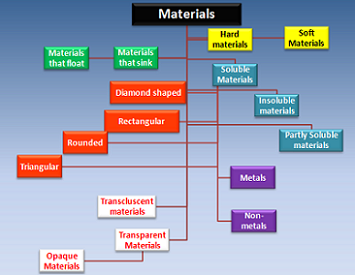
Imagine you have a supermarket and you are a trade with hundreds of variety of items. If all items are jumble and randomly dumped, a customer asks for a small toy. Can you get him quickly what he asked for? No, it is not easy. In lesson you understand the basic knowledge on the types of material and how to sort them. The different objects around us and have some properties. We need to classify the materials and the basis hardness, opacity, floating ability on water, solubility, and shininess. So, we will be solving some important questions on the lesson sorting materials into groups.
Question answers
1.Why should we sort materials into groups?
Answer: sorting materials into groups help us to organize them easily.Doing so willl allow to use them quickly when necessary
2.What are the States of matter?
Answer: Matter around is found in 3 different states . They are solids, liquids and gases
3.Name five objects which can be made from wood.
Answer: Table, duster, chair, door and books.
4.Select the objects which shine from the list: (Glass bowl, plastic toy, steel spoon, cotton shirt)
Answer: Glass bowl and steel spoon are shiny materials.
5.Given below are the names of some objects and materials: (Water, basketball, orange, sugar, globe, apple and earthen pitcher) Group them as
- Round shaped – Basketball, Orange, Globe, Apple, Earthen Pitcher.
- Other shaped– water, sugar
- Eatables – water, orange, sugar, apple.
- Non-eatables – basketball, globe, earthen pitcher.
Answer:
A few items that float on water are: sponge piece, wood, plastic cover, Paper piece, some vegetables and cork. But, these items may not float on oil or kerosene.
7. What are transparent, translucent and opaque objects?
Answer : Transparent objects allow light from one side to another hence we can see the objects through them. Translucent objects allow partial light so, we can see the other side with less clarity. Opaque objects are heavy objects that doesn’t allow light from one side to another hence, we cannot see anything from the other side.
8.Identify the objects that are made of wood and paper among the following?
Table, chair, newspaper, calendar, bullock cart, notebook.
Answer: Wooden objects are table, chair and bullock cart. Objects made up of paper are newspaper, calendar and notebook.
9. Identify the objects that shine among the following: Wood, copper wire, paper, chalk, aluminum sheet, steel spoon
Answer: Copper wire, aluminum sheet and steel spoon are shiny objects.
10. Why do objects shine ? between soft and hard material?
Answer: Objects shine because of the property of reflection. Reflective objects show shiny surface.
11.What do you mean by solute, solvent and solution?
Answer: Solute is a substance that gets dissolved in a liquid. For example, salt, sugar. Solvent is a liquid that allows solute to dissolve in them. For example, water . Solution is the combination of solute and solvent at a specific concentration.
12. Give 2 examples of translucent materials.
Answer: Clouds, paper dipped in oily.
13.Classify the following as transparent or translucent or opaque material: Cardboard, glass, water, oily paper, wood, stone, metal .
Answer: Transparent materials are glass and water . Oily paper is a translucent material while opaque objects are cardboard, wood, stone, metal.
14. Find the odd one out:
- Iron, wood, nail, cotton
- Sugar, salt, sand, milk
- Copper, wood, aluminium, gold.
- Table, chair, coin, bed.
Answers:
- Cotton because it is a spongy material
- sand because it is insoluble in water rest of them are soluble.
- Wood because it is nonmetal whereas the others are metals.
15. What are the three main properties of metals?
Answer: Metals are hard, lustrous ( shiny) and they conduct heat and electricity.
16.Which solvent is called universal solvent ?
Answer: Water is a universal solvent because it can dissolve a large number of substances.
17. On what basis all materials are sorted?
Answer: Materials are grouped on the basis of some properties such as shininess, hardness, solubility, floating ability on water, transparency, etc.
18.Materials like metals and glass are luster (shine). Give reason.
Answer: Metals or glass materials, when exposed to air and light reflect easily therefore, they show shininess.
19.Most of the oils do not dissolve in water, why?
Answer: The molecules of water do not get mixed oil because the density of water and oils are different. Substances that does not intermingle with others are called immiscible matter.
20. Metals generally occur in solid state but there is one metal that occur in liquid state, which one it is?
Answer: Mercury is the only metal that exists in liquid state.
21.Identify any one naturally occurring hardest substance knowntp to you.
Answer: Diamond, it is made up of carbon.
22. What is density? How is density of an object related to its floating or sinking ability ?
Answer: Density is how close the particles arranged inside a given substance. An object will float if its density is less than that of the surrounding liquid.
23. Give one example of each of a combustible liquid, gas and solid.
Answer: Petrol is a combustible liquid, CNG is a combustible gas and paper is a combustible solid.
24. Clean water is transparent, how will you prove it? .
Answer: Immerse a coin into a beaker half-filled with clean water. Can you see the coin? Yes, because water allows light into it, you will see the coin , therefore, water is a transparent liquid.
II. State whether the statements given below are True or False.
- Stone is transparent, while glass is opaque
- A notebook has luster while an eraser does not.
- Chalk dissolves in water.
- A piece of wood floats on water.
- Sugar does not dissolve in water.
- Oil mixes with water
- Sand settles down in the water.
- Vinegar dissolves in water.
Answers:
- False
- False
- False
- True
- False
- False
- True
- True