Earth hjas both living components and non-living components. Living Things are things that are alive. They can grow, move, breathe, eat, and reproduce (have babies or make new plants). Examples include animals, plants, and humans. Non-living components are things that are not alive. They do not grow, move, breathe, eat, or reproduce. Examples include rocks, water, and toys.Living creatures. The creatures are also known as living organisms . They are forms of life that exhibit specific characteristics that differentiate them from non-living things. Living organisns can be as simple as a bacterium or as complex as a human being.
Characteristics of Living Creatures
- Nutrition: The process by which living things obtain food for survival .
- Growth and Development: All living organisms increase in size and/or complexity over time. Growth might involve more cells (in animals) or expansion (in plants).
- Metabolism: Organisms carry out chemical reactions to maintain life, including breaking down food and building necessary substances. This process involves energy transformation (e.g., respiration, photosynthesis).
- Response to Stimuli: Living beings respond to changes in their environment (light, heat, sound, touch). Example: Plants grow toward light; humans withdraw from a hot surface.
- Reproduction: Living things have the ability to reproduce and pass on their genetic information to the next generation. This can be asexual (cloning, binary fission) or sexual (involving two parents).
- Heredity: Traits are passed from parents to offspring through DNA. This allows species to evolve and adapt over time.
- Homeostasis: Organisms maintain a stable internal environment, despite changes outside Example: Humans regulate their body temperature
- Adaptation and Evolution : Over generations, living organisms adapt to their environments through evolution, driven by natural selection.
- Movement: Plants do not move from one place to another like animals, but they show different types of movements such as the opening of flowers and the winding of climbers around objects. Animals use legs, fins, wings to move.
Nutrition in organisms
Nutrition in plants and animals differs in how they obtain and use food. Plants make their own food through a process called photosynthesis, using sunlight, carbon dioxide, and water—this is called autotrophic nutrition. In contrast, animals cannot make their own food; they rely on eating plants or other animals, which is known as heterotrophic nutrition. While plants produce energy-rich food, animals digest it to absorb nutrients and gain energy for growth and activity.
Growth
All living organisms grow and exhibit growth in different ways.Growth in organisms refers to a permanent increase in size and mass, often accompanied by changes in form and function. In unicellular organisms, growth happens when the single cell increases in size before dividing. In multicellular organisms, growth involves both an increase in the number of cells through cell division and the enlargement of those cells. This process allows organisms to develop, repair tissues, and reach maturity. Growth is usually influenced by factors like nutrition, environment, and genetic makeup.
Respiration
Respiration is necessary for all living organisms. In plants it takes place in theleaves while animals have respiraotory organs. It is through respiration that the body finally obtains energy from the food it takes. Some animals may have different mechanisms for the exchange of gases, which is a part of the respiration process. E.g. earthworms breathe through their skin, and fish have gills for using oxygen dissolved in water. In humans, we respire by breathing in oxygen and breathing out carbon dioxide.
Response to Stimulus
- Changes in our surroundings that makes us respond to them are called stimuli.
- All living beings react to changes in their surroundings.
- E.g. In response to increased temperatures in summer, we use fans to cool our homes.
Excretion
- All living things take food.
- Not all the food that is eaten is really used. Only a part of it is utilised by the body.
- Unused/remaining food becomes waste and needs to be excreted.
- Our body also produces some waste, like urea, in other life processes.
- Living organisms get rid of all this waste material, and the process is known as excretion.
Reproduction
- All living organisms give rise to a new organism of their own kind by a process called reproduction.
- The mode of reproduction may be different in different animals and plants.
- Some animals produce their young through eggs.
- Some animals give birth to young ones.
- Plants produce seeds which germinate into new plants.
- Some plants also reproduce through parts other than seeds.
- E.g, a part of a potato with a bud grows into a new plant
Movement
- Animals move from one place to another and also show other body movements.
- Plants are generally anchored in the soil so they do not move from one place to another.
- However, various substances like water, minerals and the food synthesised by the plants move from one part to other.
- Plants also show other kinds of movement, like the opening and closing of flower buds.
Animal Adaptation
Adaptation
The presence of specific features or certain habits, which enable a plant or an animal to live in its surroundings, is called adaptation.
- Different animals are adapted to their surroundings in different ways.
- For example, Fish have slippery scales on their bodies.
- These scales protect the fish and also help in easy movement through the water.
Habitats
Surroundings
- The different surroundings or areas have different organisms that live in them.
- E.g., The deserts have camels, the mountains have goats and yak.
Habitat
The surrounding where living organisms survive is known as the habitat.
- The organisms depend on their habitat for their food, water, air, shelter and other needs.
- Habitat means a dwelling place (a home).
- Several kinds of plants and animals may share the same habitat.
Biotic Components
- The living components of a habitat are called biotic components.
- For example, plants and animals
Abiotic Components
- The non-living components of a habitat are called abiotic components.
- For example, rocks, soil, air, water etc
Terrestrial Habitats
- The plants and animals that live on land are said to live in terrestrial habitats.
- For example, forests, grasslands, deserts, coastal and mountain regions.
Aquatic Habitats

- The habitats of plants and animals that live in water are called aquatic habitats.
- For example, ponds, swamps, lakes, rivers and oceans.
- Aquatic habitats could be freshwater (river, pond) or marine (sea) or even estuarine (delta of river meeting with the sea)
Text book Quesion Answers
Question 1.How would you now categorise a seed, as living or non¬living? (Page 191)
Answer:
Seed is a living thing. Seed can grow into a plant under right conditions.
Question 2.How can the life cycle of a mosquito be disrupted? (Page 197)
Answer:Larvicides (a substance used to kill larvae) target larvae in the breeding habitat before they can mature into adult mosquitoes and disperse. Larvicide treatment of breeding habitats helps reduce the adult mosquito population in nearby areas.
Liquid larvicide products are applied directly to water using backpack sprayers and truck or aircraft-mounted sprayers. Tablet, pellet, granular, and briquet formulations of larvicides are also applied by mosquito controllers to breeding areas.
Let Us Enhance Our Learning
Question 1. List the similarities and differences in life cycles of plants and animals. __
Answer: Similarities:
- Life cycles of both, plants and animals, begin with an initial stage which is followed by several stages of its growth and development and finally death.
- In life cycle of both, the process of reproduction maintains the continuity of its kind.
Differences:
|
Life Cycle of Plants |
Life Cycle of Animals |
|
1. A plant’s life cycle starts with seed germination. |
1. An animal’s life cycle begins with a new bom. |
|
2. Germination is followed by flowering and seed production. |
2. New bom animals grow to become adult animals. |
|
3. Seeds produced during their life cycle germinate into new plants. |
3. The process of reproduction does not involve formation of seeds. |
Question 2. The table given below shows some data. Study the data and try to find out examples appropriate for the conditions given in the second and third columns. If you think that an example for any of the conditions given below is not possible, explain why.
|
Sl no |
Does it grow? |
Does it respire? |
Example |
Remarks |
|
1 |
No |
No |
Stone |
Stone is a non-living thing so, it can neither respire nor grow |
|
2 |
No |
Yes |
Not Possible |
Because all living things show growth and none of the nonliving things respire |
|
3 |
Yes |
No |
Rusting on an iron metal |
Rusting increases over time but it doesn’t grow |
|
4 |
Yes |
Yes |
All animals and plants |
Since animals and plants are living creatures, they grow as well as they respire |
Question 3. You have learnt that different conditions are required for seed germination. How can we use this knowledge for proper storage of grains and pulses.
Answer: We know that seeds need moisture, air, and warmth to germinate. Using this knowledge, we can ensure proper storage of grains and pulses by preventing these conditions so that germination or spoilage does not occur. To make sure proper germination of seeds;
- Keep grains dry: Moisture encourages germination and fungal growth. So, grains should be thoroughly dried before storage.
- Store in airtight containers: Limiting air supply prevents insect activity and fungal growth.
- Keep in a cool place: Warmth can promote germination and pest growth. Cool conditions keep grains fresh longer.
- Use pest repellents: Neem leaves or other natural repellents can be added to prevent insect damage.
Question 4. You have learnt that a tail is present in a tadpole but it disappears as it grows into a frog. What is the advantage of having a tail in the tadpole stage?
Answer: The tail in the tadpole stage helps the young frog (tadpole) to swim easily in water. The tail acts like a paddle, helping the tadpole to move and escape from predators. It also helps the tadpole to find food and maintain balance while swimming. Since the tadpole lives entirely in water and does not yet have legs, the tail is its main organ of movement.
Question 5. Charan says that a wooden log is non-living as it cannot move. Charu counters it by saying that it is living because it is made of wood obtained from trees. Give your arguments in favour or against the two statements given by Charan and Cham.
Answer:
Charu is incorrect, because ,although the wooden log comes from a once-living tree, the wood itself is dead material. Once the tree is cut, the log cannot perform life processes like respiration, growth, or reproduction.
Question 6. What are the similarities and distinguishing features in the life cycles of a mosquito and a frog?
Similarities between the life cycles of a mosquito and a frog:
- Both undergo metamorphosis as they change their form during their life cycle.
- Both the creatures start their life in water.
- Both lay eggs.
- Both have a larval stage that looks very different from the adult.
- Both need water for early development (egg and larval stages).
Differences:
|
Feature |
Mosquito |
Frog |
|
Type of animal |
Insect |
Amphibian |
|
Place of egg-laying |
Eggs are laid on the surface of stagnant water |
Eggs are laid in water |
|
Larval stage |
Larva is called wriggler |
Larva is called tadpole |
|
Pupal stage |
Has a pupal stage before becoming adult |
No pupal stage |
|
Breathing in larval stage |
Through air tubes (spiracles) |
Through gills |
|
Adult habitat |
Lives mostly on land but returns to water to lay eggs |
Lives both on land and in water |
|
Metamorphosis type |
Complete metamorphosis (egg → larva → pupa → adult) |
Incomplete metamorphosis (egg → tadpole → adult frog) |
Question 7. A plant is provided with all the conditions suitable for its growth (Fig.8). Draw what you expect to see in the shoot and the root of the plant after one week. Write down the reasons.
Answer: Plants are geotropic in nature. Which means , their roots grow downwards to reach water for their survival but the shoot bends and towards the direction of sunlight as all the leaves need sunlight to make food. In this case, the stimulus is sunlight.
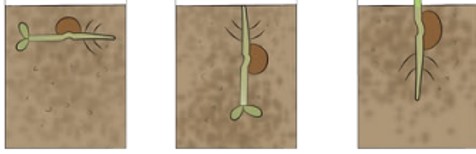
Question 8.Tara and Vijay set up the experiment shown in the picture (Fig. 9.). What do you think they want to find out? How will they know if they are correct?
Answer:
The experiment shown in the picture (with seeds placed in soil in different positions) is designed by Tara and Vijay is to find out the direction of growth of roots and shoots in a germinating seed ( Geotropism or response to gravity. After a few days of setup ,the root will always bend and grow downward (toward gravity) and the shoot will always bend and grow upward (away from gravity). This will happen even if the seed is placed horizontally, upside down, or sideways.
Question 9.Design an experiment to check if temperature has an effect on seed germination
Answer: To design this experiment , we need Materials: Identical pots, soil, seeds, thermometers, and different temperature-controlled environments (e.g., refrigerator, room temperature, heated environment).
Procedure
- Fill each pot with the same type of soil and plant some seeds in each pot and now, pace each pot in a different environment with controlled temperatures (e.g., cold, room temperature, warm). For example, keep one pot outside in balcony to get sunlight. Put another in shade in the room. Keep the third one in basement or at coldest part of the house.
(iv) Water each pot equally.
(v) Record the number of seeds germinated in each environment daily for two weeks.
Observation: Measure and compare the rate of germination and growth in different temperatures.
Conclusion: Determine the optimal temperature for seed germination based on observations.