6th Sample Papers
Food, diet, nutrition, and feeding are commonly used terms in our daily life. Without food we cannot survive. Healthy and balanced food is very essential for life. Therefore, it is important to understand the role of each food component. Let us study some important question answers to refresh our knowledge about food components. In this lesson ,we will be studying about carbohydrates, proteins, lipids, vitamins and minerals.
Answer the following questions
1. What are the main functions of food?
Answer: Food is essential for our survival. It provides energy required for various functions of our body. Healthy diet assists in the proper growth of our body and a quick repair of damaged tissues. We can live long and healthy life with a balanced food.
2. What are the main components of our food?
Answer : Food components are divided into macronutrients and micronutrients. Carbohydrates, proteins, lipids are called macronutrients because they must be consumed in large quantities. Vitamins and minerals are required in traces/minimum quantity therefore they belong to micronutrients.
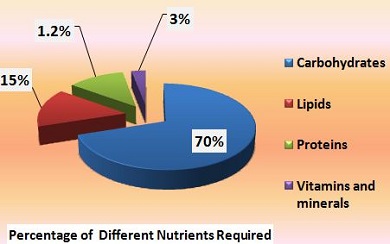
3. What are carbohydrates? What do they do in our body?
Answer: Carbohydrates are energy giving foods help in supplying calories required for daily activities. Foods like rice, bread, sweet potato, fruits, oil seeds, pasta, and potatoes provide enough carbs.
4. What are the functions of different food groups?
Answer: Foods are classified based on the functions they perform as follows
- Carbohydrates are energy yielding foods
- Proteins are body builders as they help in growth of muscles and repair our cells regularly.
- Fats are otherwise known as lipids. They provide additional energy required for our body.A layer of lipids around vital organs like the brain and liver keeps them safe .
- Vitamins and Minerals enhance our immunity by regulating the vital functions such as cell transportation, calcification of bones.Vitamins and minerals are regulators of our health.
- Roughage or fiber enhances smooth digestion thereby promote body weight management.
- Water is the most important component for each and every cell in our body. It hydrates the cells to perform the metabolism.
5. Name the 2 types of carbohydrates.
Answer: Simple carbohydrates and complex carbohydrates.
6. What are simple and complex carbohydrates?
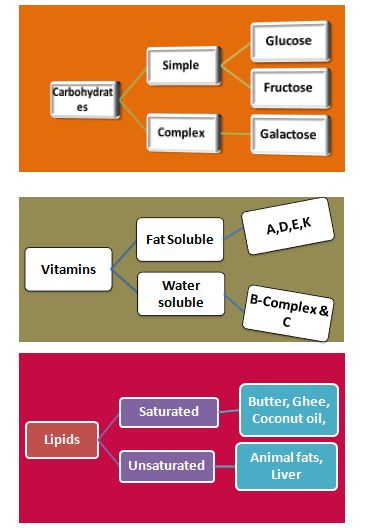
Answer: Simple carbohydrates are sugars like glucose and fructose. Simple sugars release energy instantly whereas starch and cellulose take long time t release energy slowly; therefore, they are generally known as complex carbohydrates.
7. What are some sources of carbohydrates?
Answer: Sources of carbohydrates plant and animal foods.
Plant sources:
- Fruits and Vegetable gives us very simple and healthy sugars like glucose and fructose.
- Grains such as rag, rice, wheat, oats, jowar, and corn release complex sugars help our body sustain for longer periods.
- Legumes like beans, lentils, and peas add more energy in addition to the fiber and protein.
Animal Sources:
- Dairy products - milk contain lactose. Lactose is a natural sugar that provides some carbohydrates.
- Meat and eggs also contain a decent amount of calories.
8. What are proteins? Why are they called body building foods?
Answer: Proteins are made of amino acids. They help in tissue growth, repair, and maintenance.
9. What are some animal Sources of proteins?
Answer:
- Meat: Beef, chicken, pork, and lamb are rich in protein.
- Fish and Seafoods
- Milk and milk products
10. What are some plant sources of proteins?
Answer
- Legumes such as beans, lentils, chickpeas, and soya beans.
- Nuts and seeds like peanuts, almonds, and walnuts, are healthy plant sources of proteins.
- Whole Grains of wheat, barley, and brown rice.
- Vegetables though have some amount of proteins, they aren’t protein-rich.
11. What are lipids?
Answer: Lipids or fats are the oily foods. Lipids provide long-term energy. In addition to the energy, they assist in the absorption of vitamins, and protection of vital organs like liver, brain and kidneys
12. What are some important sources of lipids?
Answer: Plant sources such as oil seeds, dry nuts are good sources of lipids. Animal sources like butter, eggs and fatty meats are very common sources of lipids.
13. Explain the types of lipids?
Answer: Two types of lipids are saturated and unsaturated fats. Saturated fats are derived from animal foods while unsaturated fats are plant-based oils.
14. What are vitamins? Explain the types of vitamins.
Answer: Vitamins are the major supporters of immune function. They perform a lot of functions. Vitamins are classified into water-soluble and fat-soluble vitamins.
15. Mention the fat-soluble vitamins.
Answer: Vitamins A,D,E,K
16. What are water soluble vitamins.
Answer : Vitamin C and B-complex.
17. Why do we need water?
Answer: Our body is composed of more than 70% water .It is vital for hydration, digestion, and maintenance of body temperature
18. What are minerals? What is their function?
Answer : Minerals are micronutrients found in the vegetables, sea foods, meat and fruits. They maintain the structure and functions of our body cells. Minerals promote nerve function, circulation, and bone health.
19. List some very common minerals and write one function each.
Answer: Calcium found in milk and green leaves makes our teeth and bones strong. Iron improves hemoglobin percentage of blood. Potassium eases muscle and nerve functions. Sodium helps maintain fluid balance and nerve signaling.
20. What are deficiency diseases?
Answer: Deficiencies occur when we fail to consume enough nutrients or when our body doesn’t absorb them. Some common deficiencies are; protein energy malnutrition, vitamin deficiencies and mineral deficiencies.
21. Explain the most common deficiency diseases.
- Scurvy : It is a condition due to the deficiency of vitamin C . Person with this condition shows symptoms of bleeding gums.
- Rickets is due to less intake of vitamin-D. The deficiency of Vitamin -D C deficiency in vitamin D can cause week teeth and bones , and bone deformities such as bowed legs.
- Pellagra is a condition due to poor intake or absorption of niacin or vitamin B3. Child with pellagra suffers from frequent loose stools, skin irritation, and confusion (dementia).
- Beriberi occurs due to the lack of vitamin B1 (thiamine). Child with this condition might suffer from weakness, nerve damage, and heart problems.
- Anaemia can occur due to the combined deficiency of iron and folic acid(vitamin B12). An anemic child feels tiredness or fatigue, weakness, and pale skin.
II. Mark true or false for the statements given under.
- By eating rice alone, we can fulfill the nutritional requirements of our body.
- Deficiency diseases can be prevented by eating a balanced diet.
- Balanced diet should contain a variety of food items.
- Meat alone is to provide all nutrients to the body.
Answers:
- False
- True
- True
- False
III. Fill in the blanks.
- ______________ is caused by the deficiency of Vitamin D.
- Deficiency of ______________ causes a disease known as beriberi.
- Deficiency of Vitamin C causes a disease known as ______________
- Night blindness is caused due to deficiency of ____________ in our food.
Answers:
- Rickets
- Vitamin B1 or Thiamine.
- Scurvy.
- Vitamin A .