6th Sample Papers
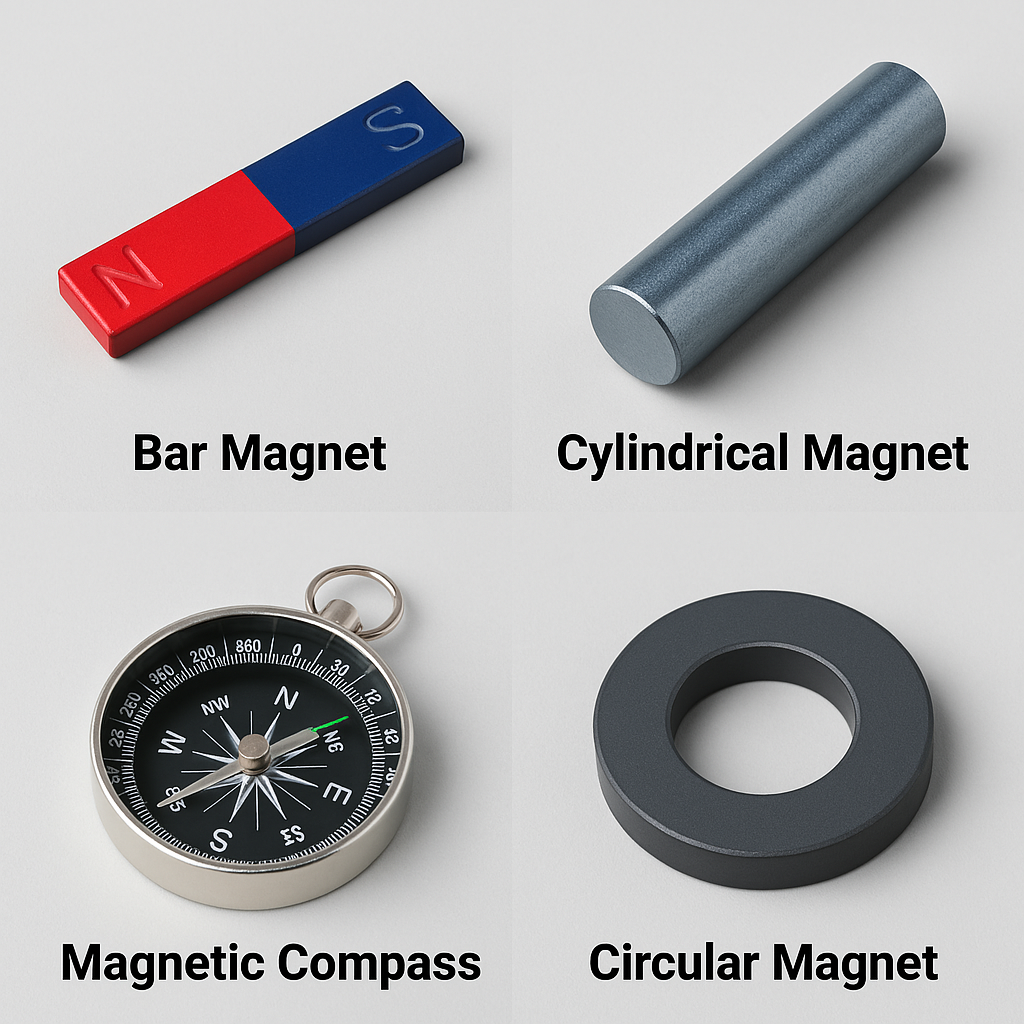
Magnetism is a wonder in science, the magnetic materials have fascinating ability to attract certain substances like iron, nickel, and cobalt. The discovery of magnets dates back to ancient times when a shepherd named Magnes noticed that the iron tip of his stick got stuck to a rock, which was actually a natural magnet. Since then, magnets have found their place in many aspects of our daily lives. From refrigerator doors and electric bells to computers and mobile phones, magnets are used in various devices around us. Magnets have two poles—North and South—and an interesting property that like poles repel each other while unlike poles attract. When suspended freely, a magnet always points in the north-south direction, which helps sailors and navigators find their way using a magnetic compass. Magnets can be natural or artificial, and artificial magnets come in different shapes such as bar magnets, horseshoe magnets, and ring magnets. They can be made using different methods like rubbing a magnetic material with a magnet, or by using electricity to make electromagnets. Some materials, like iron and steel, are magnetic, while others, such as wood and plastic, are non-magnetic. Understanding magnets not only helps us appreciate their everyday uses but also introduces us to the invisible force of magnetism that plays an important role in science and technology.
I. Answer the following questions:
1. Fill in the blanks in the following
- Artificial magnets are made in different shapes such as __________, __________ and ____________.
- The materials which are attracted towards a magnet are called________.
- Paper is not a ______ material.
- In the olden days, sailors used to find direction by suspending a piece of ___________.
- A magnet always has __________ poles.
- When a magnet is freely suspended, it stops at __________ and ______ direction.
- If a magnet looses it’s property of attraction, it is called ______
Answers:
- Bar magnet, horse shoe and cylindrical.
- Magnetic materials.
- Magnetic material.
- Magnet
- 2 poles ( South and North)
- South and North
2. Mark true or false:
- All magnets have poles.
- All metals are magnetic in nature.
- A cylindrical magnet has only one pole.
- Artificial magnets were discovered in Greece.
- Similar poles of a magnet repel each other.
- Maximum iron filings stick in the middle of a bar magnet when it is brought near them.
- Bar magnets always point towards North-South direction.
- A compass can be used to find East-West direction at any place.
- Rubber is a magnetic material.
Answers:
- True
- False
- False
- False
- True
- False
- True
- True
- False
3. Name the types of magnets .
Answer: Bar magnets, horseshoe-shaped magnets, U- shaped magnets, circular magnets, magnetic compass are some types of magnets.
4. What are some properties of magnets?
Answer:
- Magnet gets attracted towards magnetic materials easily.
- When freely suspended, the two poles of a bar magnet stop at south and north direction.
- Magnets can create a magnetic field around them.
- On heating, beating, and roughly handling, magnets get demagnetized.
5. It was observed that a pencil sharpener gets attracted by both the poles of a magnet although its body is made of plastic. Name a material that might have been used to make some part of it.
Answer:Some part of the pencil sharpener may have been made of iron.
6. Column I shows different positions in which one pole of a magnet is placed near that of the other. Column II indicates the resulting action between them for each situation. Fill in the blanks.
| Column I | Column II |
|---|---|
| N - N | No Reaction |
| N - S | Repulsion |
| S - N | Repulsion |
| S - S | Repulsion |
Answers
| Column I | Column II |
|---|---|
| N - N | Repulsion |
| N - S | Attraction |
| S - N | Attraction |
| S - S | Repulsion |
7. Name the two poles of a bar magnet, where are they located?
Answer: The two Poles of a magnet are south and north Poles. They are located at the two ends of a bar magnet.
8. List some magnetic and nonmagnetic metals.
Answer: Some magnetic metals are iron, steel, cobalt and nonmagnetic materials are gold, copper, silver .
9. You have given two magnets, one of the magnets poles are marked , while the other one was not marked. Can you find the poles of the second magnet?
Answer: When you bring the South pole of the first magnet to one of the poles of second magnet, if both got attracted, then you can confirm that the unmarked magnet's pole is North because opposite poles attract each other.
10. Can you make a magnet on your own? What are some methods to make magnets?
Answer: Yes, I can make magnet by 3 methods;
- By induction method where a natural magnet ends should be touched to the iron nail. The nail gets the property from magnet.
- An electromagnet can be made by winding a coil around an iron nail and connecting it to a battery.
- The double-touch method involves placing a nail between two magnets at their ends.
11. What type of magnets are used by sailors in oceans? Why?
Answer: A magnetic compass is used by sailors as it always shows the North and South directions when suspended. With this, sailors can guess the direction of their destination
12. A magnet was brought from different directions towards a toy boat that has been floating in water in a tub. The effect observed in each case is stated in Column I. Possible reasons for the observed effects are mentioned in Column II. Match the statements given in Column I with those in Column II.
|
Column I |
Column II |
|
Boat gets attracted towards the magnet |
Boat is fitted with a magnet with a north pole towards its head |
|
Boat is not affected by the magnet |
Boat is fitted with a magnet with a south pole towards its head |
|
Boat moved towards the magnet when the north pole was brought near its head |
Boat has a small magnet fixed along its length |
|
Boat moves away from the magnet when the north pole is brought near its head |
Boat is made up of magnetic material |
|
Boat floats without changing its direction |
Boat is made up of non-magnetic material |
Answer:
|
Column I |
Column II |
|
Boat gets attracted towards the magnet |
Boat is made up of magnetic material |
|
Boat is not affected by the magnet |
Boat is made up of non-magnetic material |
|
Boat moved towards the magnet when the north pole was brought near its head |
Boat is fitted with a magnet with the south pole towards its head |
|
Boat moves away from the magnet when the north pole is brought near its head |
Boat is fitted with a magnet with a north pole towards its head |
|
Boat floats without changing its direction |
Boat has a small magnet fixed along its length |
II. Multiple choice questions
1. When a magnet is freely suspended , what is the ultimate direction where the poles stop?
- South-west
- East-west
- North-south
- North-west
Answer: C-North-south
2. Which among the following materials has lesser magnetic property?
- Iron
- Gold
- Steel
- Cobalt
Answer-B . Gold
3. The doors of refrigerators are attached with ------
- Permanent Magnets
- Electromagnets
- Temporary Magnets
Answer -A. Permanent Magnets