Living world is a wonderful area of science. We all are living organisms including plants, animals, microorganisms etc. Our environment is the combination of biotic ( living ) and abiotic(non-living) components. In this lesson we will be glancing through the question answers related to type s of organisms, herbivores, carnivores, omnivores. We will be also highlighting the characteristics of living and nonliving organisms.
Answer the following
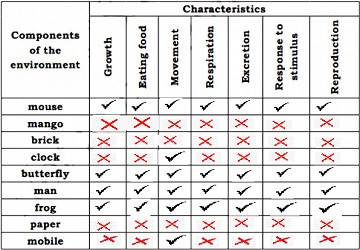
1. In the following chart some components of the environment as well as. Some of the living characteristics are given. Read carefully. It in each of the components the characteristics given in front of them are found mark tick or into.
3.Identify the Picture and write here.
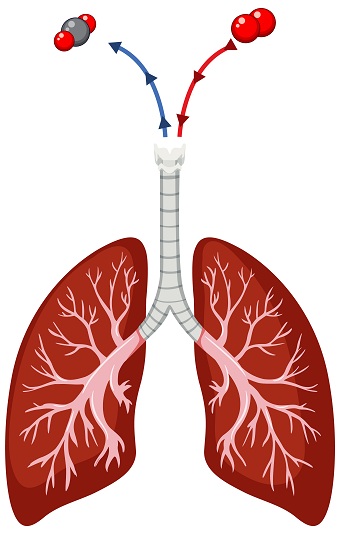
Answer: Respiratory System
4.Write the important works the following do.
|
Organism |
Work |
|
1. Elephant |
Help in tourism |
|
2. Bullock |
Help in the transportation |
|
3. Dog |
Help in tracking and Hunting |
5. Observe the figure. Four important components needed to produce food by the plants are given. Join the statements correctly and write the correct form of which and what is required.
|
Which |
From What |
Correct and write here |
|
1. Solar Energy |
Green leaf |
Solar energy is obtained from sun but not from green leaf |
|
2. Water, minerals |
Atmosphere |
Water, minerals for photosynthesis is obtained from soil but not from atmosphere |
|
3. Carbon dioxide |
Sun |
CO2 is obtained from the atmosphere but not from the sun |
|
4. Chlorophyll |
Soil |
Chlorophyll is found in the green part of the leaf but not in the soil |
6. Write the uses of glucose and oxygen
- Glucose is used to release energy for our body during aerobic respiration .
- Oxygen is used for our breathing but it is also used in industries.
7. Observe the figures below. These are plants which do not prepare food in plant kingdom. They how do they obtain their food?
Drosera, Nypenthes, Utrieularia Plants are called insectivorous plants because they depend on insects for their food.
8. Define the terms herbivores, carnivores and omnivores.
- Herbivore are the animals that eat only plants and plant products. For example; deer, cow
- Carnivore are those animals that depends on other animals in the form of flesh, eggs etc . For example Tiger, Lion
- Omnivore eat both plant and animals as their food, for example, dog and cat.
9.With the help of this figure list herbivore, carnivore and omnivore in the chart below
|
Herbivore |
Carnivore |
Omnivore |
|
Elephant |
Lion, Tiger |
Bear, Dog |
|
Parrot |
Cat, Fax |
|
|
Rabbit |
Owl |
10. Observe the figures below and write what is it?
Answer:The above pictures show the growth of each organisms showing the increase in height, width size and weight.
All living organisms should grow over a time.
11. Write the true or false for the following statements based on the growth.
- All organisms are small at the time of birth, later acquire definite height and weight – True
- Growth takes place rapidly in one or two days – false
- Plant growth is observed at its stem tip or [stem width] by the size of the stem – false
- Organisms continue their generation by reproduction – True
- In environment other organisms get food by reproduction – false
- Reproduction is seen only in animals – false
- There will not be any danger in Environment by over reproduction of a single organism – True
12. Observe these pictures, which living characteristic that these creatures indicate?
Answer:In the above picture, all are living organisms and they are capable of movement. Movement is a very important feature of all living organisms.
13. Some animal names are given below. Write here their organs for movement
- Man uses 2 legs for walking.
- Eagle uses 2 wings to fly.
- Kangaroo hops very quickly by using 2 legs.
- Bat flies with the help of 2 webbed wings.
14. Discuss in groups why animals move and write in the space given.
Answer: Animals move because they need food. They also migrate for breeding and protection from enemeis.
15. Given below are certain statements related to reproduction. Mark (?) if statements are correct (?) if wrong.
|
Sl no |
Statement |
Right OR Wrong |
Correct Statement |
|
1. |
Organisms continue their generation by reproduction |
Right |
All organisms should reproduce to continue their next generation otherwise they will be completely extinct. |
|
2. |
In environment other organisms get their food by reproduction |
Right |
Because reproduction of one organisms gives food for its predators |
|
3. |
Reproduction is seen only in animals |
Wrong |
Reproductions is seen in all living organisms |
|
4. |
There will be no danger in the environment by over-reproduction of a single organism. |
Wrong |
Over-reproduction of a single organism causes shortage of food resulting in the competetition for food. Sometimes the weaker animals die when they can’t get enough food. |
16. List the animals which lay eggs and those which directly give birth to young ones.
Answer:Some animals which lay eggs are; fish, birds, some reptiles, and insects. All mammals (feeding animals) give birth to young ones . Some of these are cows, goats, dogs and humans.17. List the plants that reproduce through seeds and stems.
Answer: Plants that reproduce through seeds include Beans, peanuts, soybeans ,mangoes etc. Some plants that reproduce through stem are; drumstick, rose, ginger etc.18. Reproduction of plants is advantageous to animals including man in many ways, how?
Answer:Plant reproduction is a vital food source for other organisms. They give us fruits, seeds, and vegetables. They also give us a lifeline for animals-oxygen; therefore, reproduction of plants is advantageous to animals
19. Observe the figures, how organisms respond to stimuli?
Answer:When we touch a touch me not plant, the leaves get folded immediately as a response to the touch. Scorpion gives a sharp sting when we try to touch them.
20.Write the uses of annuals, biennials , perennials.
Answer: Annuals growth cycle lasts for one complete year with an extended blooming period. They are sweet-scented whereas biennials can survive up to two years, examples; parsley, fennel, Lunaria, silverbeet. Perennials have a long life yielding crops for many years for example; herb gardens and fruit trees.