Chemical Reactions and Equations
Take the QuizChemistry is the study of matter and the changes it undergoes. One of the most fundamental concepts in chemistry is the chemical reaction, which involves the transformation of substances into new substances. Chemical reactions is a part of life and are very important for all living organisms. A number of reactions happen in and around us. Although we will be discussing in detail about many chemical reactions, Some common and simple reactions are as follows:
A. Tarnishing of Silver → Silver reacts with sulphur in air to form black Ag₂S.
B. Chlorination of Water → Cl₂ kills bacteria in drinking water
C. Soap and Detergent Action → Saponification helps remove grease and dirt.
D. Pop in Soft Drinks → CO₂ dissolves in water under pressure.
E. Use of Bleaching Powder → Removes stains and disinfects.These changes are accompanied by energy changes and can be observed through changes in color, temperature, formation of precipitates, or gas evolution.
F. Photosynthesis by plants where chlorophyll converts heat energy into chemical energy.
G. Digestion of food where enzymes released by the gut react with food to form the final products ready for absorption.
H. Formation of curd in which, lactic Acid turns milk into curd.
Components of a chemical reaction
A. Reactants – The substances that undergo change during the reaction. They are present at the start of the reaction. Example: In the reaction H₂ + O₂ → H₂O, hydrogen (H₂) and oxygen (O₂) are the reactants.B.Products – The new substances formed as a result of the chemical reaction. Example: In H₂ + O₂ → H₂O, water (H₂O) is the product.
C. Chemical Bonds – The forces holding atoms together in molecules. During a reaction, bonds are broken in reactants and new bonds are formed in products.
D. Reaction Conditions – External factors like temperature, pressure, catalysts, or solvents that influence the reaction rate or direction. Example: Enzymes act as catalysts in biological reactions.
E. Catalyst ,a substance that increases the rate of a chemical reaction without being consumed or permanently changed in the process. It lowers the activation energy required for the reaction and It does not affect the equilibrium of the reaction.
F. Energy Changes – Every chemical reaction involves energy absorption or release: Exothermic reactions release heat (e.g., combustion). Endothermic reactions absorb heat (e.g., photosynthesis).
G.Reaction Mechanism – The step-by-step process by which reactants are converted into products, including intermediate steps and transition states.
How do we know the chemical Reaction occurred?
A. Change in state: Example: Ice melting into water is a physical change, but the decomposition of ammonium chloride into ammonia and hydrogen chloride gases is a chemical changeB. Change in color: Example: Copper sulphate solution turns green when an iron nail is dipped into it. Care must be taken when the gas is evolved.
C. Evolution of gas: Example: When zinc reacts with hydrochloric acid, hydrogen gas is released. Eye Glasses ,mask and gloves are must to avoid harm from the gases.
D.Change in temperature: The temperature may either increase or decrease during chemical reactions. Example: Respiration releases energy in the form of heat, making it an exothermic reaction. While Photosynthesis absorb heat.
E. Formation of a precipitate: Example: Mixing silver nitrate and sodium chloride forms a white precipitate of silver chloride. A precipitate is a curd like substance formed due to reaction.
Importance of Chemical Reactions in Our Daily Life
Chemical reactions are essential to both the survival of living organisms and the functioning of the natural and industrial world. Below are key areas where chemical reactions play a critical role in everyday life:
- Basis of Life Processes
All biological activities within living organisms rely on chemical reactions. Common examples include:- Digestion: Breakdown of food into nutrients using enzymes.
- Respiration: Oxidation of glucose to release energy (ATP).
- Photosynthesis: Plants use carbon dioxide and water in the presence of sunlight to produce glucose and oxygen.
- Cellular metabolism: Reactions that support growth, repair, and reproduction.
- Industrial Applications
Many industries are dependent on chemical reactions to create essential products. Examples include:- Fertilizer production: Ammonia via the Haber process.
- Construction materials: Cement, glass, and steel manufacturing.
- Textile industry: Production of synthetic fibres like nylon and polyester.
- Natural Cycles
Chemical reactions drive several important environmental cycles:- Carbon Cycle: Involves photosynthesis, respiration, and combustion.
- Nitrogen Cycle: Includes nitrogen fixation and decomposition.
- Ozone Formation: O₂ + O → O₃ (in the upper atmosphere).
- Energy Production
Chemical reactions are the foundation of Energy generation:- Combustion: Burning of fuels like coal, petrol, and gas to produce heat and electricity.
- Batteries: Electrochemical reactions produce electric energy in cells.
- Nuclear reactions: Controlled chain reactions in power plants release large amounts of energy.
- Food and Cooking
Cooking involves numerous chemical transformations:- Baking: Fermentation releases CO₂ via yeasts action.
- Roasting and frying: Complex chemical changes in food molecules.
- Caramelization: Sugar breakdown during heating to produce flavor and color.
- Medicine and Health
Most medical treatments depend on chemical reactions:- Drug formulation: Medicines are designed based on chemical behavior in the body.
- Vaccines and antibiotics: Created through precise chemical synthesis.
- Pain relief: Painkillers alter biochemical pathways through reactions.
- Household Applications
Everyday products rely on simple but effective chemical reactions:- Cleaning agents: Reactions with stains, germs, and grime (e.g., bleach, disinfectants).
- Antiseptics: Kill bacteria via oxidation or alcohol-based reactions.
- Baking soda + vinegar: Used in cleaning and neutralization reactions.
- Food preservation: Chemicals slow down spoilage by altering microbial activity.
In conclusion, chemical reactions are deeply integrated into our lives. Understanding their applications enhances our ability to innovate, conserve energy, improve health, and protect the environment.
Chemical Equations
A chemical equation represents a chemical reaction between reactants . It is expressed using symbols and formulas. For example: Magnesium burns in oxygen to form magnesium oxide.Word equation can be written as Magnesium + Oxygen → Magnesium Oxide and the chemical equation is Mg + O₂ → MgO( unbalanced). This is not accurately balanced , hence it is important to understnad the steps of balancing a chemical equation.A balanced equation follows the Law of Conservation of Mass. According to this law, we can neither create atoms nor can be destroyed in a chemical reaction, so the number of atoms for each element on the reactants side has to balance the number of atoms that are present on the products side. Which means the sum of masses of the products formed in a chemical reaction is equal to the sum of the mases of the reactants participating in a chemical reaction.Look at the oxidation of magnesium, total mass of mangesium And oxygen is same in the left hand side and the right hand side . So it is a balanced equation ( 2Mg + O₂ → 2MgO)
Steps to Balance a Chemical Equation
Balancing a chemical equation is essential to follow the Law of Conservation of Mass, which states that mass can neither be created nor destroyed in a chemical reaction. Follow these steps to ensure your equation is balanced correctly:
- Write the Skeletal Equation: Start with the unbalanced chemical equation using correct chemical formulas for all reactants and products.
- Count the Atoms: Count the number of atoms of each element on both sides of the equation (reactants and products).
- Balance Using Coefficients: Adjust the coefficients (the numbers in front of molecules) to make the number of atoms of each element equal on both sides. Do not change subscripts in chemical formulas.
- Check the Law of Conservation of Mass: Ensure the total mass of the reactants equals the total mass of the products.
- Verify the Balance: Double-check to confirm that all atoms of every element are balanced and that the simplest whole number ratios are used.
Example:
Unbalanced Equation:
H₂ + O₂ → H₂O
Balanced Equation:
2H₂ + O₂ → 2H₂O
Now, the number of hydrogen and oxygen atoms are equal on both sides, and the equation is balanced!
Examples of Balancing Chemical Equations
Example 1:
Unbalanced: Fe + O₂ → Fe₂O₃
Balanced: 4Fe + 3O₂ → 2Fe₂O₃
Iron reacts with oxygen to form ferric oxide. To balance, ensure there are 4 Fe atoms and 6 O atoms on both sides. Use coefficients: 4 in front of Fe and 3 in front of O₂.
Example 2:
Unbalanced: Al + O₂ → Al₂O₃
Balanced: 4Al + 3O₂ → 2Al₂O₃
Aluminum and oxygen combine to form aluminum oxide. You need 4 Al atoms and 6 O atoms on both sides for balance.
Example 3:
Unbalanced: C₃H₈ + O₂ → CO₂ + H₂O
Balanced: C₃H₈ + 5O₂ → 3CO₂ + 4H₂O
Propane combustion requires balancing carbon (3), hydrogen (8), and oxygen (10 total from 5 O₂ molecules) to match 3 CO₂ and 4 H₂O.
Example 4:
Unbalanced: Na + H₂O → NaOH + H₂
Balanced: 2Na + 2H₂O → 2NaOH + H₂
Sodium reacts with water to form sodium hydroxide and hydrogen gas. Balance Na and H on both sides by placing 2 in front of Na and H₂O.
Example 5:
Unbalanced: Zn + HCl → ZnCl₂ + H₂
Balanced: Zn + 2HCl → ZnCl₂ + H₂
Zinc displaces hydrogen from hydrochloric acid. Use 2 molecules of HCl to balance both chlorine and hydrogen.
Each balanced equation maintains the same number of each type of atom on both sides, preserving the Law of Conservation of Mass.
Types of Chemical Reactions
1. Combination Reactions
A combination reaction is a type of chemical reaction in which two or more substances (reactants) combine to form a single compound, for example; A + B → AB. This type of reaction is also called a synthesis reaction, because a new compound is synthesized from simpler substances. Combination reaction involves only one product and it is usually exothermic (releases heat).
Uses of combination: It is used in manufacturing cement, slaked lime, and concrete. Vital in metallurgy and construction industries. Found in biological processes, like the formation of proteins from amino acids. The 3 main types of combination are :1. Combination of Element + Element where two elements combine to form a compound. For Example, 2Mg + O2→ 2MgO
2. Combination of Element + Compound where an element combines with a compound to form a new compound. Example; CO + O2→ CO₂
3. Combination can happen between 2 different compounds (compound+compound) where they react to form a new compound. Example: CaO + H₂O → Ca(OH)₂
2. Decomposition Reactions
A Decomposition Reaction is a type of chemical reaction in which a single compound breaks down into two or more simpler substances. It is essentially the opposite of a combination reaction and is generally represented as:
AB → A + B
These reactions are more common in everyday life than we might think. They are used in household products, industrial processes, and even in natural processes within our bodies (like breakdown of food or waste).
Types of Decomposition Reactions:
A. Thermal Decomposition
Thermal decomposition occurs when a compound breaks down upon heating. It is commonly used in the production of quicklime and cement.
Example:
CaCO₃ (heat) → CaO + CO₂
- Calcium carbonate (limestone) decomposes into calcium oxide (quicklime) and carbon dioxide.
- Used in making cement and lime for construction.
B. Electrolytic Decomposition
Electrolytic decomposition uses electricity to break down compounds. This type is key to several important industrial processes.
Example:
2H₂O (electricity) → 2H₂ + O₂
- Water is split into hydrogen and oxygen gases using electric current.
- Applied in water electrolysis, fuel cells, and hydrogen fuel production.
C. Photolytic Decomposition
Photolytic (or photochemical) decomposition takes place in the presence of light, usually sunlight. These reactions are used in photography and in some atmospheric processes.
Example:
2AgCl (light) → 2Ag + Cl₂
- Silver chloride breaks down into silver and chlorine gas when exposed to sunlight.
- This principle was used in traditional photographic films.
More Real-Life Examples of Decomposition Reactions:
- Decomposition of baking soda (NaHCO₃): Releases CO₂ in baking:
2NaHCO₃ (heat) → Na₂CO₃ + CO₂ + H₂O - Decomposition of hydrogen peroxide (H₂O₂): Used as disinfectant:
2H₂O₂ → 2H₂O + O₂ - Decomposition of ammonium dichromate: Used in volcano demonstrations:
(NH₄)₂Cr₂O₇ → Cr₂O₃ + N₂ + 4H₂O
These reactions are crucial in industrial production, energy release, photography, and natural biological processes. Understanding decomposition helps us control chemical change and develop safer, cleaner technologies.
🔬 Decomposition in Daily Life
-
Cooking and Baking:
Baking soda (NaHCO₃) decomposes when heated to release carbon dioxide gas, which helps dough rise.
2NaHCO₃ → Na₂CO₃ + CO₂ + H₂O -
Photography (Black & White):
Light causes the decomposition of silver bromide (AgBr) into silver and bromine—used in old-style photo films.
2AgBr → 2Ag + Br₂ (in presence of light) -
Airbags in Cars:
Sodium azide (NaN₃) rapidly decomposes to release nitrogen gas during a crash.
2NaN₃ → 2Na + 3N₂ -
Water Purifiers:
Electrolysis is used to break down water and impurities or generate ozone and disinfectants in some purifiers. -
Manufacturing Industry:
Quicklime (CaO), essential for cement, is produced by thermal decomposition of limestone.
CaCO₃ → CaO + CO₂ -
Medical Applications:
Hydrogen peroxide (H₂O₂) decomposes—often catalyzed by the enzyme catalase—to release oxygen and clean wounds.
2H₂O₂ → 2H₂O + O₂
Decomposition reactions are crucial not only in laboratories but in everyday life—from baking and photography to airbags and health care. They demonstrate how chemistry shapes modern life in safe, innovative, and practical ways.
Displacement Reactions
A Displacement Reaction is a type of chemical reaction in which a more reactive element displaces a less reactive element from its compound. These reactions typically occur between a metal and a compound of another metal, based on their positions in the reactivity series.
For instance, when zinc is added to a solution of copper sulfate, zinc displaces copper because it is more reactive, forming zinc sulfate and depositing copper metal:
Zn + CuSO₄ → ZnSO₄ + Cu
This is called a single displacement reaction, as only one element is replaced. Displacement reactions are crucial for understanding chemical reactivity and are used in:
- Metal extraction and purification
- Corrosion prevention
- Recovery of metals from industrial waste
Another example is iron displacing copper from copper sulfate solution. These reactions are often visible with color changes, gas evolution, or precipitate formation. Displacement reactions also occur in non-metals, especially among halogens, where a more reactive halogen displaces a less reactive one from its salt.
1. Single Displacement Reaction
A Single Displacement Reaction (or single replacement) happens when a more reactive element replaces a less reactive one in a compound.
General Equation:
A + BC → AC + B
Example 1: Zinc replaces hydrogen in hydrochloric acid:
Zn + 2HCl → ZnCl₂ + H₂
Example 2: Iron displaces copper from copper sulfate:
Fe + CuSO₄ → FeSO₄ + Cu
2. Double Displacement Reaction
A Double Displacement Reaction (or metathesis) involves the exchange of ions between two compounds, often forming a precipitate, gas, or water.
General Equation:
AB + CD → AD + CB
Example 1: Reaction of barium chloride with sodium sulfate:
BaCl₂ + Na₂SO₄ → BaSO₄ (↓) + 2NaCl
Example 2: Neutralization reaction of HCl with NaOH:
HCl + NaOH → NaCl + H₂O
Summary Table:
| Type | General Form | Example |
|---|---|---|
| Single Displacement | A + BC → AC + B | Zn + HCl → ZnCl₂ + H₂ |
| Double Displacement | AB + CD → AD + CB | BaCl₂ + Na₂SO₄ → BaSO₄ + NaCl |
Displacement reactions are essential for understanding chemical reactivity, designing industrial processes, and studying the periodic behavior of elements.
Oxidation and Reduction Reactions
In chemistry, oxidation and reduction are two key processes that involve the transfer of oxygen or hydrogen atoms, or electrons. These reactions often occur together and are collectively known as redox reactions.
What is Oxidation?
Oxidation is a process in which a substance:
- Gains oxygen
- Or loses hydrogen
- Or loses electrons (in terms of electron transfer)
What is Reduction?
Reduction is the opposite of oxidation. It is a process in which a substance:
- Loses oxygen
- Or gains hydrogen
- Or gains electrons
Example 1: Basic Redox Reaction
Reaction:
CuO + H₂ → Cu + H₂O
- CuO is reduced to Cu (loss of oxygen)
- H₂ is oxidized to H₂O (gain of oxygen)
Example 2: Combustion Reaction
Reaction:
C + O₂ → CO₂
- Carbon is oxidized to carbon dioxide (gain of oxygen)
Example 3: Displacement Reaction
Reaction:
Zn + CuSO₄ → ZnSO₄ + Cu
- Zinc is oxidized to Zn²⁺ (loss of electrons)
- Copper is reduced to metallic Cu (gain of electrons)
Example 4: Hydrogen Peroxide Reaction
Reaction:
2H₂O₂ → 2H₂O + O₂
- One part of H₂O₂ is oxidized to O₂
- The other part is reduced to H₂O
Summary Table: Oxidation vs. Reduction
| Process | Involves | Example |
|---|---|---|
| Oxidation | Gain of oxygen / Loss of hydrogen / Loss of electrons | H₂ → H₂O |
| Reduction | Loss of oxygen / Gain of hydrogen / Gain of electrons | CuO → Cu |
Understanding oxidation and reduction is crucial in studying combustion, respiration, rusting, metal extraction, and even batteries. Redox reactions are central to all major energy conversions in chemistry and biology.
Exothermic and Endothermic Reactions
Chemical reactions often involve the transfer of energy, especially in the form of heat. Based on whether heat is released or absorbed during the reaction, chemical reactions are broadly classified as exothermic or endothermic.
🌡️ Exothermic Reactions
In an exothermic reaction, energy is released to the surroundings, usually in the form of heat or light. These reactions result in a rise in temperature of the surroundings and often feel warm or hot to the touch.
Key Characteristics:
- Releases heat or light energy
- Temperature of surroundings increases
- Usually spontaneous reactions
Examples of Exothermic Reactions:
- Combustion of fuels: Wood, coal, petrol burn with release of heat and light
C + O₂ → CO₂ + heat - Neutralization reaction: Acid + Base → Salt + Water + heat
HCl + NaOH → NaCl + H₂O + heat - Reaction of quicklime (CaO) with water:
CaO + H₂O → Ca(OH)₂ + heat - Fireworks and explosives: Rapid exothermic decomposition with light and sound
❄️ Endothermic Reactions
In an endothermic reaction, energy is absorbed from the surroundings. These reactions cause the surrounding temperature to decrease, often making the container feel cool.
Key Characteristics:
- Absorbs heat energy
- Temperature of surroundings decreases
- Usually requires external energy source (e.g., heat or light)
Examples of Endothermic Reactions:
- Decomposition of calcium carbonate:
CaCO₃ → CaO + CO₂ (heat absorbed) - Photosynthesis in plants:
6CO₂ + 6H₂O + sunlight → C₆H₁₂O₆ + 6O₂ - Dissolution of ammonium nitrate in water: Cooling occurs
NH₄NO₃ (s) + H₂O → NH₄⁺ + NO₃⁻ (absorbs heat) - Cooking an egg: Heat is absorbed to change structure of proteins
🔁 Comparison Table
| Property | Exothermic Reaction | Endothermic Reaction |
|---|---|---|
| Energy Flow | Releases energy to surroundings | Absorbs energy from surroundings |
| Effect on Temperature | Surroundings become warmer | Surroundings become cooler |
| Examples | Combustion, neutralization, CaO + H₂O | Photosynthesis, CaCO₃ decomposition |
4Fe + 3O₂ + 6H₂O → 4Fe(OH)₃
This further converts to rust: Fe₂O₃·xH₂O
Electrochemical Process of Corrosion
- Anodic Reaction (Oxidation):
Fe → Fe²⁺ + 2e⁻ - Cathodic Reaction (Reduction):
O₂ + 2H₂O + 4e⁻ → 4OH⁻(in neutral/alkaline solution)
Prevention of Corrosion
Corrosion is the gradual destruction of metals, especially iron, due to chemical reactions with environmental elements such as oxygen and moisture. The following methods are commonly used to prevent corrosion and protect metal surfaces:
- Painting or Coating: Applying paint or plastic coating on metal surfaces prevents direct contact with air and moisture, thereby reducing rust formation.
- Galvanization: A process where iron or steel is coated with a thin layer of zinc. Zinc acts as a protective barrier and also sacrifices itself to prevent rusting of the base metal.
- Alloying: Replacing pure iron with alloys like stainless steel, which are more resistant to corrosion due to the presence of elements like chromium and nickel.
- Greasing or Oiling: Applying oil or grease to moving parts of machines and tools reduces friction and prevents exposure to moisture and air.
- Cathodic Protection: Connecting a more reactive metal (called a sacrificial anode) to the metal that needs protection. The reactive metal corrodes instead, protecting the main structure.
- Anti-Rust Sprays or Inhibitors: Chemical sprays or solutions are applied to form a protective film that prevents rusting, especially in industrial and automotive parts.
Proper prevention techniques extend the life of metal structures and save resources by reducing damage due to rust and corrosion.
7.Rancidity
Rancidity is the condition in which oils and fats in food get oxidized when exposed to air, light, or moisture, leading to an unpleasant smell and taste. This usually happens due to the oxidation of fatty acids, which produces harmful and foul-smelling compounds. It is commonly observed in items like chips, butter, and ghee when they are stored for a long time. Rancidity can be prevented by storing food in airtight containers, keeping it in cool and dry places, or adding antioxidants to slow down the oxidation process.
Chemical Equation for Oxidative Rancidity:
RH + O₂ → ROOH (Lipid Hydroperoxide)
Example: Oxidation of Oleic Acid:C₁₇H₃₃COOH + O₂ → C₁₇H₃₃COOOH
Prevention of Rancidity
- Adding antioxidants (e.g., vitamin E).
- Storing food in airtight containers.
- Flushing food packets with nitrogen gas.
Examples of Different Types of Chemical Reactions
| Type of Reaction | Example 1 | Example 2 |
|---|---|---|
| Combination | 2Mg + O₂ → 2MgO | CaO + H₂O → Ca(OH)₂ |
| Decomposition | CaCO₃ → CaO + CO₂ | 2AgCl → 2Ag + Cl₂ (sunlight) |
| Displacement | Zn + CuSO₄ → ZnSO₄ + Cu | Fe + CuSO₄ → FeSO₄ + Cu |
| Double Displacement | Na₂SO₄ + BaCl₂ → BaSO₄ + 2NaCl | AgNO₃ + NaCl → AgCl + NaNO₃ |
| Combustion | CH₄ + 2O₂ → CO₂ + 2H₂O | C + O₂ → CO₂ |
| Oxidation | 2Mg + O₂ → 2MgO | Fe²⁺ → Fe³⁺ + e⁻ |
| Reduction | CuO + H₂ → Cu + H₂O | Cl₂ + 2e⁻ → 2Cl⁻ |
| Electrolysis | 2H₂O → 2H₂ + O₂ | NaCl (aq) → Na⁺ + Cl₂ (electricity) |
| Corrosion | 4Fe + 3O₂ + 6H₂O → 4Fe(OH)₃ | Fe(OH)₃ → Fe₂O₃·xH₂O (rust) |
| Rancidity | Fats + O₂ → Peroxides → Aldehydes (bad smell) | Chips left in open air become rancid |
Intex Question Answers
Text Book- Part I
- Why should a magnesium ribbon be cleaned before burning in air?
Magnesium metal is highly reactive. In stored conditions, it reacts with oxygen to form magnesium oxide over its outer layer. To remove this layer and to expose the underlying metal into air, the magnesium ribbon is cleaned by sandpaper.
- Write the balanced equation for the following chemical reactions.
i) Hydrogen + Chlorine ➝ Hydrogen Chloride
Answer: H2(g) + Cl2(g) ➝ 2HCl(g)
ii) Barium chloride + Aluminium sulphate ➝ Barium sulphate + Aluminium chloride
Answer: 3BaCl2(s) + Al2(SO4)3(s) ➝ 3BaSO4 + 2Al2Cl3(s)
iii) Sodium + water ➝ Sodium hydroxide + Hydrogen
Answer: 2Na(s) + 2H2O(l) ➝ 2NaOH(aq) + H2(g)
- Write a balanced chemical equation with state symbols for the following reactions.
i) Solutions of barium chloride and sodium sulphate in water react to give insoluble barium sulphate and the solution of sodium chloride.
Balanced chemical equations with state symbols for the required reactions are as follows:BaCl2(aq) + Na2SO4(aq) → BaSO4(s) + 2NaCl(aq)
Text Book- Part II
1. A solution of a substance ‘X’ is used for whitewashing.i) Name the substance ‘X’ and write its formula. The substance X is calcium Hydroxide. Its formula is Ca(OH)and write the reaction of the substance ‘X’ named in (1) above with water.
Answer: Cao + H2O ➝ Ca(OH)2< whys the amount of gas collected in one of the test tubes in Activity
Water (H2O) contains two parts of hydrogen and one part of oxygen. The ratio of water components i.e., hydrogen and oxygen is 2:1. Therefore, the amount of hydrogen and oxygen produced after water electrolysis is in a ratio of 2:1. This is why during electrolysis the amount of gas collected in hydrogen’s test tubes is double the amount collected in the oxygen’s test tube.
- Take a plastic mug. Drill two holes at its base and fit rubber stoppers in these holes. Insert carbon electrodes in these rubber stoppers as shown in Figure.
- Connect these electrodes to a 6volt battery.
- Fill the mug with water such that the electrodes are immersed. Add a few drops of dilute sulphuric acid to the water.
- Take two test tubes filled with water and invert them over the two carbon electrodes.
- Switch on the current and leave the apparatus undisturbed for some time.
- You will observe the formation of bubbles at both electrodes. These bubbles displace water in the test tubes.
- Is the volume of the gas collected the same in both the test tubes?
- Once the test tubes are filled with the respective gases. Remove them carefully.
- Test these gases one by one by bringing a burning candle close to the mouth of the test tubes.
Caution:
- This step must be performed carefully by the teacher.
- What happens in each case?
- Which gas is present in each test tube?
Text Book- Part III
1.Why does the colour of copper sulphate solution change when an iron nail is dipped in it?
Iron is more reactive than copper. When an iron nail is dipped in copper sulphate solution, iron forms its sulphate (iron sulphate) solution by displacing copper of copper sulphate. The colour of iron sulphate is green. So, colour change in solution appears.
Question 2. Give an example of a double displacement reaction other than the one given in Activity 1.10.
Answer: 2KBr(aq)+BaI2(aq) ➝ 2KI(aq) + BaBr2 (aq)
Question 3.Identify the substances that are oxidised and the substances that are reduced in the following reactions.
i) 4Na(s) + O2(g) ➝ 2Na2O(s) 4Na(s)
Answer: Sodium is oxidized because it gets oxygen and forms sodium oxide.
- ii) CuO(s) + H2(g) ➝ Cu(s) + H2O(l)
Answer: Copper oxide reduced to copper H2changes to water.
Textbook Exercises-I
Question 1. Which of the statements about the reaction below are incorrect?
2PbO(s) + C(s) ➝ 2Pb(s) + CO2(g)
a) Lead is getting reduced.
b) Carbon dioxide is getting oxidised.
c) Carbon is getting oxidised.
d) Lead oxide is getting reduced.
i) (a) and (b)
ii) (a) and (c)
iii) (a), (b) and (c)
iv) all
Answer: (i) (a) and (b).
Lead is getting reduced. & Carbon dioxide is getting oxidised.
Question 2.Fe2O3 + 2Al ➝ Al2O3 + 2Fe
The above reaction is an example of a?
a) combination reaction
b) double displacement reaction.
c) decompoistion reaction.
d) displacement reaction.
Answer:
(d) The reaction is an example of a displacement reaction.
Question 3.What happens when dilute hydrochloric acid is added to iron fillings? Tick thecorrect Answer.
a) Hydrogen gas and iron chloride are produced.
b) Chlorine gas and iron hydroxide are produced.
c) No reaction takes place.
d) Iron salt and water are produced.
Answer:
(a) Hydrogen gas and iron chloride are produced.
Fe(s) + 2HCl(aq) ➝ FeCl2(aq) + H2l
Question 4.What is a balanced chemical equation? Why should chemical eqations be balanced?
Answer: The total mass of the elements present in the products of a chemical reaction has to be equal to the total mass of the elements present in the reactants. In other words, the number of atoms of each element remains the same, before and after a chemical reaction. This is called Balancing equation. We must balance the chemical equation, otherwise it becomes skeletal chemical equation.
Question 5.Translate the following statements into chemical equations and then balance them.
(a) Hydrogen gas combines with nitrogen to form ammonia.
(b) Hydrogen sulphide gas burns in air to give water and sulphur dioxide.
(c) Barium chloride reacts with aluminium sulphate to give aluminium chloride and a precipitate of barium sulphate.
(d) Potassium metal reacts with water to give potassium hydroxide and hydrogen gas.
Answer;
(a) 3H2(g) + N2(g) → 2NH3(g).
(b) 2H2S(g) + 3O2(g) → 2H2O(l) + 2SO2(g).
(c) 3BaCl2(aq) + Al2(SO4)3(aq) → 2AlCl3(aq) + 3BaSO4(s).
(d) 2K(s) + 2H2O(l) → 2KOH(aq) + H2(g).
Question 6.Balance the following chemical equations.
a) HNO3 + Ca(OH)2 ➝ Ca(NO3)2 + H2O
b) NaOH + H2SO4 ➝ Na2SO4 + H2O
c) NaCl + AgNO3 ➝ AgCl + NaNO3
d) BaCl2 + H2SO4 ➝ BaSO4 + HCl
Answer:
a) 2HNO3 + Ca(OH)2 ➝ Ca(NO3)2 + 2H2O
b) 2NaOH + H2SO4 ➝ Na2SO4 + 2H2O
c) NaCl + AgNO3 ➝ AgCl + NaNO3
d) BaCl2 + H2SO4 ➝ BaSO4 + 2HCl
Question 7.Write the balanced chemical equations for the following reactions.
a) Calcium hydroxide + Carbon dioxide ➝ Calcium carbonate + Water
b) Zinc + Silver nitrate ➝ Zinc nitrate + Silver
c) Aluminium + Copper chloride ➝ Aluminium chloride + Copper
d) Barium chloride + Potassium sulphate ➝ Barium sulphate + Potassium chloride
Answer:
a) Ca(OH)2 + CO2 ➝ CaCO3 + H2O
b) Zn + 2AgNO3 ➝ Zn(NO3)2 + 2Ag
c) 2Al + 3CuCl2 ➝ AlCl3 + 3Cu
d) BaCl2 + K2SO4 ➝ BaSO4 + KCl
Question 8.Write the balanced chemical equation for the following and identify the type ofreaction in each case.
a) Potassium bromide(aq) + Barium iodide(aq) ➝ Potassium iodide (aq) + Barium bromide(s)
b) Zinc carbonate(s) ➝ Zinc oxide(s) + Carbon dioxide(g)
c) Hydrogen(g) + Chlorine(g) ➝ Hydrogen chloride(g)
d) Magnesium(s) + Hydrocholoric acid(aq) ➝ Magnesium chloride(aq) + Hydrogen(g)
Answer:
a) 2KBr(aq) + Bal2(aq) ➝ 2KI(aq) + BaBr2(s) ➝ double displacement reaction.
b) ZnCO3(s) ➝ ZnO(s) + CO2(g) ➝ decompoistion reaction.
c) H2(g) + Cl2(q) ➝ 2HCl(g) ➝ combination reaction
d) Mg(s) + 2HCl(aq) —> MgCl2(aq) + H2(g) ➝ displacement reaction.
Question 9.What does one mean by exothermic and endothermic reactions? Give examples.
Answer:
- Reactions in which heat is released along with the formation of products are called exothermic chemical reactions.
Eg: CH4(g)+2O2(g) ➝ CO2(g) + 2H2O(g) - Reactions in which energy is absorbed are known as endothermic reactions.
6CO2 + 6H2O(l) ➝ C6H12O6(aq) + 6O2(g)
Question 10.Why is respiration considered an exothermic reaction? Explain.
Answer: We get energy from the food we eat. During digestion complex molecules of food are broken into simpler molecule such as glucose. This glucose combines with oxygen in the cells of our body and provides energy. Therefore respiration is considered an exothermic reaction.
Question 11.Why are decomposition reactions called the opposite of combination reactions?Write equations for these reactions.Answer: Decomposition reactions involve breaking down of compounds to form two or more substances. These reactions require energy to proceed. Thus, they are the exact opposite of combination reactions in which two or more substances combine to give a new substance.
Examples:
- ZnCO3(s) → ZnO(s) + CO2(g); Decomposition reaction.
- H2(g) + Cl2(g) → 2HCl(g); Combination reaction.
In the first equation, since ZnCO3 is broken down into ZnO and CO2 it is a decomposition reaction. In the second equation, H2 and Cl2 combine to give a new substance HCl. Therefore, it is a combination reaction.
Question 12.Write one equation each for decomposition reactions where energy is supplied inthe form of heat, light or electricity.
Answer: The three decomposition reactions, each showing the type of energy supplied:
- When energy is supplied in the form of heat (Thermal decomposition):
CaCO3+ heat → CaO+CO2 (Calcium carbonate → Calcium oxide + Carbon dioxide) - When energy is supplied in the form of light (Photochemical decomposition):
2AgCl+Light → 2Ag+Cl2 (Silver chloride → Silver + Chlorine) - When energy is supplied in the form of electricity (Electrolytic decomposition):
2H2O+Electricity → 2H2+O2
Question 13.What is the difference between displacement and double displacement reactionsWrite equations for these reactions.
Answer: In a displacement reaction, a more reactive element displaces a less reactive element from a compound.
A + BX → AX + B; where A is more reactive than B.
In a double displacement reaction, two atoms or a group of atoms switch places to form new compounds.
AB + CD → AD + CB
For example:Displacement reaction:CuSO4(aq) + Zn(s) → ZnSO4(aq) + Cu(s)
Double displacement reaction:
Na2SO4(aq) + BaCl2 (aq) → BaSO4(s) + 2NaCl(aq)
Question 14.In the refining of silver, the recovery of silver from silver nitrate solution involveddisplacement by copper metal. Write down the reactions involved.
Answer: In refining silver, when copper metal is used to recover silver from silver nitrate solution, the reaction involves a displacement reaction. Copper displaces silver from the silver nitrate solution, forming copper(II) nitrate and solid silver. The reaction is: 2AgNO3(aq) + Cu(s) → Cu(NO3)2(aq) + 2Ag(s)
Question 15.What do you mean by a precipitation reaction? Explain by giving examples.
Answer: A precipitation reaction is a type of chemical reaction where an insoluble solid, called a precipitate, forms when two solutions are mixed. This solid separates from the solution, making it appear cloudy or containing solid particles.
Here are a few examples:
Reaction between silver nitrate (AgNO3) and sodium chloride (NaCl) solutions: AgNO3(aq) + NaCl(aq) → AgCl(s) + NaNO3(aq) : This reaction produces a white precipitate of silver chloride (AgCl).
Reaction between sodium carbonate (Na2CO3) and calcium chloride (CaCl2) solutions: Na2CO3(aq) + CaCl2(aq) → CaCO3(s) + 2NaCl(aq) . This reaction produces a white precipitate of calcium carbonate (CaCO3).
Question 16. Explain the oxidation process in terms of gain or loss of oxygen with two examples each.
Answer:Oxidation means gain of oxygen by a substance and reduction means loss of oxygen from a substance.
Examples of Oxidation (gain of oxygen):
- Formation of rust: Iron (Fe) gains oxygen to form iron oxide (rust), which is an oxidation process. The reaction is written as 4Fe+3O2→2Fe2O34Fe + 3O2
- Copper to copper oxide: Copper gains oxygen to form copper oxide (black compound). The reaction is written as 2Cu+O2→2CuO2Cu + O2
Examples of Reduction (loss of oxygen):
- Heating copper oxide to get copper: 2CuO+heat→2Cu+O2
- Zinc oxide loses oxygen (reduced), while carbon gains oxygen (oxidized). The reaction is ZnO+C→Zn+CO
Question 17. A shiny brown coloured element ‘X’ on heating in air becomes black in color. Name the element ‘X’ and the black coloured compound formed.
Answer: When copper is heated in air, it reacts with oxygen (O₂) to form a black-coloured compound called copper oxide (CuO). Reaction is written as 2Cu (s)+O2(g)→2CuO . Therefore the element ‘X’ = Copper (Cu) and black colored compound is Copper(II) oxide (CuO)
Question 18.Why do we apply paint on iron articles?
Answer: Iron articles are painted to prevent them from rusting. When painted, the contact of iron articles with atmospheric moisture and the air is cut off. Hence, rusting is prevented.
Question 19. Oil and fat containing food items are flushed with nitrogen. Why?
Answer: Oil and fat containing food items are flushed with nitrogen to prevent the items from getting oxidised which may result in rancidity of such products. When fats and oils are oxidised, they become rancid and their smell and taste change. Nitrogen provides an inert atmosphere for them.
Question 20.Explain the following terms with one example each.
a) Corrosion
b) Rancidity
Answer:
(a) Corrosion:
When a metal is attacked by substances around it such as moisture, acids etc. it gets corroded and the process is called corrosion. For example, rusting of iron products.
(b) Rancidity:
The Process in which fats and oils or food products made from fats or oils get oxidised resulting in a change of smell and the taste is called rancidity. For example, food items made from oil like chips becomes rancid if kept open for some time.To prevent rancidity antioxidants (which prevent oxidation) are added to food containing fats and oils. Rancidity can also be prevented by flushing out oxygen with a gas like nitrogen. For example packets of food items like chips are flushed with nitrogen so that those can be used even after long duration.
LBA- Lesson Based Assessment
Weightage – Difficulty Level| Difficulty Level | Percentage | Marks | No. of Questions |
| Easy (E) | 30% | 30 | 35 |
| Average (A) | 50% | 50 | 59 |
| Difficult (D) | 20% | 20 | 24 |
Learning Points
- Chemical Equations
- Balancing Chemical Equations
- Types of Chemical Reactions
- Endothermic and Exothermic Reactions
- Oxidation, Reduction and Redox Reactions
- Effects of Oxidation Reactions in Daily Life
I. Multiple Choice Questions (One mark questions)
-
An example for a chemical change among the following is: (C)
A. Dissolving salt in water
B. Tearing of paper
C. Rusting of iron
D. Boiling of water -
This is not a property of a chemical reaction: (C)
A. Change in colour
B. Release of heat
C. Change in shape
D. Release of gas -
Fe₂O₃ + 2Al → Al₂O₃ + 2Fe (Sup 2019). The above chemical reaction is an example of: (C)
A. Combination reaction
B. Decomposition reaction
C. Displacement reaction
D. Double displacement reaction -
The group of reactants which react with each other to exchange ions and form a: (A)
A. Double displacement reaction
B. Dissociation reaction
C. Decomposition reaction
D. Combination reaction -
CuO + H₂ → Cu + H₂O. In this reaction, the reactants that undergo oxidation and reduction respectively are:
(Mar 2020, Apr 2025-1) (B)
A. CuO + H₂
B. H₂ + CuO
C. Cu + H₂O
D. H₂O + Cu -
Silver nitrate turns into grey colour in the presence of sunlight because: (A)
A. Silver chloride decomposes to form silver
B. Silver chloride decomposes to form chlorine
C. Silver chloride undergoes oxidation
D. Silver chloride undergoes reduction -
The ratio of hydrogen and oxygen gases released in the electrolysis of water is:
(Aug 2024) (C)
A. Hydrogen : Oxygen :: 1 : 2
B. Oxygen : Hydrogen :: 2 : 3
C. Hydrogen : Oxygen :: 2 : 1
D. Oxygen : Hydrogen :: 3 : 2 -
The conversion of vegetable waste into compost is an example of: (B)
A. Reduction reaction
B. Exothermic reaction
C. Endothermic reaction
D. Redox reaction -
The gas released at the cathode in the electrolysis of water is:
(April 2022) (B)
A. Oxygen
B. Hydrogen
C. Chlorine
D. Nitrogen -
Identify the chemical equation in which a chemical reaction takes place:
(Jun 2019) (B)
A. FeSO₄ + Pb → PbSO₄ + Fe
B. ZnSO₄ + Fe → FeSO₄ + Zn
C. 2AgNO₃ + Cu → Cu(NO₃)₂ + 2Ag
D. PbCl₂ + Cu → CuCl₂ + Pb -
When dilute hydrochloric acid is added to iron filings: (A)
A. Hydrogen gas and iron chloride are produced
B. Chlorine gas and ferric hydroxide are produced
C. No reaction takes place
D. Ferrous salt and water are produced -
The metal that displaces copper from copper sulphate:
(June 2022, Apr 2022) (D)
A. Gold
B. Silver
C. Copper
D. Iron -
Ferrous sulphate crystals lose their green colour when heated because this compound: (B)
A. Breaks down into simpler compounds
B. Loses water molecules
C. Releases sulphur dioxide gas
D. Produces brown smoke -
Chip manufacturers flush bags of chips with nitrogen gas because:
(June 2023) (B)
A. To prevent corrosion
B. To prevent oxidation
C. To cause corrosion
D. To prevent reduction
II. Answer the Following (One mark questions)
- What is a chemical reaction? (E)
- What is a chemical equation? (E)
- Why should a magnesium ribbon be cleaned with sandpaper before burning it in air? (A)
- Chemical equations are to be balanced. Why? (D)
- The decomposition of vegetable matter into compost and respiration are exothermic reactions. Why? (D)
- What is a precipitation reaction? Give an example. (E)
- What is corrosion? (E)
- Manufacturers of chips flush packets with nitrogen. Why? (Sep 2020, Mar 2023, Apr 2025-1)(A)
- Iron articles are painted. Why? (A)
- What is rancidity? (Apr 2025-1, Apr 2024-1, Apr 2022)(E)
- Suggest any two methods to prevent rancidity.
(Model 2025-1, Apr 2025-1, Apr 2024-1, Apr 2022)(E) - Zn + CO → ZnO + C
Identify the substances that are oxidized and reduced.
(Model 2025-4, Apr 2024, Apr 2022, Apr 2020)(D) - When sodium sulphate solution is added to barium chloride solution, a white precipitate of barium sulphate is formed.
Which ions are responsible? (A) - Name the product formed when calcium oxide reacts with water. (E)
- Magnesium ribbon burns with a dazzling white flame in air and forms magnesium oxide. Identify the type of reaction. (E)
III. Answer the Following
(Two-mark Questions)
- List out the observations that help us to determine that a chemical reaction has taken place. (E)
- What is a combination reaction? Give an example. (E)
- What is a decomposition reaction? Give an example. (E)
- What is a displacement reaction? Give an example. (E)
- Why does an iron nail change its colour when immersed in copper sulphate solution?
Write the chemical equation for this reaction.
(Apr 2022, Aug 2024-3)(E)
FeSO₄ + Cu → CuSO₄ + Fe
Is it possible for the above chemical reaction to take place?
Justify your answer. (D)
- What is a double displacement reaction? Give an example. (E)
- Which coloured precipitate is formed when lead nitrate solution is mixed with potassium iodide solution?
Name the precipitate and identify the type of chemical reaction. (A) - Name the brown fumes liberated when lead nitrate is heated.
Write the balanced chemical equation for this reaction. (A) - What are endothermic and exothermic reactions?
Give one example for each. (A) - When calcium carbonate is heated, calcium oxide and carbon dioxide are produced. (A)
Write the balanced chemical equation and state the type of chemical reaction. (A) - What is a redox reaction? Give an example.
(Aug 2024-3)(E) - The chemical reaction between sodium sulphate solution and barium chloride solution is called a double displacement reaction. Why?
Write the balanced chemical equation.
(Sup 2022)(A) - Which type of chemical reaction occurs when quicklime is obtained from limestone (calcium carbonate)?
Write the chemical equation.
(June 2022)(A) - Mention any two measures to prevent corrosion (rusting of iron).
(Mar 2020)(A) - A shiny brown coloured element X, on heating in air, becomes a black coloured compound Y.
a) Name the element X
b) Name the compound Y(A) - The given equation represents the reaction of copper sulphate with an element X:
CuSO₄ + X → Cu + Y - a) Which element is represented by X among Fe and Ag? Justify your answer.
b) Write the molecular formula of compound Y. (D) - Draw a diagram of the apparatus used in the electrolysis of water and label the following parts: (A)
a) Graphite rod
b) Oxygen
(Apr 2019, Jun 2019, Jul 2022)
IV. Answer the Following
(Three-mark Questions)
- To a solution of 5 mL of sodium sulphate solution, the same amount of barium chloride solution is added. Then: (A)
i) Name the white precipitate formed.
ii) Name the ions responsible for the formation of the white precipitate.
iii) Mention the type of chemical reaction. - Strips of zinc, iron, magnesium and copper are taken in test tubes A, B, C and D respectively.
An equal amount of ferrous sulphate solution is added to each test tube.
In which test tubes does the chemical reaction take place? Why?
Write the chemical equations.
(Sep 2020)(D) - Explain with one example each the decomposition reactions that take place when energy is supplied in the form of: (A)
a) Heat
b) Light
c) Electricity - Name the salts used in black-and-white photography.
Write the equations for the reactions when they are exposed to sunlight. (A) - A solution of substance Z is used for whitewashing.
i) Name the substance Z
ii) Write its molecular formula
iii) Write the balanced chemical equation when Z reacts with water
(Apr 2022)(A) - What type of chemical reaction takes place when an iron nail is immersed in copper sulphate solution? Why?
Write the balanced chemical equation. (E) - The reaction of barium chloride with aluminium sulphate solution is an example of which type of chemical reaction? Why?
Write the balanced chemical equation. (A) - Write balanced chemical equations for the following reactions: (A)
i) Calcium carbonate → Calcium oxide + Carbon dioxide
ii) Hydrogen + Chlorine → Hydrogen chloride
iii) Magnesium + Hydrochloric acid → Magnesium chloride + Hydrogen - Balance the following chemical equations:
(Apr 2025)(A)
i) H₂ + O₂ → H₂O
ii) Na₂CO₃ + HCl → NaCl + H₂O + CO₂
iii) N₂ + H₂ → NH₃ - Write balanced equations for the following chemical reactions: (E)
i) Quicklime reacts with water
ii) Zinc flakes are added to copper sulphate solution
iii) Sodium chloride solution is added to silver nitrate solution - Translate the following statements into balanced chemical equations: (D)
i) Hydrogen sulphide gas burns in air to give water and sulphur dioxide
ii) Barium chloride reacts with aluminium sulphate to give aluminium chloride and barium sulphate
iii) Potassium metal reacts with water to give potassium hydroxide and hydrogen gas - Write the balanced equations for the following chemical reactions: (A)
i) Combustion of natural gas
ii) Reaction of potassium metal with water
iii) Reaction of iron with copper sulphate - Explain the following with chemical equations: (A)
i) Oxidation
ii) Reduction
V. Four-mark Questions
- “Lead nitrate is mixed with potassium iodide solution.”
Answer the following questions related to the above reaction: (A)
i) Write the balanced chemical equation
ii) Name the precipitate formed
iii) Name the colour of the precipitate
iv) Identify the type of chemical reaction - Write balanced chemical equations for the following reactions and identify the type of reaction in each case: (A)
i) Hydrogen + Oxygen → Water
ii) Zinc sulphate + Copper → Copper sulphate + Zinc
iii) Zinc carbonate → Zinc oxide + Carbon dioxide
iv) Sodium chloride + Silver nitrate → Silver chloride + Sodium nitrate - Give reasons: (A)
i) Objects made of copper lose their lustre when exposed to air
ii) An iron nail placed in copper sulphate solution slowly turns brown
LBA Key Answers
I. Multiple Choice Questions
- Rusting of iron
- Change in shape
- Displacement reaction
- BaCl₂ and Na₂SO₄
- Endothermic reaction
- Double displacement reaction
- H₂ + CuO
- Silver chloride decomposes to form silver
- Hydrogen : Oxygen :: 2 : 1
- Exothermic reaction
- Hydrogen
- 2AgNO₃ + Cu → Cu(NO₃)₂ + Ag
- Hydrogen gas and iron chloride are formed
- Iron
- Loses water molecules
- To prevent chips from getting oxidized
II. Answer the Following (One Mark Questions)
- A process that involves the rearrangement of atoms and molecules to form a new substance with different properties.
- A chemical equation is a symbolic representation of a chemical reaction using chemical formulae and symbols.
- To remove the oxide layer deposited on the magnesium ribbon.
- To justify the law of conservation of mass.
OR
The total mass of reactants must be equal to the total mass of products. - Because in both processes heat is liberated; hence, they are exothermic reactions.
- A reaction in which an insoluble substance is produced is called a precipitation reaction.
Na₂SO₄ + BaCl₂ → BaSO₄ + 2NaCl - Corrosion is the gradual deterioration of metals caused by the action of air, moisture, or acids.
- To prevent rancidity / to prevent chips from getting oxidized.
- To prevent rusting of iron.
- The undesirable change in the smell and taste of food containing oils and fats due to oxidation is called rancidity.
- Methods to prevent rancidity are:
• Using antioxidants like nitrogen
• Keeping food in airtight containers - ZnO is reduced and C is oxidized.
- SO₄²⁻ and Ba²⁺ ions.
- Calcium hydroxide / Ca(OH)₂ (any one).
- Combination reaction / Oxidation reaction.
III. Answer the Following (Two Mark Questions)
- Signs of chemical reaction are:
- Change of state
- Change of colour
- Evolution of gas
- Change in temperature
- A chemical reaction in which two or more reactants combine to form a single product. Example:
2Mg + O₂ → 2MgO - A reaction in which a single reactant breaks down to give two or more products is decomposition, for example: CaCO₃ → CaO + CO₂
- A reaction in which a more reactive element displaces a less reactive element from its compound.
For example: CuSO₄ + Fe → FeSO₄ + Cu - Iron displaces copper from copper sulphate and the equation is CuSO₄ + Fe → FeSO₄ + Cu
- No. Because iron is more reactive than copper.
- A reaction in which reactants exchange ions to form new compounds.
Na₂SO₄ + BaCl₂ → BaSO₄ + 2NaCl - Yellow precipitate of lead iodide (PbI₂). Type: Double displacement reaction.
- Nitrogen dioxide (NO₂). Equation is 2Pb(NO₃)₂ → 2PbO + 4NO₂ + O₂
41.Endothermic reaction: Absorbs heat,for example CaCO₃ → CaO + CO₂. Exothermic reaction releases heat.For example CH₄ + 2O₂ → CO₂ + 2H₂O + Heat
- CaCO₃ → CaO + CO₂. Type: Thermal decomposition reaction.
- A reaction in which oxidation and reduction take place simultaneously is redox. In the equation
ZnO + C → Zn + CO . C is oxidized; ZnO is reduced.
- Sodium sulphate and barium chloride exchange ions. Na₂SO₄ + BaCl₂ → BaSO₄ + 2NaCl
- Decomposition reaction. CaCO₃ → CaO + CO₂
- Methods to prevent corrosion (any two):
• Painting
• Greasing
• Oil coating
• Galvanization
• Alloying
i. Element X – Copper
ii. Compound Y – Copper oxide (CuO- X = Iron (Fe). Because iron is more reactive than silver. Y = FeSO₄
- Diagram – Elec trolysis of water (labelled).
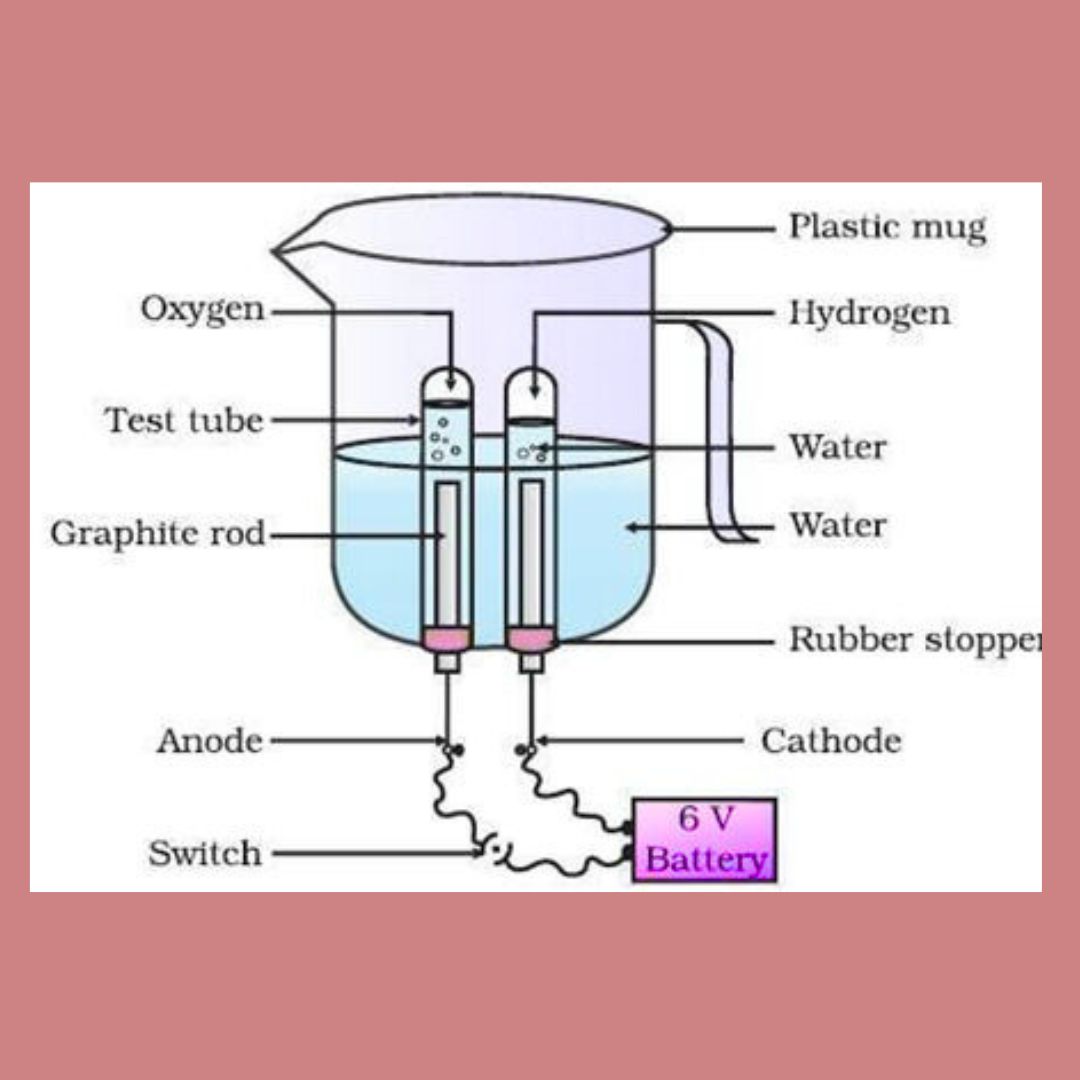
Answer the Following (Three Mark Questions)
- Barium sulphate (BaSO₄)
- SO₄²⁻ and Ba²⁺
- Double displacement reaction
- Reactions occur in test tubes A and C.
- Zn + FeSO₄ → ZnSO₄ + Fe
- Mg + FeSO₄ → MgSO₄ + Fe
52.
- Heat: CaCO₃ → CaO + CO₂
- Light: 2AgCl → 2Ag + Cl₂
- Electricity: 2H₂O → 2H₂ + O₂
- Silver chloride and silver bromide.
- 2AgCl → 2Ag + Cl₂
- 2AgBr → 2Ag + Br₂
54.
- Z = Calcium oxide
- Formula: CaO
- CaO + H₂O → Ca(OH)₂
- Displacement reaction.
CuSO₄ + Fe → FeSO₄ + Cu - Double displacement reaction.
3BaCl₂ + Al₂(SO₄)₃ → 3BaSO₄ + 2AlCl₃
57.
- CaCO₃ → CaO + CO₂
- H₂ + Cl₂ → 2HCl
- Mg + 2HCl → MgCl₂ + H₂
58.
- 2H₂ + O₂ → 2H₂O
- Na₂CO₃ + 2HCl → 2NaCl + H₂O + CO₂
- N₂ + 3H₂ → 2NH₃
59.
- CaO + H₂O → Ca(OH)₂
- Zn + CuSO₄ → ZnSO₄ + Cu
- NaCl + AgNO₃ → NaNO₃ + AgCl
60.
- 2H₂S + 3O₂ → 2SO₂ + 2H₂O
- 3BaCl₂ + Al₂(SO₄)₃ → 3BaSO₄ + 2AlCl₃
- 2K + 2H₂O → 2KOH + H₂
61.
- CH₄ + 2O₂ → CO₂ + 2H₂O
- 2K + 2H₂O → 2KOH + H₂
- CuSO₄ + Fe → FeSO₄ + Cu
- Oxidation: Addition of oxygen . For example 2Cu + O₂ → 2CuO. Reduction: Removal of oxygen. For example 2MgO → 2Mg + O₂
V. Four Mark Questions
63.
- Pb(NO₃)₂ + 2KI → PbI₂ + 2KNO₃
- Lead iodide (PbI₂)
- Yellow
- Double displacement reaction
64.
- 2H₂ + O₂ → 2H₂O
- Zn + CuSO₄ → ZnSO₄ + Cu
- ZnCO₃ → ZnO + CO₂
- NaCl + AgNO₃ → NaNO₃ + AgCl
65.
- Copper objects lose lustre due to oxidation / corrosion.
- Iron displaces copper from copper sulphate solution