Acids, Bases, and Salts
Take the Quiz on Acids, Bases and SaltsClassification of Matter
Matter is classified based on different factors. One important classification is based on atomic composition, according to which matter exists as solids, liquids, and gases. Another classification depends on the density and arrangement of atoms or molecules in a substance. Matter is also classified based on hydrogen ion concentration into acids, bases, and salts.
In our everyday experiences, we frequently come across different forms of matter. Sour substances such as lemon juice and vinegar indicate the presence of acids. Bitter and slippery substances like baking soda and soap show the presence of bases.
Acids are substances that are sour in taste and turn blue litmus paper red. Acids are commonly found in natural and household substances. Citrus fruits contain citric acid, curd contains lactic acid, tamarind contains tartaric acid, and vinegar contains acetic acid.
Bases are substances that are bitter in taste, slippery to touch, and turn red litmus paper blue. Lime water contains calcium hydroxide, baking soda contains sodium bicarbonate, and many cleaning agents and antacids are basic in nature. When bases dissolve in water, they are called alkalis.
Salts are substances that are usually neutral in nature and are formed as a result of reactions between acids and bases. Salts are widely used in cooking, food preservation, and in the manufacture of many industrial products.
To identify acids and bases safely, scientists use special substances called indicators. Litmus turns red in acids and blue in bases. Turmeric remains yellow in acidic solutions but turns reddish-brown in basic solutions. China rose indicator becomes pink in acids and greenish in bases.
Acids and bases have great practical importance in daily life. Antacids are used to relieve stomach acidity by neutralizing excess acid. In agriculture, lime is added to acidic soil to make it suitable for farming. Baking soda is commonly used for cooking and cleaning purposes. Acids and bases are also essential ingredients in many cleaning agents and industrial solutions.
🔹 Arrhenius’ Theory of Acids and Bases
The Arrhenius Theory, proposed by Swedish scientist Svante Arrhenius in 1884, was one of the earliest models to explain acid-base behavior in aqueous solutions.
- Acid: Increases the concentration of hydrogen ions (H⁺) in water.
- Base: Increases the concentration of hydroxide ions (OH⁻) in water.
Examples:
HCl → H⁺ + Cl⁻→ HCl is an Arrhenius acid.NaOH → Na⁺ + OH⁻→ NaOH is an Arrhenius base.
Neutralization reaction:H⁺ + OH⁻ → H₂O
Limitations of Arrhenius Theory:
- Only applies to aqueous (water-based) solutions.
- Cannot explain acid-base reactions in gases or non-aqueous solvents.
- Fails to classify substances like ammonia (NH₃), which doesn’t release OH⁻ but still acts as a base.
Despite these limitations, the Arrhenius theory laid the foundation for understanding many simple acid-base reactions in water.
🔹 Brønsted–Lowry Theory of Acids and Bases
Developed independently by Johannes Brønsted and Thomas Lowry in 1923, this theory extends the concept of acids and bases beyond water-based reactions.
- Acid: Proton (H⁺) donor
- Base: Proton (H⁺) acceptor
Example: Reaction between HCl and NH₃:HCl + NH₃ → NH₄⁺ + Cl⁻
- HCl donates a proton → Brønsted acid
- NH₃ accepts a proton → Brønsted base
Conjugate Acid–Base Pairs:
- Conjugate base: The species left after an acid donates a proton (e.g., Cl⁻ from HCl).
- Conjugate acid: The species formed after a base accepts a proton (e.g., NH₄⁺ from NH₃).
Additional Key Concept:
- Amphoteric substances: Can act as both acid and base depending on the reaction (e.g., H₂O).
This theory can explain acid-base behavior in gas phases, non-aqueous solutions, and reversible reactions, making it more versatile and broadly applicable than the Arrhenius theory.
🔍 Acid–Base Indicators
Acid–base indicators are substances that change their color depending on whether they are in an acidic or basic solution. Since tasting or touching unknown substances is unsafe, indicators offer a quick and safe way to test for acids or bases. Indicators react with hydrogen ions (H⁺) or hydroxide ions (OH⁻) to produce a visible color change.
🟢 Types of Indicators:
1. Natural Indicators
These are indicators extracted from natural sources like plants. They are commonly used in household and educational settings.
- Litmus: Extracted from lichens. Available as red/blue paper or solution.
🔵 Turns red in acids, blue in bases - Turmeric: A common kitchen spice.
🟡 Stays yellow in acids, turns reddish-brown in bases - China Rose (Hibiscus) Extract:
🌸 Turns dark pink in acids, green in bases
2. Synthetic Indicators
These are man-made chemical compounds used mostly in labs for titrations and precise analysis.
- Phenolphthalein:
⚪ Colorless in acids, pink in bases - Methyl Orange:
🔴 Red in acids, yellow in bases
3. Universal Indicator
A universal indicator is a mixture of several indicators that provides a wide range of color changes across the entire pH scale (0 to 14). It can give more specific information about how acidic or basic a solution is.
- pH 0–6: Acidic (colors vary from red to orange to yellow)
- pH 7: Neutral (green)
- pH 8–14: Basic/Alkaline (colors range from blue to violet)
Understanding indicators helps us detect the nature of substances safely, both in labs and at home. They play a key role in chemical analysis, agriculture, medicine, and industry.
Acids and Bases – Their Reaction with Indicators
🔹 Litmus Reaction
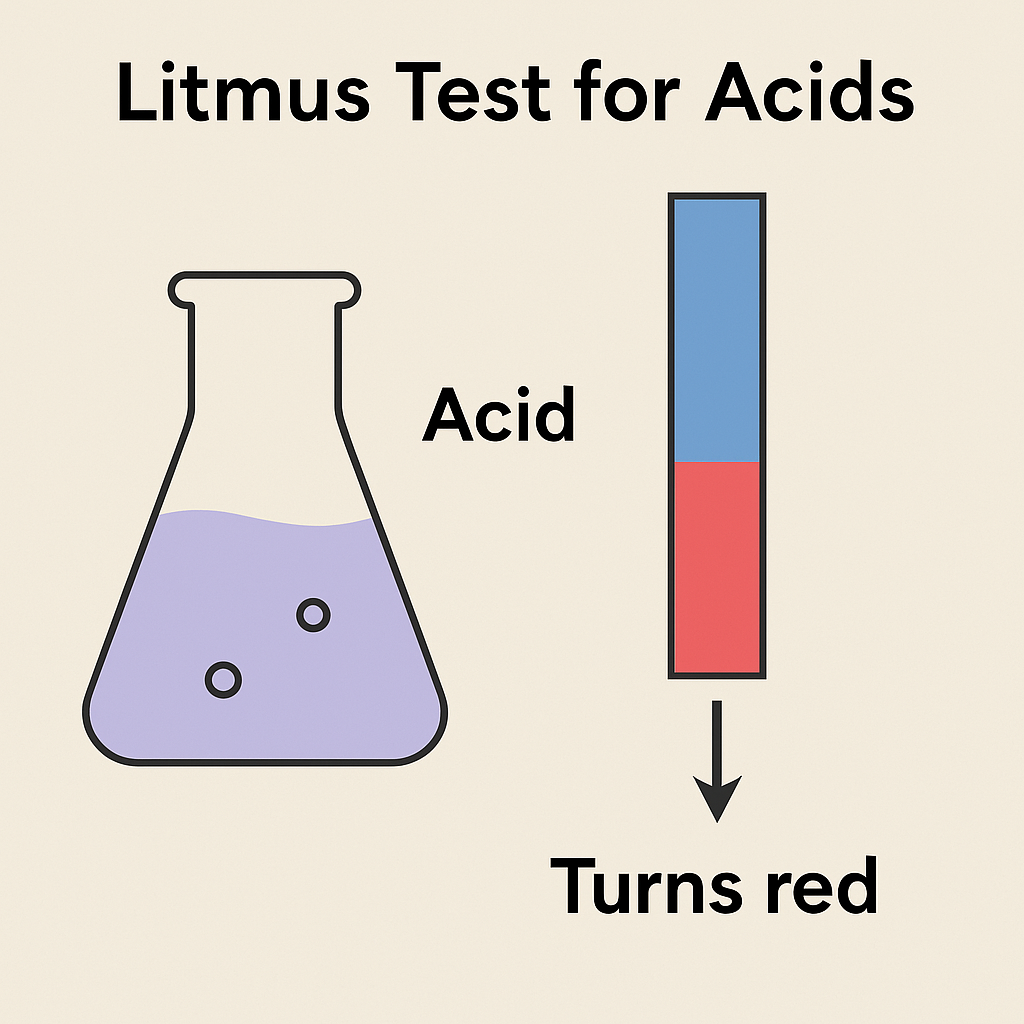
Litmus is a natural indicator extracted from lichens. It is available in both solution and paper form (red and blue). It reacts visibly with acids and bases:
- 🔴 Blue litmus turns red in acidic solution (pH < 7)
- 🔵 Red litmus turns blue in basic solution (pH > 7)
- ⚪ No color change in neutral substances (pH ≈ 7), like distilled water or salt solution
Litmus is widely used in school labs, industries, agriculture, and environmental testing due to its quick, safe, and clear results.
🔸 Reaction with Methyl Orange
Methyl orange is a synthetic indicator used mainly in titrations. It shows sharp and distinct color changes:
- 🔴 Appears red in acidic solutions (pH < 3.1)
- 🟠 Appears orange in near-neutral/slightly acidic conditions
- 🟡 Turns yellow in basic solutions (pH > 4.4)
Because of its sharp transition, methyl orange is perfect for identifying the end point in strong acid–weak base titrations.
🔺 Reaction with Phenolphthalein
Phenolphthalein is another common laboratory indicator, especially used in titrations involving strong bases:
- ⚪ Colorless in acidic (pH < 7) and neutral solutions
- 🌸 Turns pink in basic solutions (pH > 8.2)
The sudden color change makes phenolphthalein very effective in acid-base titration experiments.
📘 Summary Table of Indicators
📘 Summary Table of Indicators
| Indicator | Acid | Base | Neutral |
|---|---|---|---|
| Litmus | Blue → Red | Red → Blue | No change |
| Methyl Orange | Red | Yellow | Orange |
| Phenolphthalein | Colorless | Pink | Colorless |
Dilution of acid bases
Dilution is the process of reducing the concentration of a solution by adding more solvent (usually water) to it. It is a highly exothermic process. To dilute acid, the acid must be added to water and not the other way round.
Strength of acid, base and salts
The strength of acids and bases refers to their degree of ionization or dissociation in water, which directly affects their reactivity and the concentration of hydrogen (H⁺) or hydroxide (OH⁻) ions they produce. A strong acid is one that completely ionizes in an aqueous solution, releasing a large number of H⁺ ions. Examples include hydrochloric acid (HCl), sulfuric acid (H₂SO₄), and nitric acid (HNO₃). In contrast, a weak acid only partially ionizes in water and releases fewer H⁺ ions—examples include acetic acid (CH₃COOH) and citric acid. Similarly, a strong base like sodium hydroxide (NaOH) or potassium hydroxide (KOH) completely dissociates to release OH⁻ ions, whereas a weak base like ammonium hydroxide (NH₄OH) or magnesium hydroxide (Mg(OH)₂) only partially dissociates. The strength of these substances affects their ability to participate in chemical reactions, their corrosiveness, and their behavior in neutralization reactions. On the other hand, salts, which are formed by the neutralization of acids and bases, can be neutral, acidic, or basic depending on the strength of the acid and base that produced them. For example, the salt sodium chloride (NaCl) formed from a strong acid (HCl) and strong base (NaOH) is neutral. However, ammonium chloride (NH₄Cl), formed from a strong acid and weak base, results in an acidic salt, while sodium carbonate (Na₂CO₃), formed from a strong base and weak acid, is a basic salt. Thus, the strength of acids, bases, and the nature of the salt formed plays a crucial role in determining the pH, reactivity, and behavior of solutions in chemical and biological systems.
pH Scale
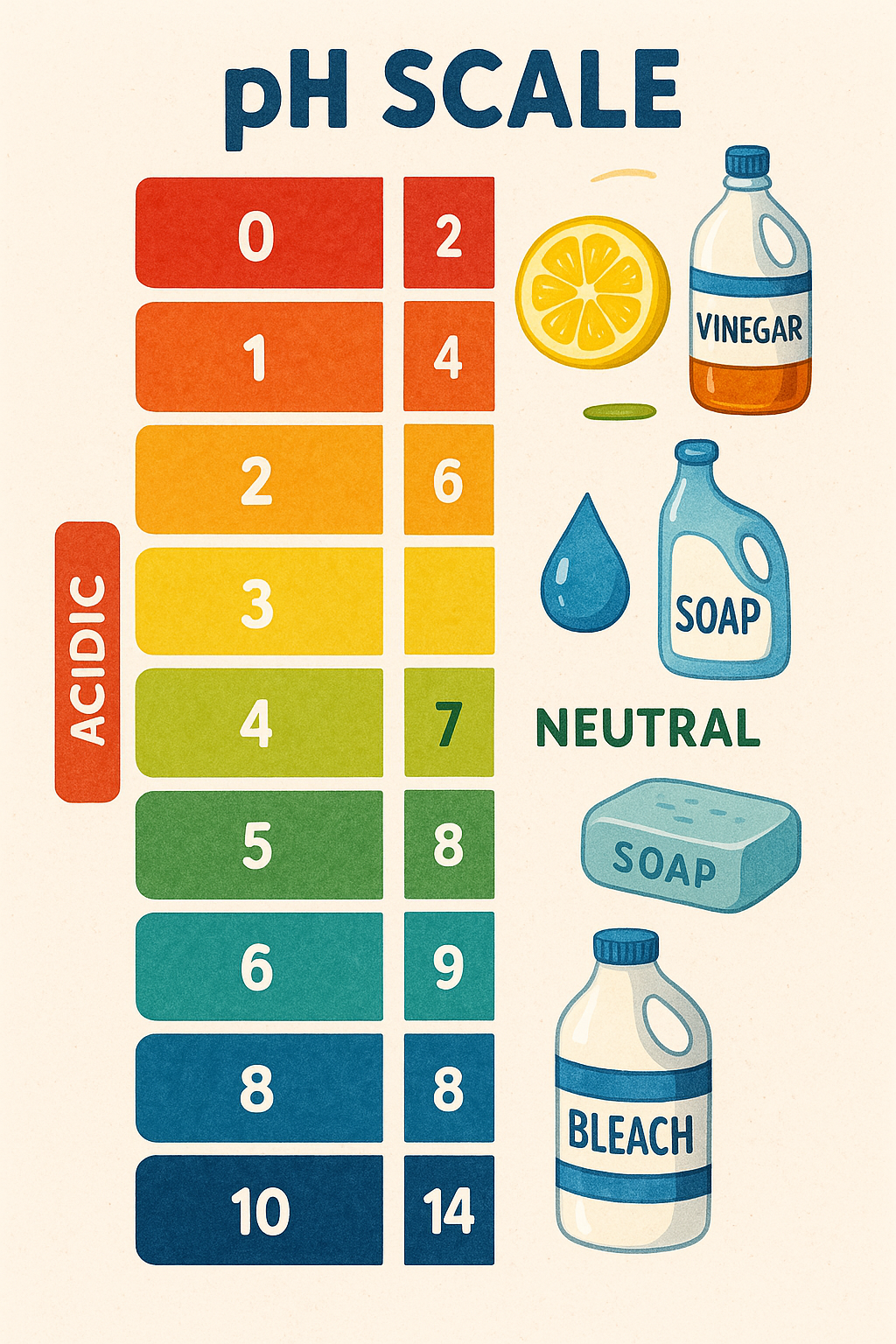
The pH scale ranges from 0 to 14 and helps determine how acidic or basic a solution is. A value below 7 indicates acidity, 7 is neutral, and above 7 is basic.
pH in Our Daily Life
The concept of pH, which measures the acidity or basicity of a solution on a scale from 0 to 14, plays a vital role in everyday life. A proper balance of pH is essential for biological, chemical, agricultural, and environmental processes.
In the human body, the stomach secretes hydrochloric acid (pH around 1.5 to 3.5) to aid digestion and kill harmful bacteria. Excess acid causes acidity or heartburn, which is treated using antacids that neutralize the acid.
In oral care, maintaining mouth pH is important because a drop below pH 5.5 can cause tooth enamel erosion and cavities. Hence, toothpaste is slightly basic.
In agriculture, soil pH affects nutrient availability. Acidic soils are treated with lime. Water bodies are monitored for pH to protect aquatic life.
In the food industry, pH controls taste and preservation, such as the sourness of curd or fizz in soft drinks. Household cleaners are also designed based on pH to remove grease and stains.
Acid–Base Reactions
Neutralization
A neutralization reaction occurs when an acid reacts with a base to form salt and water. Acid + Base → Salt + Water + Heat
Example: HCl + NaOH → NaCl + H₂O
Reaction of Acids with Metals
Acids react with metals to produce salt and hydrogen gas.
Example: 2HCl + Mg → MgCl₂ + H₂↑
Reaction of Bases with Metals
When a base reacts with certain metals like zinc, hydrogen gas is released and complex salts are formed.
Example: 2NaOH + Zn → Na₂ZnO₂ + H₂↑
Reaction of Acids with Metal Carbonates and Bicarbonates
Acids react with metal carbonates or bicarbonates to produce salt, water, and carbon dioxide.
Example: 2HCl + CaCO₃ → CaCl₂ + H₂O + CO₂
Reaction of Non-Metal Oxides with Bases
Non-metal oxides are acidic in nature and react with bases to form salt and water.
Example: 2NaOH + CO₂ → Na₂CO₃ + H₂O
Reaction of Acids and Bases in Water
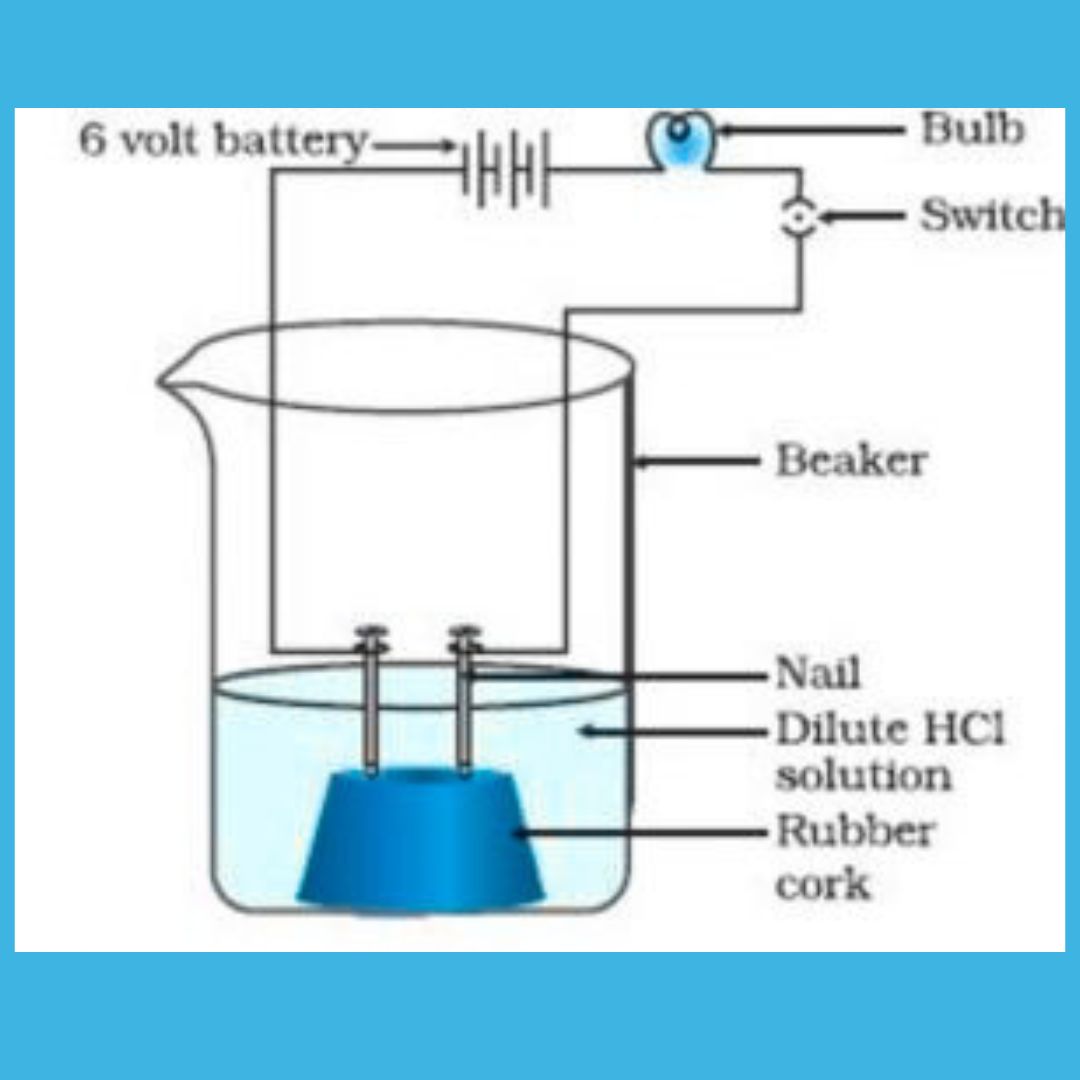
Acids and bases dissociate into ions in water and conduct electricity.
NaOH → Na⁺ + OH⁻
HCl → H⁺ + Cl⁻
Difference Between a Base and an Alkali
| Base | Alkali |
|---|---|
| A base neutralizes an acid. | An alkali is a base soluble in water. |
| May be soluble or insoluble. | Always soluble in water. |
| Example: CuO, ZnO | Example: NaOH, KOH |
Preparation of Acids
Acids can be prepared from non-metal oxides reacting with water.
Example: SO₂ + H₂O → H₂SO₃
Hydrogen reacts with non-metals to form acids. Example: H₂ + Cl₂ → 2HCl
Preparation of Bases
Bases are prepared by reacting metal oxides with water. Example: CaO + H₂O → Ca(OH)₂
Reactive metals with water also form bases. Example: 2Na + 2H₂O → 2NaOH + H₂↑
Electrolysis of brine produces sodium hydroxide (Chlor-alkali process).
Salts
Preparation of Salts
Salts are formed by the neutralization of acids and bases. Example: NaCl (common salt)
Family of Salts
Salts derived from the same acid or base form a family of salts. Examples include chlorides, sulphates, nitrates, and carbonates.
Naming of Salts
Salts are named after the anion of the acid, such as chlorides (NaCl), sulphates (Na₂SO₄), nitrates (KNO₃), and carbonates (Na₂CO₃).
pH of Salts
A salt formed by a strong acid and a strong base will be neutral with pH = almost 7 . A salt of a weak acid and a strong base will be alkaline in nature with pH > 7. A salt of a strong acid and a weak base will be acidic in nature. pH < 7. The pH of a salt of a weak acid and a weak base is determined by conducting a pH test.
Common Salt
Common salt, also known as sodium chloride (NaCl), is a white crystalline substance widely used in cooking and food preservation. It is made up of sodium and chloride ions and is an essential mineral for the human body, helping to regulate fluids and nerve functions. Common salt is mainly obtained from sea water through evaporation or mined from rock salt deposits. Apart from its use in food, it serves as a raw material for producing important chemicals like sodium hydroxide, baking soda, and hydrochloric acid. It also finds use in industries, water softening, and de-icing roads in cold climates.
Chemicals Prepared from Common Salt:
Common salt (Sodium chloride – NaCl) is not just used in cooking; it is also a raw material for making many important industrial chemicals.Some important compounds of common salts are as follows:
Sodium Hydroxide (NaOH) is prepared by the electrolysis of brine (brine = solution of NaCl in water). The equation can be written as 2NaCl + 2H₂O → 2NaOH + Cl₂ + H₂. It is used in making soap, paper, and cleaning agents.Chlorine (Cl₂) is obtained during electrolysis of brine. It is used for disinfecting water, making PVC plastic, and bleaches.Hydrogen (H₂) is a by-product of the electrolysis of brine. It is used as fuel, band a catalyst for hydrogenation of oils.Bleaching Powder (Ca(OCl)Cl) : It is prepared by reacting chlorine with slaked lime (Ca(OH)₂). The equation for this is, Cl₂ + Ca(OH)₂ → Ca(OCl)Cl + H₂O. Bleaching powder is used as a disinfectant, bleaching agent for fabrics and paper. Baking Soda (NaHCO₃) : Made through Solvay process. Where, sodium chloride + ammonia + CO₂ + water (Solvay process). It is useful in baking, as an antacid, and fire extinguisher. Washing Soda (Na₂CO₃·10H₂O) : Made when baking soda is heated and re-crystallized. It is useful for Softening hard water, glass and soap manufacturing. Hydrochloric Acid (HCl): prepared by dissolving hydrogen chloride gas in water. It is used in cleaning metals, making medicines .
Crystallization of Salts
Crystallization is a process used to obtain pure solid crystals from a solution. It is a physical change commonly used in chemistry labs and industries to purify substances. Crystallization involves the formation of solid crystals from a homogeneous solution. The basic steps include:
- Preparation of a Saturated Solution – Dissolve the solute in hot water until no more can dissolve.
- Filtration – Filter the hot solution to remove any undissolved impurities.
- Cooling – Allow the clear hot solution to cool slowly. As the temperature drops, solubility decreases and crystals begin to form .Crystals are then separated from the solution by decanting or filtration.
Crystallization of Copper Sulphate
Heat water and dissolve copper sulphate until the solution becomes saturated. Filter the hot solution to remove impurities and let it cool undisturbed. Beautiful blue crystals of copper sulphate will form as the solution cools. Common examples of crystallization include the preparation of table salt (sodium chloride), sugar (sucrose), and snowflakes. Many gemstones, such as quartz and diamond, are also natural crystals.
POP (Plaster of Paris)
Plaster of Paris is chemically known as Calcium Sulphate Hemihydrate, with the formula CaSO₄ · ½H₂O. It is widely used in medical applications for casting fractured bones and also in construction and decorative work. Plaster of Paris is prepared by heating gypsum (calcium sulphate dihydrate) at about 150 degree Celsius. When Gypsum (CaSO₄·2H₂O) is heated it releases water vapour and POP. The equation is, CaSO₄·2H₂O) → heated → POP (CaSO₄·½H₂O) + water vapor. POP is a white powder easily reacts with water to form gypsum and it can easily be set into a hard mass in 10–15 minutes. In addition to the bone setting, POP is used for decorative ceiling designs (false ceilings) and sealing cracks in walls
Board paper solutions ( previous years)
1. As the pH value of a solution increases:
- Number of H+ ions increases
- Number of OH− ions increases
- Number of OH− ions decreases
- Equal number of H+ and OH− ions
Answer: B. As the pH value increases, the solution becomes more basic and the concentration of OH− ions increases.
2. The amphoteric oxide among the following is:
- Potassium oxide
- Sodium oxide
- Calcium oxide
- Zinc oxide
Answer: D. Zinc oxide reacts with both acids and bases.
3. When dilute HCl is added to zinc pieces taken in a test tube:
- No change takes place
- The colour of the solution becomes yellow
- A pungent smelling gas is liberated
- Small bubbles of H2 gas appear on the surface of zinc
Answer: D. Hydrogen gas is liberated due to displacement reaction.
4. Sodium aluminium silicate is also called:
- Washing soda
- Silicone
- Water glass
- Zeolite
Answer: D. Zeolite
5. The chemical mixed with LPG to detect leakage is:
- Methyl mercaptan
- Benzyl mercaptan
- Ethyl mercaptan
- Propyl mercaptan
Answer: C. Ethyl mercaptan
6. Raw materials used in the manufacture of cement are:
- Clay and washing soda
- Clay and limestone
- Washing soda and limestone
- Calcium silicate and gypsum
Answer: B. Clay and limestone
7. Which of the following is a soap?
- Sodium sulphate
- Sodium stearate
- Sodium chloride
- Sodium hydroxide
Answer: B. Sodium stearate
8. During the preparation of soap, the liquid separated is:
- Sodium hydroxide
- Oil
- Stearic acid
- Glycerol
Answer: D. Glycerol
9. The acid related to the preparation of detergents is:
- Stearic acid
- Hydrochloric acid
- Nitric acid
- Sulphuric acid
Answer: D. Sulphuric acid
10. Cement is used as a building material because it:
- Is a good binding agent
- Sets rapidly
- Is prepared from cheap raw materials
- Withstands high temperature
Answer: A. It is a good binding agent.
11. Chemical heated with fatty oil during soap manufacture is:
- Sodium chloride
- Sodium sulphate
- Calcium sulphate
- Sodium hydroxide
Answer: D. Sodium hydroxide
12. Eggshells may break easily if there is a deficiency of:
- Magnesium carbonate
- Ferrous sulphate
- Calcium carbonate
- Calcium
Answer: C. Calcium carbonate
13. Increasing order of reactivity of Fe, Zn and Mg is:
- Fe, Mg, Zn
- Mg, Zn, Fe
- Fe, Zn, Mg
- Zn, Mg, Fe
Answer: C. Fe, Zn, Mg
14. Amphoteric oxides are:
- Sodium oxide and copper oxide
- Aluminium oxide and zinc oxide
- Aluminium oxide and sodium oxide
- Zinc oxide and copper oxide
Answer: B. Aluminium oxide and zinc oxide
15. Raw materials used in detergent manufacture are:
- Vegetable oil, sodium hydroxide, sulphuric acid
- Vegetable oil, sodium hydroxide, long-chain hydrocarbon
- Long-chain hydrocarbon, sodium hydroxide, sulphuric acid
- Long-chain hydrocarbon, oil, sulphuric acid
Answer: C. Long-chain hydrocarbon, sodium hydroxide, sulphuric acid
Answer the following
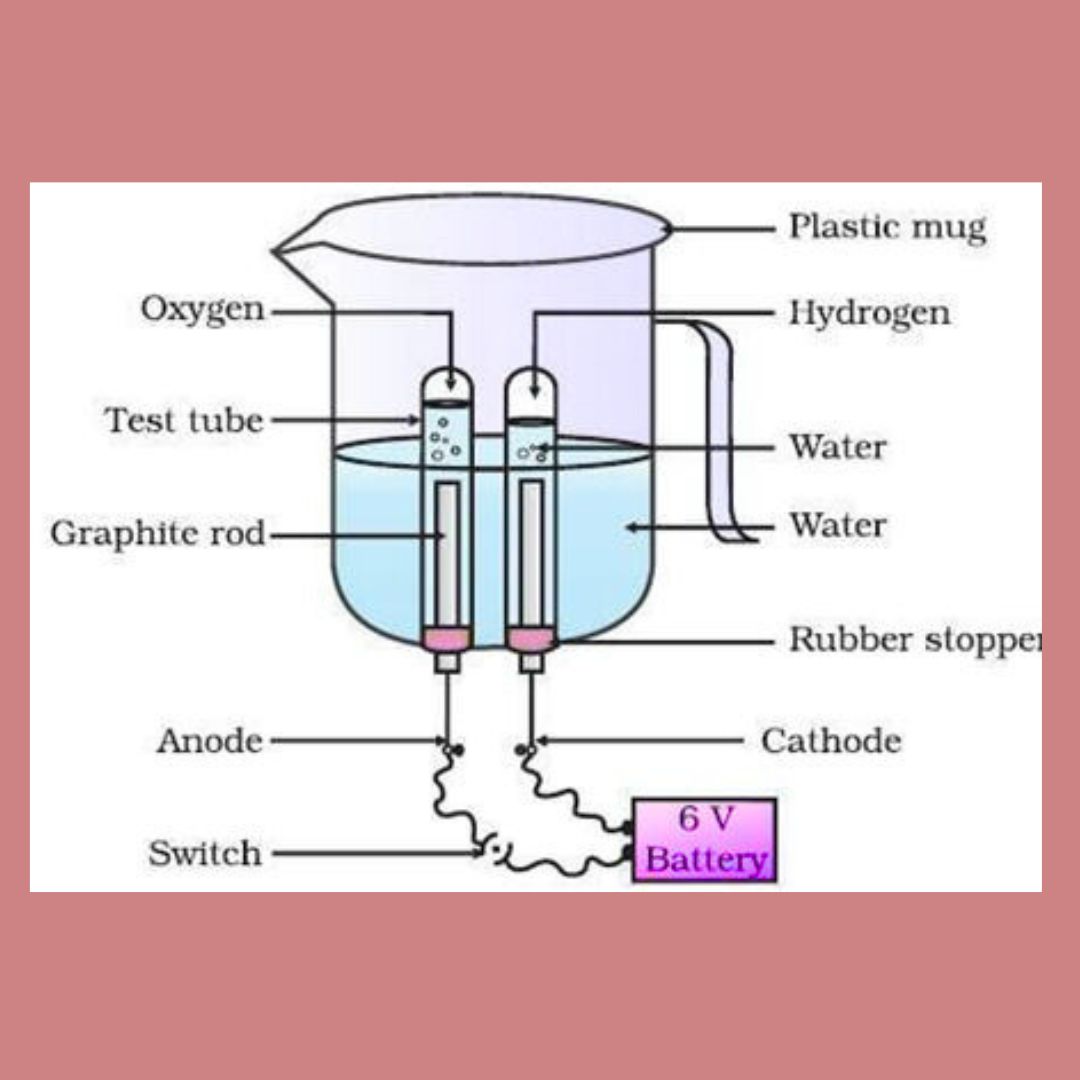
- Draw the diagram of the arrangement of apparatus to show the electrolysis of water and label the ‘graphite rod’.
- Write the molecular formula and two uses of Washing soda and bleaching powder
Answer: Washing Soda (Sodium Carbonate), Molecular Formula: Na₂CO₃
Uses:
- Water Softening:It helps remove the hardness of water by reacting with calcium and magnesium ions, making it easier to use with soaps and detergents.
- Cleaning Agent:It is a common ingredient in many cleaning products and can be used to remove tough stains and grease from various surfaces, including kitchen utensils.
Bleaching Powder (Calcium Hypochlorite), Molecular Formula: Ca(ClO)₂
Uses:
- Disinfectant:It's a powerful disinfectant used to purify water and sanitize surfaces.
- Bleaching Agent:It is used to bleach fabrics, paper, and other materials.
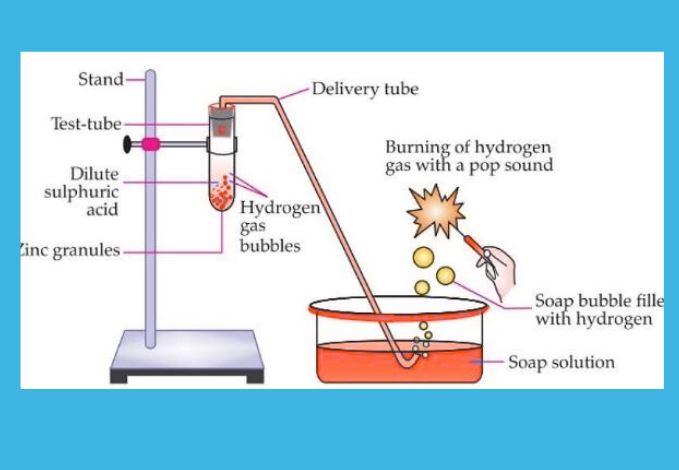
- Draw the diagram of arrangement of the apparatus to show the reaction of zinc granules with dilute sulphuric acid and testing hydrogen gas by burning. Label the following parts.
 alt="Reaction of zinc granules with sulphuric acid" />
- zinc granules
- soap solution
- The reaction of lead with Copper Chloride solution is an example for which type of chemical reaction? Why? Write the balanced chemical equation for this reaction.
Answer: The reaction of lead with copper chloride is a single displacement reaction. In this type of reaction, a more reactive element displaces a less reactive element from its compound. In this case, lead (Pb) displaces copper (Cu) from copper chloride (CuCl2). The balanced chemical equation for this reaction is: Pb + CuCl2 → PbCl2 + Cu.
- Write the balanced chemical equations for the following reactions andidentify the exothermic and endothermic reaction.
- Heating of ferrous sulphate
- Calcium oxide reacts with
Answer:
- The chemical equation for the heating of Ferrous Sulphate is :FeSo₄ ⇒ Fe₂O₃ + SO₂ + SO₃. It is anEndothermic Reaction.
- The chemical equation for heating Calcium Oxide with water is :CaO + H₂O ⇒ Ca(OH)₂. It is anEndothermic Reaction.
- Why do we say that Aluminium oxide is amphoteric oxide?
Answer: Aluminium oxide (Al₂O₃) is considered amphoteric because it can react with both acids and bases to form salts and water, exhibiting both acidic and basic properties.
- Observe the following chemical equations:
- Al2O3 + 2NaOH → 2NaAlO + H2O
- (Al2O3 + 6HCl → 2AlCl3 + 3H2
In the above reaction, what is the conclusion that you take about the nature of aluminium oxide with the help of these equations? Give reason for your conclusion.
Answer: Aluminium oxide is amphoteric in nature. Aluminium oxide is reacting with base in the first equation to give salt & water. Hence, it is an amphoteric oxide.
- Molten cryolite is mixed with molten alumina in the extraction ofaluminium by electrolysis., why? And name the substances that are used as anode and cathode in this method.
Answer: Molten cryolite is mixed with molten alumina in the electrolysis of aluminum to lower the melting point of alumina and improve its electrical conductivity. Graphite rods are used as the anode, and a carbon lining acts as the cathode in this process.
- The Ph value of 4 solutions is 4, 12, 1, and 6. Classify these into acidic, highly acidic, alkaline and highly alkaline solutions.’
Answer: Solution e has a pH value of 5, which is below 7. Hence, solution is acidic. Solution f has a pH value of 13, which is above 7. Therefore, solution f is basic.Solution g has a pH value of 9, which is also above 7. Thus, solution g is basic. Solution h has a pH value of 2, which is significantly below 7. Thus, solution h is highly acidic.Therefore, based on the given pH values: Solutions e and h are acidic. Solutions f and g are basic.
- Name the acid present inthe stinging hairof nettle leaves the substances that are used as anode and cathode in this method.
Answer: The acid present in the stinging hairs of nettle leaves is methanoic acid, also known as formic acid. The substances used as anode and cathode in the method are not specified in the context of nettle stings.
- Ionic compounds in solid state do not conduct electricity, whereas in molten state are good conductors of electricity, WHY?
Answer: Ionic compounds in the solid state do not conduct electricity because their ions are held in a fixed, rigid lattice structure and cannot move freely to carry an electrical charge. However, when melted, the ionic bonds break, and the ions become mobile, allowing them to conduct electricity.
- What is dilution of acids ?
Answer: Dilution of acids is the process of reducing the concentration of an acid by adding more solvent, typically water, to a solution. This process decreases the number of acid molecules or ions per unit volume, making the solution less concentrated.
- What could be the pH value of a salt that is commonly used to remove strong oil stains in any source ? Why ?
Answer: A common salt used for removing strong oil stains is sodium carbonate (Na₂CO₃), also known as washing soda. It's basic in nature, with a pH typically around 11, due to the hydrolysis of its carbonate ions in water, which produces hydroxide ions.
- Farmer should add certain amount of lime powder to an agricultural field what is the reason explain.
Answer: Farmers add lime to their fields primarily to reduce soil acidity, which can hinder plant growth and nutrient absorption. Lime, also known as agricultural lime or calcium carbonate, helps neutralize acidic soil, bringing the pH level closer to the ideal range for most crops, which is generally around 6.0 to 7.0.
- What is the reason for the formation of water when moderately reactive metals react with nitric acid?
Answer: When moderately reactive metals react with nitric acid, water is formed because nitric acid acts as a strong oxidizing agent, and the hydrogen ions produced in the reaction are oxidized to water, rather than being released as hydrogen gas.
- Though concentrated sulphuric acid is not a reactant during the conversion of ethanol to ethene, its presence is necessary. Why?
Answer: Concentrated sulphuric acid is necessary for the conversion of ethanol to ethene because it acts as a dehydrating agent, removing water from ethanol and facilitating the formation of ethene. While it's not a reactant in the sense that it's consumed in the reaction, its presence is crucial for the reaction to occur.
- Observe the following chemical equations and Answer the question given: Which property of metallic oxide and non-metallic oxide is expressed here? Explain.
Answer: The property expressed is the basic nature of metallic oxides as Cuo as basic as it reacts with acid( Hcl) forming water and a salt . While non-metallic oxides are acidic in nature.
- How sodium carbonate is prepared? Explain with suitable chemical equations. Mention any two uses of this salt.
Answer: Sodium carbonate is commonly prepared by the Solvay process using sodium chloride (NaCl), ammonia (NH₃), carbon dioxide (CO₂), and water (H₂O).
Steps and Chemical Equations:
- Formation of Ammonium Bicarbonate:
CO₂ + H₂O + NH₃ → NH₄HCO₃ - Reaction with Sodium Chloride:
NH₄HCO₃ + NaCl → NaHCO₃ + NH₄Cl - Conversion to Sodium Carbonate (on heating):
2NaHCO₃ → Na₂CO₃ + H₂O + CO₂
Uses of Sodium Carbonate:
- It is used in the manufacture of glass, soap, and paper.
- It is used as a cleaning agent (washing soda) in homes and industries.
- What is cement? Name the substance which prevents too rapid setting of
Answer: Cement is a binder, a substance used in construction that sets, hardens, and adheres to other materials to bind them together. Gypsum is the substance typically added to cement to prevent it from setting too quickly.
- What is the product formed when heated aluminium powder is sprinkled in a gas jar containing chlorine ? Write balanced chemical equation of the reaction.
Answer: The product formed is aluminium chloride(Al2Cl3) and the balanced equation is 2Al+3Cl2 → 2AlCl3
- How do you obtain hydrogen gas from silicon and water?
Answer: Hydrogen gas can be obtained from the reaction of silicon and water, producing silicon dioxide and hydrogen gas. This reaction is typically represented by the equation: Si (s) + 2H₂O (l) → SiO₂ (s) + 2H₂ (g).
- What is hard water? Name two salts which cause temporary hardness in water.
Answer: Hard water is water that contains a high concentration of dissolved minerals, primarily calcium and magnesium ions. Temporary hardness in water is caused by the presence of dissolved bicarbonates of calcium and magnesium. Therefore, calcium bicarbonate and magnesium bicarbonate are two salts that cause temporary hardness in water.
- What is the element produced when silicon dioxide reacts with magnesium ? Write the equation of the chemical reaction.
Answer: When silicon dioxide (SiO₂) reacts with magnesium (Mg) at high temperatures, elemental silicon (Si) is produced. Magnesium oxide (MgO) is also formed in the reaction. The balanced chemical equation for the reaction is: 2Mg(s) + SiO₂(s) → Si(s) + 2MgO(s) . This reaction is known as the magnesiothermic reduction of silicon dioxide. It's a way to produce silicon at a much lower temperature (500-700°C) compared to traditional methods like carbothermic reduction.
- Name the ions responsible for acidic and basic nature of the
Answer: In acidic substances, the hydrogen ion (H+) is responsible for the acidic properties. In basic substances, the hydroxide ion (OH-) is responsible for the basic properties.
- Ionic compounds have high melting point and boiling point, why?
Answer: Ionic compounds have high melting and boiling points due to the strong electrostatic forces of attraction between their oppositely charged ions. These forces are present throughout the entire ionic lattice structure, and a significant amount of energy is required to overcome them and transition the substance from a solid to a liquid (melting) or a liquid to a gas (boiling).
- When a piece of metal that was stored in kerosene is put into water, then the evolved gas catches fire and burns. Which is that metal? Which gas is evolved? Evolved gas catches fire immediately. Why?
Answer: The metal is sodium (Na), the gas evolved is hydrogen (H2), and the hydrogen gas ignites due to the heat generated from the reaction between sodium and water. Sine sodium is a highly reactive metal that is stored under kerosene to prevent it from reacting with oxygen and moisture in the air. When sodium reacts with water, it produces sodium hydroxide (NaOH) and hydrogen gas (H2). The reaction between sodium and water is exothermic, meaning it releases a large amount of heat. This heat is sufficient to ignite the hydrogen gas, causing it to catch fire.
- Draw the diagram to show the arrangement of the apparatus when acid solution in water conducts electricity. Label the following
- HCl solution
- Rubber Cork
- Name the acid which causes pain and irritation by ant sting.
Answer: The acid found in ant stings that causes pain and irritation is formic acid, also known as methanoic acid.
Its chemical formula is HCOOH.
- What is the pH value of acid rain?
Answer: Acid rain typically has a pH value less than 5.6. Normal rain has a pH of around 5.6 due to dissolved carbon dioxide, but acid rain becomes more acidic due to pollutants like sulphur dioxide and nitrogen oxides, resulting in a pH value below 5.6. Some sources even state that acid rain's pH can be between 4.2 and 4.4.
- Oils have very limited shelf-life, explain.
Answer: Oils undergo rancidity when stored improperly which leads to bad smell and taste.
- Draw the diagram of arrangement of the apparatus used to show the action of steam on metal. Label the Metal sample and the Delivery tube.
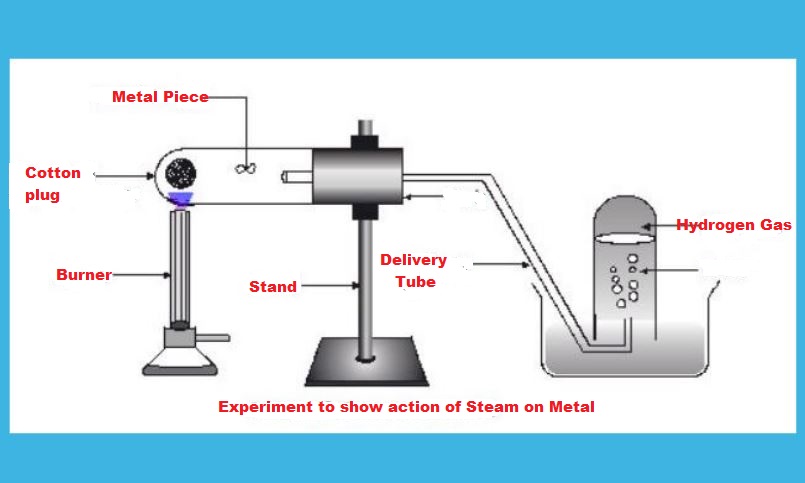
Experiment: Action of steam on a metal - Covalent compounds are generally bad conductors of electricity. Mention the reason.
Answer: In covalent bonds, atoms share electrons to achieve a stable electron configuration. This means there are no free-moving electrons or ions to carry an electrical charge, as electrical conductivity relies on the movement of charged particles.
- A strong solution of sodium hydroxide is added to the strong solution of hydrochloric acid. What is the nature of the salt solution formed here? Write a balanced chemical equation for this reaction.
Answer: When a strong solution of sodium hydroxide (NaOH) is added to a strong solution of hydrochloric acid (HCl), a neutralization reaction occurs, producing sodium chloride (NaCl) and water (H₂O). The reaction is represented by the equation: NaOH + HCl → NaCl + H₂O. This is an exothermic reaction, meaning it releases heat.
- There is no change in the color of red litmus and blue Litmus Paper when introduced into an aqueous solution of sodium chloride by passing direct current through the same solution whereas red litmus changes to blue color. Which product is responsible for this change mention any two uses of this product?
Answer: When a direct current is passed through an aqueous solution of sodium chloride (NaCl), the product responsible for turning red litmus paper blue is sodium hydroxide (NaOH). This is because the electrolysis of sodium chloride produces sodium hydroxide, along with hydrogen and chlorine gases. Sodium hydroxide is a base, and bases turn red litmus paper blue. Two uses of sodium hydroxide are in the manufacture of soap and detergents, and in the pulping of wood for paper production.
- Name the gas liberated when an acid reacts with metallic carbonate write the chemical equation of the reaction when this gas is passed through the lime water. What is the color of the precipitate obtained in this reaction?
Answer: When an acid reacts with a metallic carbonate, carbon dioxide (CO2) gas is liberated. When this carbon dioxide gas is passed through lime water (calcium hydroxide solution), it reacts to form a white precipitate of calcium carbonate (CaCO3). The chemical equation for this reaction is: Ca(OH)2(aq) + CO2(g) → CaCO3(s) + H2O(l).
- While diluting, an acid should be added to the water but not water to the acid, why?
Answer: When diluting an acid, it is recommended to add the acid to water, not the other way around, because the dilution process is highly exothermic (releases a lot of heat). Adding water to concentrated acid can cause the water to boil and the mixture to splash out, potentially causing severe burns and injuries due to the rapid heat release. Adding acid to water, even though still exothermic, allows the water to absorb the heat more effectively and prevent splattering, making the process much safer.
- Plaster of Paris should be stored in a moisture proof container why?
Answer: Plaster of Paris (POP) must be stored in a moisture-proof container because it readily absorbs moisture from the air, which causes it to react with water and harden into gypsum, rendering it unusable for its intended purposes.
- What is neutralization reaction give an example with equation?
Answer: A neutralization reaction is a chemical reaction in which an acid and a base react to form a salt and water. This reaction involves the combination of hydrogen ions (H+) from the acid and hydroxide ions (OH-) from the base, which produce water (H2O).
- Name the products of chlor alkali process? Mention any two uses
Answer: The chlor-alkali process produces sodium hydroxide (NaOH), chlorine gas (Cl2), and hydrogen gas (H2). Sodium hydroxide is used in soap and detergent manufacturing, while chlorine is used in water purification and the production of plastics like PVC.
- Write the molecular formula of bleaching powder, baking powder and common salt. Explain the methods of preparation of these salts.
Answer: The molecular formulas are: bleaching powder is CaOCl₂, baking powder is a mixture, mainly containing NaHCO₃, and common salt is NaCl. Bleaching powder is made by reacting chlorine gas with slaked lime. Baking powder is a mixture of baking soda and a weak acid. Common salt is obtained by evaporating seawater or by mining.
- What is the formula of plaster of Paris. Explain the method of preparation and its uses.
Answer: Plaster of Paris has the chemical formula CaSO₄·½H₂O (calcium sulfate hemihydrate). It's made by heating gypsum (CaSO₄·2H₂O) to around 150°C, which drives off water molecules. This partially dehydrated gypsum is then ground into a fine powder. Plaster of Paris is used in building materials, orthopedic casts, and for creating molds and statues.
- What are strong and weak acids?
Answer: Strong acids completely dissociate into ions when dissolved in water, releasing a large number of hydrogen ions, while weak acids only partially dissociate, releasing a smaller number of hydrogen ions.
- Explain the tooth decay mechanisms and its prevention.
Answer: Tooth decay, also known as dental caries or cavities, is a process where bacteria in the mouth produce acids that erode tooth enamel. This occurs when sugars and carbohydrates are consumed, and the bacteria in plaque convert them into acids that attack the tooth's surface. Proper oral hygiene, including regular brushing and flossing, along with fluoride use and dietary adjustments, can effectively prevent tooth decay.
- What are antacids? Name some antacids. How does antacids act?
Answer: Antacids are medications that neutralize stomach acid to relieve heartburn, indigestion, and other symptoms caused by excess stomach acid. They work by reacting with stomach acid (primarily hydrochloric acid, HCl) to form salt and water, thus reducing the acidity of the stomach contents. Common antacids include magnesium hydroxide, calcium carbonate, and aluminum hydroxide
- What is the common name of
- NaHco3
- Nacl
- CaSo41/2H20
- CH3COOH
- HCOOH
Answer:
- NaHCO3:Baking soda or Sodium bicarbonate.
- NaCl:Table salt, common salt, or halite (mineral form).
- CaSO4·1/2H2O:Plaster of Paris.
- CH3COOH:Acetic acid.
- HCOOH:Formic acid.
In the following day-to-day situations write the molecular formula of chemical compounds used.
- To remove permanent hardness of water
- To make drinking water free from germs
- To support fractured bones in the right position
Answer:
- To remove permanent hardness of water: Sodium carbonate (Na2CO3)
- To make drinking water free from germs: Calcium hypochlorite (Ca(OCl)2)
- To support fractured bones in the right position: Calcium sulfate hemihydrate (CaSO4.1/2H2O), also known as plaster of Paris
- Write any two uses of washing soda
Answer: Washing soda (sodium carbonate) is a versatile compound with several uses. Two prominent applications include its role in removing permanent hardness from water and as a cleaning agent for various household and industrial purposes.
- Simultaneously, red and blue Litmus Paper brine solution in the aqueous product produced by subjecting the solution to electrolysis? What changes do you observe in Litmus Paper support your Answer with three reasons?
Answer: When red and blue litmus papers are dipped into the aqueous product of brine electrolysis, the red litmus paper will turn blue, while the blue litmus paper will remain blue. This change indicates the solution is basic due to the presence of sodium hydroxide.
- The pH of 4 solutions P, Q R S is 10, 7, 7.0, 1.2. Respectively. Which solution can be used to prepare an antacid and why? Which two solutions can be used to get a neutral salt and why?
Answer: An antacid can be prepared using solution P (pH 10) because antacids are basic and neutralize stomach acid, which is acidic; solution P with a high pH value is basic and can counteract the acidity of stomach acid. To get a neutral salt, solutions P (pH 10) and S (pH 1.2) can be used because a neutral salt is formed when a strong acid reacts with a strong base, and solutions P and S represent a strong base and a strong acid respectively.
LBA Solutions
Learning Points
- Physical properties of acids, bases
- Chemical properties of acids, bases
- How strong are solutions of acids and bases
- Importance of pH in daily life
- More about salts
- Uses of salts
Question Paper Pattern
|
Sl. No |
Type of Questions |
No. of Questions |
Marks |
Percentage |
|
1 |
Easy |
16 |
35 |
30% |
|
2 |
Average |
32 |
59 |
50% |
|
3 |
Difficult |
19 |
23 |
20% |
I. Multiple Choice Questions (1 Mark each)
- The chemical equation that represents a neutralization reaction is:
A) BaCl₂ + H₂SO₄ → BaSO₄ + 2HCl
B) MnO₂ + 4HCl → MnCl₂ + 2H₂O + Cl₂
C) 2NaOH + H₂SO₄ → Na₂SO₄ + 2H₂O
D) AgNO₃ + HCl → AgCl + HNO₃ - As the pH value of a neutral solution increases:
A) Basic property decreases and OH⁻ ions increase
B) Acidic property increases and H⁺ ions decrease
C) Basic property increases and OH⁻ ions increase
D) Acidic property decreases and H⁺ ions increase - A compound that reacts with both acids and bases to produce salts and water is:
A) Aluminium oxide
B) Copper oxide
C) Iron oxide
D) Sodium oxide - The gas liberated when sodium carbonate reacts with dilute hydrochloric acid is:
A) Carbon dioxide
B) Nitrogen dioxide
C) Hydrogen
D) Chlorine - The substance that turns blue litmus paper red is:
A) Lime water
B) Pure water
C) Sodium hydroxide solution
D) Gastric juice - An acid present in the stinging hair of nettle plant leaves is:
A) Methanoic acid
B) Oxalic acid
C) Citric acid
D) Lactic acid - The compound used to remove permanent hardness of water is:
A) Sodium carbonate
B) Sodium hydroxide
C) Sodium hydrogen carbonate
D) Sodium chloride - The pH value range of an acid is:
A) 0–7
B) 2–12
C) 7–14
D) 12–14 - As the number of hydrogen ions increases in a solution, it:
A) Becomes neutral
B) Increases acidity
C) Increases basicity
D) Reduces acidity - Gas released when dilute sulphuric acid reacts with lead is:
A) Oxygen
B) Nitrogen
C) Hydrogen
D) Carbon - The product obtained when an acid reacts with a metal is:
A) Metal oxide + water
B) Salt + water
C) Metal oxide + hydrogen gas
D) Salt + hydrogen gas - The molecular formula of lime water is:
A) CaO
B) Ca(OH)₂
C) CaCO₃
D) CO₂ - When hydrochloric acid is added to copper oxide, the solution turns blue-green due to:
A) Copper oxide
B) Water
C) Copper hydroxide
D) Copper chloride - Acid should be added to water, not water to acid, because it is:
A) Exothermic and may explode
B) Endothermic and may explode
C) Does not mix
D) Mixes very slowly
Key Answers
I. Multiple Choice Questions
- (C) 2NaOH + H₂SO₄ → Na₂SO₄ + 2H₂O
- (C) Basic property increases and number of OH⁻ ions increases
- (A) Aluminium oxide
- (A) Carbon dioxide
- (D) Gastric juice
- (A) Methanoic acid
- (A) Sodium carbonate
- (A) 0 – 7
- (D) Reduces acidity
- (C) Hydrogen
- (C) Metal oxide and hydrogen gas
- (B) Ca(OH)₂
- (C) Copper hydroxide
- (A) Exothermic and may explode
II. Answer the Following (1 Mark each)
- What is a neutralization reaction?
- Why should plaster of Paris be stored in a moisture-proof container?
- What are amphoteric oxides?
- Can detergents be used to detect permanent hardness of water? Give reason.
- Name the ions responsible for acidic and basic nature of substances.
- Write any two uses of washing soda.
- 1 ml of acetic acid is mixed with 1 ml of sodium hydroxide solution. Determine the nature of the salt formed with reason.
- How is concentrated acid diluted?
- How do you detect acid using litmus paper?
- What is an acid?
- Write a chemical equation for the reaction of a metal with a base.
- What is the reaction product when air is blown into lime water?
- Which gas is released when acids react with metal carbonate and metal hydrogen carbonate?
- Why is a metal oxide called a basic oxide?
- Why is a non-metal oxide called an acidic oxide?
- What are bases?
- What ion is formed when an acid dissolves in water?
- What happens as the number of hydroxide ions increases in a solution?
- What is the pH value of acid rain?
- What is the chemical name of baking powder?
- Write the chemical equation for the preparation of baking powder.
- What is baking powder?
- Give the molecular formula and chemical name of washing soda.
- Which salt is used in fire extinguishers?
- Why does baking soda swell when mixed with bread dough?
1 Mark Key Answers
- The reaction between an acid and a base producing salt and water is called neutralisation reaction.
- Amphoteric oxides are metallic oxides that show both acidic and basic behaviour.
- Uses of Plaster of Paris (any two):
Supporting fractured bones
• Making toys
• Decorative materials
• Making smooth surfaces - —
- Acidic nature: H⁺ / H₃O⁺ ions
- Uses of washing soda:
i) Glass, soap and paper industries
ii) Manufacture of sodium compounds like borax - It is a basic salt because sodium hydroxide is a strong base.
- By adding acid slowly to water with constant stirring.
- Blue litmus turns red in acid; red litmus shows no change.
- A solution with pH value 0–7 is called an acid.
- 2NaOH + Zn → Na₂ZnO₂ + H₂
- Calcium carbonate (CaCO₃)
- Carbon dioxide (CO₂)
- Metal oxides react with acids to form salt and water, hence called basic oxides.
- Non-metal oxides react like acids and form salt and water.
- Bases contain hydroxide (OH⁻) ions.
- Hydronium ion (H₃O⁺)
- Basicity and pH value increase.
- Less than 5
- Calcium oxychloride
- Ca(OH)₂ + Cl₂ → CaOCl₂ + H₂O
- Baking powder is an edible mixture of baking soda and tartaric acid.
- NaHCO₃ — Sodium hydrogen carbonate
- NaHCO₃ — Sodium hydrogen carbonate
- Baking soda produces CO₂ gas when reacting with water.
III. Answer the Following (2 Marks each)
- Give scientific reason: While diluting an acid, the acid should be added to water.
- Why do agricultural scientists recommend adding lime powder to agricultural fields?
- pH values of solutions A, B and C are 5, 6 and 7 respectively. Which is most acidic and why?
- State the properties of acids.
- State the properties of bases.
- Using only red litmus paper, how will you identify distilled water, acidic and basic solutions?
- Why do HCl and HNO₃ show acidic properties in aqueous solutions but alcohol and glucose do not?
- Why does rainwater conduct electricity but distilled water does not?
- Fresh milk has pH 6. How does its pH change as it curdles? Explain.
- A milkman adds a small amount of baking soda to fresh milk:
a) Why does he make it slightly alkaline?
b) Why does the milk take longer to curdle?
Key Answers- 2 Marks
- Adding water to acid releases heat suddenly and may cause splashing or break the container.
- Soil is acidic
• Lime is basic
• Lime neutralises acidic soil
- Solution A is most acidic due to higher H⁺
- Properties of acids:
Sour taste
• Turn blue litmus red
• Contain H⁺ ions
• Conduct electricity - Properties of bases:
Bitter taste
• Turn red litmus blue
• Contain OH⁻ ions
• Poor conductors
- • No change → Distilled water
• Red → Blue → Base
• Blue → Red → Acid
- HCl and HNO₃ produce H⁺ ions in water; glucose and alcohol do not.
- Rainwater contains ions; distilled water has no ions.
- pH decreases due to formation of lactic acid.
- a) To increase shelf life
b) Alkaline milk curdles slowly
IV. Answer the Following (3 Marks each)
- Draw the apparatus to show reaction of zinc with dilute sulphuric acid and testing hydrogen gas.
- Name the gas released when acid reacts with metal carbonate. Write the equation and colour of precipitate.
- Explain colour change of litmus after electrolysis of sodium chloride solution. Mention two uses of the product.
- What is a strong acid? Explain tooth decay and its prevention.
- Write molecular formula and two uses of:
a) Bleaching powder
b) Plaster of Paris - What is a neutralization reaction? Give an example.
- What is the common name of CaSO₄½H₂O?
- Differentiate concentrated and weak acids. Mention precautions.
- Name the salts used for:
a) Removing permanent hardness of water
b) Purifying drinking water
c) Supporting fractured bones - Given pH values of four solutions:
a) Classify them as acidic or basic
b) Name the antacid used for excess stomach acid - Explain litmus changes in brine and its electrolysed product.
- Observe the pH table and answer questions.
- Name the acid present in:
i) Curd
ii) Gastric juice - Solutions A, B, C and D have pH 2, 6, 8 and 13 respectively:
i) Which has more H⁺ and OH⁻ ions?
ii) Which solutions form neutral salts?
IV. Three-Mark key Answers
- —
- Gas: Carbon dioxide
Ca(OH)₂ + CO₂ → CaCO₃ + H₂O
White precipitate formed - Product: Sodium hydroxide (NaOH)
Uses:
Soap and detergent making
• Paper industry - Strong acids produce more H⁺
Tooth decay is caused by acids produced by bacteria.
Prevented by basic toothpaste.
- a) Bleaching powder (CaOCl₂) – bleaching, disinfecting
b) Plaster of Paris (CaSO₄·½H₂O) – toys, decoration
- Neutralisation: NaOH + HCl → NaCl + H₂O
- Plaster of Paris / Calcium sulphate hemihydrate
- • Concentrated acids contain less water
• Weak acids produce fewer H⁺ ions
• Always add acid to water slowly
- a) Sodium hydroxide
b) Bleaching powder
c) Plaster of Paris
- a) Acidic – e, h
Basic – g
b) Milk of magnesia (Mg(OH)₂)
- • Brine: No change (neutral)
• Electrolysed product: Red litmus → Blue (basic)
- i) P – mild base, antacid
ii) Q and S – strong base + strong acid
- i) Curd – Lactic acid
ii) Gastric juice – Hydrochloric acid
V. Answer the Following (4 Marks each)
- Name the products of the chlor-alkali process and give one use of each.
- Using NaOH, Ca(OH)₂, H₂ and Cl₂, explain preparation of bleaching powder with one use.
- How do you identify a basic solution using blue litmus paper?
- When does a farmer treat soil with slaked lime?
- Write differences between acids and bases.
Four Marks- key Answers
- Name the products of the chlor-alkali process and give one use of each.
Answer:The products of the chlor-alkali process are:
• Sodium hydroxide – Used in the manufacture of soaps and detergents.
• Chlorine – Used for disinfecting drinking water.
• Hydrogen – Used as a fuel.
- Using NaOH, Ca(OH)₂, H₂ and Cl₂, explain preparation of bleaching powder with one use.
Bleaching powder is prepared by passing chlorine gas over dry slaked lime.
Chlorine gas is obtained during the chlor-alkali process in which sodium hydroxide and hydrogen gas are also produced.
Reaction:Calcium hydroxide + Chlorine → Bleaching powder + Water
One use of bleaching powder:• It is used for disinfecting drinking water.
- How do you identify a basic solution using blue litmus paper?
A basic solution does not change the colour of blue litmus paper. The blue litmus paper remains blue.
- When does a farmer treat soil with slaked lime?
A farmer treats the soil with slaked lime when the soil is acidic. Slaked lime neutralizes the acidity of the soil and improves fertility.
- Write differences between acids and bases.
Acids:
• Sour in taste
• Turn blue litmus paper red
• Produce hydrogen ions in solution
• Example: Hydrochloric acid, Sulphuric acid
Bases:
• Bitter in taste
• Turn red litmus paper blue
• Produce hydroxide ions in solution
• Example: Sodium hydroxide, Calcium hydroxide