Structure of Atom Notes
Essentially, the structure of an atom comprises protons, neutrons and electrons. These basic components provide the mass and charge of the atoms. The nucleus comprises protons and neutrons, with the electron orbiting around that.
Atoms
Atoms are the building blocks of matter. It is the smallest unit of matter that is composed of three sub-atomic particles: the proton, the neutron and the electron.
The Structure of an Atom
The discovery of electrons and protons disproved Dalton’s claim that atoms were indivisible and indestructible. Subsequently, several scientists proposed atomic models to explain the arrangement of electrons and protons.
Thomson’s Atomic Model (1904):

Known as the "Plum Pudding Model," it aimed to describe atomic structure based on existing knowledge:
1.Electrons are negatively charged.
2.Atoms are neutral overall.
In this model, the atom is a sphere of positive charge with negatively charged electrons embedded throughout, similar to plums scattered in a pudding. The electrostatic forces between these particles maintain the atom's neutrality.
Drawbacks of J.J. Thomson’s Atomic Model:
1.It couldn't explain the results of Rutherford's particle scattering experiment.
2.Lacked experimental evidence to support the model.
3.Failed to explain atomic stability.
Cathode Ray Experiment

- J. Thomson discovered the existence of electrons.
- He did this using a cathode raytube, which is a vacuum-sealed tube with a cathode and anode on one end that created a beam of electrons travelling towards the other end of the tube.
- The air inside the chamber is subjected to high voltage, and electricity flows through the air from the negative electrode to the positive electrode.
- The characteristics of cathode rays (electrons) do not depend upon the material of electrodes and the nature of the gas present in the cathode ray tube.
- The experiment showed that the atom was not a simple, indivisible particle and contained at least one subatomic particle – the electron.
Radioactivity
- Radioactivity is the term for the process by which an unstable nucleus of an atom loses energy by giving out particles.
- It does so by giving out particles such as alpha and beta particles.
- This process is spontaneous.
- An atom is unstable if the nucleus has an imbalance, meaning a difference in the protons and neutrons.
Rutherford’s Atomic Model (1911)
Rutherford bombarded gold foil with alpha particles (positively charged He²? ions).

Observations:
- Most particles passed straight through.
- Some deflected near the centre.
- A few were reflected.
Conclusions:
- Atoms are mostly empty space, with mass and positive charge concentrated in a tiny nucleus.
- Electrons orbit the nucleus in circular paths, with their movement balanced by centrifugal force.
Nuclear Model of Atom
- The nucleus is the positively charged centre containing most of the atom's mass.
- Electrons orbit the nucleus, which is much smaller than the atom.
Drawbacks:
The model could not explain atomic stability, as spinning electrons should lose energy and collapse into the nucleus, making matter unstable, which contradicts observations.
Bohr Model of the Atom (1913)
Niels Bohr proposed a model in which electrons orbit the nucleus in quantized energy levels. When they jump to lower-energy orbits, electrons emit radiation. This model explains fixed wavelengths of emitted light and introduces discrete energy levels.
Key Principles:
- Electrons occupy specific energy shells (K, L, M, N, etc.).
- Complete shells make atoms stable.
- Shells are filled in order with a maximum of 2n² electrons (n = shell number).
Electron Distribution:
- K-Shell (n = 1): 2 electrons
- L-Shell (n = 2): 8 electrons
- M-Shell (n = 3): 18 electrons
- N-Shell (n = 4): 32 electrons
Drawbacks:
- Mainly applicable to hydrogen.
- It cannot explain multi-electron atom spectra.
- Ignores wave nature of electrons (de Broglie).
- Does not explain chemical bonding or molecular formation.
- Violates Heisenberg’s Uncertainty Principle.
- It cannot account for the Zeeman and Stark effects.
Neil Bohr's Atomic Model

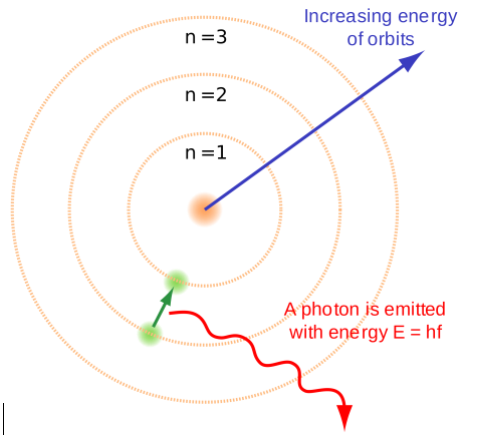
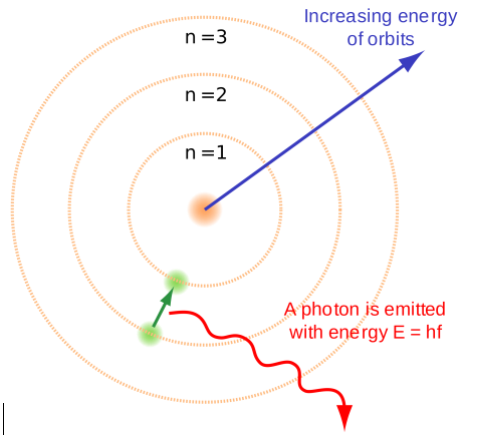
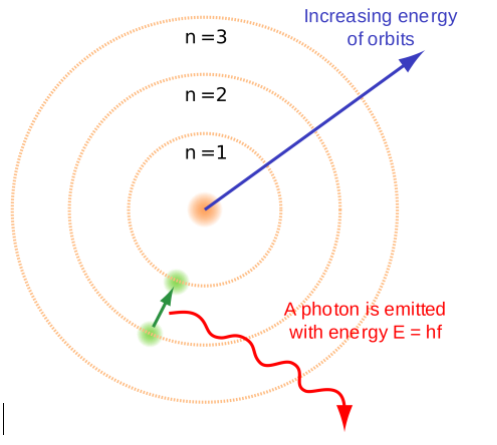
In 1913, Niels Bohr proposed a model of the atom that introduced the concept of energy levels or shells around the nucleus. His model was an improvement over Rutherford’s atomic model and explained the stability of electrons in an atom.
Key Points of Bohr’s Model:
• Electrons revolve around the nucleus in fixed circular paths called orbits or shells (energy levels).
• Each orbit has a fixed energy. Hence, they are called energy levels.
• Energy levels are represented as K, L, M, N or n = 1, 2, 3, 4…
• Electrons do not radiate energy while moving in their orbits.
• Electrons can jump from one orbit to another by absorbing or releasing energy (called quantum of energy).
Properties of Electrons, Protons, and Neutrons
|
Particle |
Symbol |
Charge |
Relative Mass |
Location in Atom |
|
Electron |
e- |
-1 |
1/1836 (approx. negligible) |
Outside nucleus (in shells) |
|
Proton |
p+ |
+1 |
1 |
Inside nucleus |
|
Neutron |
n0 |
0 (neutral) |
1 |
Inside nucleus |
Bohr’s Model of an Atom
Bohr came up with the following postulates to overcome the objections raised against Rutherford’s model.
- Electrons revolve around the nucleus in stable orbits without the emission of radiant energy. Each orbit has a definite energy and is called an energy shell or energy level.
- An orbit or energy level is designated as K, L, M, and N shells. When the electron is in the lowest energy level, it is said to be in the ground state.
- An electron emits or absorbs energy when it jumps from one orbit or energy level to another.
- When it jumps from a higher energy level to a lower energy level, it emits energy, while it absorbs energy when it jumps from a lower energy level to a higher energy level.
<a title="MikeRun, CC BY-SA 4.0 <https://creativecommons.org/licenses/by-sa/4.0>, via Wikimedia Commons" href="https://commons.wikimedia.org/wiki/File:Bohr-atom-shells-KLM.svg"><img width="128" alt="Bohr-atom-shells-KLM" src="https://upload.wikimedia.org/wikipedia/commons/thumb/6/6e/Bohr-atom-shells-KLM.svg/128px-Bohr-atom-shells-KLM.svg.png?20201024152145"></a>
Orbits
Orbits are energy shells surrounding the nucleus in which electrons revolve.
Electron Distribution in Different Orbits
The distribution was suggested by Bohr and Bury.
- The maximum number of electrons present in a shell is given by the formula 2n2, where ‘n’ is the orbit number or energy level index, 1,2,3,….
- The maximum number of electrons in different shells are as follows: the first orbit will have 2*12=2, the second orbit will have 2*2Msup>2=8, the third orbit will have 2*32=18, the fourth orbit 2*42=32 and so on.
- The shells are always filled in a step-wise manner from the lower to higher energy levels. Electrons are not filled in the next shell unless previous shells are filled.
Valency
- The electrons present in the outermost shell of an atom are known as the valence electrons.
- The combining capacity of the atoms or their tendency to react and form molecules with atoms of the same or different elements is known as the valency of the atom.
- Atoms of elements, having a completely filled outermost shell, show little chemical activity.
- Their combining capacity or valency is zero.
- For example, we know that the number of electrons in the outermost shell of hydrogen is 1, and in magnesium, it is 2.
- Therefore, the valency of hydrogen is 1 as it can easily lose 1 electron and become stable.
- On the other hand, that of magnesium is 2 as it can lose 2 electrons easily and also attain stability.
Atomic Number
The number of protons found in the nucleus of an atom is termed the atomic number. It is denoted by the letter ‘Z’.
Mass Number and Representation of an Atom
Protons and neutrons are present in the nucleus, so the mass number is the total of these protons and neutrons.
Isotopes and Isobars
Isotopes are defined as the atoms of the same element, having the same atomic number ( number of protons ) but different mass numbers ( number of protons+neutrons ).
For example: In the case of Hydrogen we have:
Atoms of different elements with different atomic numbers, which have the same mass number, are known as isobars.
For example, Calcium and Argon: both have the same mass number – 40
20Ca40 and 18Ar40
Calculation of Mass Number for Isotopic Elements
When an element has an isotope, the mass number can be calculated by the different proportions it exists in.
For example, take 98% Carbon-12u and 2% Carbon-13u
(12X98/100)+(13x2/100)=12.02u
This does not mean that any Carbon atoms exist with a mass number of 12.02u. If you take a certain amount of Carbon, it will contain both isotopes of Carbon, and the average mass is 12.02 u.
Neutron
In 1932, J. Chadwick discovered a subatomic particle with no charge and a mass nearly equal to a proton called the neutron. Neutrons, represented by 'n', are found in the nucleus of all atoms except hydrogen. The atomic mass is determined by the sum of the masses of protons and neutrons in the nucleus..
Valency
Valency is determined by the number of electrons in an atom's outermost shell and their need to complete or achieve a stable electron configuration.According to the Bohr-Bury scheme, this shell can hold up to 8 electrons. Atoms with fully-filled outer shells (like helium with 2 electrons or other inert gases with 8) are chemically inactive and have zero valency. Atoms strive to complete their outer shell (octet) by gaining, losing, or sharing electrons. For example:
- Hydrogen, lithium, and sodium have one outer electron and a valency 1.
- Magnesium has two outer electrons and a valency of 2.
- Aluminum has three outer electrons and a valency of 3.
Atoms close to completing their octet, like fluorine with seven outer electrons, gain 1 electron (valency of 1), while oxygen, with six outer electrons, gains 2 electrons (valency of 2). Valency reflects an atom's combining capacity to achieve a filled outer shell(8 electrons)
Atomic Number and Mass Number
The atomic number (Z) is the number of protons in an atom's nucleus and defines the element. For instance, hydrogen has Z = 1, and carbon has Z = 6. The mass number is the sum of protons and neutrons in an atom's nucleus. For example, carbon has a mass 12 (6 protons + 6 neutrons), and aluminium has 27 (13 protons + 14 neutrons).
Notation
The atomic number (Z), mass number, and symbol of an element are written in the following format:
Isotopes and Isobars
Isotopes
Some elements have atoms with the same atomic number but different mass numbers, known as isotopes. They are chemically similar but differ in physical properties. For example, hydrogen has three isotopes:
If an element has isotopic forms, we calculate its average atomic mass by considering the percentage of each isotope. For chlorine, which consists of 75% 35Cl and 25% 37Cl, the average atomic mass is calculated as:
= (75 / 100) × 35u) +(25 / 100 × 37u )
= 35.5 u
This does not mean a single chlorine atom has a mass of 35.5 u, but that a sample of chlorine contains both isotopes and the weighted average mass is 35.5 u.
Isobars
Atoms of different elements with distinct atomic numbers but the same mass number are called isobars. For example, calcium (atomic number 20) and argon (atomic number 18) have different electrons, yet both have a mass 40. This means the number of nucleons (protons and neutrons) is the same in both atoms.
Text book Exercises-1
1. What are the canal rays?
Answer: The radiations that are positively charged are canal rays. This discovery was crucial in the discovery of another subatomic particle that was positively charged – the proton.
2. If an atom contains one electron and one proton, will it carry any charge or not?
Answer: Since a proton is a positively charged particle and an electron is a negatively charged particle, the net charge becomes neutral as both particles neutralise each other.
Exercise-2
1. On the basis of Thompson’s model of an atom, explain how the atom is neutral as a whole.
Answer: As per Thompson’s model of an atom,
(i) An atom contains a positively charged sphere in which the negatively charged electrons are implanted.
(ii) Electrons and protons are equal in magnitude; hence, an atom, on the whole, is electrically neutral.
2. On the basis of Rutherford’s model of an atom, which subatomic particle is present in the nucleus of an atom?
Answer: As per Rutherford’s model of an atom, the positively charged protons are the ones that are present in the atom.
3. Draw a sketch of Bohr’s model of an atom with three shells.
Answer:
4. What do you think would be the observation if the ∝– particle scattering experiment is carried out using a foil of a metal other than gold?
Answer: In the ∝ – particle scattering experiment, when any other metal foil is used instead of gold, the observation would remain the same. This is because the structure of an atom, when considered individually, remains the same.
Exercise-3
1. Name the three subatomic particles of an atom.
Answer: An atom consists of three subatomic particles:
- Protons – Positively charged
- Electrons – Negatively charged
- Neutrons – Neutral in nature (no charge)
2. Helium atom has an atomic mass of 4 u and two protons in its nucleus. How many neutrons does it have?
Answer: Given: Atomic mass of helium atom = 4u, 2 protons in helium nucleus.
- Since Atomic mass = number of protons + number of neutrons, this gives
- 4 = 2 + number of neutrons
- Number of neutrons = 4 – 2 = 2
- Hence, Helium has 2 neutrons.
Exercise-4
1. Write the distribution of electrons in Carbon and Sodium atoms.
Answer:
1. Carbon (C)
- Atomic number = 6 → It has 6 electrons.
- Electrons are distributed in energy levels (shells) following the 2, 8, 18… rule.
Electron distribution of Carbon:
1st shell: 2 electrons, 2nd shell: 4 electrons\text{1st shell: 2 electrons, 2nd shell: 4 electrons}1st shell: 2 electrons, 2nd shell: 4 electrons
So, C → 2, 4
✅ Carbon has 2 electrons in the K-shell and 4 electrons in the L-shell.
2. Sodium (Na)
- Atomic number = 11 → It has 11 electrons.
- Electron distribution in shells:
1st shell: 2 electrons, 2nd shell: 8 electrons, 3rd shell: 1 electron\text{1st shell: 2 electrons, 2nd shell: 8 electrons, 3rd shell: 1 electron}1st shell: 2 electrons, 2nd shell: 8 electrons, 3rd shell: 1 electron
So, Na → 2, 8, 1
✅ Sodium has 1 electron in its outermost shell, which makes it highly reactive.
2. If the K and L shells of an atom are full, then what would be the total number of electrons in the atom?
Solution:
K shell can hold 2 electrons.
L shell can hold 8 electrons.
Hence, when both the shells are full, the total number of electrons present in the atom = 2+8 = 10 electrons.
Exercise-4
1. How will you find the valency of chlorine, sulphur and magnesium?
Answer: We know that an element’s valency refers to its proclivity for accepting or losing electrons in order to complete its octet and achieve a stable electronic state.It is the smallest number of electrons that must be added or removed to entirely occupy an element’s outermost shell.Mathematically, if an atom’s outermost shell contains 4 or fewer electrons, the element’s valency is equal to the number of electrons present in the outermost shell; if it contains more than 4, the valency is determined by subtracting the total number of electrons present in the outermost shell from 8.
Calculation of valency of chlorine:
- The electronic configuration of chlorine = 2, 8, 7
- Chlorine has 7 (more than 4) electrons in its outermost shell.
- Therefore, the valency of chlorine = 8 – the number of electrons in the outermost shell
- = 8−7
- = 1
Valency of Sulphur:
- The electronic configuration of Sulphur = 2, 8,6
- Sulphur has 6 (more than 4) electrons in its outermost shell.
- Therefore, the valency of chlorine = 8 – the number of electrons in the outermost shell
- = 8−6
- = 2
Valency of magnesium:
- The electronic configuration of Magnesium = 2, 8, 2
- Magnesium has 2 (less than 4) electrons in its outermost shell.
- Therefore, the valency of magnesium= Number of electrons in its outermost shell
- = 2
Exercise-5
1. If the number of electrons in an atom is 8 and the number of protons is also 8, then
(i) What is the atomic number of the atom? and
(ii) What is the charge on the atom?
Answer: Given: Number of electrons = 8 & Number of protons = 8
(i) The atomic number of an atom is the same as the number of protons in that atom; hence, its atomic number is 8.
(ii) In an atom, the number of protons is equal to the number of electrons. Hence, both the charges – positive and negative – neutralise each other. Therefore, the atom does not possess any charge.
2. With the help of the given table, find out the mass number of oxygen and sulphur atom.
Table: Composition of Atoms of the First Eighteen Elements with Electron Distribution in Various Shells.
| Name of Element | Symbol | Atomic number | Number of Protons | Number of Neutrons | Number of electrons | Distribution of electrons
K L M N |
Valency | |||
| Hydrogen
Helium Lithium Beryllium Boron Carbon Nitrogen Oxygen Fluorine Neon Sodium Magnesium |
H
He Li Be B C N O F Ne Na Mg |
1
2 3 4 5 6 7 8 9 10 11 12 |
1
2 3 4 5 6 7 8 9 10 11 12 |
–
2 4 5 6 6 7 8 10 10 12 12 |
1
2 3 4 5 6 7 8 9 10 11 12 |
1
2 2 2 2 2 2 2 2 2 2 2 |
–
– 1 2 3 4 5 6 7 8 8 8 |
–
– – – – – – – – – 1 2 |
–
– – – – – – – – — – – |
1
0 1 2 3 4 3 2 1 0 1 2 |
| Aluminium
Silicon Phosphorus Sulphur Chlorine Argon |
Al
Si P S Cl Ar |
13
14 15 16 17 18 |
13
14 15 16 17 18 |
14
14 16 16 18 22 |
13
14 15 16 17 18 |
2
2 2 2 2 2 |
8
8 8 8 8 8 |
3
4 5 6 7 8 |
–
– – – – |
3
4 3,5 2 1 0 |
Answer:
(a) To find the mass number of Oxygen,
- Number of protons = 8
- Number of neutrons = 8
- Atomic number = 8
- Atomic mass number = Number of protons + number of neutrons = 8 + 8 = 16
- Therefore, the mass number of oxygen = 16
(b) To find the mass number of Sulphur,
- Number of protons = 16
- Number of neutrons = 16
- Atomic number = 16
- Atomic mass number = Number of protons + number of neutrons = 16 + 16 = 32
Exercise-6
1. For the symbols H, D and T, tabulate three subatomic particles found in each of them.
Answer: The following table depicts the subatomic particles in Hydrogen (H), Deuterium (D), and Tritium(T).
| Isotope | Symbol | Mass no. | Atomic no. | No. of electrons | No. of protons | No. of neutrons |
| Hydrogen | H | 1 | 1 | 1 | 1 | 0 |
| Deuterium | D | 2 | 1 | 1 | 1 | 1 |
| Tritium | T | 3 | 1 | 1 | 1 | 2 |
2. Write the electronic configuration of any one pair of isotopes and isobar.
Answer: (a) Isotopes: Isotopes are atoms which have the same number of protons, but the number of neutrons differs. This leads to the variation in mass number too.
Example: Carbon molecule exists as 6C12 and 6C14, but when their electronic configuration is noticed, both have K-2; L-4
(b) Isobars: Isobars are atoms which have the same mass number but differ in atomic number. The electronic configuration of an isobar pair is as follows:
Example: Electronic configuration of 20Ca40 – K-2; L-8; M-8; N- 2
Electronic configuration of 18Ar40 – K-2; L-8; M-8
Exercise Page: 54
1. Compare the properties of electrons, protons and neutrons.
Answer:
| Property | Electrons | Protons | Neutrons |
| Charge | Negatively charged | Positively charged | No charge. |
| Location | Located outside the nucleus | Located within the nucleus | Located inside the nucleus of an atom |
| Weight | Mass is negligible | 1 a.m.u | 1 a.m.u |
| Affinity | Attracted towards positively charged | Attracted towards negatively charged | Do not get attracted to any charged particle |
2. What are the limitations of J.J.Thomson’s model of the atom?
Answer: The following are the limitations of J.J. Thomson’s model of an atom:
- The model failed to explain the outcome of alpha particle scattering, which was conducted by Rutherford. The model failed to depict why the majority of these alpha particles pass through the gold foil, while some diverted through small and big angles, while some others rebound completely, returning on their path.
- It did not provide any experimental evidence and was established on imagination.
3. What are the limitations of Rutherford’s model of the atom?
Answer:The following are the limitations of Rutherford’s model of the atom:
- There is no expected stability in the revolution of the electron in a circular orbit.
- Charged particles radiate energy when accelerated, thus causing the revolving electrons to lose energy and would fall into the nucleus.
- Hence, atoms must be highly unstable. The matter would not exist in its known form, which clearly is an assumption as atoms are highly stable.
4. Describe Bohr’s model of the atom.
Answer:
- An atom holds the nucleus at the centre.
- Negatively charged electrons revolve around the nucleus.
- The atoms in it contain distinct orbits of electrons.
- Electrons do not radiate energy when they are in their orbits.
- The distinct orbits are named K, L, M, and N orbits. Numbers used to denote them are n=1, 2, 3, 4
5. Compare all the proposed models of an atom given in this chapter.
Answer:
| Thomson | Rutherford | Bohr |
| ● Sphere is positively charged.
● Electrons are negatively charged and scattered all through the inside of the sphere. ● Positively charged = negatively charged ● The net charge in the atom is zero. |
● The nucleus is at the centre and is positively charged, holding the entire mass.
● Electrons are negatively charged, revolving in a well-defined path ● In comparison with the nucleus, the size of the atom is very large. ● Force of attraction of the electrons towards the nucleus is balanced by centrifugal force acting away from it. As a result, electrons are not drawn close to the nucleus. |
● Nucleus is present at the centre and is positively charged
● Electrons are negatively charged, revolving around but do not radiate energy. ● The distinct orbits are labelled as K, L, M, and N |
6. Thomson’s Model of Atom.
7. Rutherford’s Model of Atoms.
8. Bohr’s model of the atom.
Summarise the rules for the writing of the distribution of electrons in various shells for the first eighteen elements.
Answer:
- The maximum number of electrons that can be accommodated in a shell is given by the formula: 2n2, where n= 1, 2, 3…
- The maximum number of electrons in different shells are:
K shell – n=1 ; 2n2 = 2(1)2 = 2
L shell – n=2 ; 2n2 = 2(2)2 = 8
M shell – n=3 ; 2n2 = 2(3)2 = 18
N shell- n=4 ; 2n2 = 2(4)2 = 32
- The outermost orbit can be accommodated with 8 electrons at the maximum.
- The electrons are not taken in unless the inner shells are filled, which are filled step-wise; hence, the highest element has K-2; L-8; M-8 distribution of electrons.
9. Define valency by taking examples of silicon and oxygen.
Answer:
The definite combining capacity of the atoms of each element, wherein electrons are lost, gained or shared to make the octet of electrons present in the outermost shell, is defined as valency. To measure valency, we can figure out the number of electrons that are required to complete the shell in which it is contained or losing excess electrons, if present, once the filling is complete.
Example: To find the valency of silicon,
- The atomic number of silicon is 14.
- The number of electrons is equal to the number of protons in silicon, i.e., 14.
- The distribution of electrons in silicon atoms is K – 2, L – 8, M – 4
- Hence, from the distribution of silicon, it is clearly evident that to fill the M shell, 4 electrons are required. Therefore, its valency is 8-4=4
- To find the valency of oxygen,
- The atomic number of oxygen is 8.
- The number of electrons is equal to the number of protons in oxygen, i.e., 8.
- The distribution of electrons in oxygen atom is K – 2, L – 6
- Hence, from the distribution of oxygen, it is clearly evident that to fill the M shell, 6 more electrons are required. Therefore, its valency is 8-6=2
10. Explain with examples
(i) Atomic number,
(ii) Mass number,
(iii) Isotopes and
(iv) Isobars.
Give any two uses of isotopes.
Solution:
(i) The number of positively charged protons present in the nucleus of an atom is defined as the atomic number and is denoted by Z. Example: Hydrogen has one proton in its nucleus; hence, its atomic number is one.
(ii) The total number of protons and neutrons present in the nucleus of an atom is known as the mass number. It is denoted by A. 20Ca40 . The mass number is 40. The atomic number is 20.
(iii) The atoms which have the same number of protons but a different number of neutrons are referred to as isotopes. Hence, the mass number varies.
Example: The most simple example is the Carbon molecule which exists as 6C12 and 6C14
(iv) Isobars: Isobars are atoms which have the same mass number but differ in atomic number.
Examples are, 20Ca40and 18Ar40
Uses of isotopes
- The isotope of the Iodine atom is used to treat goitre, an iodine-deficient disease.
- In the treatment of cancer, an isotope of cobalt is used.
- Fuel for nuclear reactors is derived from the isotopes of the Uranium atom.
11. Na+ has completely filled K and L shells. Explain.
Answer:The atomic number of sodium is 11. It has 11 electrons in its orbitals, wherein the number of protons is equal to the number of electrons. Hence, its electronic configuration is K-2 ; L-8 ; M-1 ; The one electron in the M shell is lost, and it obtains a positive charge since it has one more proton than electrons and obtains a positive charge, Na+ . The new electronic configuration is K-1; L-8, which is the filled state. Hence, it is very difficult to eliminate the electron from a filled state as it is very stable.
12. If the bromine atom is available in the form of, say, two isotopes 35Br79 (49.7%) and 35Br81 (50.3%), calculate the average atomic mass of the Bromine atom.
Answer:
- The atomic mass of an element is the mass of one atom of that element. Average atomic mass takes into account the isotopic abundance.Isotope of bromine with atomic mass 79 u = 49.7%.Therefore, Contribution of 35Br79 to atomic mass = (79 × 49.7)/100 ⇒ 39.26 u
- Isotope of bromine with atomic mass 81 u = 50.3%, hence the contribution of 35Br81 to the atomic mass of bromine = (81 × 50.3)/100 ⇒ 40.64u
- Hence, the average atomic mass of the bromine atom = 39.26 + 40.64 u = 79.9u
13. The average atomic mass of a sample of element X is 16.2 u. What are the percentages of isotopes 8X16 and 8X18 in the sample?
Answer:
Let the percentage of 8X16 be ‘a’ and that of 8X18 be ‘100-a’.
- As per the given data,
- 16.2u = 16 a / 100 + 18 (100-a) /100
- 1620 = 16a + 1800 – 18a
- 1620 = 1800 – 2a
- a = 90%
- Hence, the percentage of the isotope in the sample 8X16 is 90% and that of
- 8X18 = 100-a = 100- 90=10%
14. If Z=3, what would be the valency of the element? Also, name the element.
Answer:
- Given: Atomic number, Z = 3
- The electronic configuration of the element = K-2; L-1, hence its valency = 1
- The element with atomic number 3 is Lithium.
15. Composition of the nuclei of two atomic species, X and Y, are given as under
X Y
Protons = 6 6
Neutrons = 6 8
Give the mass numbers of X and Y. What is the relation between the two species?
Answer:
- Mass number of X: Protons + neutrons = 6+6 = 12
- Mass number of Y: Protons + neutrons = 6+8 = 14
- They are the same element, and their atomic numbers are the same.
- They are isotopes, as they differ in the number of neutrons and hence their mass numbers.
16. For the following statements, write T for true and F for false.
(a) J.J. Thomson proposed that the nucleus of an atom contains only nucleons.
(b) A neutron is formed by an electron and a proton combining together. Therefore, it is neutral.
(c) The mass of an electron is about 1/2000 times that of a proton.
(d) An isotope of iodine is used for making tincture iodine, which is used as a medicine.
Answer:
(a) The statement is False.
(b) The statement is False.
(c) The statement is True.
(d) The statement is False.
17. Put a tick(✓) against the correct choice and cross(x) against the wrong choice in questions 15, 16 and 17.
Rutherford’s alpha–particle scattering experiment was responsible for the discovery of
(a) Atomic nucleus
(b) Electron
(c) Proton
(d) Neutron
Answer: (a) Atomic nucleus
Isotopes of an element have
(a) The same physical properties
(b) Different chemical properties
(c) Different number of neutrons
(d) Different atomic numbers
Answer: (c) Different number of neutrons
18. Number of valence electrons in Cl– ion are
(a) 16
(b) 8
(c) 17
(d) 18
Answer:(b) 8
The electronic distribution of Cl is K-2, L-8, M-7. Valence electrons are 7; hence, chlorine gains one electron for the formation of Cl–. Therefore, its valency is 8.
19. Which one of the following is a correct electronic configuration of Sodium?
(a) 2, 8
(b) 8, 2, 1
(c) 2, 1, 8
(d) 2, 8, 1
Answer:(d) 2, 8, 1
Complete the following table.
| Atomic Number | Mass Number | Number of Neutrons | Number of Protons | Number of Electrons | Name of the Atomic Species |
| 9
16 – – – |
–
32 24 2 1 |
10
– – – 0 |
–
– 12 1 1 |
–
– – – 0 |
–
Sulphur – – – |
Answer:
The following table depicts the missing data:
Atomic number(Z) = Number of protons
Mass number = Number of neutrons + atomic number
(or)
Mass number(A) = Number of neutrons + number of neutrons
| Atomic Number | Mass Number | Number of Neutrons | Number of Protons | Number of Electrons | Name of the Atomic Species |
| 9
16 12 1 1 |
19
32 24 2 1 |
10
16 12 1 0 |
9
16 12 1 1 |
9
16 12 1 0 |
Fluorine
Sulphur Magnesium Deuterium Hydrogen |