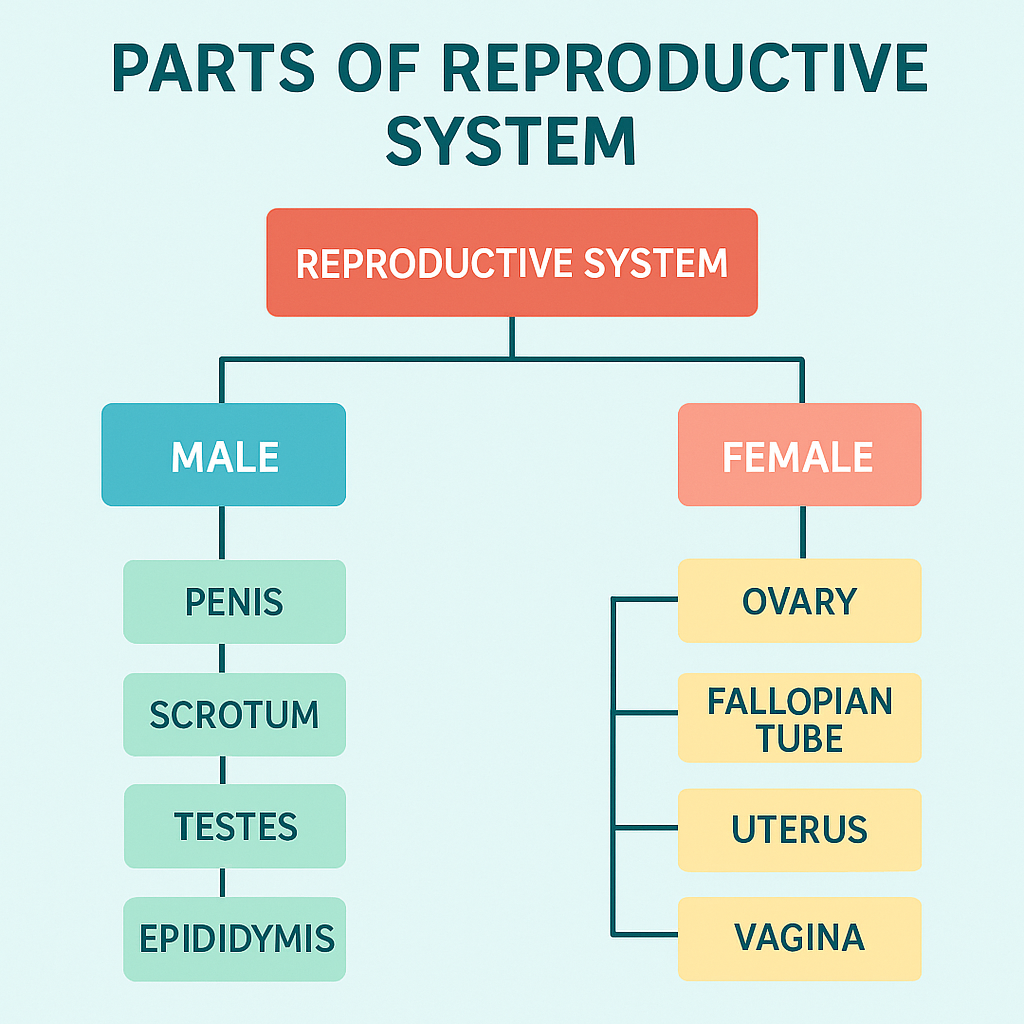
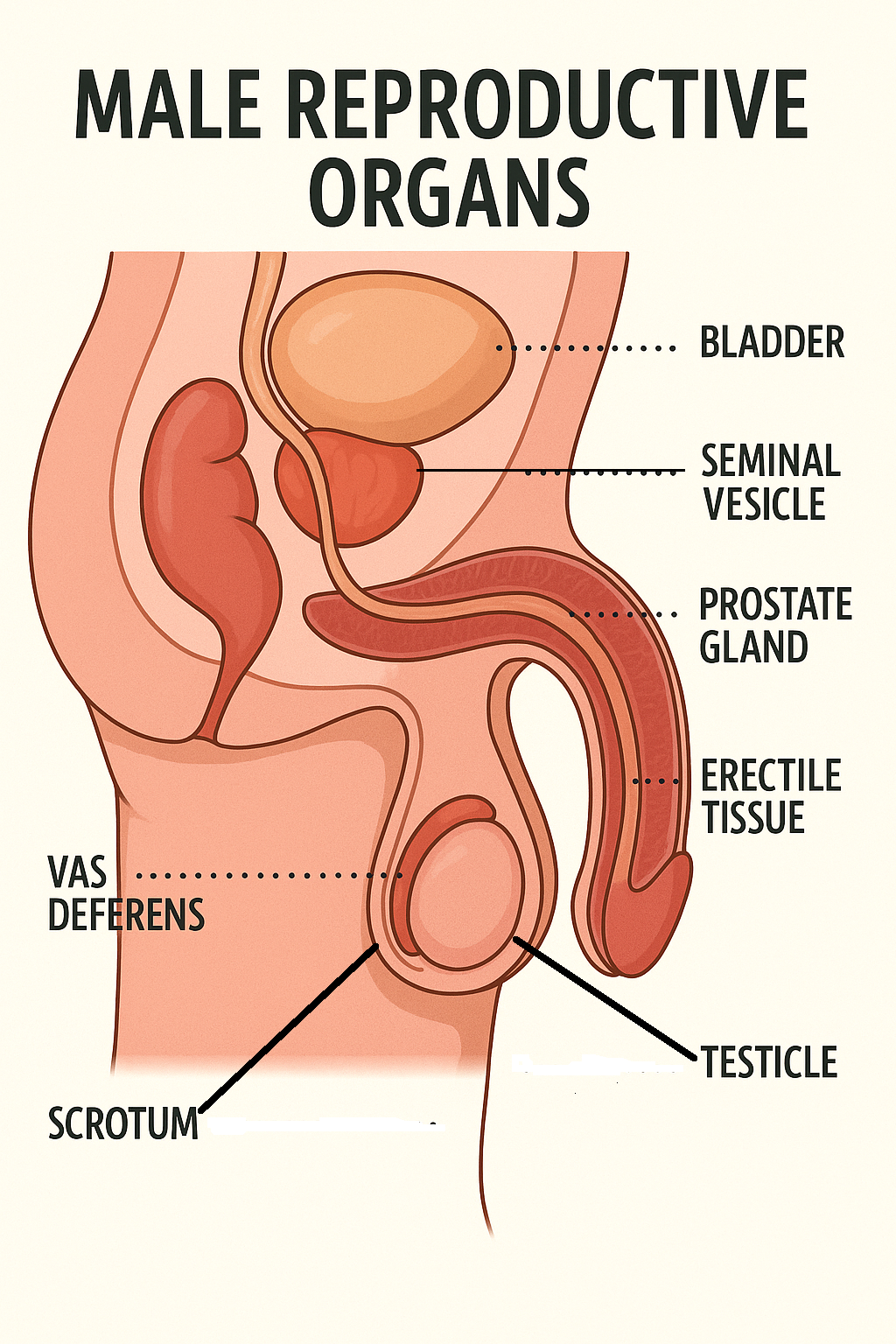
1. Penis
The penis is the male external sexual organ, primarily responsible for delivering sperm into the female reproductive system during sexual intercourse.
2. Scrotum
The scrotum is a pouch of skin and muscle thatprotects s the male testes, which are responsible for producing sperm and the hormone testosterone.
3. Testes
The testes are two oval-shaped organs located within the scrotum, responsible for producing sperm and the hormone testosterone. They are vital components of the male reproductive system. The testes contain tightly coiled structures called seminiferous tubules, where sperm production (spermatogenesis) occurs. Once produced, the sperm move to the epididymis, where they mature and are stored.
4. Vas Deferens
It is part of the male reproductive system and plays a crucial role in sperm transport. The vas deferens is essential for the delivery of sperm to the urethra, where it is then expelled from the body through the penis.
5. Seminal Vesicles
The seminal vesicles are two small, sac-like glands located behind the bladder in males, which play a key role in the production of semen. They secrete a significant portion of the seminal fluid, which combines with sperm from the testes to form semen.
Sperms
Sperms are the male reproductive cells in humans, responsible for fertilizing the female egg (ovum) during reproduction. Each sperm carries half the genetic material (23 chromosomes) needed to form a baby.
| Feature | Description |
|---|---|
| Produced in | Testes (inside scrotum) |
| Stored in | Epididymis (where they mature) |
| Released through | Penis during ejaculation |
| Number per ejaculation | 200 to 500 million |
| Size | Microscopic |
| Mobility | Motile (can swim toward the egg) |
Structure of a Sperm
- Head: Contains the nucleus with 23 chromosomes. It is covered by an acrosome which has enzymes that help the sperm penetrate the egg.
- Midpiece: Contains many mitochondria that provide energy for movement.
- Tail (Flagellum): Helps the sperm swim actively toward the egg.
Sperm Production Process (Spermatogenesis)
| Step | Description |
|---|---|
| 1. Begins at puberty | Around age 12 to 14 years |
| 2. Happens in seminiferous tubules | Located inside the testes |
| 3. Controlled by hormones | Mainly testosterone |
| 4. Continuous process | Sperms are produced daily throughout life |
Fertilization in Humans
Fertilization in humans is the process where a male sperm cell fuses with a female egg cell (ovum) to form a single cell called a zygote, which eventually develops into a baby.

Steps of Fertilization in Humans:
-
Ovulation:
-
An ovary releases a mature egg during the middle of the menstrual cycle.
-
-
Sperm Transport:
-
During sexual intercourse, millions of sperm are released into the female reproductive tract.
-
-
Fertilization Site:
-
Fertilization usually occurs in the fallopian tube (also called the oviduct).
-
-
Sperm Meets Egg:
-
Out of millions, only one sperm successfully penetrates the outer layer of the egg.
-
-
Formation of Zygote:
-
The nuclei of the sperm and egg fuse to form a zygote with a full set of chromosomes (46 in total: 23 from each parent).
-
Role of hormones in male reproductive system
The production of sperm is controlled by several hormones:
- Testosterone: Stimulates sperm production and the development of male sexual characteristics.
- Luteinizing Hormone (LH): Stimulates testosterone production.
- Follicle-Stimulating Hormone (FSH): Works with testosterone to promote spermatogenesis.
Female Reproductive System
- Ovaries: The ovaries are two almond-shaped organs responsible for producing eggs (ova) and the hormones estrogen and progesterone. They are located on either side of the uterus.
- Fallopian Tubes: These tubes transport the eggs from the ovaries to the uterus. Fertilization of the egg by the sperm usually occurs here.
- Uterus: The uterus is a hollow, muscular organ where the fertilized egg implants and develops into a fetus during pregnancy. It has three parts: the fundus (top), the body (main part), and the cervix (lower part).
- Cervix: The cervix is the lower, narrow part of the uterus that connects to the vagina. It plays an important role during childbirth by dilating to allow the passage of the baby.
- Vagina: The vagina is a muscular canal that connects the uterus to the outside of the body. It serves as the passage for menstrual blood, sperm during intercourse, and the baby during childbirth.
Menstrual Cycle
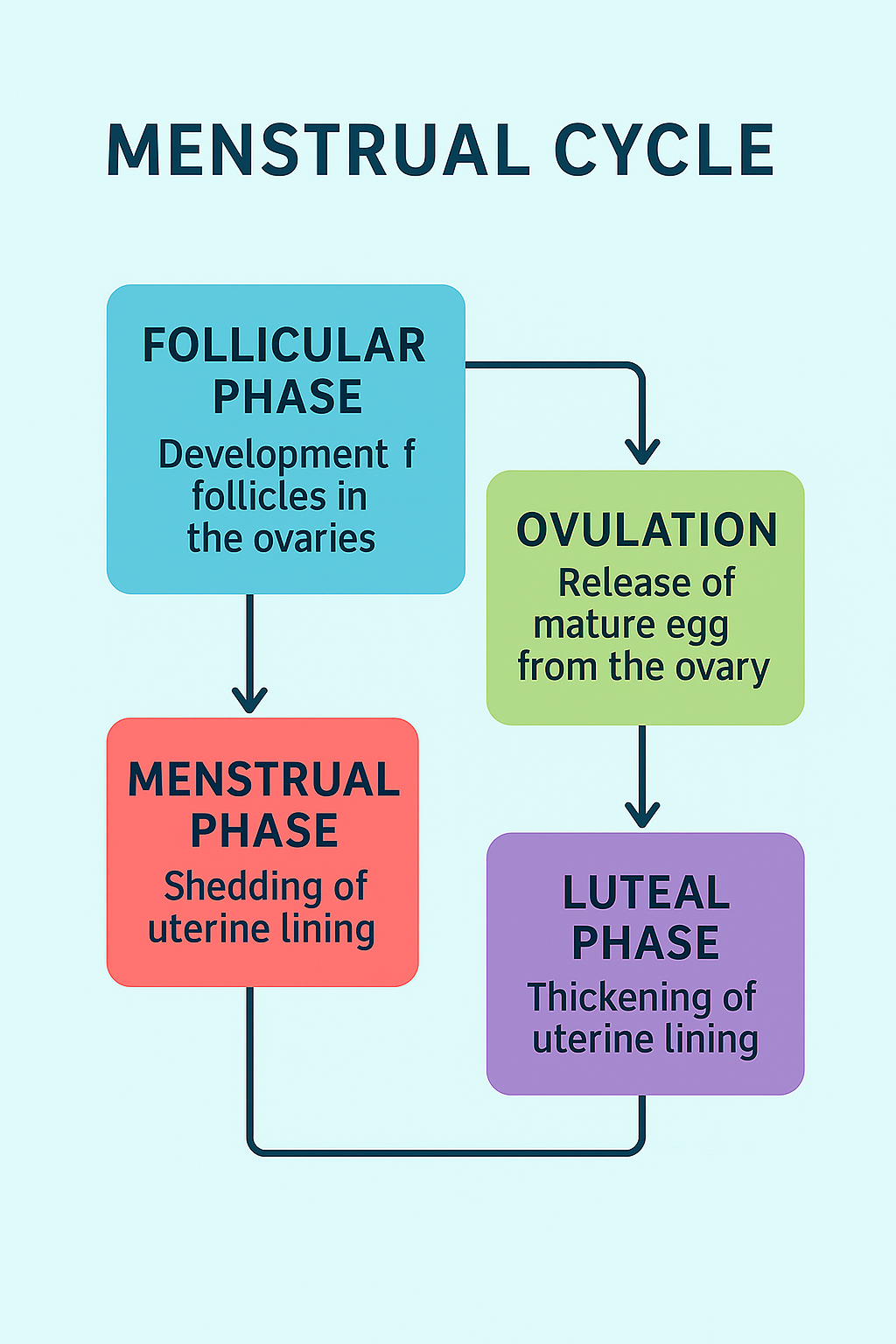
The first menstrual cycle is called menarche and the last on eis called menopause. Menarche usually occurs in girls of age 12-17 years while menopause occurs between 45-50 years. The menstrual cycle is a natural process that occurs in the female reproductive system, typically lasting around 28 days. It is regulated by hormones and prepares the body for potential pregnancy. The cycle involves the shedding of the uterine lining (menstruation) and the maturation of an egg for fertilization. It consists of four main phases: the menstrual phase, the follicular phase, ovulation, and the luteal phase.
Hormonal Regulation of the Menstrual Cycle
The menstrual cycle is regulated by a complex interaction of hormones produced by the hypothalamus, pituitary gland, and ovaries. The main hormones involved in the cycle include:
- Estrogen: Produced by the ovaries, estrogen helps in the development of the eggs and the thickening of the endometrial lining.
- Progesterone: Secreted by the corpus luteum, progesterone helps maintain the uterine lining and prepares it for the potential implantation of a fertilized egg.
- Follicle-Stimulating Hormone (FSH): Produced by the pituitary gland, FSH stimulates the maturation of follicles in the ovaries.
- Luteinizing Hormone (LH): Also produced by the pituitary gland, LH triggers ovulation (release of the egg from the follicle).
- Human Chorionic Gonadotropin (hCG): If pregnancy occurs, hCG is released by the fertilized egg and embryo, signaling the body to maintain the corpus luteum and prevent menstruation.
Development of embryo

sEmbryonic development is the complex process by which a fertilized egg (zygote) transforms into a fully formed embryo. Following implantation in the uterine wall, the blastocyst undergoes rapid cell division and differentiation, forming three primary germ layers called ectoderm, mesoderm, and endoderm which give rise to all the tissues and organs of the body. This stage includes critical events such as the formation of the neural tube (which becomes the brain and spinal cord), the development of the heart and circulatory system, and the early formation of limbs and sensory organs. By the end of the embryonic period, which lasts about eight weeks in humans, all major organ systems have begun to develop. The embryo is especially vulnerable during this stage, and proper nutrition and a healthy maternal environment are essential for normal growth. Embryonic development lays the foundation for the fetal stage and ultimately determines the structure and function of the body.
Types of Fertilization
Fertilization is the process of the male and female gametes (sperm and egg) fusing to form a zygote. Based on where this process occurs, fertilization is of two types:
1. Internal Fertilization
Internal Fertilization takes place inside the female body. The male deposits sperms inside the female's body. The sperm meets the egg and fertilization occurs internally. Animals that reproduces internally are called oviparous animals. Examples: Humans, Dog, cats etc. In this type of fertilization, Fewer eggs are produced and there is a good chance of survival of the young ones. The growing fetus is more protected.
2. External Fertilization
Fertilization takes place outside the female body, usually in water hence these animals are called viviparous animal.Both male and female release gametes into the environment (usually water), where fertilization occurs externally.Frogs,Fi and Amphibians reproduce by this method. In an external reproduction, large number of eggs are released because there is a very less chance of zygote survival.
Lifecycle of a Frog
- Egg: Jelly-like clusters laid in water.
- Tadpole: Fish-like larva with gills and a tail.
- Tadpole with Legs: Legs develop, tail shrinks, lungs form.
- Adult Frog: Fully developed, can live on land and reproduce.
TEXT BOOK QUESTION ANSWERS
Question 1. Explain the importance of reproduction in organisms.
Answer: Reproduction is a vital phenomenon on this planet earth which is essential for existence and continuity of life and species on it, generation after generation.
Question 2. Describe the process of fertilisation in human beings.
Answer: In the process of fertilisation, sperms come in contact with an ova (egg). One of the sperms may fuse with the egg. The nuclei of the sperm and the egg fuse to form a single nucleus resulting in the formation of a fertilised egg called zygote. In human being, the fertilisation takes place inside the female body,known as internal fertilisation.
Question 3. Choose the most appropriate answer.
(a) Internal fertilisation occurs
(i) in female body.
(ii) outside female body.
(iii) in male body.
(iv) outside male body.
(b) A tadpole develops into an adult frog by the process of:
(i) fertilisation
(ii) metamorphosis
(iii) embedding
(iv) budding
(c) The number of nuclei present in a zygote is:
(i) none
(ii) one
(iii) two
(iv) four
Answer: (a) (i) (b) (ii) (c) (ii)
Question 4. Indicate whether the following statements are True (T) or False (F).
- Oviparous animals give birth to young ones.
- Each sperm is a single cell.
- External fertilisation takes place in frog.
- A new human individual develops from a cell called gamete
- Egg laid after fertilisation is made up of a single cell.
- Amoeba reproduces by budding.
- Binary fission is a method of asexual reproduction.
- A zygote is formed as a result of fertilisation.
- An embryo is made up of a single cell.
Answer:
- False 2. True 3. True 4. False 5. True 6. False
- False 8. True 9. True 10. False
Question 5. Give two differences between a zygote and a foetus.
Answer:
|
Zygote |
Foetus |
|
(i) It is a single celled, i.e., it contains only one cell. |
(i) It is multicelled, i.e., it contains many cells. |
|
(ii) It is formed by the fusion of male gamete or sperm and female gamete or ova (egg). |
(ii) It is formed by the repeated division of the zygote. |
Question 6.Define asexual reproduction. Describe two methods of asexual reproduction in animals.
Answer: The mode of reproduction in which only a single parent is involved is called asexual reproduction. In this type of reproduction, sex cells (gametes) are not produced and no fusion of gametes takes place for the reproduction of zygote or offsprings. Asexual reproduction takes place in Amoeba, Hydra, yeast, starfish, sponges, etc. There are mainly two methods of asexual reproduction:
(i) Binary fission: In binary fission, a single parent cell is divided into two equal individual cells as in Amoeba. It divides into two by division of their bodies, each of them gets one nucleus and develops into separate individual. The figure given below shows how binary fission occurs in Amoeba.
(ii) Budding: In budding, the organism develops a bulge called bud which further develops into an adult organism and separates itself from the parent body to lead an independent life. This type of reproduction is shown in Hydra. The following figure shows budding in Hydra.
Question 7. In which female reproductive organ does the embryo get embedded?
Answer: Uterus
Question 8. What is metamorphosis? Give examples.
Answer:
The transformation of larva into an adult involving sudden and abrupt changes in the body of an ani¬mal during the life cycle of an invertebrate or amphibian is called metamorphosis. Example, frog and butterfly.
Question 9. Differentiate between internal fertilisation and external fertilisation.
Answer:
|
Internal Fertilisation |
External Fertilisation |
|
(i) The fusion of male gamete or sperm and female gamete or ova occurs inside the body of a female partner, such as human beings, birds, and mammal. |
(i) The fusion of male gamete and female gamete takes place outside the body of a female partner, such as in frog, fish and starfish. |
|
(ii) The female partner lays either fertilised eggs or a fully grown young one. |
(ii) The female partner discharges unfertilised eggs. |
|
(iii) Offsprings have a high chance of survival. |
(iii) Offsprings have a low chance of survival. |
Question 10. Complete the crossword puzzle using the hints given below.
Across
1. The process of the fusion of the gametes.
6. The type of fertilisation in a hen.
7. The term used for bulges observed on the sides of the body of Hydra.
8. Eggs are produced here.
Down
2. Sperms are produced in these male reproductive organs
3. Another term for the fertilised egg.
4. These animals lay eggs.
5. A type of fission in Amoeba.
Additional questions
Question 1. Choose the most appropriate answer
Internal fertilisation occurs :
- in female body
- outside female body
- in male body
- outside male body
A tadpole develops into an adult by the process of
- fertilisation
- metamorphosis
- embedding
- budding
The number of nuclei present in a zygote is :
- none
- one
- two
- four
Question 2. In which female reproductive organ does the embryo get embedded ?
Answer: Embedding of the embryo takes place in the wall of the uterus.
Question 3.Name the male reproductive organs.
Answer: The male reproductive organs are a pair of testis, sperm ducts and a penis.
Question 4. Name the organ producing the male gametes.
Answer: Testis produce the male gametes
Question 5. What are sperms ?
Answer: The male gametes produced by the testis are known as sperms.
Question 6. Give the structure of sperm.
Answer: A sperm has a head, a middle piece and a tail.
Question 7. Draw a labelled diagram of sperm.
Answer:
|
Internal Fertilisation |
External Fertilisation |
|
(a) Fertilisation that takes place inside the female body. |
(a)Fertilisation that takes place outside the female body. |
|
Sexual Reproduction |
Asexual Reproduction |
|
(a)Reproduction which takes place by the fusion of male and female gametes. |
(a)Reproduction in which only a single parent is involved. |
Question 8. Differentiate between internal fertilisation and external fertilisation.
Answer:
Question 9. Differentiate between sexual and asexual reproduction.
Answer:
Question 10. Differentiate between viviparous and oviparous animals.
Answer:
|
Viviparous Animals |
Oviparous Animals |
|
(a) The animals which give birth to young ones. |
(a)The animals which lay eggs. |
Question 11. How does the size of the egg varies in different animals ?
Answer: The egg is very small in humans, much larger in hens and the largest in ostrich.
Question 12. The different stages of the life cycle of mosquito and silkmoth are given below. Arrange themin proper sequence.
Mosquito – Pupa —–> Eggs ———> Larva ——-> Adult.
Silk moth – Larvae ——-> Zygote ——> Cocoon ——> Adult ——–> Caterpillar.
Answer:
Eggs —–> Larva ——> Pupa ——–> Adult
Zygote ——> Larvae ——> Caterpillar ——> Cocoon ——-> Adult.
Indicate whether the following statements are True (T) or False (F).
- Oviparous animals give birth to young ones( )
- Each sperm is a single cell( )
- External fertilisation takes place in frog( )
- A new human individual develops from a cell called gamete( )
- Egg laid after fertilisation is made up of a single cell( )
- Amoeba reproduces by budding
- Fertilisation is necessary even in asexual reproduction. ( )
- Binary fission is a method of asexual reproduction. ( )
- A zygote is formed as a result of fertilisation. ( )
- An embryo is made up of a single cell. ( )
Answer:
- F
- T
- T
- F
- T
- F
- F
- T
- T
- F
Additional questions
Question 1.Give the right word for :
- A hormone that helps in reproduction.
- A gland in the neck, which when swollen causes goitre.
- A hormone which helps to balance the suger in the body.
- An element without which thyroxine hormone is not formed. .
Answer:
- Gonadotropin
- Thyroid
- Insulin
- Iodine
Question 2. Distinguish between exocrine and endocrine glands.
Answer:
Distinguish between exocrine and endocrine glands :
|
Exocrine Glands |
Endocrine Glands |
|
(a) They secrete enzymes which come out through ducts. |
(a)They secrete hormones which are pushed directly into the blood. |
Question 3. Name the glands
which secrete juices
which secrete hormones.
Give one example in each case.
Answer:
Exocrine glands, e.g., liver secretes bile.
Endocrine glands, e.g., adrenal gland.
Question 4. Why should adolescents eat a balanced diet ?
Answer: A balanced diet during adolescence helps in proper development of reproductive organs and a beautiful body.
Question 5. What is “female foeticide” ?
Answer:
Killing of the female foetus in the mother’s womb is known as female foeticide.
Question 6. Which is the main change in boys at puberty ?
Answer:
The most obvious change in body is the sudden increase in height. The person looks tall because the bones of the legs and arms suddenly become long.
Question 7. What do you think is the main difference in the boys and girls of your class ?
Answer:
In girls, there is more growth in the body parts below the waist. The boys have wider chest and shoulders.
Question 8. What is the difference in the voice of boys and girls during adolescence ?
Answer:
The voice of boys becomes hoarse and deep but the voice of girls become shrill but sweet during adolescence.
Question 9. What is the difference in the reproductive activity of male and female humans ?
Answer:
In male humans the reproductive activity is from puberty to 60 or 70 years.
In female humans the reproductive activity is from puberty to 45 to 50 years.
Question 10. What do you understand by X and Y chromosomes ?
Answer:
X chromosomes stand for female characters and Y chromosomes for male characters.
Question 11.
What will be the sex of the baby developing from XX zygote ?
What will be the sex of the baby developing from XY zygote ?
Answer:
Female baby.
Male baby.
MCQs( chose the best answer)
Question 1. Multiple fission is observed in
(a) Amoeba
(b) Bacteria
(c) Hydra
(d) Plasmodium
Answer: (d)
Question 2.Yeast reproduces by
(a) sexual reproduction
(b) asexual reproduction
(c) parthenogenesis
(d) none of these.
Answer: (b)
Question 3.External fertilisation and external development takes place in
(a) hen
(b) frog
(c) elephant
(d) human beings
Answer: (b)
Question 4.Testes are found in
(a) males only
(b) females only
(c) both males and females
(d) none of these
Answer: (a)
Question 5. When the embryo can be identified with body parts, it is known as
(a) zygote
(b) foetus
(c) infant
(d) egg
Answer: (b)
Question 6.Metamorphosis can be observed in
(a) tadpole
(b) earthworm
(c) hen
(d) Hydra
Answer: (a)
Question 7. Internal fertilisation and internal development takes place in
(a) hen
(b) frogs
(c) earthworm
(d) elephants
Answer: (d)
Question 8. Ovaries are present in
(a) male’s
(b) females
(c) both males and females
(d) none of these
Answer: (b)
Question 9. Breaking of the egg shell and the chick coming out is known as
(a) hatching
(b) incubation
(c) fertilisation
(d) metamorphosis
Answer: (a)