Reaching The Age of Adolesence
Take the QuizAdolescence is the most crucial period of life. It spans between childhood and adulthood, typically ranging from ages 10 to 19 year although it can extend into the early twenties. It is characterised by the most essential physical, emotional, and behavioural changes in children. Adolescence begins with primary sexual characteristics and slowly evolves into the development of secondary sexual characteristics like changes in body hair, height, and voice, as well as the onset of sexual maturity. Adolescence in girls can begin one or two years earlier than boys.
| Category | Changes During Adolescence |
|---|---|
| Physical Changes | |
| Growth Spurts |
- Rapid increase in height and weight. - Growth plates in bones close, leading to final adult height (usually around 16 for girls and 18–21 for boys). |
| Puberty |
- Onset of sexual maturity. - Girls: Development of breasts, wider hips, onset of menstruation. - Boys: Deepening of voice, growth of facial and body hair, enlargement of testes and penis. |
| Skin and Hair |
- Increased oil production, leading to acne. - Pubic and underarm hair growth. |
| Muscle Development | - Increased muscle mass, particularly in males, leading to a more defined physique. |
| Brain Development | |
| Prefrontal Cortex | - Continued development of the prefrontal cortex, responsible for decision-making, planning, and impulse control. Matures into the mid-20s. |
| Cognitive Abilities |
- Increased ability to think abstractly, solve complex problems, and consider hypothetical scenarios. - Better problem-solving and reasoning skills, but also more prone to risky behaviour due to incomplete brain development. |
| Emotional Development | |
| Identity Formation | - Adolescents begin exploring personal identity, beliefs, and social roles. |
| Mood Swings | - Fluctuating emotions due to hormonal changes and shifting social roles. |
| Increased Independence | - Desire for autonomy from family. More decision-making and questioning authority. |
| Social Development | |
| Peer Relationships |
- Greater influence of peers. Formation of close friendships. - Increased interest in romantic relationships and sexual attraction. |
| Family Relationships | - Conflicts may arise due to independence struggles. Opportunity for adult-like relationships to develop. |
| Self-Esteem & Social Identity |
- Heightened awareness of social categories (race, gender, etc.). - Exploration and affirmation of self-image and role in society. |
| Sexual Development | |
| Sexual Maturation |
- Development of sexual feelings and desires. - Exploration of gender roles, sexual identity, and orientation. |
| Health and Risk Behaviors | |
| Substance Use | - Risk of experimenting with alcohol, drugs, and tobacco due to peer influence and curiosity. |
| Mental Health |
- Possibility of mood disorders like depression and anxiety. - Adolescents are more sensitive to stress due to ongoing brain development. |
| Diet and Nutrition | - Nutritional needs increase with growth. Eating patterns may be influenced by peers, media, and body image. |
| Sleep Patterns | - Circadian rhythms shift, causing a tendency to sleep late and wake up late. |
| Risk-Taking | - Increased risk-taking (unsafe driving, unprotected sex, etc.) due to underdeveloped impulse control. |
Other endocrinal glands
The endocrine glands are specialized organs in the body that secrete hormones directly into the bloodstream. These hormones act as messengers, regulating various physiological processes such as metabolism, growth, reproduction, mood, and stress response. Unlike exocrine glands (which secrete substances like sweat or digestive enzymes through ducts), endocrine glands release their secretions directly into the bloodstream.
Thyroid gland
It is situated close to trachea in the neck. It produces a hormone called thyroxine which regulates metabolism in the body. The hyposecretion ( lesser secretion) of thyroxine causes hypothyroidism. The patients often feel constant feeling of tiredness or low energy, weight Gain, cold Sensitivity, dry Skin and hair, muscle Weakness and Joint Pain. Excess secretion of thyroxine causes hyperthyroidism. It results in high metabolism, protrusion of the eye balls, high BP, nervous tension, etc.
Parathyroid Gland
There are four parathyroid glands present on back side of thyroid glands that secrete parathyroid hormone or parathormone (PTH). This hormone regulates the level of calcium ions in the bloodstream. Excess of parathyroid hormone removes calcium from bones and makes them soft.
Pancreas
The pancreas is a vital organ located behind the stomach, playing a crucial role in both digestion and endocrine function. As an exocrine gland, it produces digestive enzymes like amylase, lipase, and proteases, which help break down food in the small intestine. As an endocrine gland, the pancreas produces hormones, including insulin, which lowers blood sugar levels, and glucagon, which raises blood sugar levels. These hormonal functions are essential for regulating glucose metabolism and maintaining blood sugar balance
Adrenal Gland
There are two adrenal glands located one on the top of each kidney. The adrenal glands are small, triangular-shaped glands located on top of each kidney, responsible for producing a variety of essential hormones. They consist of two main parts: the adrenal cortex and the adrenal medulla. The adrenal cortex produces steroid hormones such as cortisol, which regulates stress responses, metabolism, and immune function; aldosterone, which controls sodium and water balance to regulate blood pressure; and androgens, which contribute to the development of male and female secondary sexual characteristics. The adrenal medulla produces catecholamines, including adrenaline (epinephrine) and noradrenaline (norepinephrine), which trigger the body's fight-or-flight response, increasing heart rate, blood flow to muscles, and energy production during stress.
HIV/AIDS
HIV (Human Immunodeficiency Virus) is a serious viral infection more commonly seen in some groups. Adolescence is a time of physical, emotional, and social development, and during this stage, young people may be particularly vulnerable to HIV. AIDS is the term used to indicate a person with advanced stage of HIV infection. The global HIV epidemic has significantly impacted this age group, with adolescents being at risk of both HIV infection and poor health outcomes. The first case of AIDS was recognized in U.S.A in the year 1981. The AIDS virus was first discovered by the team of French scientists lead by Luc Montagnier in1983. The major challenge in treating HIV is that the disease doesn’t respond to any medicine. Prevention is the greatest way to be safe.
Structure of HIV
The structure of HIV (Human Immunodeficiency Virus) is that of a retrovirus, consisting of an outer lipid envelope derived from the host cell membrane and an inner core containing RNA as its genetic material. The virus's surface is studded with glycoproteins, the most important being gp120, which helps the virus attach to and enter CD4+ T-cells, the primary target cells for infection. Beneath the envelope is a capsid made of p24 protein, which encases two single-stranded RNA molecules along with essential enzymes like reverse transcriptase, integrase, and protease. These enzymes are critical for the virus's lifecycle, allowing it to reverse transcribe its RNA into DNA, integrate it into the host cell’s genome, and replicate. The combination of these structural elements enables HIV to infect host cells, replicate, and evade the immune system.
Transmission of HIV
HIV is mostly transmitted through contact with certain body fluids from a person who has HIV, including blood, semen, vaginal fluids, rectal fluids, and breast milk. The most common routes of transmission are:
- Unprotected Sexual Contact: The virus is most commonly spread through unprotected vaginal, anal, or oral sex with an infected person. The risk is higher in receptive anal sex.
- Sharing Needles: HIV can be transmitted through sharing contaminated needles or syringes, often among people who inject drugs.
- Mother-to-Child Transmission: An HIV-positive mother can transmit the virus to her child during pregnancy, childbirth, or breastfeeding.
- Blood Transfusions or Organ Transplants: Although rare today due to screening, HIV can be transmitted through contaminated blood products or organ transplants.
- Infected Blood Exposure: Healthcare workers or individuals who come into contact with infected blood via accidents (e.g., needle sticks) are at risk, though this is uncommon.
Prevention of HIV
Preventing HIV involves a combination of behavioural, medical, and social strategies. Consistent use of condoms during vaginal, anal, or
oral sex is one of the most effective ways to reduce the risk of transmission. For individuals at higher risk, Pre-exposure Prophylaxis (PrEP)—a
daily pill—can significantly reduce the chance of acquiring HIV. Post-exposure prophylaxis (PEP) is a treatment option that can prevent infection if
taken within 72 hours of potential exposure. Additionally, individuals living with HIV who are on antiretroviral therapy (ART) and maintain an undetectable
viral load cannot transmit HIV to their partners, a concept known as undetectable = untransmittable (U=U). Other preventive measures include harm reduction
strategies like needle exchange programs for people who inject drugs, circumcision, and increasing access to HIV testing and education to promote awareness
and reduce risky behaviours.
Tests for detection of HIV
There are several tests used to detect HIV infection,
which can be grouped into diagnostic tests and screening tests. The key tests include:
2. HIV Antigen/Antibody Combination Tests (4th Generation Test) detect both HIV antibodies and the p24 antigen, which is a protein of the virus.
3.Nucleic Acid Tests (NAT) detects HIV’s genetic material (RNA) in the blood.
4. Western Blot Test is a confirmatory test used after an initial positive result from an HIV antibody test. It detects specific proteins (antibodies) that the body produces in response to HIV.
5. Viral Load Tests are used to measure the amount of HIV in the blood. This test helps assess how active the virus is and how well the antiretroviral therapy (ART) is working.
Care of adolescents
- Adolescents should have a balanced diet with right proportions of various nutrients.
- Adolescents should maintain cleanliness to prevent bacterial infections.
- They should indulge in some physical exercises to keep their bodies fit.
- TThey should avoid the consumption of drugs and alcohol
Sex determination in humans
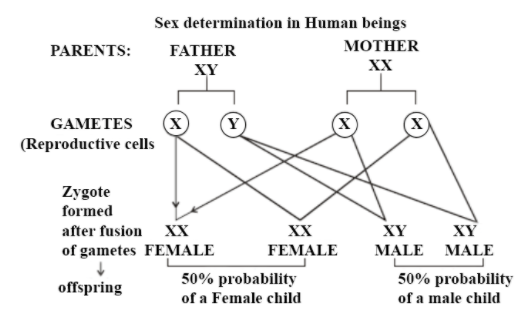
Autosomes are the first 22 pairs of chromosomes that do not determine the sex of an individual whereas sex chromosomes- last pair of chromosomes, represented as X and Y would determine the gender of a child. Females have two X chromosomes, so can be represented as 44+XX. Males have one X and one Y chromosome, so can be represented as 44+XY. During the fertilization, new-born receives half of the chromosomes i.e. 22+X or 22+Y from father but only 22+X from mother . Therefore , male gametes have 22 autosomes and either X or Y sex chromosome while female gametes are purely 22X which together forms either 44XX ( female) or 44XY(Male).
Chapter Question Answer
Question 1. What is the term used for secretions of endocrine glands responsible for changes taking place in the body?
Answer: Hormones
Question 2. Define adolescence.
Answer: The period of life, when the body undergoes changes, leading to reproductive maturity, is called adolescence. The period of adolescence is normally 11 years to 19 years.
Question 3. What is menstruation? Explain.
Answer: In females, the ova or eggs begin to mature
with the onset of puberty (10 to 12 years of age) one egg get matured and is released by one of the ovaries once in about 28 to 30 days. During this period, the wall of the uterus becomes thick so as to receive the fertilized egg. In case it is fertilized, it begins to develop. This results in pregnancy. If the fertilization fails to take place, the ovum or the released egg and the thickened lining of the uterus along with its blood vessels are shed off. This causes bleeding in women. This is called menstruation. It occurs once in 28 to 30 days.
Question 4. List changes in the body that take place at puberty.
Answer: The changes take place differently in the body of boys and girls at puberty. These change may be listed as below:
- There is sudden increase in the height of both boys and girls. However, both reach their maximum height at the age of 17 to 18 years.
- The voice of boys become hoarse and that of girls become shrill.
- Shoulders become broader and muscles grow more prominently in boys. In girls, the regions below the waist becomes wider.
- Hair start growing in different parts of boys and girls.
- In most of the teenagers, due to increased secretion of sweat and sebaceous gland, get acne and pimples on their face.
- Onset of puberty brings changes in secondary sexual characters in both male and female.
- Boys and girls become capable of reproduction.
- In girls, menstruation starts.
- Different types of hormones start to release in initiating a reproductive function.
Question 5. Prepare a table having two columns depicting names of endocrine glands and hormones secreted by them.
Answer:
| Endocrine Glands | Hormones Secreted |
|---|---|
| 1. Pituitary Gland | Growth Hormone |
| 2. Ovaries | Estrogen |
| 3. Testes | Testosterone |
| 4. Thyroid | Thyroxine |
| 5. Pancreas | Insulin |
| 6. Adrenal Glands | Adrenaline |
Question 6. What are sex hormones? Why are they named so? State their function.
Answer:
The hormones which help and control the formation of secondary sexual characters are called sex hormones. They are named so because they control the sexual activities and are secreted by males and females separately.
Functions of sex hormones are given below separately: A. Male sex hormone:
Female sex hormone: It is also called estrogen. It is secreted by ovaries and controls the secondary sexual characters in females, appearance of mammary glands, etc. It also maintains pregnancy.
Question 7. Choose the correct option.
(a) Adolescents should be careful about what they eat, because:
(i) proper diet develops their brains.
(ii) proper diet is needed for the rapid growth taking place in their body.
(iii) adolescents feel hungry all the time.
(iv) taste buds are well developed in teenagers.
(b) Reproductive age in women starts when their:
(i) menstruation starts.
(ii) breasts start developing.
(iii) body weight increases.
(iv) height increases.
(c) The right meal for adolescents consists of:
(i) chips, noodles, coke.
(ii) chapati, dal, vegetables.
(iii) rice, noodles and burger.
(iv) vegetable cutlets, chips and lemon drink.
Answers:
(a) (ii)
(b) (i)
(c) (ii)
Question 8.Write notes on:
(a) Adams apple(b) Secondary sexual characters.
(c) Sex determination in the unborn baby.
Answer:
(a) Adams apple: During puberty, a change in the voice of boys and girls takes place due to increase in the size of the voice box or larynx. In boys, the voice box tends to protrude out on the upper part of the neck, below the chin and is often referred to as Adam’s apple.
(b) Secondary sexual characters: Those characters which are visible more apparently and help in distinguishing a male from a female are called secondary sexual characters. For example, in girls, breasts and in boys, facial hair, i.e., moustache and beard.
(c) Sex determination in the unborn baby: The sex of a child, i.e., whether it is a male or a female is determined at the time of fertilisation when a male gametes fuse with a female gamete. All human beings have 23 pairs of chromosomes in the nuclei of their cells. Two chromosomes out of these are sex chromosomes. A female has two X chromosomes, while a male has one X and one Y chromosome. The gametes (egg and sperm) have only one set of chromosomes. The unfertilised egg always has one X chromosome.
But sperms are of two kinds—One having X chromosome, and the other having Y chromosome. When a sperm containing X chromosome fertilises the egg, the zygote would have two X chromosomes and develop into a female child. If the sperm contributes a Y chromosome to the egg or ovum at fertilisation, the zygote would develop into a male child. It is thus also clear that the sex chromosomes of the father determine the sex of an unborn baby.
Question 9. Word game: Use the clues to work out the words.
 Across:
3. Protruding voice box in boys
4. Glands without ducts
7. Endocrine gland attached to brain
8. Secretion of endocrine glands
9. Pancreatic hormone
10. Female hormone
Down:
Across
3. Adam's Apple.
4. Endocrine.
7. Pituitary.
8. Hormone.
9. Insulin.
10. Estrogen.
1. Male hormone
2. Secretes thyroxine
3. Another term for teenage
5. Hormone reaches here through blood stream
6. Voice box
7. Term for changes at adolescence
Answers
Down
1. Testosterone.
2. Thyroid.
3. Adolescence.
5. Target Site.
6. Larynx.
7. Puberty.
|
Age (Years) |
Height (cm) |
|
|
Boys |
Girls |
|
|
0 |
53 |
53 |
|
4 |
96 |
92 |
|
8 |
114 |
110 |
|
12 |
129 |
133 |
|
16 |
150 |
150 |
|
20 |
173 |
165 |
Answer:
From the above graph, we conclude that initially boys grow faster than girls from 0-8 years, and girls grow faster than
boys from 8-16 years. But both reach their maximum height at the age of 20. Here boys show a greater increase in height than girls.
Additional questions
Question 1.What is the other name for duct gland ?
Answer: Exocrine glands.
Question 2.Name two duct glands.
Answer: Tear glands and sweat glands.
Question 3.What are ductless glands ?
Answer: Ductless glands are those glands, from which the hormones are directly poured into the blood.
Question 4.Name any two ductless glands.
Answer: Pituitary gland and thyroid gland.
Question 5.Define hormones
Answer: Hormones are secretions from endocrine glands.
Question 6.Name a gland whose size gets reduced as the child grows older.
Answer: Thymus gland.
Question 7. Which gland secretes the hormone thyroxine ?
Answer: Thyroid gland.
Question 8.Which gland is known as the master gland ?
Answer: Pituitary gland.
Question 9.Name the female sex hormone and where is it produced ?
Answer: Estrogen is produced in the ovary.
Question 10.Name the male sex hormone and where is it produced ?
Answer: Testosterone is produced in the testes.
Question 11.Name the sex glands in male and female.
Answer: The sex glands are testes in male and ovaries in female.
Question 12.Apart from estrogen, name the other female hormone secreted by ovaries.
Answer: Progesterone.
Question 13.Which gland is responsible for the fatness in the body ?
Answer: Thyroid gland.
Long Answer questions
Distinguish between exocrine and endocrine glands.
|
Exocrine Glands |
Endocrine Glands |
|
(a) They secrete enzymes which come out through ducts. |
(a)They secrete hormones which are pushed directly into the blood. |
Question 2.Name the hormones secreted by pancreas. Give function of each secretion.
Answer: Glucagon and insulin are secreted by pancreas.
- Glucago which helps to break down glycogen in liver to raise blood glucose level.
- Insulin which helps to reduce blood glucose level and maintains the sugar level.
Question 3.A mother is angry at her child for misbehaving. The child is also afraid of scolding.Which hormones would be released in both their bodies ? What will be the effect of the hormone?
Answer: When the mother is angry and the child is afraid more adrenalin would be released from the adrenal gland. Due to this tere will be heavy sweating and lowering of body temperature.
Question 4. Give one similarity and one difference in the secondary sex characters developed in boys and girl.
Answer:Similarity : In both boys and girls hair start to grow in arm pits and the pubic region above the thighs.
Difference : In boys, moustaches and beard appear due to growth of facial hair.
In girls, the breast develop and menstrual cycle starts.
Question5. Why should adolescents avoid sexual contact ?
Answer:Sexual contact by adolescents should be avoided because :
- to avoid unwanted pregnancies.
- to avoid getting HIV (AIDS) infection or any other sexually transmitted disease.
- the responsibilities of parenthood should only be taken when you are settled in life.
Question 6. . Show diagrammatically how the sex of the child is determined ?
Answer:
Question7.What is menstruation ? Explain.
Answer: Before a zygote is received in the uterus, the uterus wall becomes thick with a lining of soft and spongy tissue full of blood vessels. In case fertilisation does not take place, the ovum along with the lining and blood vessels along the uterus wall shed off. This results in bleeding in women which continues for 2 to 3 days. This is called menstruation.