Our Environment
Take the QuizEnvironment is the sorroundings we all live. Our environment includes both living (biotic) and non-living (abiotic) components, the combination of these 2 creates an ecosystem. The biotic and abiotic components exist mutually as all living organisms obtain food, air, water, and shelter by abiotic components. An ecosystem is healthy when living components coexist - depend on each other. Such coexistance form food chains and food webs in nature.This chapter helps you understand the components of our environmnet and the effects of all human activities on the environment and their prevention and management.
Ecosystem
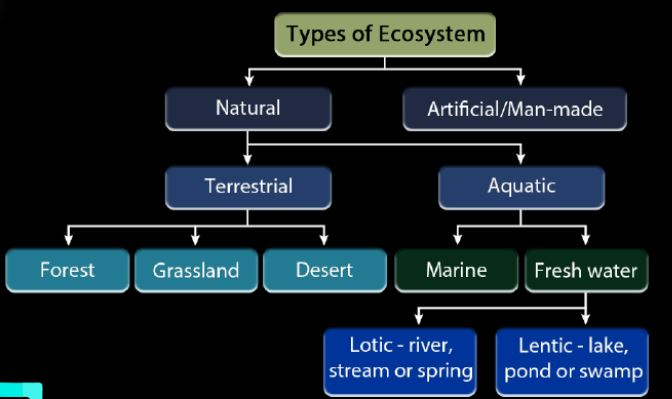
An ecosystem, is a self-sustaining community of all living organisms such as plants, animals, and microorganisms interacting with each other within their abiotic environment (air, water, soil, and sunlight) in a specific area.It is a functional unit where everything is connected and all living organisms depends on each other for their survival. Natural ecosystem exist in nature on its own. E.g. Forest, lake , ocean. while artificial ecosystem is a man-made ecosystem e.g.Cropfield , acquaruiam , garden etc . An ecosystem can also be classified as terrestrial (land) or aquatic( water).
Components of Ecosystem
Biotic Components (Living Organisms)
Organisms exist these living in the ecosystem. Biotic components are grouped based on how they get their energy and their role in the food chain. The main classes of biotic components are producers, consumers and decomposers.
Producers (Autotrophs)
These organisms produce their own food, usually through photosynthesis using sunlight, water, and carbon dioxide. Their main function is to convert solar energy into chemical energy (glucose), forming the base of the food chain. Some examples include all green plants, algae, and cyanobacteria (as some bacteria use chemosynthesis using chemicals like hydrogen sulfide) instead of sunlight.
Consumers (Heterotrophs)
Consumers cannot make their own food and depend on other organisms for energy. They are classified as
- Primary consumers – Herbivores that eat producers Example: Grasshoppers, rabbits, zooplankton
- Secondary consumers – Carnivores that eat herbivores Example: Frogs, spiders, small fish
- Tertiary consumers – Carnivores that eat other carnivores Example: Eagles, sharks, big cats
- Omnivores – Eat both plants and animals Example: Humans, bears, pigs
- Parasites – Live on or inside another organism (host) and feed off it Example: Tapeworms, lice
Decomposers and detritivores
Decomposers are very important to keep a balance in the environment by recycling the waste to replenish them as nutrients into soil. They maintain the flow of materials in the ecosystem.
- Decomposers: Microorganisms (like fungi and bacteria) that break down dead organic matter into simpler substances and release nutrients back into the soil.
- Detritivores: Organisms that feed on dead organic material and help decomposition Examples: Earthworms, dung beetles, millipedes
Abiotic Components (Non-Living Elements)
These are the physical and chemical factors that influence living organisms and the structure of the ecosystem.A. Sunlight
Sunlight is one of the most important abiotic (non-living) components of an ecosystem because it provides the primary source of energy that drives nearly all life processes on Earth.Sunlight affects photosynthesis, temperature, and daily/seasonal rhythms of organisms.B. Water
Water is a vital abiotic (non-living) component of all ecosystems. Life cannot exist without it, and it plays a key role in biological, chemical, and physical processes. It is essential for all living organisms as water is involved in nutrient transportation, photosynthesis, and temperature regulation. Water availability determines the types of organisms present (e.g., desert vs. rainforest).C. Air (Gases like Oxygen and Carbon Dioxide)
Air is a critical abiotic (non-living) component of ecosystems. It consists of a mixture of gases that support life, influence climate, and facilitate key biological processes. Our atmospheric air has 78% Nitrogen (N₂) . It is used by plants (after fixation) for proteins and DNA. Oxygen (O₂) is found around 21% of the air and it is essential for respiration in animals and plants. Carbon dioxide (CO₂- 0.04%) is used in photosynthesis by producers. Other gases ~1% Includes argon, methane, ozone, etc.D. Temperature
Temperature is a key abiotic (non-living) factor that greatly affects the structure, function, and diversity of ecosystems. It influences the rate of biological processes, the types of organisms that can live in an area, and how they behave and interact. Temperature affects metabolic rates and biological activities of all living organisms.It determines the types of plants and animals that can survive in a given area. Atmospheric temperature determines species distribution as only organisms which are adapted to certain temperature ranges can survive in specific environments. In the polar regions → Arctic fox, polar bear, lichens live while in the tropical regions common animals include monkeys, orchids, insects. Deserts with high temperature provide shelter to camels, cacti with water-conserving features. Temperaturte influences hibernation, migration, and reproduction in animals. Cold-blooded animals (e.g., reptiles) rely directly on external temperatures to regulate body heat. Warm-blooded animals maintain internal body temperature but expend more energy doing so in extreme climates.E. Soil
Soil provides nutrients and a medium for plant growth. Healthy soil is important for plants as it affects the types of plants and microorganisms in an ecosystem. Soil composition, pH, and moisture content are crucial abiotic factors. Elements like nitrogen, phosphorus, potassium, calcium, etc. found in the soil are required for growth and development. Nutrient availability influences plant health and productivity. Ph level of soil also affects chemical availability and microbial activity in soil and water.Interactions between Biotic and Abiotic Components
Ecosystems are dynamic systems where biotic and abiotic components interact continuously: Plants (biotic) use sunlight, water, CO₂, and soil nutrients (abiotic) to grow while animals (biotic) depends on plants for their food and oxygen. Both plants and qanimals get their shelter, water, and temperature (abiotic factors) from environment. Decomposers return nutrients from dead organisms to the soil (abiotic), which are then used again by plants. Changes in abiotic factors (e.g., drought, temperature rise) affect the balance and health of the ecosystem.
Food Chain
A food chain is a linear sequence that shows how energy and nutrients flow from one organism to another in an ecosystem. Food chains are crucial for understanding how energy and nutrients move from one tropic level to the next. A food chain illustrates the complex relationships within ecosystems. Any damage to this energy flow can have irreversible effects on all leves can lead to the destruction of multiple species. Food chains also demonstrate the importance of biodiversity and how balance is essential for ecosystem stability.
A lot of energy is being lost when it flows from 1 tropic level to the next . So, the green plants in a terrestrial ecosystem captures only about 1% of the energy of sunlight and convert it into food energy. When green plants are eaten by primary consumers, enormous amount of energy is further lost as heat to the environment, only a small amount goes into digestion while the remaing goes towards growth and reproduction. An average of 10% of the food eaten is turned into its own body and made available for the next level of consumers. Therefore, it is concluded that an average 10% of energy reaches the next level of consumers. A large number of individuals are found at the lower trophic levels of an ecosystem( the greatest number is of the producers).As we move on to the higher levels, the number of organisms reduce therefore tertiary consumers are the lowest in numbers.
🔗 Structure of a Food Chain:

- Producers (Autotrophs)
- Make their own food (usually through photosynthesis)
- Example: Grass, algae
- Primary Consumers (Herbivores)
- Eat producers
- Example: Grasshopper, rabbit
- Secondary Consumers (Carnivores/Omnivores)
- Eat herbivores
- Example: Frog, small fish
- Tertiary Consumers (Top predators)
- Eat secondary consumers
- Example: Snake, hawk
- Decomposers (Bacteria, fungi, earthworms)
- Break down dead organisms and recycle nutrients
Some examples of food chains
A food chain illustrates the flow of energy from one organism to another. Here are a few examples:
- Grassland Food Chain:
A classic grassland food chain has plants, like grasses, and trees as the primary producers which are eaten - herbivores like grasshoppers and some insects dogs, which are the primary consumers. The primary consumers are eaten by the secondary consumers, like frogs or small mammals and tertiary consumers, like snakes or hawks, could prey on the secondary consumers.
- Forest Food Chain:
In forest food chain producers includes small plants, bushes, trees as they are capable of photosynthesis. Primary Consumers are deer, sheep, goat etc which eats the leaves of the oak trees while Secondary Consumers are Wolves that eat the primary consumers. Decomposers includes fungi , bacteria which break down dead organic matter, returning nutrients to the soil.
- Aquatic Food Chain:
An aquatic food chain shows the flow of energy and nutrients through different organisms in a sweet water-based ecosystem where producers like algae participate in photosynthesis and Primary Consumers includes small fishes that eat the algae. The secondary Consumers like larger fish, whales eat the small fish and the tertiary Consumers that eat then secondary consumers includes crane and, Hawk
- Marine Food Chain:
A marine food chain depicts the flow of energy and nutrients through different levels of salt water( oceans) . The energy flows from primary producers to consumers which starts with phytoplankton, the microscopic plant-like organisms that perform photosynthesis, providing food for zooplankton, which in turn are consumed by Secondary Consumers like small fish (eat the zooplankton). The tertiary Consumers in this chain are seals (eat the small fish), Killer whale (eats the seals)
Food Web
A food web is a complex network of interconnected food chains showing all possible feeding relationships in an ecosystem. A food chain is a bit different than food web as it is a simple linear arrangement of tropic levels. There is a flow of energy from one tropic level to another (one organism to another). A food web, on the other hand, is a complex network of interconnected food chains, illustrating how multiple food chains overlap and interact . In simple terms food web is a collectin of multiple food chains.
️ Benefits of a Food web
- Shows the interdependence of organisms.
- Helps explain how ecosystems stay in balance.
- If one species is removed, it can show the impact on others.
🔄 Energy Flow in Food Chains/Webs
- Energy decreases as it moves up the food chain.
- Only 10% of energy is transferred from one level to the next; the rest is lost as heat.
📊 Trophic Levels (Energy Levels in the Chain/Web):
| Trophic Level | Example | Role |
|---|---|---|
| 1st | Grass, algae | Producers – Make food via photosynthesis |
| 2nd | Rabbit, zooplankton | Primary consumers – Eat producers |
| 3rd | Snake, small fish | Secondary consumers – Eat herbivores |
| 4th | Hawk, shark | Tertiary consumers – Eat carnivores |
| All levels | Bacteria, fungi | Decomposers – Recycle nutrients from dead matter |
Biomagnification
The entry of chemicals into the food chain, through pollution, or any manmade activities can have various negative effects, particularly through the process of biomagnification. Biomagnifications can have effects ranging from simple disruptions to animal populations to the serious disasters related to health. The main culprit of this process is the non-biodegradable chemicals (like pesticides and heavy metals) which can accumulate in the cells of organisms at different tropic levels . The accumulation begins at the primary consumer level( lower-level organisms ) which consume contaminated plants or prey, and the chemicals are then passed on to their predators. With each trophic level, the concentration of the chemical increases, as the organisms are consuming prey that have already accumulated the chemical. This means that top predators (like large fish or birds of prey) can have significantly higher concentrations of the chemical than organisms lower in the food chain. Biomagnifications has been observed with pesticides like DDT, which caused problems in bird populations. It can also occur with mercury and other heavy metals.
Effects of biomagnification
High concentrations of chemicals in animals can lead to various health problems, including reproductive issues, developmental abnormalities, and even death. This can negatively impact populations by reducing their ability to reproduce or survive. Some chemicals in the food chain can disrupt the balance of ecosystems. For example, the presence of toxins can affect the behavior, feeding habits, and survival rates of different species.
How do our activities affect environment?
1. Air Pollution
Human activities such as burning fossil fuels for transportation, electricity, and industry are major sources of air pollution. When coal, oil, and gas are burned, they release harmful gases like carbon dioxide (CO₂), nitrogen oxides, and sulfur dioxide into the atmosphere. These pollutants contribute to problems like smog, acid rain, and respiratory diseases in humans and animals. More importantly, greenhouse gases trap heat in the Earth's atmosphere, leading to global warming and climate change.2. Water Pollution
Water pollution is mainly caused by the release of harmful substances into rivers, lakes, and oceans. Factories discharge toxic chemicals, while farms often use fertilizers and pesticides that wash into water bodies through rain. In many areas, untreated sewage and plastic waste are also dumped into the water. These pollutants harm aquatic animals, destroy marine ecosystems, and make water unsafe for human consumption and recreation.3. Deforestation
Deforestation occurs when forests are cleared to make way for farming, logging, or urban development. This activity destroys the habitats of countless species, leading to a loss of biodiversity. Forests also play a crucial role in absorbing carbon dioxide, so when they are cut down, more CO₂ remains in the atmosphere, increasing the effects of climate change. Furthermore, removing trees makes the soil less stable, leading to erosion and loss of fertile land.4. Waste Generation
Modern lifestyles produce a huge amount of waste, much of it non-biodegradable like plastic. Improper disposal of waste—whether by dumping it in landfills, rivers, or the ocean—pollutes the environment. Plastic waste, in particular, poses a serious threat to wildlife, as animals can ingest it or become entangled in it. Landfills also release harmful gases like methane, which is a potent greenhouse gas, contributing to climate change.5. Climate Change
Climate change is largely driven by human activities that increase the concentration of greenhouse gases in the atmosphere. These include burning fossil fuels, cutting down forests, and certain farming practices, such as raising livestock that emit methane. As a result, the Earth's average temperature is rising, leading to extreme weather events, melting glaciers, rising sea levels, and disruption of ecosystems across the globe.6. Loss of Biodiversity
Many human activities, such as deforestation, pollution, overfishing, and hunting, are causing a rapid loss of biodiversity. When natural habitats are destroyed or polluted, many species cannot survive. This leads to extinction and weakens ecosystems, making them less resilient to changes. Biodiversity is important because every species plays a role in maintaining the balance of nature and provides resources like food, medicine, and clean air.7. Soil Degradation
Soil degradation is caused by overfarming, deforestation, overgrazing by livestock, and industrial pollution. These practices strip the soil of its nutrients and structure, making it less fertile and more prone to erosion. Poor soil leads to lower agricultural productivity, which can threaten food security. In severe cases, this can result in desertification, where once-productive land becomes barren and lifeless.8. Overconsumption of Resources
Humans consume natural resources—such as water, minerals, fossil fuels, and forests—at an unsustainable rate. This overconsumption leads to depletion of resources that future generations may not be able to use. It also causes environmental stress, as ecosystems are pushed beyond their capacity to regenerate. For example, excessive water use can dry up rivers, and overfishing can collapse entire fish populations.Ozone Layer Destruction
Ozone (O₃) is formed in the stratosphere through a process involving ultraviolet (UV) light and oxygen molecules (O₂). Splitting of oxygen molecules by UV light can be written as O + O 2 → O 3 O+O 2 →O 3 (A free oxygen atom (O) combines with an oxygen molecule (O₂) to form ozone (O₃).) The destruction of the ozone layer is mainly caused by human-made chemicals called chlorofluorocarbons (CFCs), which were once commonly used in refrigerators, air conditioners, and aerosol sprays. When these substances are released into the atmosphere, they eventually rise up to the stratosphere, where they break down and release chlorine atoms. These chlorine atoms react with ozone (O₃) molecules and destroy them, reducing the ozone layer’s ability to block harmful ultraviolet (UV) rays from the sun. As a result, more UV radiation reaches the Earth’s surface, increasing the risk of skin cancer, cataracts, and harm to plants and marine life. Although the use of CFCs has been greatly reduced due to international agreements like the Montreal Protocol, the ozone layer is still slowly recovering, and continued efforts are needed to protect it.Biodegradable and Non-Biodegradable Substances
Biodegradable substances are materials that can be broken down naturally by microorganisms like bacteria and fungi into simpler, harmless substances. These materials decompose over time and do not pollute the environment. Common examples include food waste, paper, cotton, wood, and animal waste. Because they return to the earth without leaving harmful residues, biodegradable substances are considered environmentally friendly and sustainable. On the other hand, non-biodegradable substances are materials that do not decompose easily or take hundreds of years to break down. These substances accumulate in the environment, leading to pollution and harm to wildlife and ecosystems. Examples include plastic, synthetic fibers, metal cans, glass, and chemicals like pesticides. Since they persist in nature for a long time, managing non-biodegradable waste is a major environmental challenge, and recycling or reducing their use is essential to protect the planet.
Text book Solutions
Part-1
Question 1. What are the trophic levels? Give an example of a food chain and state the different trophic levels in it.
Answer:Each step or level of a food chain is called Trophic levels. There are many food chains in the ecosystem. Example for Food chain on terrestrial habitat induiacates grass is a producer because it prepares its own food. This grass is eaten by herbivores means secondary, small carnivores (Frog) are tertiary and higher carnivores are in the fourth level.
Question2.What is the role of decomposers in the ecosystem?
Answer: Decomposers clean the environment, recycle nutrients, enrich the soil, and keep the food chain functioning smoothly. Without them, life on Earth would collapse.
Part-2
Question 1.Why are some substances biodegradable and some nonbiodegradable?
Answer: Substances are classified as biodegradable or non-biodegradable based on whether natural decomposers (bacteria, fungi, and other microorganisms) can break them down. The table below illustartes the difference between the two.
| Type | Why they behave this way | Examples |
|---|---|---|
| Biodegradable | Simple, natural, easily broken by microbes | Food waste, paper, cloth, leaves |
| Non-biodegradable | Complex, synthetic, toxic, or extremely slow to break | Plastic, glass, metal, pesticides |
Question 2.Give any two ways in which biodegradable substances would affect the environment.
Answer:
-
They increase soil fertility
When biodegradable substances like food waste, leaves, and dead plants decompose, they release nutrients (nitrogen, phosphorus, minerals) into the soil. This improves soil quality and helps plants grow better
-
They may cause foul smell and pollution if not managed properly
Biodegradable waste (kitchen waste, animal waste) can decompose rapidly, producing foul smell, attracting flies, and sometimes causing water pollution if dumped in water bodies. This can harm health and hygien
Question 3.Give any two ways in which non biodegradable substances would affect the environment.
Answer:
- They cause long-term pollution : Non-biodegradable materials like plastic, glass, and metals do not decompose easily. They remain in the environment for hundreds of years, causing land pollution, water pollution, and air pollution (when burned).
- They harm living organisms :Animals often eat plastic or get trapped in it. This can cause injury, choking, or even death. Toxic chemicals from pesticides and plastics can also enter the food chain and harm humans and wildlife.
Part-3
Question 1.What is ozone and how does it affect any ecosystem?
Answer:Ozone at the higher levels of the atmosphere is a product of UV radiations acting on O2 molecule. The higher energy UV radiations split apart some molecular Oa in free oxygen (O) atoms. These atoms then combine with the molecular O2 to form Ozone.
Ozone shields the surface of the earth from ultraviolet (UV) radiation from the Sun. This radiation is highly damaging to organisms for example, it is known to cause skin cancer in human beings.
Question 2.How can you help in reducing the problem of waste disposal? Give any two methods.
Answer:
Reduce, Reuse, and Recycle (3Rs) where Reduce: Avoid using unnecessary items like single-use plastics. Reuse: Use reusable bags, bottles, and containers. Recycle: Separate waste at home and send recyclable materials like paper, plastic, and metal to recycling centers. The 3Rs decreases the amount of waste that goes to landfills.
Composting biodegradable waste : Collect kitchen waste like vegetable peels, fruit scraps, and dry leaves and convert them into compost, a natural fertilizer. This reduces garbage and enriches soil instead of polluting the environment.
Part-4
MCQs
Question 1.Which of the following groups contain only biodegradable items?
(a) Grass, flowers and leather.
(b) Grass, wood and plastic.
(c) Fruitpeels, cake and limejuice.
(d) Cake, wood and grass.
Answer:(b) Grass, wood and plastic.
Question 2.Which of the following constitute a food-chain?
(a) Grass, wheat and mango.
(b) Grass, goat and human.
(c) Goat, cow and elephant.
(d) Grass, fish and goat.
Answer:(b) Grass, goat and human.
Question 3.Which of the following are environmentfriendly practices?
(a) Carrying clothbags to put purchases in while shopping.
(b) Switching off unnecessary lights and fans.
(c) Walking to school instead of getting your mother to drop you on her scooter
(d) All of the above.
Answer:(d) All of the above.
Question 4.What will happen if we kill all the organisms in one trophic level?
Answer:If we kill all the organisms in one trophic level, the population size of organisms in lower level increases uncontrollably and the number of organisms in higher trophic level decreases due to non¬availability of food. This results in an imbalance in ecosystem.
Question 5.Will the impact of removing all the organisms in a trophic level be different fordifferent trophic levels? Can the organisms of any trophic level be removed without causing anydamage to the ecosystem?
Answer:
- Removing producers: All the heterotrophs die.
- Removing herbivores: Carnivores would not get food.
- Removing carnivores: Herbivores would increase to unsustainable levels.
- Removing decomposers: Organic wastes, plant, and animal dead remains would pile up.
- The role of each and every species belonging to every trophic level is unique.
- No, the organisms of any trophic level cannot be removed without damaging the ecosystem.
Question 6. What is the biological magnification? Will the levels of this magnification be different at different levels of the ecosystem?
Answer:Some harmful chemicals enter our bodies through the food chain, one of the reasons is the use of several pesticides and other chemicals to protect our crops from disease and pests. These chemicals are either washed down into the soil or into the water bodies. From the soil, these are absorbed by the plants along with water and minerals and from the water bodies these are taken up by aquatic plants and animals.This is one of the ways in which they enter the food chain. This phenomenon is known as biological magnification. This level of magnification be different at different levels of the ecosystem.Eg: Spraying of DDT will remain for a long time in the environment.
Question 7.What are the problems caused by the nonbiodegradable wastes that we generate?
Answer:
- Nonaesthetic look.
- Death of cattle by ingestion of plastic bags.
- The quality of soil is adversely affected.
- Biomagnification of harmful chemicals like DDT in birds disturb their calcium metabolism.
- Non – biodegradable wastes cause pollution of soil and water.
Question 8. If all the waste we generate is biodegradable, will this have no impact on the environment?
Answer:If all the waste we generate is biodegradable, there is a imbalance in nature. Because with the increase of wastes there is decrease in the number of decomposers. These wastes spread every where and microbes are more which causes many diseases to us.
Question 9.Why is damage to the ozone layer a cause for concern? What steps are being taken to limit this damage?
Answer:Damage to the ozone layer causes so many problems. At the higher levels of the atmosphere, ozone performs an essential function. It shields the surface of the earth from ultraviolet radiation from the sun. If ozone layer is damaged no organism can survive. The following are the steps being taken to limit this damage.
- We should minimize the use of vehicles.
- We should not encourage the burning of fossilic fuels.
- It is now mandatory for all the manufacturing companies to make CFC free refrigerators throughout the world.
Part-5
Question 1. What changes can you make in your habits to become more environment friendly?
Answer:
- We must refuse to buy products that harm us and the environment.
- We should minimise the use of electricity and water.
- We should encourage recycling of things.
Question 2. What would be the advantages of exploiting resources with shortterm aims?
Answer:With the human population increasing at a tremendous rate due to improvement in healthcare, thedem and for all resources is increasing at an exponential rate. The management of natural resources requires a long term perspective so that these will last for the generations to come and will not merely be exploited to the hilt for short term gains.
Question 3. How would these advantages differ from the advantages of using a long term perspective inmanaging our resources?
Answer:If resources are used in accordance with short term aims, present generation will be able to utilize the resources properly for overall development. But if we plan to use resources with long term aims, not only the present generation is benefited but also the future generations will also be able to utilize resources for fulfilling its necessities. Thus it would be better to use our natural resources with a long term perspective so that it could be used by the present generation as well as conserved for future use.
Question 4. Why do you think that there should be equitable distribution of resources? What forces would beworking against an equitable distribution of our resources?
Answer:Nature shows no partiality. Natural resources belong to all and these resources should be used judiciously. Equitable distribution of resources will benefit both poor as well as rich people.
Human greed, corruption, and the lobby of the rich and powerful are the forces working against an equitable distribution of our resources.
Textbook Exercises-1
Question 1. Why should we conserve forests and wildlife?
Answer:
- Destruction of forests not only affect on forest products but it affects the water resources and it is soil pollution.
- Destruction of forest leads to shortage of fodder for animals, shortage of medicinal plants, shortage of fruits and nuts.
- There is a shortage of valuable timbers such as sal, sandal wood etc.
- Wild animals are also useful to us in many ways, hence we should conserve these by building sanctuaries and prohibited hunting.
Question 2. Suggest some approaches towards the conservation of forests.
Answer:
- Cutting valuable trees should be prevented.
- We should use forest products, such that there should not be damage to the environment.
- All people should participate in the conservation of forest and wild animals.
Question 3. Find out about the traditional systems of water harvesting/ management in your region.
Answer:We must dug small pits and lakes, put in place simple water shed systems, built small earthen dams, constructed dykes, sand and limestone reservoirs, set up root top water collecting units. These are the traditional systems of water harvesting/management in our region.
Question 4.Compare the above system with the probable systems in hilly/ mountainous areas or plains or plateau regions.
Answer:In the above mentioned places check dams are built because here water harvesting is difficult.
Question 5.Find out the source of water in your region/locality. Is water from this sourceavailable to all people living in that area?
Answer:Tube wells and river water (Tungabhadra) are the water sources available to all people in our area. There are different sources in different places. In some places there is too much shortage of water because of failure of rain recently.
Textbook Exercises-2
Question 1.What changes would you suggest in your home in order to be environment friendly?
Answer:
- We must save water and electricity.
- We should not waste food.
- We should encourage reuse and recycling.
- We must minimise the use of plastics.
Question 2.Can you suggest some changes in your school which would make it environment friendly?
Answer:
- Enough plants and trees can be planted in the school.
- Water should not be wasted but should be used judiciously.
- Students should be taught to keep their classrooms and immediate surroundings neat and tidy.
- Compost pits may be made in safe comers of the school, where biodegradable wastes may be dumped to prepare compost.
- Minimising the usage of loudspeakers.
- Organising seminars, quiz, essay competition, drawing competitions for spreading environmental awareness, celebrating Vanamahotsava… etc.
Question 3.We saw in this chapter that there are four main stakeholders when it comes to forests and wildlife. Which among these should have the authority to decide the management of forest produce? Why do you think so?
Answer:The local people need large quantities of firewood, small timber and thatch. Bamboo is used to make slats for huts, and baskets for collecting and storing food materials. Implements for agriculture, fishing and hunting are largely made of wood, also forests are sites for fishing and hunting.In addition to the people gathering fruits, nuts and medicines from the forests, there cattle also graze in forest areas or food on the fodder which is collected from forests.
Because of these reasons the people who live in or around forests have authority to decide the management of forest produce.
Question 4.How can you as an individual contribute or make a difference to the management of
(a) forests and wildlife
(b) water resources and
(c) coal and petroleum?
Answer:
a) Forests and wild animals.
- cutting valuable trees should be avoided by destroying forest affects the quality of soil and water resources.
- Hunting should be prohibited.
- There should be wild sanctuaries which gives protection for wild animals.
- b) Water Resources:
Answer:
- Water resources should be free from pollution.
- Excess usage of water should be avoided.
- c) Coal and Petroleum:
Answer:
We should minimise the use of coal and petroleum, because these are fossil fuels. By burning these there are ill effects such as air pollution and acid rainfall etc.
Question 5.What can you as an individual do to reduce your consumption of the various naturalresources?
Answer:
- We must have come across the five R’s to save the environment: Refuse, Reduce, Reuse, Repurpose and Recycle.
- We should encourage tree plantation programmes.
- We must reduce the burning of fossil fuels.
- Encouragement should be given for harvesting the water.
Question 6.List five things you have done over the last one week to —
(a) conserve our natural resources.
Answer:
We should travel in bus instead of using own vehicles or we should practice walking, we must use LED bulbs or fluorescent tubes in our homes. We must use the lift or taking the stairs, wearing an extra sweater or using a heating device (heater or sign) on cold days.
(b) increase the pressure on our natural resources.
Answer:
- We should grow Number of trees around our house.
- Reducing own vehicles by using public transport system or by, walking.
- There should not be more factories.
- We must prevent soil erosion.
- We must reduce the usage of vehicles to avoid air pollution.
Question 7.
On the basis of the issues raised in this chapter, what changes would you incorporate in your lifestyle in a move towards sustainable use of our resources?
Answer:
We need to change our lifestyles so that we can use natural resources on a sustainable basis. The changes which can be brought about are as follows:
- Stop cutting trees and start planting trees.
Use LED bulbs and fluorescent tubes.
- Take the stairs and avoid using lifts.
- During summers use bamboo made fans avoid air coolers and electricians.
- Use more of public transport.
- Let our conscience be always alert not to pollute the environment from any of our activities.
Additional Question Answers
- Fill in the blanks
Question 1. …… and …… are followed as means of protection of nature and natural resources.
Answer:traditions, customs and rituals.
Question 2.Prticipation of the …… can indeed lead to the efficient management of forests.
Answer:local people
Question 3.Irrigation methods like have been used in various parts of India since ancient times.
Answer:dams, tanks and canals.
Question 4.…… and …… were formed from the degradation of biomass millions of years ago.
Answer:Coal, petroleum
Question 5.Fossil fuels contain carbon along with …… also.
Answer:hydrogen, nitrogen and sulphur.
LBA Solutions
Learning Points
- Ecosystem – what are its components
- Food chains and food webs
- How do our activities affect the environment
- Ozone layer and how it is getting depleted
- Waste management
Weightage to Difficulty Level
|
Sl. No. |
Difficulty Level |
Question Number |
Marks |
Percentage |
|
01 |
Easy |
12 |
21 |
30% |
|
02 |
Average |
23 |
35 |
50% |
|
03 |
Difficulty |
09 |
14 |
20% |
I. Multiple Choice Questions (1 Mark Each)
Four alternatives are given for each of the following questions/incomplete statements. Only one of them is correct or most appropriate. Choose the correct alternative and write the complete answer along with its letter.
- Observe the food chain given below: (SUP-2019) [D]
Grass → Grasshopper → Frog → Snake → Eagle
If the energy available at first trophic level is 5000 J, then the amount of energy available for snake is:
- 500 J
B. 5 J
C. 0.5 J
D. 50 J
- The correct statement with respect to biodegradable substances among the following: (MAIN-2021) [A]
- Undergo recycling naturally in the environment
B. Harm various organisms in the ecosystem
C. Increase the density of harmful chemicals in different trophic levels
D. Remain inert in the environment for a long time
- The materials that change slowly their form and structure in the environment are: (SUP-2021) [E]
- Plant fibers
B. Peels of vegetables
C. Waste papers
D. Used tea leaves
- Atmospheric layer that absorbs ultraviolet radiations coming from sunlight is made up of this molecule: (MAIN-2022) [A]
- N₂
B. H₂
C. O₃
D. O₂
- Primary consumers in any food chain are always: (SUP-2022) [A]
- Carnivores
B. Herbivores
C. Higher carnivores
D. Producers
- Producers of aquatic ecosystem are: (SUP-2023) [A]
- Algae
B. Small fishes
C. Larvae
D. Protozoa
- The second trophic level of a food chain consists of: (2025-MODEL-4) [A]
- Producers
B. Herbivores
C. Secondary consumers
D. Primary carnivores
Algae → Small insects → Large insects → Small fish → Large fish → Humans
The arrangement of trophic levels in this food chain is:
- In the order of increasing energy availability
B. In the order of increasing both energy availability and accumulation of harmful chemicals
C. In the order of increasing accumulation of harmful chemicals
D. In the order of decreasing both energy availability and accumulation of harmful chemicals
- Which of the following groups contain only biodegradable materials? [A]
- Grass, flowers and leather
B. Grass, wood and plastic
C. Fruit peel, cake and lemon juice
D. Cake, tree and grass
- Which of the following can form a food chain? [A]
- Grass, wheat and mango
B. Grass, goat and human
C. Goat, cow and elephant
D. Grass, fish and goat
- Which of the following are eco-friendly practices? [D]
- Carrying cloth bags while shopping
B. Switching off unnecessary lights and fans
C. Walking instead of using two-wheeler
D. All of the above
- The flow of energy in an ecosystem is unidirectional. [A]
- The number of predators is constant
B. The number of organisms is less
C. The available energy is used completely by predators
D. The loss of energy is more than the amount of energy available
MCQ Answers
- D. 50 J
- A. Undergo recycling naturally in the environment
- D. Used tea leaves
- C. O₃
- B. Herbivores
- A. Algae
- B. Herbivores
- C. In the order of increasing accumulation of harmful chemicals
- C. Fruit peel, cake and lemon juice
- B. Grass, goat and human
- D. All of the above
- D. The loss of energy is more than the amount of energy available
II. Answer the Following (One Mark Questions)
- Micro-organisms like bacteria are called decomposers. Why? (SUP-2019) [A]
- What is the role of decomposers in an ecosystem? (MAIN-2022) [A]
- Nowadays Chlorofluorocarbon (CFC) free refrigerators are being manufactured. Why? (SUP-2022) [D]
- What is ‘biological magnification’? (SUP-2022, 2023) [E]
- “Though ozone is a deadly poison, it is essential for life on the earth.” Justify this statement. (2024-Exam-1A) [E]
- “The number of organisms decreases by reaching higher trophic level of a food chain.” Why? (2024-Exam-1A) [A]
- What is a food chain? [E]
- State the 10% law. [E]
- The use of CFCs in refrigeration units is banned. Why? [A]
1 Mark Answers
- Micro-organisms like bacteria are called decomposers because they break down dead plants and animals into simpler substances.
- Decomposers recycle nutrients back to the soil and maintain balance in the ecosystem.
- CFC-free refrigerators are manufactured because CFCs damage the ozone layer.
- Biological magnification is the increase in concentration of harmful chemicals at higher trophic levels in a food chain.
- Ozone is poisonous at ground level but in the stratosphere it absorbs harmful UV rays and protects life on Earth.
- The number of organisms decreases at higher trophic levels because only 10% of energy is transferred to the next level.
- A food chain is a linear sequence of organisms where each organism feeds on the previous one.
- The 10% law states that only 10% of energy is transferred from one trophic level to the next.
- CFCs are banned because they cause depletion of the ozone layer.
III. Answer the Following (Two Mark Questions)
- A food chain in a polluted aquatic ecosystem is given: (MAIN-2019) [A]
Fresh water → Algae → Fishes → Birds
(i) Which organisms are disturbed more due to biomagnification? Why?
(ii) Why will this ecosystem be destroyed gradually?
- A student places a cucumber piece, glass piece, banana peel and plastic pen in a pit and closes it.
What changes will be observed after a month? Give scientific reason. (MAIN-2019) [D]
- “As energy moves through trophic levels, it is no longer available to the previous level.” Give reasons. (MAIN-2020) [D]
- Mention any two effects of non-biodegradable substances on the environment. (SUP-2022) [E]
- Mention any two methods to reduce waste disposal problems. [E]
- Give an example of grassland food chain.
If the second trophic level increases, how does it affect the food chain? (MAIN-2023) [A] - In an aquatic ecosystem, if 10 calories of energy is available to tertiary consumers, how much energy was produced in the first trophic level? (2024-Exam-2A) [A]
- Observe the food chain and answer: (2024-Exam-3A) [E]
Green Plants → Deer → Tiger
T1 → T2 → T3
(i) If energy available to tiger is 700 kJ, what is energy in green plants?
(ii) Which trophic level has maximum accumulation of harmful chemicals? Why?
- Construct a food chain using: snake, frog, grass and grasshopper.
Which organism has maximum accumulation of harmful chemicals? (2025-Exam-1) [A] - Why should use of non-biodegradable substances be minimised? (2025-Model-1) [D]
- How is ozone layer formed? Why is its protection necessary? (2025-Model-1) [D]
- State the impact of biodegradable substances on environment. [E]
- Why do food chains consist of only three or four levels? [D]
- What happens if all organisms in a trophic level are killed? [D]
- If all wastes were biodegradable, would there be no impact? Why? [D]
- Why is ozone layer damage a concern? What steps are taken to limit this damage? [A]
- How can you help reduce waste disposal? Mention any two ways. [A]
- What is an ecosystem? What are its components? [A]
- Why does interconnection between food chains occur in an ecosystem? [A]
- How does energy flow in a food chain? [A]
2- Mark Answers
(i) Birds are affected more due to biomagnification because harmful chemicals accumulate at higher trophic levels.
(ii) Toxic substances increase at each level and disturb the balance of the ecosystem.
23.Cucumber and banana peel decompose.
Glass piece and plastic pen remain unchanged.
Reason: Organic wastes are biodegradable, plastic and glass are non-biodegradable.
24.Energy is lost as heat during respiration and other life processes; hence it does not return to the previous level.
25.
- Cause pollution
- Show biological magnification
26.
- Recycling
- Reusing materials / Composting
27.Example: Grass → Grasshopper → Frog → Snake
If second trophic level increases, producers decrease due to overgrazing.
28.If tertiary consumers have 10 calories,
Secondary = 100 calories
Primary = 1000 calories
Producers = 10,000 calories
29.i) Tiger = 700 kJ
T2 = 7000 kJ
T1 (plants) = 70,000 kJ
- ii) T3 (Tiger) — because harmful chemicals accumulate at higher trophic levels.
30.Grass → Grasshopper → Frog → Snake
Snake has maximum accumulation of harmful chemicals.
31.They persist for long time and cause environmental pollution.
32.Ozone layer forms when UV rays split O₂ into O and combine to form O₃.
It protects Earth from harmful UV radiation.
33.They decompose naturally and recycle nutrients.
34.Because only 10% energy is transferred at each level.
35.Removing a trophic level disturbs the food chain and ecological balance.
36.Yes, excessive biodegradable waste can still cause pollution and foul smell.
Ozone damage increases UV radiation causing skin cancer.
Steps: Ban on CFCs, use eco-friendly products.
38.
- Use cloth bags
- Segregate waste
39.An ecosystem is a system formed by interaction of living and non-living components.
Components:
• Biotic (plants, animals, microbes)
• Abiotic (air, water, soil, sunlight)
40.Food chains interconnect to form food webs for stability of ecosystem.
41.Energy flows from producers → herbivores → carnivores in one direction.
IV. Answer the Following (Three Mark Questions)
- Give reasons: (SUP-2020) [A]
a) Food chains consist of only three or four steps.
b) Decomposers play an important role.
c) Protection of ozone layer is necessary.
- What is a trophic level?
Why is energy flow always unidirectional? Explain. (MAIN-2022) [A]
- Differentiate between biodegradable and non-biodegradable materials. [A]
3 Mark Answers
42.a) Food chains are short because energy decreases at each level (10% law).
b) Decomposers recycle nutrients and prevent waste accumulation.
c) Ozone layer protects from harmful UV rays.43.
A trophic level is each step in a food chain.
Energy flow is unidirectional because it moves from Sun → Producers → Consumers and is lost as heat; it never returns.
- Difference between biodegradable and non-biodegradable materials
|
Biodegradable |
Non-biodegradable |
|
Decomposed by microorganisms |
Cannot be decomposed easily |
|
Do not accumulate |
Accumulate in environment |
|
Example: food waste |
Example: plastic |