Chapter 4 -The World of Metals and Non metals
Physical Properties of metals and non metals
Metals and non-metals are the sub-categories of substances called elements. Most of the elements are metals. Element are the substance that cannot be broken down into simpler substances. They are the building blocks of all matter. Presently, there are 118 elements known. Some of them are naturally occurring, while some others are artificially made in laboratories. Materials, such as plastic, glass, wood, rubber and paper, are not classified as metals or non-metals because they are not elements. Elements are classified into metals and non-metals primarily based on their physical traits. Some important properties of metals and non metals are explained in the table given below;
|
Property |
Metals |
Non-Metals |
|
Appearance |
Shiny and lustrous (can be polished). |
Dull appearance (except Iodine). |
|
State |
Mostly solid at room temp (except Mercury, Gallium). |
Exists in all states (solids, liquids like Bromine, gases like Oxygen). |
|
Hardness |
Generally hard and strong (except Sodium, Potassium). |
Soft and brittle (except Diamond, a form of Carbon). |
|
Malleability |
Highly malleable (can be beaten into thin sheets like aluminum foil). |
Non-malleable (break into pieces when hammered). |
|
Ductility |
Highly ductile (can be drawn into thin wires like copper). |
Non-ductile. |
|
Conductivity |
Good conductors of heat and electricity. |
Poor conductors (except Graphite, which conducts electricity). |
|
Sonority |
Sonorous (produce a ringing sound when struck). |
Non-sonorous. |
Chemical Properties of metals
Metals and non-metals behave very differently when interacting with other substances. Except the noble metals – gold and silver react with oxygen to form metallic oxides. Metallic oxides are basic in nature. They turn red litmus paper to blue. Reactive metals such as Sodium reacts vigorously with oxygen and water. Hence, it is stored in kerosene oil Iron undergoes rusting . Rusting is the process of formation of a brown colored coat on the metal rust on objects made of iron due to moisture, oxygen and sunlight. Rusting of iron can be prevented by using methods like painting, oiling, greasing or galvanisation (applying a protective layer of zinc on iron metal). Corrosion is the gradual deterioration of metal surfaces caused by air, water or other substances.
Chemical Properties of Non-metals:
Non-metals react with oxygen to form non- metallic oxides. Non-metallic oxides are generally acidic in nature. They turn blue litmus paper to red. Sulphur burns in air (oxygen), it forms sulphur dioxide gas. On dissolving sulphur dioxide gas in water, it forms sulphurous acid. Some non-metals, like phosphorus, react with the air. It catches fire if exposed to atmospheric air. Thus, phosphorus is stored in water.
Everyday Uses of Metals:
- Iron: Construction, machinery, and manufacturing.
- Copper & Aluminum: Electrical wires, cooking utensils, and food packaging foils.
- Gold & Silver: Jewelry and decorative items.
Everyday Uses of Non-Metals:
- Oxygen: Essential for human respiration and combustion.
- Nitrogen & Phosphorus: Used heavily in agricultural fertilizers and matchsticks.
- Carbon (Graphite): Used in pencil leads and dry cell batteries.
- Sulphur: Used in the vulcanization of rubber and medicines.
Important Definitions & Concepts
- Corrosion: The gradual degradation of metals (especially iron) when exposed to moist air, resulting in a reddish-brown flaky layer known as rust. It can be prevented by painting, oiling, or galvanization.
- Reactivity Series: A list arrangement of metals in order of decreasing reactivity, which helps determine which metal can displace another in a chemical reaction.
TEXTBOOK SOLUTIONS
Question 1. Can you give some examples of metal sheets? (Page 43)
Answer: Some examples of metal sheets are silver foil and aluminium foil.
Question2.Can you name some metals that are used for making cooking vessels? (Page 46)
Answer: Metals like aluminium, copper, and stainless steel are commonly used for making cooking vessels.
Question 3. Have you ever seen an electrician using a screwdriver? What type of material is used for making its handle? (Page 47)
Answer: Yes. The handle of a screwdriver is usually made of plastic or rubber.
Question 1.Which metal is commonly used to make food packaging materials as it is cheaper, and its thin sheets can be folded easily into any shape?
(i) Aluminium
(ii) Copper
(iii) Iron
(iv) Gold
(i) Aluminium
Question 2. Which of the following metal catches fire when it comes in contact with water?
(i) Copper
(ii) Aluminium
(iii) Zinc
(iv) Sodium
(v) Sodium
Question 3. State with reason(s) whether the following statements are True [T] or False [F].
(i) Aluminium and copper are examples of non-metals used for making utensils and statues.
(ii) Metals form oxides when combined with oxygen, the solution of which turns blue litmus paper to red.
(iii) Oxygen is a non-metal essential for respiration.
(iv) Copper vessels are used for boiling water because they are good conductors of electricity.
Answer:
- [F], Aluminium and copper are examples of metals, not non-metals.
- [F], Metal oxides are basic, they turn red litmus paper to blue.
- [T], Oxygen is a non-metal and is essential for respiration.
- [F], Copper vessels are used for boiling water because copper is a good conductor of heat.
Question 4. Why are only a few metals suitable for making jewellery?
Answer: Only a few metals are suitable for making jewellery because they are lustrous. These metals are also soft, which allows them to be easily shaped into various designs. Also, they do not react easily with air or water, so they do not rust or lose their shine over time.
Question 5. Match the uses of metals and non-metals given in Column I with the jumbled names of metals and non-metals given in Column II.
|
Column I |
Column II |
|
(i) Used in electrical wiring |
(a) ENXYGO |
|
(ii) Most malleable and ductile |
(b) NECOHIRL |
|
(iii) Living Organisms cannot survive without it. |
(c) PEPORC |
|
(iv) Plants grow healthy when fertilisers containing it are added to the soil. |
(d) TENGOINR |
|
(v) Used in water purification |
(e) OGDL |
Answer:
|
Column I |
Column II |
|
(i) Used in electrical wiring |
(c) PEPORC( Copper) |
|
(ii) Most malleable and ductile |
(e) OGDL( Gold) |
|
(iii) Living Organisms cannot survive without it. |
(a) ENXYGO(Oxygen) |
|
(iv) Plants grow healthy when fertilisers containing it are added to the soil. |
(d) TENGOINR( Nitrogen) |
|
(v) Used in water purification |
(b) NECOHIRL( Chlorine) |
Question 6. What happens when oxygen reacts with magnesium and sulphur. What are the main differences in the nature of products formed?
Answer: When oxygen reacts with magnesium, it forms magnesium oxide, which is a basic oxide and turns red litmus paper to blue. However, when oxygen reacts with sulphur, it forms sulphur dioxide, which is an acidic oxide and turns blue litmus paper to red.
Question 7.Complete the following flowchart:
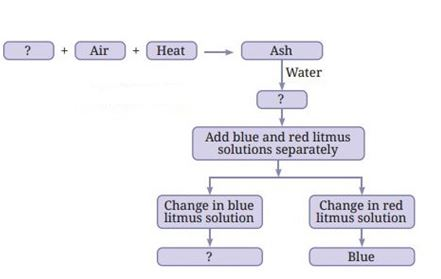
Answer
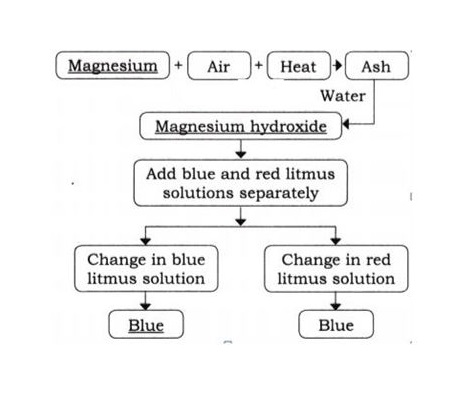
Answer:
Question 8. You are provided with the following materials. Discuss which material would be your choice to make a pan that is most suitable for boiling water and why?
Answer: For boiling water, the pan must be made of a material that is a good conductor of heat. Among the given materials, only iron and copper are metals and both are good conductors of heat. However, copper is the best choice because it is highly resistant to rust compared to iron. Therefore, a pan made of copper is the most suitable choice for boiling water.
Question 9. You are provided with three iron nails, each dipped in oil, water and vinegar. Which iron nail will not rust, and why?
Answer: The iron nail dipped in oil will not rust because the oil prevents the iron nail from coming into contact with air or moisture. It forms a protective layer on the metal, which prevents rusting.
Question 10. How do the different properties of metals and non-metals determine their uses in everyday life?
Answer:
Metals and non-metals have various properties that make them useful in our everyday life.
Metals:
- Metals are malleable, for example, aluminium foil is used for wrapping food.
- Metals are ductile, wires made of copper or aluminium are used in electrical fittings.
- Metals are sonorous, they produce a ringing sound.
- Metals are good conductors of heat, so they are used in making cooking vessels.
- Metals are good conductors of electricity, making them ideal for electrical wires.
Non-metals:
- Generally non-metals are poor conductor of heat and electricity; for example, sulphur and carbon are used in insulating materials to prevent the transfer of heat or electricity.
- Non-metals are brittle: for example, sulphur and phosphoros are often used in matchsticks as they break easily or react quickly.
- Non-metals are gaseous at room temperature: for example, oxygen is essential for breathing.
- Non-metals are non-lustrous: carbon (as graphite) are used in pencils and dry cell batteries.
Question 11. One of the methods of protecting iron from getting rusted is to put a thin coating of zinc metal over it. Since sulphur does not react with water, can it be used for this purpose? Justify your answer.
Answer: No, sulphur cannot be used to protect iron from rusting. While sulphur does not react with water, it does not have the property of forming a protective layer over iron like zinc. It cannot prevent air and moisture from coming into contact with the iron.
Question 12. An ironsmith heats iron before making tools Why is heating necessary in this process?
Answer: For making tools, a ironsmith first heats a piece of iron until it becomes red-hot. This is because heating makes the iron soft, more malleable and easier to bend, hammer and mould into the desired shape for tools.
(Activities)
Activity 4.1: Let Us Explore (Pages 42-43)
Observation: Table 4.1: Appearance, hardness, and effect of hammering on different objects or materials
|
Object/Material |
Appearance (lustrous/non-lustrous) |
Hard/Soft |
Effect of hammering (fattens/ breaks into pieces) |
|
Piece of copper |
Lustrous |
Hard |
Flattens |
|
Piece of aluminium |
Lustrous |
Hard |
Flattens |
|
Iron nail |
Lustrous |
Hard |
Flattens |
|
Piece of coal |
Non-lustrous |
Soft |
breaks into pieces |
|
Lump of sulphur (pea-sized) |
Non-lustrous |
Soft |
breaks into pieces |
|
Block of wood |
Non-lustrous |
Hard but not hard as metal |
Neither flattens nor breaks into pieces |
Conclusion:
• Materials like copper, aluminium and iron are lustrous, hard and can be flattened into thin sheets.
• Materials like coal, sulphur are non-lustrous, soft and breaks into pieces. Wood is neither malleable nor brittle.
Activity 4.2: Let Us Investigate (Pages 45 – 46)
Observation: Metal spoon and metal coin produce a ringing sound. On the other hand, coal and wood produce dull sounds.
Conclusion: Metals are sonorous, they produce a ringing sound.
Activity 4.3: Let us Investigate (Pages 46-47)
Observation: Metal spoon is hotter to touch than wooden spoon.
Conclusion: Heat transfers through the metal spoon easily, making it hotter. While heat transfers through the wooden spoon poorly. Hence, metals are good conductors of heat, but wood is a poor conductor of heat.
Activity 4.4: Let Us Design And Create (Pages 47-48)
Observation: Table 4.2: Conduction of electricity by different objects or materials
|
Object/ Material |
Observation (bulb glows/ does not glow) |
Good conductor of electricity or poor conductor of electricity |
|
Piece of aluminium foil |
Bulb slows |
Good conductor of electricitv |
|
Iron nail |
Bulb glows |
Good conductor of electricitv |
|
Lump of sulphur (peasized) |
Bulb does not glow |
Poor conductor of electricity |
|
CooDer wire |
Bulb glows |
Good conductor of electricity |
|
Piece of coal |
Bulb does not glow |
Poor conductor of electricity |
|
Piece of dry wood |
Bulb does not glow |
Poor conductor of electricity |
|
Stone |
Bulb does not glow |
Poor conductor of electricity |
Conclusion:
• Materials like aluminium, iron and copper allows electricity to pass through them. So, they are good conductors of electricity.
• Materials like sulphur, coal, dry wood, stone, eraser and nylon do not allow electricity to pass through them. So, they are poor conductors of electricity.
Activity 4.5: Let Us Experiment (Pages 49-50)
Observation: Table 4.3: Formation of brown deposit on iron nails
|
Glass Bottle A |
Conditions |
Observations |
|
|
Presence of water (Yes/No) |
Presence of air (Yes/No) |
||
|
A |
No |
Yes |
No brown denosit on iron nail |
|
B |
Yes |
No |
No brown denosit on iron nail |
|
C |
Yes |
Yes |
Brown deposits on iron nail |
Conclusion: The presence of both air and water is essential for the brown deposit to be formed on iron (rusting of iron).
Activity 4.6: Let Us Investigate (demonstration activity) (Page 51)
Observation:
• Magnesium ribbon burns with a dazzling white flame and changes into a white powder (ash).
• The solution changes the colour of red litmus paper to blue.
Conclusion:
• Magnesium burns with oxygen in the air and produces magnesium oxide.
• The oxides of metals are generally basic in nature.
Activity 4.7: Let Us Experiment (demonstration activity) (Pages 52-53)
Observation: The solution obtained after the addition of water to the glass jar turns blue litmus paper to red.
Conclusion:Sulphur burns with oxygen in the air and produces sulphur dioxide gas. On dissolving sulphur dioxide gas in water, sulphurous acid is formed, which turns blue litmus paper to red. Thus, oxides of non-metals are acidic in nature.
Activity 4.8: Let Us Explore (Page 53)
Observation: When sulphur is placed in water, no reaction occurs.
Conclusion: Sulphur does not react with water.