Lesson 1. Matter In Our Sorroundings Notess
Take the QuizIntroduction
Since early times human beings have been trying to understand their nature. Early Indian philosopher classified matter into five basic elements. The “Panch Tatva”– air, earth, fire, sky and water. According to them, living as well as non living things are made up of these elements. Nowadays, scientists evolved to types of classification of matter – physical properties and chemical nature.
Physical Nature of Matter
Matter is made up of very small particles called atoms. These particles of matter are too small so they cannot be seen by naked eyes or simple microscope. Particles of matter are continuously moving as they posses kinetic energy, with the increase of temperature kinetic energy of particles also increases so particle moves faster. There is a force of attraction between particles and the force is strongest in solids, weaker in liquids, and very weak in gases.
Diffusion
Brownian Motion
The zigzag or random path travelled by the particles of matter is called Brownian motion. Intermixing of particles of two different types of matter on their own is called diffusion. The rate of diffusion increases on increasing the temperature of the diffusing substance (by heating). It is natural process. It takes place in solid, liquid and gas.
Characteristics of Particles of Matter
-
Particles of matter have space between them
Gas can be compressed a lot because of the space between their particles. When sugar is dissolved in water, the particles of sugar disappear in water. This happens because particles of sugar get adjusted in the spaces between the particles of water. Additionally, you will notice that there is no rise in water level when one or two teaspoons of sugar are added to a glass of water. This is because sugar particles occupy the spaces between water particles. -
Particles of matter attract each other because of force of attraction
The force of attraction between particles of matter keeps them bonded together. The force of attraction is greatest in solids, moderate in liquids, and lowest in gases. Because of the very low force of attraction in gases, we can move our hand through air easily. In liquids like water, some force is required, and in solids like wood, movement is not possible. Hence, the order of force of attraction is: Solid > Liquid > Gas
States of Matter
Solid State
- The space between the particles is very less.
- The force of attraction between the particles is strong. Thus, particles in a solid are closely packed.
- Solids maintain their shape even when they are subjected to external force i.e. they are rigid.
- Solids cannot be compressed
- The kinetic energy of the particles is very less and so solids have an orderly arrangement of the particles. Therefore, solids have a fixed shape and volume.
Liquid State
- The space between the particles is slightly more as compared to solids, but still very less as compared to gases. The particles of a liquid can slip and slide over each other.
- The force of attraction between the particles is strong enough to hold the particles together but not strong enough to hold the particles in a fixed position.
- Liquids do not have a fixed shape but have a fixed volume. Liquids take up the shape of the container in which they are poured.
- The kinetic energy of the particles is more than that of solids. Thus, liquids have a disorderly arrangement of particles compared to solids.
- Liquids cannot be compressed much. The compressibility of liquids is almost negligible.
Gaseous State
- The particles are much farther apart from one another as compared to solids and liquids. They have a very disorderly arrangement of particles compared to the solids and liquids.
- The force of attraction between the particles is negligible, hence particles of a gas move freely in all the directions. Gases thus can mix or diffuse into other gases.
- The particles of a gas have maximum kinetic energy. They move with high speed in all directions and can exert pressure on the walls of its container.
- Gases neither have a definite shape nor a definite volume. They fill up the container completely.
- Gases can be compressed easily. Example: the LPG cylinders used at home and the CNG cylinders used in vehicles.
| Property | Solid | Liquid | Gas |
|---|---|---|---|
| Shape and volume | Fixed shape and volume | No fixed shape but has volume | No definite shape or volume |
| Energy | Lowest | Medium | Highest |
| Compressibility | Difficult | Almost difficult | Easy |
| Arrangement of molecules | Regular and closely packed | Random and slightly apart | Random and widely spaced |
| Fluidity | Cannot flow | Flows from higher to lower level | Flows in all directions |
| Movement | Negligible | Moderate (depends on interparticle attraction) | Free, constant, and random |
| Interparticle space | Very small | More | Large |
| Interparticle attraction | Maximum | Medium | Minimum |
| Density | Maximum | Medium | Minimum |
| Rate of diffusion | Negligible | Moderate (depends on particle interaction) | Maximum |
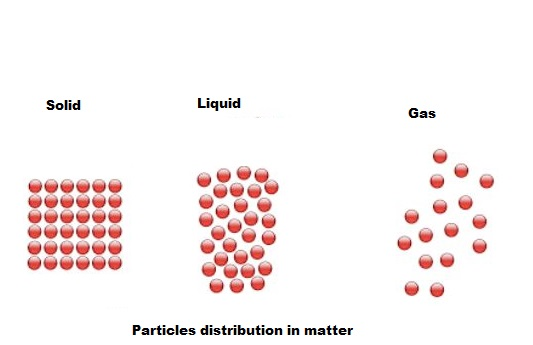
Diagram of change of State of Matter
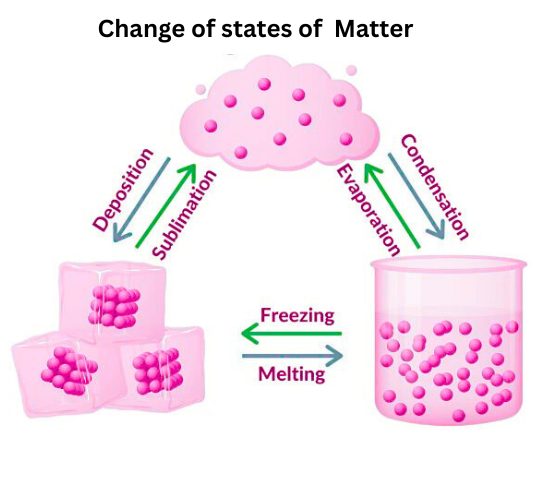
The phenomenon of change from one state of matter to another, and then back to the original state is called the interconversion of states of matter. Matter Can Change its State. Water can exist in three states of matter:
• Solid as ice
• Liquid as water
• Gas as water vapour
Effect of Temperature
- On increasing the temperature of solids, the kinetic energy of the particles increases which overcomes the forces of attraction between the particles thereby solid melts and is converted to a liquid.
- The boiling point of a liquid is defined as the temperature at which the vapour pressure of the liquid is equal to the atmospheric pressure.
- The temperature at which a solid melts to become a liquid at the atmospheric pressure is called its melting point. The melting point of ice is 16 K.
The process of melting, that is, change of solid state into liquid state is also known as fusion.
Latent heat
The hidden heat which breaks the force of attraction between the molecules is known as thelatent heat. Since, the heat energy is hidden in the bulk of the matter, it is called latent heat.
Latent heat of fusion
It is the heat energy required to convert 1 kilogram of a solid into liquid at atmospheric pressure, at its melting point. The temperature at which a liquid starts boiling, at atmospheric pressure, is called its boiling point. Boiling is a bulk phenomenon. Particles from the bulk of the liquid gain energy to change into the gaseous state. For example, boiling point of water is 100° C. (or 100° C = 273 + 100 = 373 K)
Latent heat of vaporisation
- The heat energy required to convert 1 kilogram of liquid into gas, at atmospheric pressure, at its boiling point, is known as the latent heat of vaporisation
- The process, in which a gas, on cooling, turns into a liquid at a specific temperature is calledcondensation or liquefaction.
- Formation of clouds is due to the condensation of water vapour from the Earth’s surface.
- The change of state of a substance directly from a solid to gas, without changing into the liquid state (or vice versa) is called sublimation.
- The temperature at which the state of a substance changes from a liquid to a solid is called the freezing pointof that substance.
- When a solid melts, its temperature remains the same because heat gets used up in changing the
state by overcoming the forces of attraction between the particles. It is considered that it gets
hidden into the contents of the beaker and is known as the latent heat. - Water vapour at 373 K have more energy than water at the same temperature because
particles in steam have absorbed extra energy in the form of latent heat of vaporisation.
Effect of change of pressure
- Gases can be liquefied by applying pressure and reducing the temperature. When a high pressure is applied to a gas, it gets compressed and if the temperature is lowered, the gas is liquefied.
- Solid CO2gets converted directly to gaseous state on decrease of pressure to 1 atmosphere without coming into liquid state. This is the reason that solid carbon dioxide is also known as dry ice.
Evaporation
The process of conversion of a substance from the liquid state to the gaseous state at any temperature below its boiling point is called evaporation or vaporisation. Evaporation is a surface phenomenon. Factors Affecting Evaporation arer:
- Temperature:The rate of evaporation increases with an increase in temperature.
- Surface area: The rate of evaporation increases with an increase in surface area.
- Humidity:The rate of evaporation decreases with an increase in humidity.
- Wind speed:The rate of evaporation increases with an increase in wind speed.
Sublimation
The transition of a substance directly from its solid phase to gaseous phase without changing into the liquid phase (or vice versa) is called sublimation.
Factors affecting the rate of evaporation
- The rate of evaporation increases on increasing the surface area of the liquid.
- The rate of evaporation increases with an increase in temperature.
- Decrease in the humidity increases the rate of evaporation.
- An increase in the wind speed increases the rate of evaporation.
Evaporation causes cooling
The particles of liquid absorb energy from the surrounding to regain the energy lost during evaporation. This absorption of energy from the surroundings make the surroundings cold. Lately, scientists are talking about five states of matter or five phases of matter. These are-solids, liquids, gases, plasmas and the Bose–Einstein condensate.
Plasma
The state consists of super energetic and super excited particles. These particles are in the form of ionised gases. The fluorescent tube and neon sign bulbs consist of plasma.
Bose-Einstein Condensate
→ Indian physicist Satyendra Nath Bose made a study regarding the fifth state of matter. Based on his study, Albert Einstein predicted a fifth state of matter called the Bose-Einstein Condensate.
→ The Bose-Einstein Condensate or BEC is formed by cooling a gas of extremely low density to super low temperatures.
Some Important Measurements
- The SI unit of mass is kilogram (kg).
- The SI unit of volume is cubic metre (m3). The common unit of measuring volume is litre (L) such that 1L = 1 dm3, 1L = 1000 mL, 1 mL = 1 cm3.
- Kelvin is the SI unit of temperature, 0° C = 273.16 K. For convenience, we take 0° C = 273 K
after rounding off the decimal. To change a temperature on the Kelvin scale to the Celsius scale
you have to subtract 273 from the given temperature, and to convert a temperature on the
Celsius scale to the Kelvin scale you have to add 273 to the given temperature. - Atmosphere (atm) is a unit of measuring pressure exerted by a gas. The unit of pressure is Pascal (Pa): 1 atmosphere = 101325 Pa. The pressure of air in atmosphere is called atmospheric pressure.
- The atmospheric pressure at sea level is 1 atmosphere, and is taken as the normal atmospheric pressure.
Text Book Solutions
Question 1. Which of the following is matter?
{Chair, air, love, smell, hate, almonds, thought, cold, drink, smell of perfume}
Answer: Chair, air, smell, almonds, cold, cold drink, smell of perfume are matter.
Question 2. Give reasons for the following observation:
The smell hot sizzling food reaches you several metres away, but to get the smell from cold food you have to go close.
Answer: When food is hot, diffusion is more. But in cold food diffusion is slow. Hence, to get the smell from cold food we have to go close.
Question 3.A driver is able to cut through water in a swimming pool. Which property of matter does this observation show?
Answer: This observation shows that particles of matter have kinetic energy.
Question 4. What are the characteristics of the particles of matter?
Answer: The characteristics of particles are as follows:
- Particles of matter have space between them.
- Particles of matter are continuously moving.
- Particles of matter attract each other.
Question 5. The mass per unit volume of a substance is called density (density = mass /volume). Arrange the following in order of increasing density – air, exhaust from chimneys, honey, water, chalk, cotton and iron.
Answer: air, water, exhaust from chimneys, chalk, cotton, honey, iron.
Question 6. (a) Tabulate the differences in the characteristics of state of matter.
(b) Comment upon the following: rigidity, compressibility, fluidity filling a gas container, shape, kinetic energy and density.
Answer: (a) Differences in the characteristics of states of matter
| Solids | Liquids | Gases |
|---|---|---|
| Solids have a definite shape and fixed volume. | Liquids have no fixed shape but have a fixed volume. | Gases have particles that move randomly at high speed and have more space between particles. |
Answer:
b):
- Rigidity: The condition which does not alters the shape of solids.
- Compressibility: Compressing particles of gases is called compressibility.
- filling a gas container: In the laboratory, after the preparation of gases, they are collected in gas jar. This is called filling a gas container.
- Fluidity: Fluidity means flowing of liquids freely.
- Shape: Things are in which form is called shape.
- Kinetic energy: The energy possessed by moving body is called kinetic energy.
- Density: Density is the mass per unit
Question 7. Give reasons:
(a) A gas fills completely the vessel in which it is kept.
(b) A gas exerts pressure on the walls of the container.
(c) A wooden table should be called a solid.
(d) We can easily move our hand in air but to do the same through a solid block of wood we need a karate expert.
Answers:
(a A gas fills completely the vessel because gas occupies space.
(b) A gas exerts pressure on the walls of the container because in the gaseous state, the particles move about randomly at high speed. Due to this random movement, the particles hit each other and also the walls of the container. The pressure exerted by the gas is because of this force exerted by gas particles per unit area on the walls of the container.
(c) A wooden table should be called a solid because in the wooden table particles are closely packed and have less space in between particles.
(d) We can easily move our hand in air as it has more space in between particles. But solid block of wood is rigid, hence it is difficult to move our hands through it.
Question 8. Liquids generally have lower density as compared to solids. But you must have observed that ice Boots on water. Find out why?
Answer: Density of ice is lesser than water. Hence ice floats on water.
Question 9. Convert the following temperature to Celsius scale.
(a) 300 K
(b) 573K
Answer:
(a) 300 – 273
= 27° C
∴ 300K means 27° C.
(b) 573 K
573 – 273 = 300° C
∴ 573K means 300° C.
Question 10. What is the physical state of water at:
(a) 250° C
(b) 100° C
Answer: (a) Water changes to water vapour at 250° C temperature (b) Water changes to water vapour at 100°C.
Question 11. For any substance, why does the temperature remain constant during the change of state?
Answer: Because with the increase of temperature, more number of particles get enough kinetic energy to go into the vapour state. Hence temperature remains constant during the change of state.
Question 12. Suggest a method to liquefy atmospheric gases.
Answer: L.P.G. which is used for cooking. In the cylinder petrol is in liquid form. When it is lighted it becomes gas.
Question 13. Why does a desert cooler cool better on a hot dry day?
Answer: The particles of liquid in desert cooler absorb energy from the surrounding to regain the energy lost during evaporation. In summer, this is fast. Hence, desert cooler cool better in a hot dry day.
Question 14.How does the water kept in an earthen pot (matka) become cool during summer?
Answer: Water loses its temperature through small pores present in the pot. Hence in an earthen pot (matka) become cool during summer.
Question 15. Why does our palm feel cold when we put some acetone or petrol or perfume on it?
Answer: Because acetone or petrol or perfume looses their temperature and gain energy by using from surrounding air.
Question 16. Why are we able to sip hot tea or milk faster from a saucer rather than a cup.
Answer: Because in a saucer, the surface is broad comparing to cup and here rate of evaporation is greater. Hence we are able to sip hot tea or milk faster from a saucer rather than a cup.
Question 17. What type of clothes should we wear in summer?
Answer: During summer we should wear cotton clothes because cotton absorbs heat quickly and evaporate and helps to cool our body.
Question 1. Convert the following temperatures to the Celsius scale.
(a). 293 K
(b). 470 K
Answer: (a) 293K – 273K = 20° C
(b) 470 K – 273 K = 197° C.
Question 2. Convert the following temperatures to the Kelvin scale.
a) 25° C
b) 373° C
Answer: a) 25° C
= 25°+ 273
= 298 K
b) 373° C
= 373 + 273
= 646K.
Question 3. Give a reason for the following observations.
a) Naphthalene balls disappear with time without leaving any solid.
b) We can get the smell of perfume sitting several meters away.
Answer: a) Because Naphthalene changes its state from solid to gaseous matter. Hence it disappears with time without leaving any solid,
b) Because of particles of perfumes diffuse in the air with higher speed and reaches our nose.
Question 4. Arrange the following substances in increasing order of forces of attraction between the particles – water, sugar, oxygen.
Answer: Sugar, water, oxygen.
Question 5. What is the physical state of water- at
a) 25° C
b) Q° C
c) 100° C
Answer: a) 25° C – liquid state
b) 0° C – Ice
c) 100° C – water vapour.
Question 6. Give two reasons to justify-
a. Water at room temperature is liquid.
b. an iron almirah is a solid at room temperature.
Answer:
a)
- Temperature of the room is lesser, so there is no change of state of water, hence it is liquid at room temperature,
- Pressure is low.
b)
- Temperature is less,
- Pressure is low.
Question 7. Why is ice at 273 k. More effective in cooling than water at the same temperature?
Answer:
Because at 0° C (273 K) particles of water have more energy comparing it to water at the same temperature.
Question 8. What produces more severe burns, boiling water or steam.
Answer: Steam causes severe burns comparing to boiling water or steam.
Question 9. Name A, B, C, D, E and F the following diagram showing the change in its state.
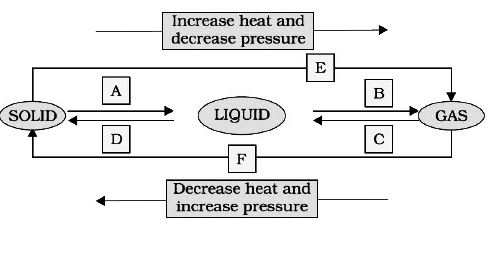
A] Indicates heating
B] Indicates heating
C] Indicates cooling
D] Indicates cooling.
E] Indicates sublimation.
F] Indicates sublimation.
Additional Questions and Answers
Question 1. Why should we wear cotton clothes in summer?
Answer : Cotton is a good absorber of water helps in absorbing the sweat and exposing it to the atmosphere for easy evaporation.
Question 2. Mention the advantages of CNG.
Answer :Due to high compressibility, large volumes of a gas can be compressed into a small cylinder and transported easily.
Question 3. Why do we see water droplets on the outer surface of a glass containing ice-cold water?
Answer : The water vapor present in air on coming in contact with the cold glass of water. It loses energy and gets converted to the liquid state.