Light is a form of energy that enables us to see the objects around us. Without light,
the world would be in complete darkness. When light interacts with different objects, it
produces interesting effects such as shadows and reflections.
A shadow is formed when an opaque object blocks the path of light,
while a reflection occurs when light bounces off a shiny surface like a mirror.
These basic concepts help explain everyday phenomena like seeing our image in water or the shadow
cast by a tree in sunlight.Understanding these concepts lays the foundation for various scientific applications
such as cameras, mirrors, periscopes, and solar panels.Understanding the behavior of light helps us use mirrors, lenses, projectors, fiber optics,
and other optical technologies in daily life and scientific applications.
In this lesson, you will learn about:
Light is a form of energy that travels in the form of electromagnetic waves and enables us to see
objects. It is the visible part of the electromagnetic spectrum and does not require a medium to travel ,
it can move through vacuum.
-
Light Travels in a Straight Line:
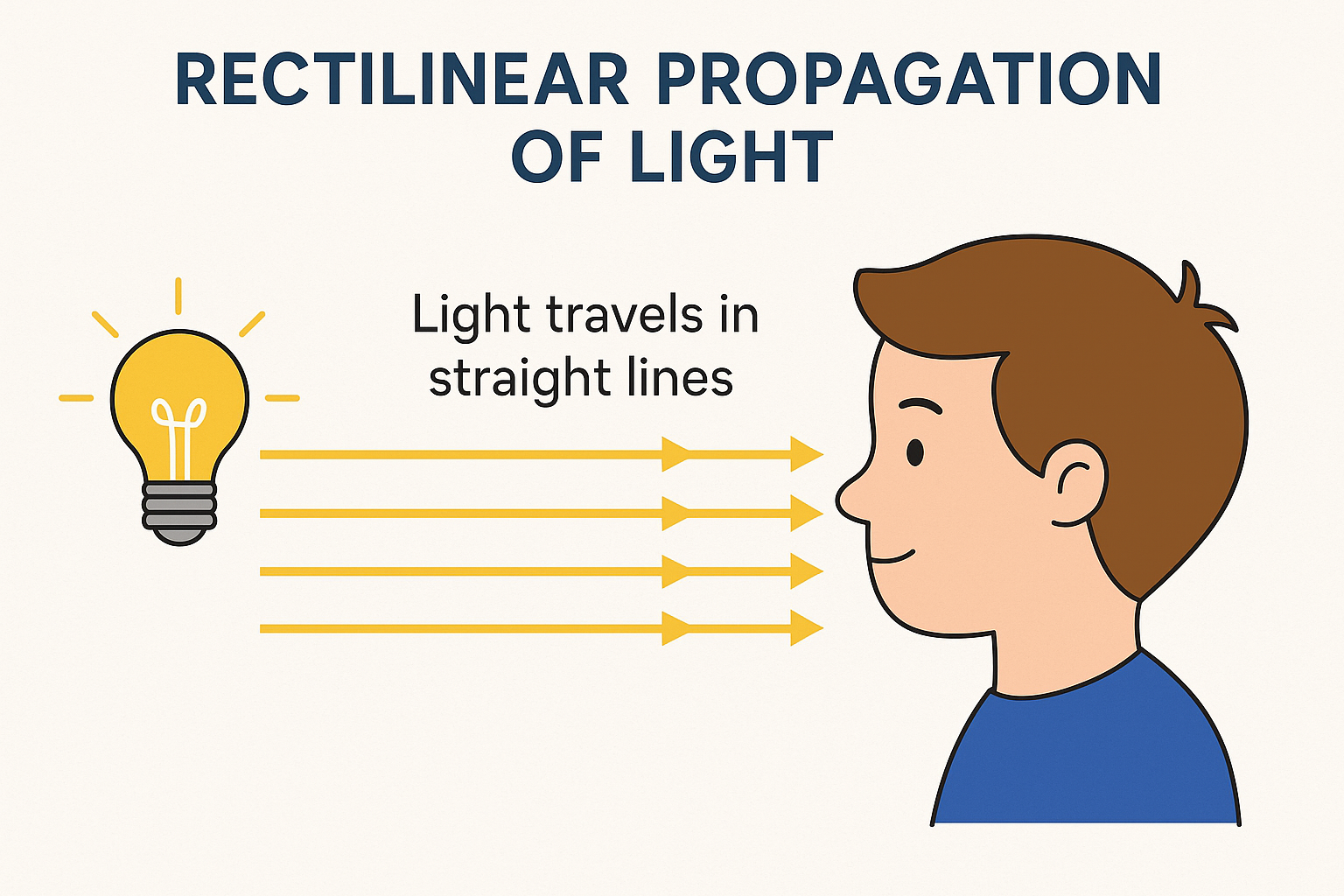 Light moves in a straight path in a uniform medium, the pehenomenon is called rectilinear propagation.
. This property of light explains why shadows form and why we cannot see around corners.
When light encounters an opaque object, it is blocked, creating a well-defined shadow — further proving
that light does not bend on its own. This principle is the foundation of devices like pinhole cameras and
explains the path of light beams from lasers, torches, and the sun, which all follow straight-line
trajectories unless reflected or refracted.
Light moves in a straight path in a uniform medium, the pehenomenon is called rectilinear propagation.
. This property of light explains why shadows form and why we cannot see around corners.
When light encounters an opaque object, it is blocked, creating a well-defined shadow — further proving
that light does not bend on its own. This principle is the foundation of devices like pinhole cameras and
explains the path of light beams from lasers, torches, and the sun, which all follow straight-line
trajectories unless reflected or refracted.
-
Reflection of Light:
When light hits a smooth surface like a mirror, it bounces back. This is called reflection. It follows the law of reflection where the angle of incidence equals the angle of reflection.
-
Refraction of Light:
Refraction is the bending of light when it passes from one medium to another. This explains why a pencil appears bent in water.
-
Dispersion of Light:
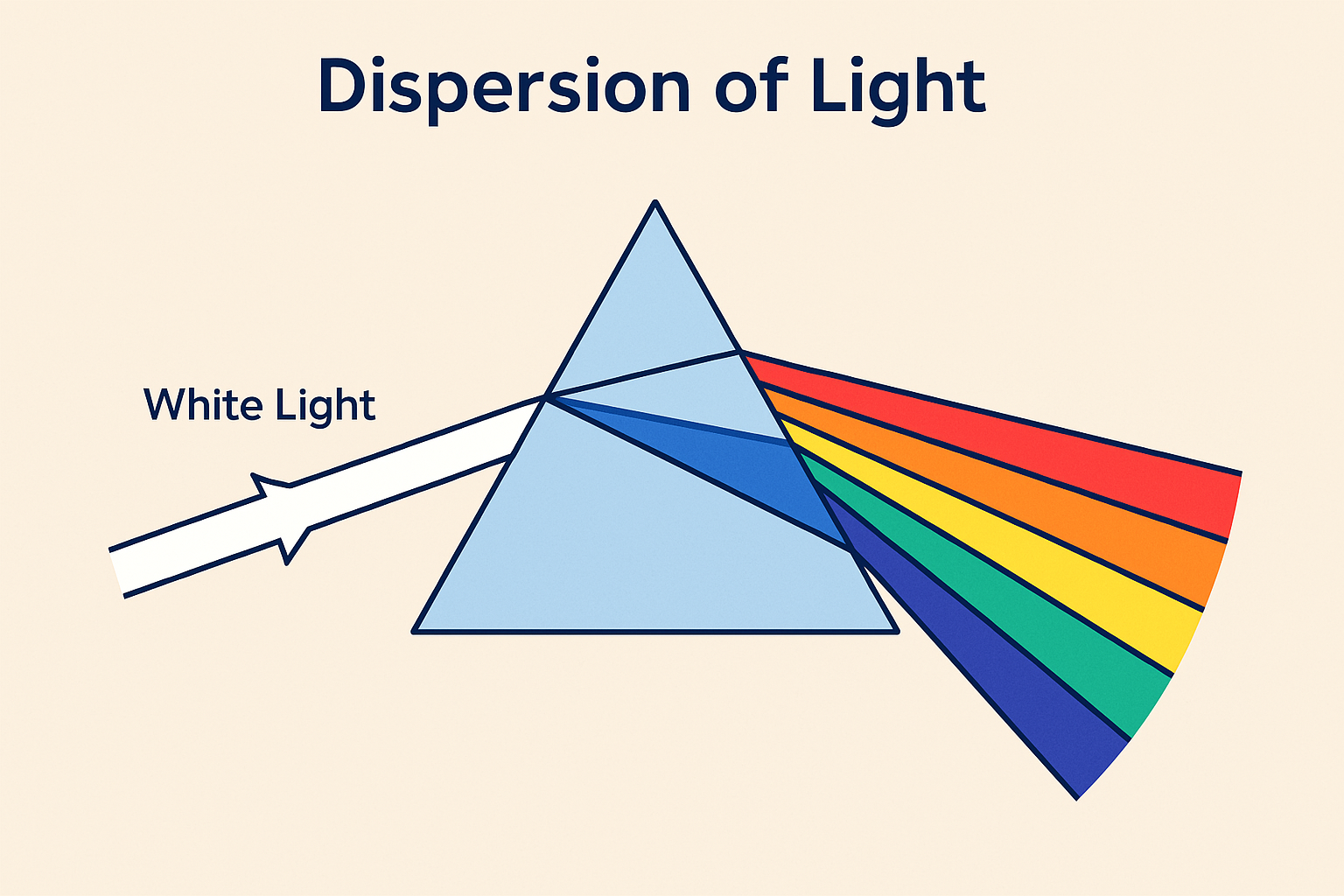 White light splits into seven colors (VIBGYOR) when it passes through a prism. This is called dispersion and is observed in rainbows.
-
Light Has Dual Nature:
Light behaves both as a wave and a particle. It shows interference like a wave and carries energy in particles called photons.
-
Speed of Light:
The speed of light in a vacuum is approximately 3 X 10⁸ m/s. It slows down when it enters denser materials like water or glass.
Sources of Light
Light helps us to see the objects around us. Objects that emit light on their own are called sources of light. These sources can be naturally occurring or man-made, and they can be further classified based on their ability to emit light.
Classification of Light Sources
- Natural Sources of Light: Natural sources of light are those that occur in nature
and emit light on their own without any human invention or intervention. These sources provide
illumination naturally and have been present long before artificial light sources were invented.
The Sun is essential for life on Earth, driving photosynthesis in plants
and maintaining the climate while stars help us understand space and navigation.
Natural light cycles regulate the day-night rhythm and biological processes in living beings.
- Artificial Sources of Light: Artificial sources of light are man-made objects or devices that produce
light through various mechanisms like electricity, combustion, or chemical reactions.
These sources were developed by humans to provide light when natural light is unavailable,
such as at night or in dark spaces.
| Type |
Examples |
Description |
| Natural Sources |
Sun, Stars, Fireflies, Lightning |
Occur in nature and emit light naturally |
| Artificial Sources |
Bulbs, Candles, Tube lights, LED |
Created by humans to produce light |
Luminous and Non-Luminous Objects
Light is essential for vision, and we see objects around us because of the light they emit or reflect. Based on their ability to produce light, objects are classified into luminous and non-luminous objects.
💡 Luminous Objects
Luminous objects are those that produce and emit their own light. These objects are visible on their own without the need for an external light source. The light produced may be due to heat (incandescence), chemical reactions, or other energy sources.
- Examples: Sun, stars, electric bulb, candle, fireflies, tube light, torch.
- Characteristics:
- They are natural or artificial sources of light.
- They enable us to see other objects by illuminating the surroundings.
- They may emit light continuously (bulb) or periodically (flashing LED).
🌑 Non-Luminous Objects
Non-luminous objects do not produce their own light. We can see them only when light from a luminous object reflects off their surface and reaches our eyes.
- Examples: Moon, books, trees, tables, walls, people.
- Characteristics:
- They do not emit any light of their own.
- They are visible only when illuminated by a light source.
- They can reflect, absorb, or block light.
📊 Comparison Table
| Feature |
Luminous Objects |
Non-Luminous Objects |
| Light Production |
Emit their own light |
Do not emit light |
| Visibility |
Visible on their own |
Visible only by reflected light |
| Examples |
Sun, bulb, candle, firefly |
Moon, chair, wall, human |
| Type |
Light source |
Object illuminated by a source |
Understanding the difference between luminous and non-luminous objects helps in identifying sources
of light and understanding how visibility works in the natural and artificial world.
Comparison Between Natural and Artificial Sources of Light
| Feature |
Natural Sources of Light |
Artificial Sources of Light |
| Definition |
Sources of light that occur naturally and emit light on their own without human involvement. |
Man-made sources that produce light using electricity, chemicals, or combustion. |
| Origin |
Created by nature (e.g., Sun, stars, lightning). |
Created by humans (e.g., bulb, tube light, LED). |
| Examples |
Sun, stars, fireflies, lightning, glowworms. |
Electric bulbs, LEDs, tube lights, candles, lasers. |
| Energy Source |
Derive energy from natural processes like nuclear fusion or bioluminescence. |
Depend on external energy sources like electricity or fuel. |
| Control Over Light |
Cannot be controlled by humans. |
Can be switched on/off and controlled as needed. |
| Usage Time |
Mostly available during the day (e.g., Sun); may be temporary (e.g., lightning). |
Can be used anytime as per convenience. |
| Intensity |
Usually very bright and powerful (e.g., sunlight). |
Varies from dim (candles) to very bright (lasers, LEDs). |
| Environmental Impact |
Eco-friendly and part of natural cycles. |
May contribute to energy consumption and pollution if not managed properly. |
Classification of Objects based on the light passage
Objects are classified based on how much light they allow to pass through them. This classification helps us understand visibility, shadow formation, and the behavior of light when it strikes different materials.
🔳 Opaque Objects
Opaque objects do not allow any light to pass through them. Instead, they either reflect or absorb all the incident light. Because light cannot travel through them, these objects form dark and well-defined shadows.
- Examples: Wood, metal, stone, book, wall
- Characteristics:
- No light transmission
- Forms sharp shadows
- Objects behind them are not visible
🔲 Translucent Objects
Translucent objects allow some light to pass through, but not clearly. Light is scattered as it passes, so objects on the other side appear blurred or unclear.
- Examples: Frosted glass, butter paper, wax paper, oiled paper
- Characteristics:
- Partial light transmission
- Creates faint or blurry shadows
- Only outlines of objects are visible
⬜ Transparent Objects
Transparent objects allow almost all light to pass through them. As a result, you can clearly see through these objects without any distortion.
- Examples: Clear glass, clean water, air, plastic wrap
- Characteristics:
- Full light transmission
- Do not form shadows (or very faint ones)
- Objects behind are clearly visible
📊 Comparison Table
| Feature |
Opaque |
Translucent |
Transparent |
| Light Transmission |
Does not allow light |
Allows some light |
Allows all/most light |
| Visibility Through |
Not visible |
Partially visible |
Clearly visible |
| Shadow Formation |
Dark and sharp |
Faint and blurred |
Very faint or no shadow |
| Examples |
Wood, metal, book |
Frosted glass, tracing paper |
Clear glass, water, air |
Understanding the properties of materials based on their transparency helps in choosing the right materials for windows, doors, lampshades, packaging, and scientific instruments.
Propagation of Light
Light is a form of energy that travels in the form of waves. The propagation of light refers to the way light moves or spreads through different mediums. One of the most important characteristics of light is that it travels in a straight line. This is known as the rectilinear propagation of light.
This principle can be observed in everyday life. For example, if you shine a torch in a dark room, the beam of light forms a straight path. Light cannot bend around corners; instead, it gets blocked, leading to the formation of shadows.
Conditions for Light Propagation
- Light travels faster in vacuum (~3 X 10⁸ m/s).
- It slows down in denser mediums like water or glass.
- Light does not need a medium to travel as it can propagate in vacuum.
Examples of Rectilinear Propagation
- Shadows formed when an object blocks sunlight.
- Laser beams traveling in a straight line.
- Light from a projector forming a sharp image on a screen.
This property of light is essential in the working of devices like pin-hole cameras, projectors, and the study of **eclipses**.
Behavior of Light
Light exhibits several behaviors when it interacts with different materials and surfaces.
These behaviors help us understand natural phenomena like rainbows, shadows, mirrors, and lenses, and are the basis for many optical instruments.
Main Behaviors of Light
-
Reflection: Light bounces off a surface like a mirror. The angle at which light hits the surface (angle of incidence) is equal to the angle at which it reflects (angle of reflection).
-
Refraction: Light bends when it passes from one medium to another (like air to water). This happens because light travels at different speeds in different materials.
-
Dispersion: White light splits into its seven colors (VIBGYOR) when it passes through a prism. This creates a rainbow effect.
-
Absorption: Some surfaces absorb light energy instead of reflecting or transmitting it. Dark colors absorb more light than light-colored surfaces.
-
Transmission: Light can pass through some materials (like glass or water). These are called transparent or translucent materials.
-
Scattering: Light spreads in different directions when it hits small particles, like dust or air molecules. This explains why the sky appears blue.
Image Formation by Light
When light rays from an object bounce off a surface or pass through optical devices like lenses
or mirrors, they form an image of that object. This process is called image formation.
Images are formed by 2 types of surfaces,Mirrors which use reflection to form images
and lenses use refraction to bend light and create images.
Types of Images
Real and Virtual Images
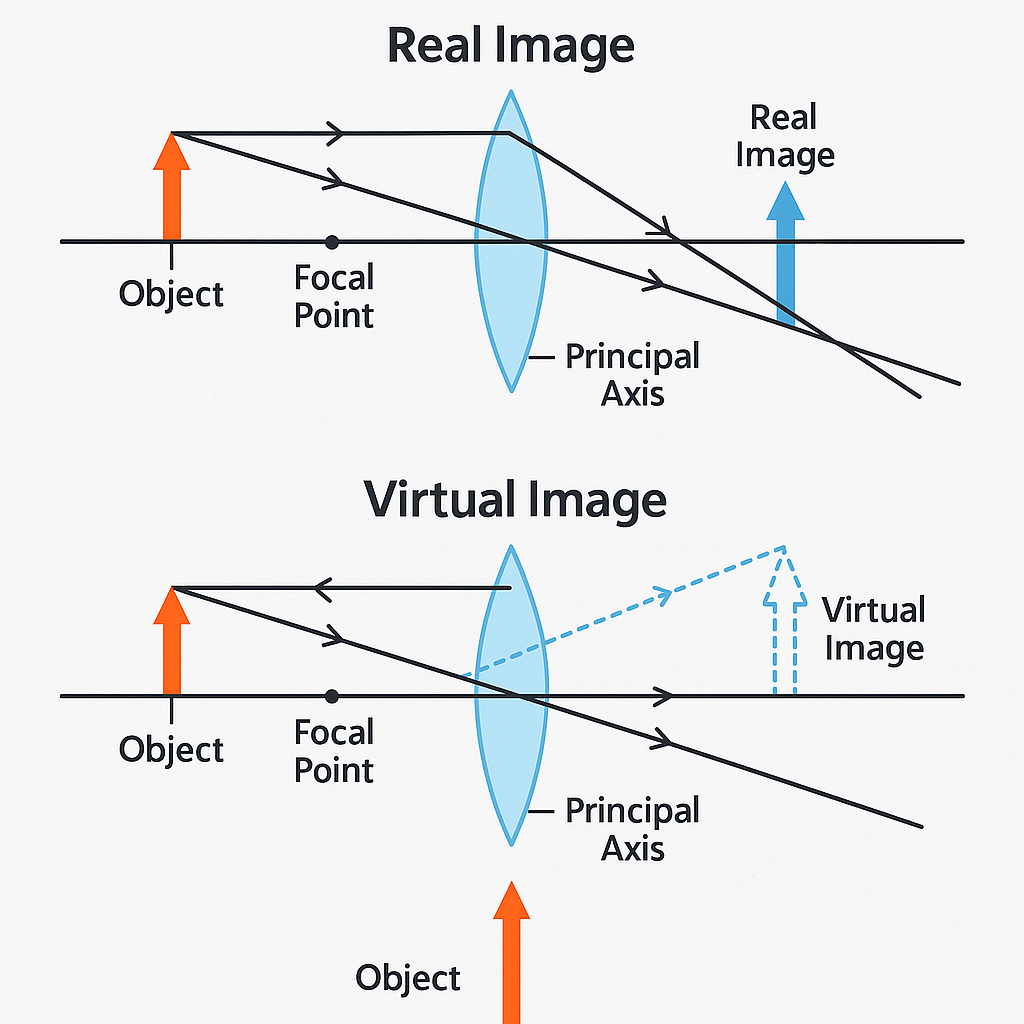
When light rays interact with mirrors or lenses, they form images. The nature of the image formed depends on how the light rays behave after reflection or refraction. Based on this, images are broadly classified into two types: real images and virtual images.
Real Image
A real image is formed when the reflected or refracted light rays actually converge (meet) at a point. These images are formed on the same side as the screen or a surface and can be projected onto it.
- Can be captured on a screen (like in a projector or cinema).
- Always inverted (upside down) with respect to the object.
- Formed by:
- Concave mirrors (when the object is placed beyond the focus)
- Convex lenses (when the object is placed beyond the focal point)
- Examples:
- Image formed on a movie screen using a projector
- Image formed on the retina of the human eye
- Image captured by a camera lens on the film or sensor
Virtual Image
A virtual image is formed when the reflected or refracted rays do not actually meet but appear to come from a point behind the mirror or lens. These images cannot be projected onto a screen because the rays don’t physically intersect.
- Cannot be captured on a screen, only seen by the eye.
- Always upright (same orientation as the object).
- Formed by:
- Plane mirrors (always form virtual images)
- Convex mirrors
- Concave lenses
- Convex lenses (when object is very close, within the focal length)
- Examples:
- Your reflection in a plane mirror
- Rear-view mirror of a vehicle
- Magnifying glass when held close to an object
Comparison Table: Real vs Virtual Images
| Feature |
Real Image |
Virtual Image |
| Light Ray Behavior |
Rays actually meet |
Rays appear to meet |
| Visibility |
Can be projected on a screen |
Cannot be projected |
| Orientation |
Inverted |
Upright |
| Formed by |
Concave mirrors, Convex lenses |
Plane mirrors, Convex mirrors, Concave lenses |
| Common Examples |
Camera, projector, human eye |
Mirror reflection, magnifying glass, rear-view mirror |
Understanding the difference between real and virtual images is essential in the study of optics, and it plays a major role in designing devices like cameras, telescopes, microscopes, and everyday objects like mirrors and lenses.
Understanding image formation helps in designing devices like telescopes, microscopes, cameras, and even eyeglasses.
Reflection of Light
Reflection of light is the phenomenon where light rays bounce off a surface
and change direction, returning into the same medium from which they originated. It occurs when a
light wave strikes a surface and does not get absorbed or transmitted but rather reflects back.Reflection of light is fundamental to vision and optical systems. Understanding how light behaves
when it strikes different surfaces helps in designing instruments and enhancing visibility.
Scientific Definition
Reflection of light is the change in direction of light rays when they strike a surface, such that the angle of incidence equals the angle of reflection.
Laws of Reflection
There are two fundamental laws governing the reflection of light:

-
First Law: The incident ray, the reflected ray, and the normal to the reflecting surface at the point of incidence all lie in the same plane.
-
Second Law: The angle of incidence (i) is equal to the angle of reflection (r), i.e., ∠i = ∠r.
Types of Reflection
-
Regular Reflection: Occurs on smooth, polished surfaces like mirrors. The reflected rays are parallel, and a clear image is formed.
-
Diffuse Reflection: Occurs on rough surfaces where light rays scatter in different directions, and no clear image is formed.
Important Terms
- Incident Ray: The incoming light ray that strikes the surface.
- Reflected Ray: The ray that bounces back from the surface.
- Normal: A perpendicular line drawn to the surface at the point of incidence.
- Angle of Incidence (i): Angle between the incident ray and the normal.
- Angle of Reflection (r): Angle between the reflected ray and the normal.
Fermats Principle of Least Time
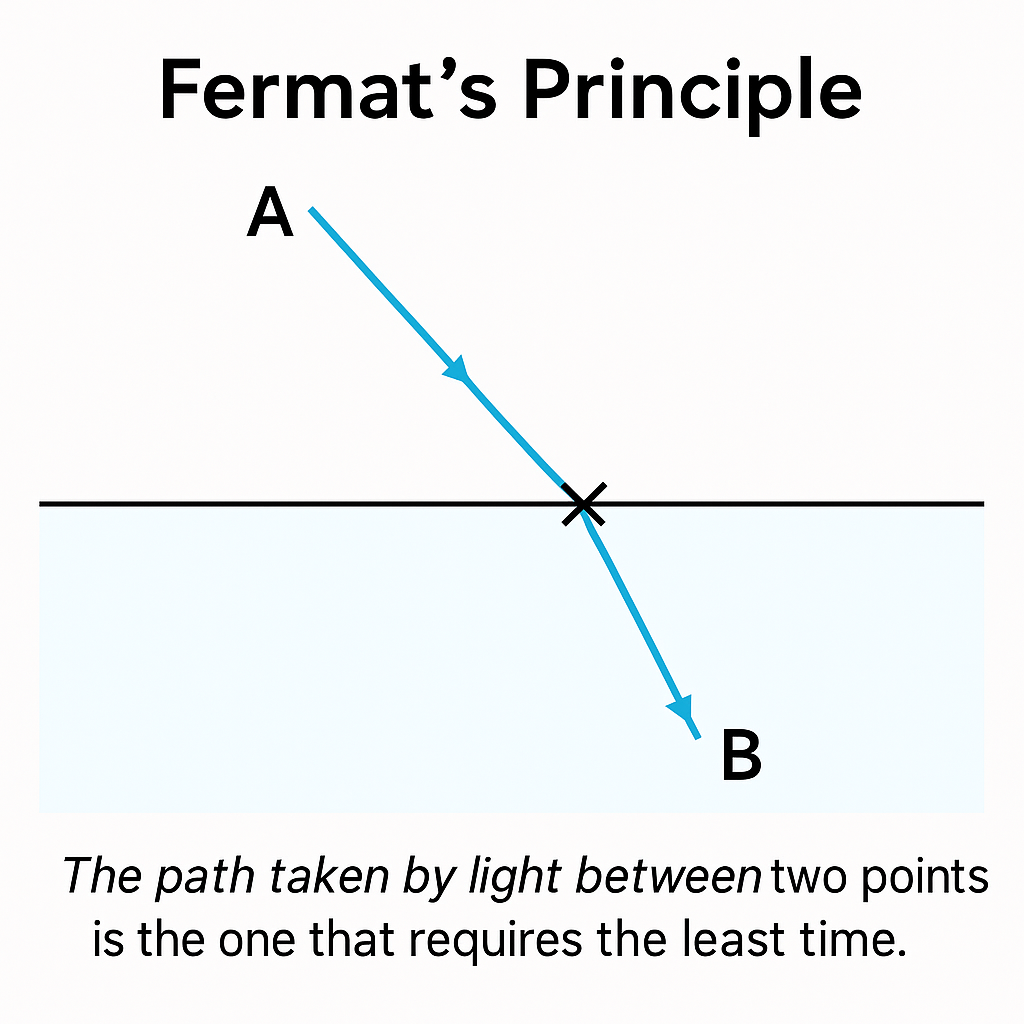
Fermats Principle, also known as the Principle of Least Time, states that:
The path taken by a ray of light between two points is the path that requires the least time.
In simpler terms, when light travels from one point to another especially, when
moving between different media , it chooses the route that allows it to reach the destination in the
shortest possible time.
Scientific Significance
- Fermats Principle explains the laws of reflection and refraction using the idea of time minimization.
- When light moves from air to water, for example, it bends at the boundary to maintain a minimum
travel time , this bending is explained by Snell's Law.
- It forms the foundation of geometrical optics.
Applications
- Explaining why light bends (refracts) when passing through lenses or water
- Understanding how light reflects in mirrors
- Used in designing optical systems like microscopes, telescopes, and cameras
Example
Imagine a lifeguard running on sand and then swimming in water to reach a person.
To get there as quickly as possible, the lifeguard doesn't go in a straight line but chooses
a point on the boundary where they enter the water to minimize total time. Light does the same
as it chooses the optimal path for speed.
Applications of Reflection
- Formation of images in plane and spherical mirrors
- Working of periscopes and kaleidoscopes
- Rear-view mirrors in vehicles
- Use in optical instruments like telescopes
Refraction of Light
When a ray of light passes from one transparent medium to another (such as from air to water),
it changes direction. This bending of light is called refraction.
When light travels from one medium to another,such as from air
to water or from glass to air , it changes its direction. This bending of light is
known as refraction. It occurs because light travels at different speeds
in different media.
Refraction is a fundamental concept in optics and plays a key role in our daily lives, from the way we see objects underwater to how lenses correct vision and focus light in cameras and telescopes.
The behavior of light during refraction follows two fundamental laws.
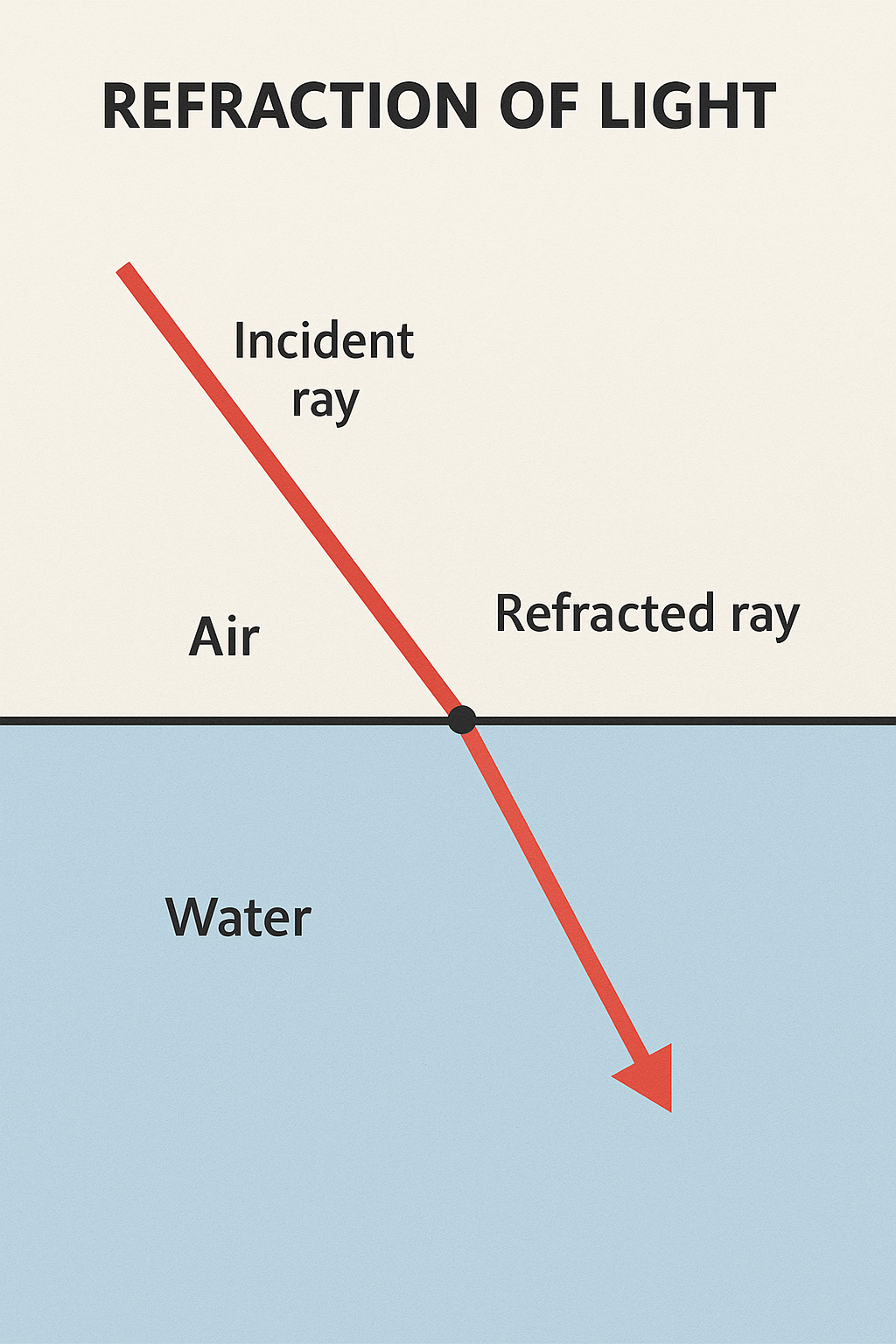
Laws of Refraction of Light
First Law of Refraction:
The incident ray, the refracted ray, and the normal
to the interface of the two media all lie in the same plane.This law ensures that
light follows a predictable path when changing media.
and it is used in ray diagrams to trace light through lenses and prisms accurately.
Second Law of Refraction (Snells Law):
The ratio of the sine of the angle of incidence (i) to the sine of the angle of
refraction (r) is a constant. This constant is called the refractive index (n)
of the second medium with respect to the first:
Snells Law:
sin i / sin r = constant = n
This law explains why light bends more when it enters a denser medium (like glass)
and bends away when it moves to a rarer medium (like air).
Important Terms:
Angle of Incidence (i): The angle between the incident ray and the normal.
- Angle of Refraction (r): The angle between the refracted ray and the normal.
- Refractive Index (n): A measure of how much a medium can bend light. Higher the value, more the bending.
Real-Life Examples:
- A pencil appearing bent in a glass of water.
- The bottom of a swimming pool appearing raised.
- Light focusing through a lens to form an image in a camera or human eye.
These laws help in the design of lenses, microscopes, telescopes, spectacles, and many optical
instruments used in science and daily life.
Image Formation by Plane and Curved Surfaces
Light reflects off surfaces to form images. The nature of the image depends on whether the surface is plane (flat) or curved (spherical). Let's explore how images are formed by both types of mirrors.
Image Formation by a Plane Mirror
A plane mirror has a flat reflecting surface. When light rays reflect from it,
The image formed is virtual (cannot be projected on a screen),and it is
upright (erect). When you look at the image, it is laterally inverted (left and right appear reversed).
with same size as of the object.and is formed at the same distance
behind the mirror as the object is in front.
Plane mirrors are commonly used in bathrooms, dressing mirrors, and periscopes due to their consistent, undistorted image formation.
Image Formation by Curved Mirrors (Spherical Mirrors)
A spherical mirror is a curved mirror that is part of a sphere. There are two types of curved mirrors.
Concave Mirror which is curved inward (like the inside of a spoon) and the
Convex Mirror which is curved outward (like the back of a spoon).
Image Formation by a Concave Mirror
The nature of the image formed by a concave mirror varies depending on the position of the object:
Terminology Related to Spherical Mirror
-
Pole (P): The midpoint of the spherical mirror. It lies on the surface of the mirror and is used as the reference point for measuring distances.
-
Centre of Curvature (C): The center of the sphere of which the mirror is a part. It lies in front of the mirror for concave mirrors and behind for convex mirrors.
-
Radius of Curvature (r): The distance between the pole (P) and the centre of curvature (C). It is twice the focal length.
-
Principal Axis: An imaginary straight line that passes through the pole and the centre of curvature. It is perpendicular to the mirror's surface at the pole.
-
Concave Mirror: A spherical mirror with a reflecting surface that curves inward (like the inside of a sphere).
-
Convex Mirror: A spherical mirror with a reflecting surface that bulges outward (like the outside of a sphere).
-
Focus (F): The point where parallel rays of light, after reflecting from a concave mirror, converge (meet). For a convex mirror, it's the point from which rays appear to diverge.
-
Focal Length (f): The distance between the pole (P) and the focus (F). It is half the radius of curvature (f = r/2).
Comparison Between Concave and Convex Mirrors
| Feature |
Concave Mirror |
Convex Mirror |
| Shape |
Curved inward (like a cave) |
Curved outward (like the back of a spoon) |
| Type of Mirror |
Converging mirror |
Diverging mirror |
| Image Formation |
Can form real and virtual images |
Forms only virtual images |
| Image Nature |
Real/inverted or virtual/erect (based on object distance) |
Always virtual, erect, and diminished |
| Field of View |
Narrow |
Wide |
| Uses |
Shaving mirrors, solar cookers, headlights, telescopes |
Rear-view mirrors, road safety mirrors, surveillance |
| Focus Position |
In front of the mirror |
Behind the mirror |
Rules of Ray Diagram for Representation of Images
A ray diagram is a simplified scientific drawing that uses straight lines, called rays,
to represent the path of light. It helps visualize how light behaves when it reflects off mirrors or
refracts through lenses. By following a set of standard rules, ray diagrams allow us to determine
the position, size, orientation, and nature (real or virtual, upright or inverted) of the image formed.
These diagrams are commonly used in physics to explain how devices like mirrors, lenses, cameras, and the
human eye form images. They are an essential part of understanding the principles of light in geometrical
optics. Ray diagrams help us determine the position, nature,
and size of the image formed by spherical mirrors. To draw accurate ray diagrams,
certain rules based on the behavior of reflected rays must be followed.
Common Rules for Both Concave and Convex Mirrors:
-
Ray parallel to the principal axis:
A ray of light parallel to the principal axis will reflect through the focus (concave mirror) or appear to come from the focus (convex mirror).
-
Ray passing through the centre of curvature (C):
A ray of light directed toward (or from) the centre of curvature reflects back along the same path because it strikes the mirror perpendicularly.
-
Ray passing through the focus (F):
A ray of light that passes through the focus (for concave) or appears to move toward the focus (for convex) will reflect parallel to the principal axis.
-
Ray incident at the pole (P):
A ray that strikes the pole reflects according to the law of reflection (?i = ?r), following the mirror surface.
Tips for Drawing Ray Diagrams:
- Use any two of the above rules to locate the image.
- Use a scale and compass for accurate representation.
- Label all key points: Object (O), Image (I), Pole (P), Focus (F), and Centre of Curvature (C).
Ray Diagrams for images formed by concave Mirrors:
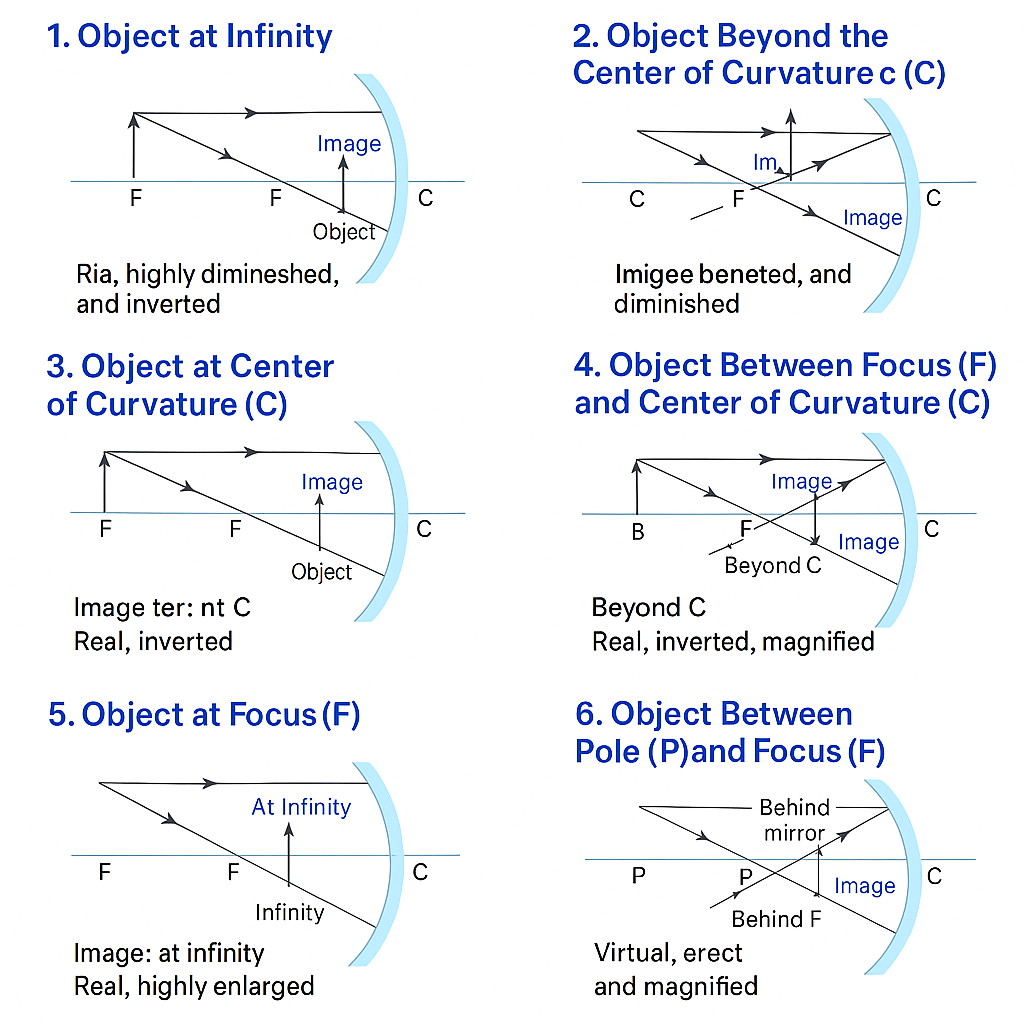
| Object Position |
Nature of Image |
| At infinity |
Real, inverted, highly diminished, formed at focus |
| Beyond the center of curvature (C) |
Real, inverted, diminished, between focus and center |
| At center of curvature (C) |
Real, inverted, same size, formed at C |
| Between focus (F) and center (C) |
Real, inverted, magnified, beyond C |
| At focus (F) |
No image (rays become parallel) |
| Between pole and focus |
Virtual, erect, magnified, behind the mirror |
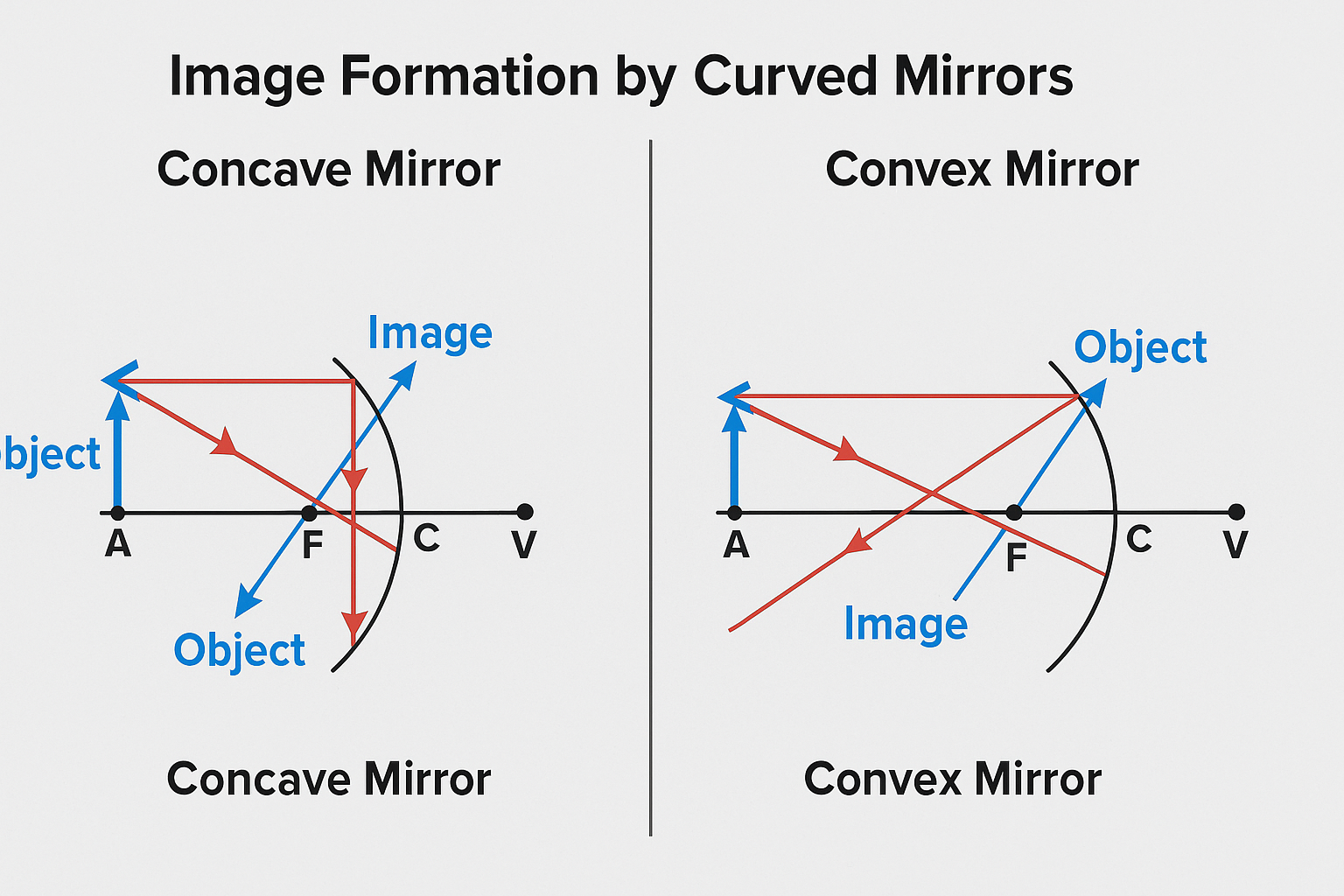
Image Formation by a Convex Mirror
- Always forms a virtual, erect, and diminished image.
- The image is located behind the mirror, between the pole and focus.
Mirror Formula
The mirror formula is a mathematical equation used to relate the object distance,
image distance, and focal length of a spherical mirror (concave or convex).
It helps in calculating the position and nature of the image formed by the mirror.
📐 The Formula:
1/f = 1/v + 1/u
Where:
- f = focal length of the mirror
- v = image distance (from the pole of the mirror)
- u = object distance (from the pole of the mirror)
🧭 Sign Convention:
While using the mirror formula, the following sign convention is applied (based on the Cartesian coordinate system):
- All distances are measured from the pole (P) of the mirror.
- Distances measured in the direction of incoming light (left to right) are taken as positive.
- Distances measured against the direction of incoming light (right to left) are taken as negative.
- Focal length (f) of a concave mirror is negative, and for a convex mirror, it is positive.
📊 Example:
If an object is placed 20 cm in front of a concave mirror (u = -20 cm) with a focal length of 10 cm (f = -10 cm), find the image distance (v).
Using the formula:
1/f = 1/v + 1/u
1/(-10) = 1/v + 1/(-20)
⇒ -1/10 = 1/v - 1/20
⇒ 1/v = -1/10 + 1/20 = (-2 + 1)/20 = -1/20
⇒ v = -20 cm
Result: The image is formed 20 cm in front of the mirror. It is real and inverted.
📌 Applications:
- Used in calculating image position in spherical mirrors
- Helpful in designing optical devices like telescopes, cameras, and headlamps
- Essential in ray diagram analysis and physics problems
Uses of Mirrors
Uses of Concave Mirrors
A concave mirror is a spherical mirror with a reflecting surface that curves inward like the inside of a bowl. It converges light rays to a point (focus), making it useful in situations where light needs to be concentrated.
-
1. Reflecting Telescopes: Used to gather and focus light from distant celestial bodies due to their ability to form real, inverted, and magnified images.
-
2. Shaving/Makeup Mirrors: Concave mirrors are used in personal grooming mirrors to produce enlarged, upright virtual images when the face is close to the mirror.
-
3. Dental Instruments: Dentists use small concave mirrors to get a magnified view of the inner parts of the mouth.
-
4. Solar Concentrators: Used in solar cookers and furnaces to focus sunlight onto a small area to generate heat.
-
5. Headlights and Torches: Positioned behind the light source to reflect and focus parallel beams of light forward.
Uses of Convex Mirrors
A convex mirror is a spherical mirror with a reflecting surface that bulges outward. It diverges light rays, making objects appear smaller but covering a wider field of view. These properties make convex mirrors very useful for safety and surveillance.
-
1. Vehicle Rear-View Mirrors: Convex mirrors give a wider field of view to help drivers see vehicles behind them. They always form virtual, erect, and diminished images.
-
2. Road Safety Mirrors: Installed at sharp turns and blind spots on roads and in parking lots to help drivers spot incoming traffic or pedestrians.
-
3. Security Surveillance: Used in shops, malls, and hospitals for monitoring large areas as they provide a panoramic view.
-
4. Hallway or Corridor Corners: Used in public buildings and offices to prevent collisions by allowing people to see around corners.
Text book Questiobn Answers
- Define the principal focus of a concave mirror.
Answer: The principal focus of a concave mirror is the point on its principal axis where light rays parallel to the principal axis converge after reflection from the mirror. This point is in front of a concave mirror.
- The radius of curvature of a spherical mirror is 20 cm. What is its focal length?
Answer: Given, the radius of curvature (R) = 20 cm. Since the focal length of a spherical mirror is half of its radius of curvature. The formula is R = 2f , so radius of curvature of the spherical mirror = 2 × Focal length (f), f= R/2 = 20 / 2 = 10. Therefore, the focal length of the spherical mirror is 10 cm.
- Name the mirror that can give an erect and enlarged image of an object.
Answer-: Concave Mirror can give an erect and enlarged image of an object
- Why do we prefer a convex mirror as a rear-view mirror in vehicles?
Answer: We prefer a convex mirror as a rear-view mirror in vehicles because, it gives a wider field of view, allowing the driver to see more area behind the vehicle. It always forms an image that is virtual, erect, and smaller, which helps include more traffic in a small mirror, so it helps the driver judge the position of vehicles coming from behind more easily.
5 Find the focal length of a convex mirror whose radius of curvature is 32 cm.
Answer: Given, the radius of curvature (R) = 32 cm. Since radius of curvature = 2 × Focal length (f)(R= 2f). f = R/2 = 32/2 = 16. Therefore, the focal length of the given convex mirror is 16 cm.
- A concave mirror produces three times magnified (enlarged) real image of an object placed at 10 cm in front of it. Where is the image located?
Answer: magnification=height of the image / height of the object, therefore, m=h1/h0. The magnification is 3 times, and the object is placed 10 cm in front of a concave mirror. A real image formed by a concave mirror appears in front of the mirror. Since the image is 3 times bigger, it will be located 30 cm in front of the mirror. Object distance (u) = – 10 cm. Therefore, the negative sign indicates that an inverted image is formed in front of the given concave mirror at a distance of 30 cm.
Page No: 176
- A ray of light travelling in air enters obliquely into water.
Does the light ray bend towards the normal or away from the normal? Why?
Answer: The light ray bends towards the normal because water is denser than air. Normally, light slows down when it enters a denser medium, and this causes it to bend towards the normal.
- Light enters from air to glass, having a refractive index 1.50. What is the speed of light in the glass? The speed of light in vacuum is 3 x 10⁸ms-1.
Answer: Refractive index of a medium (nm) = Speed of light in vacuum/Speed of light in the medium. Since speed of light in vacuum (c) = 3 × 10⁸ m/s and the refractive index of glass (ng) = 1.50. Speed of light in the glass (v) = Speed of light in vacuum/ Refractive index of glass. I,e = c/ng. =3 × 10⁸/1.50 = 2x 10⁸ ms-1. Therefore, speed of light in the glass = 2x 10⁸ ms-1.
- From the following table of refractive indices, identify the medium having the highest optical density
and the medium having the lowest optical density.
Refractive indices of various materials
| Material (medium) |
Refractive index (n) |
Material (medium) |
Refractive index (n) |
| Air |
1.0003 |
Canada Balsam |
1.53 |
| Ice |
1.31 |
— |
— |
| Water |
1.33 |
Rock salt |
1.54 |
| Alcohol |
1.36 |
— |
— |
| Kerosene |
1.44 |
Carbon disulphide |
1.63 |
| Fused quartz |
1.46 |
Dense flint glass |
1.65 |
| Turpentine oil |
1.47 |
Ruby |
1.71 |
| Benzene |
1.50 |
Sapphire |
1.77 |
| Crown glass |
1.52 |
Diamond |
2.42 |
Reasoning: Optical density increases with increasing refractive index. Thus the material with the largest refractive index has the highest optical density and vice versa.
Highest optical density: Diamond (n = 2.42)
Lowest optical density: Air (n = 1.0003)
Answer: The highest optical density is for the material with the largest refractive index. From the table, Diamond (2.42) has the highest refractive index. So, Diamond has the highest optical density. The lowest optical density is for the material with the smallest refractive index. From the table, Air (1.0003) has the lowest refractive index. So, Air has the lowest optical density.
- You are given kerosene, turpentine and water. In which of these does light travel fastest?
Use the refractive indices in the table below to decide where light travels fastest.
Refractive indices of various materials
| Material (medium) |
Refractive index (n) |
Material (medium) |
Refractive index (n) |
| Air |
1.0003 |
Canada Balsam |
1.53 |
| Ice |
1.31 |
— |
— |
| Water |
1.33 |
Rock salt |
1.54 |
| Alcohol |
1.36 |
— |
— |
| Kerosene |
1.44 |
Carbon disulphide |
1.63 |
| Fused quartz |
1.46 |
Dense flint glass |
1.65 |
| Turpentine oil |
1.47 |
Ruby |
1.71 |
| Benzene |
1.50 |
Sapphire |
1.77 |
| Crown glass |
1.52 |
Diamond |
2.42 |
Explanation: The speed of light in a material is inversely related to its refractive index: v = c / n. So the lower the refractive index, the faster light travels in that medium.
Answer:
Light travels fastest in water (n = 1.33), then in kerosene (n = 1.44), and slowest in turpentine oil (n = 1.47).
- The refractive index of diamond is 2.42. What is the meaning of this statement?
Answer: Since the diamond has a refractive index of 2.42, it is more resistant to light rays hence the speed of light in a diamond will reduce by a factor of 2.42 as compared to its speed in the air. In other words, the speed of light in a diamond is 1/2.42 times the speed of light in a vacuum.
- Define 1 dioptre of power of a lens.
Answer: Dioptre is the SI unit of power of lens is denoted by the letter One dioptre is defined as the power of a lens of focal length 1 metre.
- A convex lens forms a real and inverted image of a needle at a distance of 50 cm from it. Where is the needle placed in front of the convex lens if the image is equal to the size of the object? Also, find the power of the lens.
Answer-
The position of the image should be at 2F since the image is real and the same size. It is given that the image of the needle is formed at a distance of 50 cm from the convex lens. Therefore, the needle is placed in front of the lens at a distance of 50 cm. Object distance (u) = – 50 cm and the Image distance, (v) = 50 cm, Focal length = f. According to the lens formula, i/v-i/u=1/f , which gives
=1/f=1/50-1/(-50)
=1/25 or 0.25 meters
Therefore, power of lens , P= 1/f(focal length in meters)
= 1/0.25= +AD
- Find the power of a concave lens of focal length 2 m.
Answer: The focal length of the concave lens (f) = 2 m. Power of lens (P) = 1/f
= 1/ (-2) = -0.5D.
- Which one of the following materials cannot be used to make a lens?
- Water
- Glass
- Plastic
- Clay
Answer – (D) Clay cannot be used to make a lens because if the lens is made up of clay, the light rays cannot pass through it.
- The image formed by a concave mirror is virtual, erect and larger than the object. Where should be the position of the object?
- Between the principal focus and the centre of curvature
- At the centre of curvature
- Beyond the centre of curvature
- Between the pole of the mirror and its principal focus
Answer – (D) The object should be placed between the pole of the mirror and its principal focus.
- Where should an object be placed in front of a convex lens to get a real image of the size of the object?
- At the principal focus of the lens
- At twice the focal length
- At infinity
- Between the optical centre of the lens and its principal focus
Answer – (B) The object should be placed at twice the focal length.
- A spherical mirror and a thin spherical lens have a focal length of -15 cm. The mirror and the lens are likely to be
- Both concave
- Both convex
- The mirror is concave, and the lens is convex
- The mirror is convex, but the lens is concave
Answer – (A) Both are likely to be concave.
- No matter how far you stand from a mirror, your image appears erect. The mirror is likely to be
- Plane
- Concave
- Convex
- Either plane or convex
Answer – (D) The mirror is likely to be either plane or convex.
- Which of the following lenses would you prefer to use while reading small letters found in a dictionary?
- A convex lens of focal length 50 cm
- A concave lens of focal length 50 cm
- A convex lens of focal length 5 cm
- A concave lens of focal length 5 cm
Answer –
(C) A convex lens of focal length 5 cm can be used while reading small letters found in a dictionary
- We wish to obtain an erect image of an object, using a concave mirror of focal length 15 cm. What should be the range of distance of the object from the mirror? What is the nature of the image? Is the image larger or smaller than the object? Draw a ray diagram to show the image formation in this case.
Answer: Range of the distance of the object = 0 to 15 cm from the pole of the mirror. Nature of the image = virtual, erect, and larger than the object.
- Name the type of mirror used in the following situations.
A. Headlights of a car
B. Side/rear-view mirror of a vehicle
C. Solar furnace
Support your answer with a reason.
Answer:
- Headlights of a car — Concave mirror (parabolic/reflector)
Reason: The bulb is placed at the mirror’s focus so the reflected rays become nearly parallel and produce a strong, focused beam that lights the road ahead.
- Side / rear-view mirror of a vehicle — Convex mirror
Reason: A convex mirror forms a virtual, erect, and reduced image and gives a wider field of view, so the driver can see more area behind and to the side.
- Solar furnace — Concave (parabolic) mirror
Reason: A parabolic concave mirror converges parallel sunlight to a small focal point, concentrating energy to produce very high temperatures.
- One-half of a convex lens is covered with black paper. Will this lens produce a complete image of the object? Verify your answer experimentally. Explain your observations.
Answer: Yes — the lens will still produce a complete image of the object, but the image will be dimmer (less bright). Every point on the object sends rays in many directions. Different parts of the lens collect different sets of those rays, but each unobstructed part of the lens can form the whole image. Covering half the lens only reduces the number of rays that reach the image plane (so brightness falls), it does not change the position or size of the image (assuming the same lens and same object–screen geometry).
To verify it experimentally, place a convex lens on a stand and put a bright object (a candle or an illuminated arrow on a sheet) at a distance > focal length from the lens. Place a white screen on the other side of the lens and move it until a sharp image appears. Mark the image position and note brightness. Now cover one half of the lens with black paper (cut so exactly half the lens aperture is blocked). Keep object, lens and screen fixed. You will observe that, the image remains sharp and complete (same size and at the same screen position). The image is dimmer — roughly about half the light (depends on how accurately “half” is blocked). There may be a small loss of resolution or slight increase in edge diffraction effects if the aperture becomes very small, but for ordinary classroom sizes the main effect is reduced brightness only.
- An object 5 cm in length is held 25 cm away from a converging lens of focal length 10 cm. Draw the ray diagram and find the position, size and nature of the image formed.
Given: Object height = 5 cm, Object distance = 25 cm and focal length of lens = 10 cm.Using the lens formula, the image is formed at 16.7 cm on the other side of the lens (This means the image is real.)
So the image height is 0.67 × 5 cm = 3.3 cm and the image is smaller than the object. A (convex lens forms real
image which is inverted and diminished (smaller)
- A concave lens of focal length 15 cm forms an image 10 cm from the lens. How far is the object placed from the lens? Draw the ray diagram.
Answer: Focal length of concave lens (OF1), f = – 15 cm. Image distance, v= – 10 cm. According to the lens formula,
- 1/v-1/u=1/f
- =i/u=1/v-1/f
- = -1/10+1/15
- = -30 cm or 0.3 meters
The negative value of u indicates that the object is placed 30 cm in front of the lens. This is shown in the following ray diagram. This is shown in the following ray diagram.
- An object is placed at a distance of 10 cm from a convex mirror of focal length 15 cm. Find the position and nature of the image.
Answer: Focal length of convex mirror (f) = +15 cm, Object distance (u) = – 10 cm. According to the mirror formula,
- 1/v=1/f-1/u
- =i/u=1/v-1/f.
- =1/v=1/15-1/-10= 2+3/30
- =6 cm
- Magnification = –v/u
- =-6/-10
- =0.6
The image is located at a distance of 6 cm from the mirror on the other side of the mirror. The positive and a value of less than 1 magnification indicates that the image formed is virtual, erect, and diminished.
- The magnification produced by a plane mirror is +1. What does this mean?
Answer: The + sign shows that, an image formed by a plane mirror is virtual and erect. Since the magnification is 1, it means that the size of the image is equal to the size of the object.
- An object 5 cm is placed at a distance of 20 cm in front of a convex mirror of radius of curvature 30 cm. Find the position, nature and size of the image.
Numerical Problem – Convex Mirror
Question:
An object 5 cm high is placed at a distance of 20 cm in front of a convex mirror of radius of curvature 30 cm.
Find the position, nature and size of the image.
Given:
Height of object (ho) = 5 cm
Object distance (u) = –20 cm
Radius of curvature (R) = +30 cm
Step 1: Find Focal Length
f = R / 2
f = 30 / 2
f = +15 cm
(Focal length is positive for a convex mirror.)
Step 2: Using Mirror Formula
1/f = 1/v + 1/u
1/15 = 1/v + 1/(-20)
1/15 = 1/v – 1/20
1/v = 1/15 + 1/20
Taking LCM = 60
1/v = (4 + 3) / 60
1/v = 7/60
v = 60/7
v ≈ +8.57 cm
Step 3: Nature of Image
Since v is positive, the image is formed behind the mirror.
Step 4: Size of Image
Magnification (m) = -v/u
m = -8.57 / (-20)
m = 0.4285
hi = m × ho
hi = 0.4285 × 5
hi ≈ 2.14 cm
Final Answer:
Position of image: 8.57 cm behind the mirror
Nature of image: Virtual, erect and diminished
Size of image: 2.14 cm
- An object of size 7.0 cm is placed at 27 cm in front of a concave mirror of focal length 18 cm. At what distance from the mirror should a screen be placed so that a sharply focused image can be obtained? Find the size and nature of the image.
Answer-
- Object distance (u) = – 27 cm
- Object height (h) = 7 cm
- Focal length (f) = – 18 cm
- According to the mirror formula, 1/v-1/u=1/f
- =-1/18+1/27=-1/54
- -54 cm.
Because the image distance is real and on the same side as expected for a concave mirror, the image is real and inverted. Since m=2m=2m=2 (>1), the image is magnified (larger than the object). and the negative value of image height indicates that the image formed is inverted.
- Find the focal length of a lens of power -2.0 D. What type of lens is this?
Answer: Power of lens (P) = 1/f, P = -2D
f = -1/2 = -0.5 m
A concave lens has a negative focal length. Therefore, it is a concave lens.
- A doctor has prescribed a corrective lens of power +1.5 D. Find the focal length of the lens. Is the prescribed lens diverging or converging?
Answer-
- Power of lens (P) = 1/f
- P = 1.5D
- f = 1/1.5 = 10/15 = 0.66 m
- A convex lens has a positive focal length. Therefore, it is a convex lens or a converging lens.
LBA Solutions
Learning Points
- Reflection of light
- Spherical mirrors
- Reflection by spherical mirrors
- Representing reflections by spherical mirrors using diagrams
- Conventional symbols for reflection by spherical mirrors
- Reflection formula and magnification
- Refraction of light – Refraction by a rectangular glass slab
- Laws of refraction and refractive index
- Refraction by spherical lenses
- Formation of images by lenses
- Lens formula and magnification
- Power of lens
Weightage
|
SL No
|
Difficulty Level
|
Number of Questions
|
Marks
|
Percentage
|
|
1
|
Easy
|
31
|
45
|
30%
|
|
2
|
Average
|
38
|
75
|
50%
|
|
3
|
Difficult
|
21
|
29
|
20%
|
I. Multiple Choice Questions
1. In order to obtain an image smaller than the object in a concave mirror, the object should be placed:
(F = Principal focus, C = Centre of curvature, P = Pole)
- A) Between C and F
B) Far from C
C) Between P and F
D) At F
2. Identify the emergent ray in the image.
- A) CD
B) BC
C) AB
D) IJ
3.An object is placed at the centre of curvature of a concave mirror. What is the position and nature of the image formed?
- A) Between F and C and inverted
B) Behind the mirror and erect
C) Between F and P and erect
D) At the centre of curvature and inverted
4.The focal length of a lens is +0.50 m. The power and type of lens are:
- A) +2.0 D and a convex lens
B) +2.0 D and a concave lens
C) –2.0 D and a concave lens
D) –2.0 D and a convex lens
5.When an object is placed between the principal focus F₁ and the optical centre O of a convex lens, the image formed is:
- A) Virtual, erect and large
B) Real, inverted and small
C) Virtual, inverted and small
D) Real, inverted and large
6.Observe the table below, in which material is the velocity of light highest?
- A) Q
B) P
C) S
D) R
|
Material Medium
|
Refractive Index
|
|
P
|
1.52
|
|
Q
|
1.44
|
|
R
|
2.42
|
|
S
|
1.33
|
7. Which of the following is a property of a convex lens?
- A) Diverges light rays
B) Thick at edges and thin in the middle
C) Produces a real and erect image
D) Thin at edges and thick in the middle
8.To obtain a small and real image from a concave lens, the object should be placed:
- A) At the principal focus F₁
B) Between F₁ and 2F₁
C) Beyond 2F₁
D) Between F₁ and O
9.Which of the following is correct regarding your lens?
- A) Converges light rays
B) Diverges light rays
C) Produces inverted image
D) Produces real image
10.A mirror produces an erect and enlarged image. The mirror and image nature are:
- A) Concave mirror and virtual image
B) Convex mirror and real image
C) Plane mirror and real image
D) Convex mirror and virtual image
11.If a ray of light enters a rarer medium from a denser medium, the speed of the ray:
- A) Decreases and bends towards the normal
B) Increases and bends away from the normal
C) Decreases and bends away from the normal
D) Increases and bends towards the normal
12.The type of mirror used as a rear-view mirror of a vehicle is:
- A) Plane mirror
B) Convex mirror
C) Concave mirror
D) Plane concave mirror
13.Convex mirrors are used in:
- A) Torches
B) Rear-view mirrors of vehicles
C) Inspection lamps
D) Shaving mirrors
14.The reflecting surface of a spherical mirror is called:
- A) Centre of curvature
B) Pole
C) Radius of curvature
D) Aperture
15.Which of the following is correct regarding a concave lens?
- A) Converges light rays
B) Diverges light rays
C) Produces an inverted image
D) Produces a real image
16.The distance between the principal focus and the optical centre of a lens is:
- A) Radius of curvature
B) Focal length
C) Object distance
D) Image distance
17.If the image formed by a concave mirror is virtual, erect and larger than the object, the object is placed:
- A) At C
B) Between C and F
C) At F
D) Between F and O
18.The relationship between radius of curvature (R) and focal length (f) is:
- A) R = 2f
B) R = ½f
C) f = 2R
D) f = 2/3R
19.SI unit of power of a lens is:
- A) Metre
B) Diopter
C) Ohm
D) Centimetre
20.The power of a lens prescribed is +2D. The focal length of the lens is:
- A) 2 m
B) 0.2 m
C) 0.50 m
D) 5 m
21.The object distance and image distance are –60 cm and –20 cm respectively. The magnification is:
- A) –0.33
B) +3
C) +0.33
D) +4
22.Refractive indices of media:
K – 1.62
L – 1.81
M – 1.94
N – 2.43
The speed of light is minimum and maximum respectively in:
- A) K and N
B) N and K
C) N and L
D) M and N
23.Which of the following is correct regarding the optical density of the transparent media shown?
- A) n₁ = n₂ and n₃ > n₄
B) n₁ > n₂ and n₃ > n₄
C) n₁ = n₂ and n₃ < n₄
D) n₁ = n₂ and n₃ = n₄
24.Focal lengths of convex lenses P, Q, R and S are 20 cm, 15 cm, 5 cm and 10 cm respectively. The lens with highest power is:
- A) Q
B) P
C) R
D) S
25.The object position that produces an image at infinity in a convex lens is:
- A) Beyond 2F₁
B) Between 2F₁ and F₁
C) At F₁
D) Between F₁ and O
26.In refraction, the angle between incident ray and normal is 40°. The angle between reflected ray and mirror surface is:
- A) 40°
B) 50°
C) 60°
D) 90°
27.If a spherical mirror has focal length 30 cm, its radius of curvature is:
- A) 30 cm
B) 40 cm
C) 60 cm
D) 25 cm
28.A student stands 2 m in front of a plane mirror. The distance between the student and his image is:
- A) 2 m
B) 3 m
C) 4 m
D) 6 m
29.The correct statement regarding the image shown is:
- A) Speed of light is higher in medium A
B) Speed of light is higher in medium B
C) A is optically rarer medium
D) B is optically denser medium
30.The image of the English letter “L” in a concave mirror looks like (as shown in figure). (Choose the correct option based on lateral inversion/formation shown in the diagram.)
31.If the magnification of the image formed by a mirror is 1.73, the nature of the image is:
- A) Real and enlarged
B) Real and diminished
C) Virtual and enlarged
D) Virtual and diminished
32.The power of a lens is –2.5 D. The focal length and type of lens are:
- A) +0.40 m and convex lens
B) –0.40 m and convex lens
C) +0.40 m and concave lens
D) –0.40 m and concave lens
33.Which of the following is a property of a concave lens?
- A) Converges light rays
B) Thick at edges and thin in middle
C) Thin at edges and thick in middle
D) Produces a real and inverted image
34. The focal length of a lens is +0.50 m. The power and type of the lens are:
- A) +2.0 D and convex lens
B) +2.0 D and concave lens
C) –2.0 D and concave lens
D) –2.0 D and convex lens
Answers for MCQs
-
B
-
(Depends on diagram provided)
-
D
-
A
-
A
-
C (S)
-
D
-
Not possible – concave lens always forms virtual, erect, diminished image
-
A (if convex lens)
-
A
-
B
-
B
-
B
-
D
-
B
-
B
-
D
-
A
-
B
-
C
-
C(m = –v/u = –(–20)/–60 = +0.33)
-
B(Minimum speed → highest refractive index → N; Maximum speed → lowest refractive index → K)
-
(Depends on diagram provided)
-
C(Power = 1/f → smallest f = highest power → 5 cm)
-
C
-
B
-
C(R = 2f → 2 × 30 = 60 cm)
-
C(2 m in front → image 2 m behind → total = 4 m)
-
(Depends on diagram provided)
-
(Depends on diagram provided)
-
C(Magnification positive and >1 → virtual and enlarged)
-
D(f = 1/P = 1/–2.5 = –0.40 m → concave lens)
-
B
-
A
II. Answer the Following Questions (1 Mark Each)
- Why is a convex mirror used as a rear-view mirror?
- What is the centre of curvature of a spherical mirror?
- Complete the ray diagram showing refraction and image formation.
- Find the power of a convex lens with focal length +0.5 m.
- Find the radius of curvature of a spherical mirror with focal length 25 cm.
- What is reflection of light?
- What is lateral inversion?
- What is a spherical mirror?
- Define the principal focus of a concave mirror.
- Define the principal focus of a convex mirror.
- What is the aperture of a spherical mirror?
- Define refractive index. Write the mirror formula.
- Why does light not refract between two media having the same refractive index?
- Why are incident and emergent rays parallel in a rectangular glass slab?
- How does image position change in a convex mirror when object moves from infinity to pole?
- Define principal focus of a convex lens.
- Define principal focus of a concave lens.
1 Mark answers
- A convex mirror is used as a rear-view mirror because it gives a wide field of view and forms erect, diminished images.
- The centre of curvature is the centre of the sphere of which the spherical mirror is a part.
- The refracted ray bends towards the normal in a denser medium and away from the normal in a rarer medium, forming the image as per lens rules. (Ray diagram to be drawn.)
- Power P=1/f
=1/0.5
=+2 diopter
- Radius of curvature R=2f
=2×25=50 cm
- Reflection of light is the bouncing back of light into the same medium after striking a surface.
- Lateral inversion is the phenomenon in which left and right sides of an object appear interchanged in a mirror.
- A spherical mirror is a mirror whose reflecting surface is part of a hollow sphere.
- The principal focus of a concave mirror is the point where parallel rays of light meet after reflection.
- The principal focus of a convex mirror is the point from which parallel rays appear to diverge after reflection.
- The aperture of a spherical mirror is the diameter of its reflecting surface.
- Refractive index is the ratio of speed of light in vacuum to its speed in a medium.
Mirror formula: 1/f=1/v+1/u
- Light does not refract because its speed remains the same in both media.
- Incident and emergent rays are parallel because the opposite faces of a rectangular glass slab are parallel, causing equal and opposite deviations.
- In a convex mirror, the image moves from focus (F) towards the pole (P) as the object moves from infinity to the pole.
- The principal focus of a convex lens is the point where parallel rays of light converge after refraction.
- The principal focus of a concave lens is the point from which parallel rays appear to diverge after refraction.
III. Answer the Following Questions (2 Marks Each)
- State the two laws of reflection.
- A concave lens has focal length 30 cm. Find object position and magnification.
- Draw ray diagrams for convex lens at:
i) Between F₁ and 2F₁
ii) At 2F₁
- Find magnification when u = –30 cm and v = –10 cm.
- Object placed 25 cm in front of mirror (f = 15 cm). Find image position.
- Find object distance for concave lens when image forms at 10 cm.
- Calculate speed of light in benzene (n = 1.50).
- Concave lens (f = 12 cm). Image at 9 cm. Find object distance.
- Define focal point and aperture of lens.
- Define refraction and state Snell’s law.
- Differences between convex and concave mirror.
- What are spherical mirrors? Name types.
- Uses of concave mirror.
- Differences between convex and concave lens.
- Difference between real and virtual images.
- In which medium does light travel faster: ice (1.31) or water (1.33)?
- State two rays used in spherical mirror diagrams.
- Why does pencil in water appear displaced? Name phenomenon.
- Draw two rays for convex lens diagram.
- Nature of image formed by plane mirror.
- Find speed of light in medium P given refractive index ratio.
2 Mark Answers
- State the two laws of reflection.
- The incident ray, reflected ray and the normal lie in the same plane.
- The angle of incidence is equal to the angle of reflection.
- A concave lens has focal length 30 cm. Find object position and magnification.
For a concave lens, focal length is taken as negative (f = –30 cm).
To find exact object position and magnification, either image distance or object distance must be given.
Magnification is given by:
m = v / u
- Draw ray diagrams for convex lens.
- i) Object between F₁ and 2F₁:
Image is formed beyond 2F₂. It is real, inverted and enlarged.
- ii) Object at 2F₁:
Image is formed at 2F₂. It is real, inverted and same size.
- Find magnification when u = –30 cm and v = –10 cm.
Magnification m = v / u
m = (–10) / (–30)
m = +0.33
The image is virtual, erect and diminished.
- Object placed 25 cm in front of mirror (f = 15 cm). Find image position.
Using mirror formula:
1/f = 1/v + 1/u
Substituting values:
1/15 = 1/v + 1/(–25)
Solving,
v ≈ 9.37 cm
Image is formed at about 9.37 cm.
- Find object distance for concave lens when image forms at 10 cm.
Using lens formula and solving,
Object distance = –15 cm
- Calculate speed of light in benzene (n = 1.50).
Refractive index formula:
n = c / v
v = c / n
v = (3 × 10⁸) / 1.5
Speed of light in benzene = 2 × 10⁸ m/s.
- Concave lens (f = 12 cm). Image at 9 cm. Find object distance.
After applying lens formula,
Object distance = –36 cm.
- Define focal point and aperture of lens.
Focal point: The point where parallel rays meet (convex) or appear to meet (concave).
Aperture: The effective diameter of the lens.
- Define refraction and state Snell’s law.
Refraction is the bending of light when it passes from one medium to another.
Snell’s law states:
n₁ sin i = n₂ sin r
- Differences between convex and concave mirror.
Convex mirror: Diverges light and forms virtual, diminished image.
Concave mirror: Converges light and can form real or virtual images.
- What are spherical mirrors? Name types.
Spherical mirrors are mirrors whose reflecting surface is part of a sphere.
Types: Concave mirror and Convex mirror.
- Uses of concave mirror.
Used as shaving mirrors, headlights of vehicles and in solar furnaces.
- Differences between convex and concave lens.
Convex lens: Converges light and can form real images.
Concave lens: Diverges light and always forms virtual images.
- Difference between real and virtual images.
Real image: Can be obtained on a screen and is inverted.
Virtual image: Cannot be obtained on a screen and is erect.
- In which medium does light travel faster: ice (1.31) or water (1.33)?
Light travels faster in ice because it has lower refractive index.
- State two rays used in spherical mirror diagrams.
- Ray parallel to principal axis
- Ray passing through centre of curvature
- Why does pencil in water appear displaced? Name phenomenon.
Because of refraction of light. The phenomenon is called refraction.
- Draw two rays for convex lens diagram.
- A ray parallel to principal axis passes through focus.
- A ray through optical centre passes without deviation.
- Nature of image formed by plane mirror.
The image is virtual, erect and same size as the object.
- Find speed of light in medium P given refractive index ratio.
Speed can be found using formula: v = c / n
IV. Answer the Following Questions (3 Marks Each)
73.The magnification of the image formed by a spherical mirror is –1. The image is formed at a distance of 50 cm.
-
i) What is the type of mirror?
ii) At what distance is the object placed?
iii) State the nature and size of the image.
74.Draw the ray diagram of the image formed by a convex lens when the object is placed at:
-
i) The principal focus F₁
ii) Beyond 2F₁
75. An object is placed on the principal axis in front of a concave mirror with focal length 12 cm. The object is 18 cm away from the mirror.
-
i) Calculate the image distance.
ii) Find the magnification.
iii) State the nature of the image.
76.Draw the ray diagram of the image formed by a convex lens when the object is placed between F₁ and 2F₁.
77.A doctor prescribes a corrective lens of power –0.5 D to a person.
-
i) Find the focal length of the lens.
ii) Is it a converging or diverging lens? Give reason.
iii) How is this property used to correct eye defects
78.a) Explain the laws of refraction of light.
- b) In the given figure, AB is the incident ray, BC is the refracted ray, and MN is the normal at the point of incidence. Which medium is denser? Give reason.
79.Write any three new Cartesian sign conventions used for spherical mirrors.
80.Draw the ray diagram when an object is placed between C and F in front of a concave mirror. Find the position and nature of the image using the diagram.
81.Draw the ray diagram when an object is placed at C in front of a concave mirror. Find the position and nature of the image using the diagram.
82.Draw the ray diagram when an object is placed beyond C in front of a concave mirror. Find the position and nature of the image using the diagram.
83.Draw the ray diagram when an object is placed at F in front of a concave mirror. Find the position and nature of the image. (F – Principal focus, C – Centre of curvature)
84.Draw the ray diagram when an object is placed between F and P in front of a concave mirror.Find the position and nature of the image. (P – Pole of the mirror)
85.Draw the ray diagram and state the position and nature of the image formed when an object is placed between F₁ and O in front of a convex lens.
86.The magnification produced by a convex mirror is 0.5 and the object is 15 cm away from the mirror.
- i) Find the focal length of the mirror.
ii) Write the nature and size of the image.
87.Explain the activity to show that a convex lens converges parallel rays of light.
88.Explain the activity to find the approximate focal length of a concave mirror.
3 Mark Answers
73. Magnification = –1, image distance = 50 cm
Given:
m = –1, v = –50 cm (real image → negative)
- i) Type of mirror:
Since magnification is negative, the mirror is a concave mirror.
- ii) Object distance:
m = –v/u
–1 = –(–50)/u
–1 = 50/u
u = –50 cm
Object is placed 50 cm in front of the mirror.
iii) Nature and size of image:
Image is real, inverted and same size as object.
74. Convex lens ray diagrams
- i) Object at F₁:
Image forms at infinity.
Nature: Real, inverted, highly enlarged.
- ii) Object beyond 2F₁:
Image forms between F₂ and 2F₂.
Nature: Real, inverted, diminished.
(Diagram to be drawn in exam.)
75. Concave mirror (f = 12 cm, u = 18 cm)
Sign convention:
f = –12 cm
u = –18 cm
- i) Image distance:
Mirror formula: 1/f = 1/v + 1/u
1/–12 = 1/v + 1/–18
Solving, v = –36 cm
- ii) Magnification:
m = –v/u
m = –(–36)/–18
m = –2
iii) Nature of image:
Real, inverted and enlarged.
76. Convex lens (object between F₁ and 2F₁)
Image forms beyond 2F₂.
Nature: Real, inverted and enlarged.
(Draw ray diagram.)
77. Power = –0.5 D
- i) Focal length:
f = 1/P
f = 1/(–0.5)
f = –2 m
- ii) Type of lens:Negative focal length means concave (diverging) lens.
iii) Use in correction:
Used to correct myopia (short-sightedness) by diverging light rays before entering eye.
78. Laws of refraction
- a) Laws:
- Incident ray, refracted ray and normal lie in same plane.
- n₁ sin i = n₂ sin r (Snell’s law).
- b) Denser medium: If refracted ray bends towards the normal, that medium is denser.
So, the medium in which ray bends towards normal is optically denser.
79. New Cartesian sign conventions
- All distances are measured from pole.
- Distances measured in direction of incident light are positive.
- Distances measured opposite to direction of incident light are negative.
80. Object between C and F (concave mirror)
Image forms beyond C.
Nature: Real, inverted and enlarged.
81. Object at C (concave mirror)
Image forms at C.
Nature: Real, inverted and same size.
82. Object beyond C (concave mirror)
Image forms between C and F.
Nature: Real, inverted and diminished.
83. Object at F (concave mirror)
Image forms at infinity.
Nature: Real, inverted and highly enlarged.
84. Object between F and P (concave mirror)
Image forms behind the mirror.
Nature: Virtual, erect and enlarged.
85. Convex lens (object between F₁ and O)
Image forms on same side of lens.
Nature: Virtual, erect and enlarged.
86. Convex mirror (m = 0.5, u = –15 cm)
m = –v/u
0.5 = –v/–15
0.5 = v/15
v = 7.5 cm
Using mirror formula:
1/f = 1/v + 1/u
1/f = 1/7.5 + 1/–15
1/f = 2/15 – 1/15
1/f = 1/15
f = 15 cm
- i) Focal length = +15 cm
- ii) Nature: Virtual, erect and diminished.
87. Activity: Convex lens converges light
- Take a convex lens and hold it facing sunlight.
- Place a white screen behind it.
- A bright spot is formed on the screen.
This shows parallel rays meet at a point → convex lens converges light.
88. Activity: Find focal length of concave mirror
- Place mirror facing sunlight.
- Move a screen in front of it until sharp bright image forms.
- Measure distance between mirror and screen.
That distance is approximate focal length.
V. Answer the Following Questions (4 Marks)
- Explain refraction through rectangular glass slab.
- Draw ray diagram for convex lens when object is at 2F₁.
4 Mark Answers
1. Explain refraction through a rectangular glass slab.
When a ray of light passes from air into a rectangular glass slab, it undergoes refraction at both surfaces.
Explanation:
- When light enters from air (rarer medium) into glass (denser medium), it bends towards the normal.
- Inside the slab, the ray travels in a straight line.
- When it emerges from glass to air, it bends away from the normal.
- Since the two faces of the slab are parallel, the emergent ray is parallel to the incident ray, but it is shifted sideways.
Important Points:
- There is lateral displacement.
- Angle of incidence = Angle of emergence.
- No change in direction overall, but position changes.
(Diagram: Draw incident ray, normal, refracted ray inside slab, emergent ray parallel to incident ray with lateral shift marked.)
2. Draw ray diagram for convex lens when object is at 2F₁.
Construction Steps:
- Draw principal axis and convex lens.
- Mark F₁, F₂ and 2F₁, 2F₂.
- Place object at 2F₁.
- Draw one ray parallel to principal axis → after refraction it passes through F₂.
- Draw second ray through optical centre → it passes undeviated.
- The two rays meet at 2F₂.
Conclusion:
- Image is formed at 2F₂.
- Nature: Real and inverted
- Size: Same size as object