Soil-(KSEEB 7th Science) Notes
7th Sample Papers
Soil is foundation of life on Earth. All organisms born out of the soil and goes ito soil after the death. Every plant we see, every tree that grows, and every crop that feeds us begins its journey in soil. Formed over thousands of years through the weathering of rocks and the decay of organic matter, soil is a rich, living layer teeming with nutrients, air, water, and countless microorganisms. From supporting plant life to filtering water and regulating temperature, soil plays a vital role in sustaining ecosystems. Understanding its layers, types, and properties helps us appreciate how this humble natural resource quietly shapes our environment, agriculture, and even our climate. In this lesson, we will explore the fascinating world of soil, its formation, structure, functions, and how we can protect it for generations to come.
Formation of Soils
Soil is a natural resource formed over thousands of years by the physical and chemical weathering of rocks. This process is influenced by natural forces such as wind, water, temperature changes, and biological activity. When the hard rocks are broken down, they form fine particles that mix with organic matter, water, air, and living organisms, giving rise to different layers of soil. This gradual transformation of hard rock into soft and fertile soil is what sustains life on Earth. This process of transformation of hard rocks into soil is called weathering. Weathering is the natural process by which rocks are broken down into smaller pieces over time. It is the first step in the formation of soil and occurs due to the effects of the atmosphere, water, plants, and changing temperatures. Weathering does not involve the movement of materials but it only breaks rocks down in place.
Types of Weathering
 There are 3 types of weathering, they are
- Physical Weathering
- Chemical Weathering
- Biological Weathering
Physical Weathering (Mechanical Weathering) is type involves breaking rocks into smaller pieces without changing their chemical composition. It is caused by: Temperature changes: Rocks expand when heated during the day and contract at night. Repeated expansion and contraction cause cracks and eventually break the rock. Frost action: Water enters cracks in rocks. When it freezes, it expands, putting pressure on the rock and causing it to crack and split. Abrasion: Wind, rain, and rivers can rub and grind rocks against each other, slowly wearing them down. Exfoliation: In hot climates, surface layers of rocks peel off due to sudden temperature changes. Chemical Weathering involves chemical reactions between the rock and external agents like water, oxygen, and acids. It changes the chemical structure of rocks. Examples include: Oxidation: Oxygen reacts with minerals in rocks (especially iron), causing rusting and weakening of the rock. Carbonation: Rainwater absorbs carbon dioxide from the air to form a weak acid, which reacts with minerals like calcium carbonate in rocks like limestone, dissolving them. Hydrolysis: Minerals in rocks react with water, forming new minerals and weakening the structure of the rock. Biological Weathering , where living organisms contribute to breaking rocks down. This includes: Plant roots growing into cracks in rocks, forcing them apart as the roots grow. Lichens and mosses produce weak acids that dissolve minerals in rocks. Burrowing animals like earthworms and rodents loosen the soil and expose rocks to air and water.
Soil profile
The soil profile consists of several distinct horizontal layers known as horizons. Each layer has unique characteristics:
| Horizon | Name | Characteristics | Components |
|---|---|---|---|
| O Horizon | Organic Layer |
Topmost layer; rich in organic material Consists of decomposed leaves, twigs, and animal remains |
Humus, decaying organic matter |
| A Horizon | Topsoil |
Dark in color; fertile and crucial for plant growth Contains roots of most plants and high biological activity |
Humus, minerals, microorganisms, plant roots |
| B Horizon | Subsoil |
Lighter in color than A horizon Accumulates minerals like iron, aluminum, and clay leached from above |
Clay, minerals, some organic matter |
| C Horizon | Weathered Parent Material |
Contains partially weathered rocks Very little organic matter and root activity |
Rock fragments, sand, silt, weathered materials |
| R Horizon | Bedrock |
Bottommost layer; unweathered and hard rock Source of parent material for upper layers |
Solid rock (granite, basalt, limestone, etc.) |

Functions of Soil
- Acts as a medium for plant growth, anchoring roots and providing nutrients.
- Filters, holds, and supplies water to plants and underground aquifers.
- Hosts billions of organisms like bacteria, fungi, earthworms, and insects that decompose matter and enrich soil.
- Regulates atmospheric gases and temperature by storing carbon and releasing gases.
- Supports ecosystems and biodiversity through nutrient recycling.
Properties of Different Soil Types
| Property | Sandy Soil | Clayey Soil | Loamy Soil |
|---|---|---|---|
| Texture | Coarse and gritty | Very fine and sticky when wet | Balanced texture with a mix of sand, silt, and clay |
| Water Holding Capacity | Low , hence the water drains quickly through | High so, it retains water for a long time | Moderate and retains adequate moisture |
| Air Permeability | High which allows good aeration | Low which aloows poor aeration | Good hence, there is a balanced air circulation |
| Fertility | Poor as it lacks nutrients | High as it is rich in nutrients | Very fertile and ideal for plant growth |
| Drainage | Excellent drainage | Poor drainage making water a great logging possibility | Good drainage |
| Color | Light brown or yellowish | Dark brown or reddish | Dark brown or blackish |
| Usage | Used for growing root vegetables like carrots and potatoes | Suitable for crops like paddy that require standing water | Best for growing a variety of crops such as wheat, pulses, and vegetables |
| Organic Matter | Low in organic matter | High in organic content | Rich in humus and organic matter |
| Ease of Tilling | Easy to till | Hard to till when dry and sticky when wet | Easy to till and manage |
Types of Soil
Soils are classified based on particle size and texture:
| Type | Characteristics | Suitable Crops |
|---|---|---|
| Sandy Soil | Coarse texture, quick drainage, low nutrients | Carrots, Groundnuts |
| Clayey Soil | Holds water, sticky, nutrient-rich | Paddy, Sugarcane |
| Loamy Soil | Balanced mix, fertile, retains water and drains well | Wheat, Vegetables |
| Silty Soil | Soft, smooth, moisture-retentive | Pulses, Fruits |
| Peaty Soil | Dark, high organic content, acidic | Moisture-loving crops |
Structure of Soil Layers
The physical arrangement of particles in the soil determines its structure. Loamy soils have granular structure, making them ideal for agriculture. Clay soils have blocky or platy structures and are dense, while sandy soils are loose and porous. Structure affects porosity, permeability, and root penetration.
Preserving Soils
- Avoid overgrazing and deforestation to prevent erosion.
- Apply organic compost and rotate crops to maintain fertility.
- Reduce use of chemical fertilizers and pesticides.
- Plant cover crops and trees to bind soil.
Soil Erosion and Its Effects
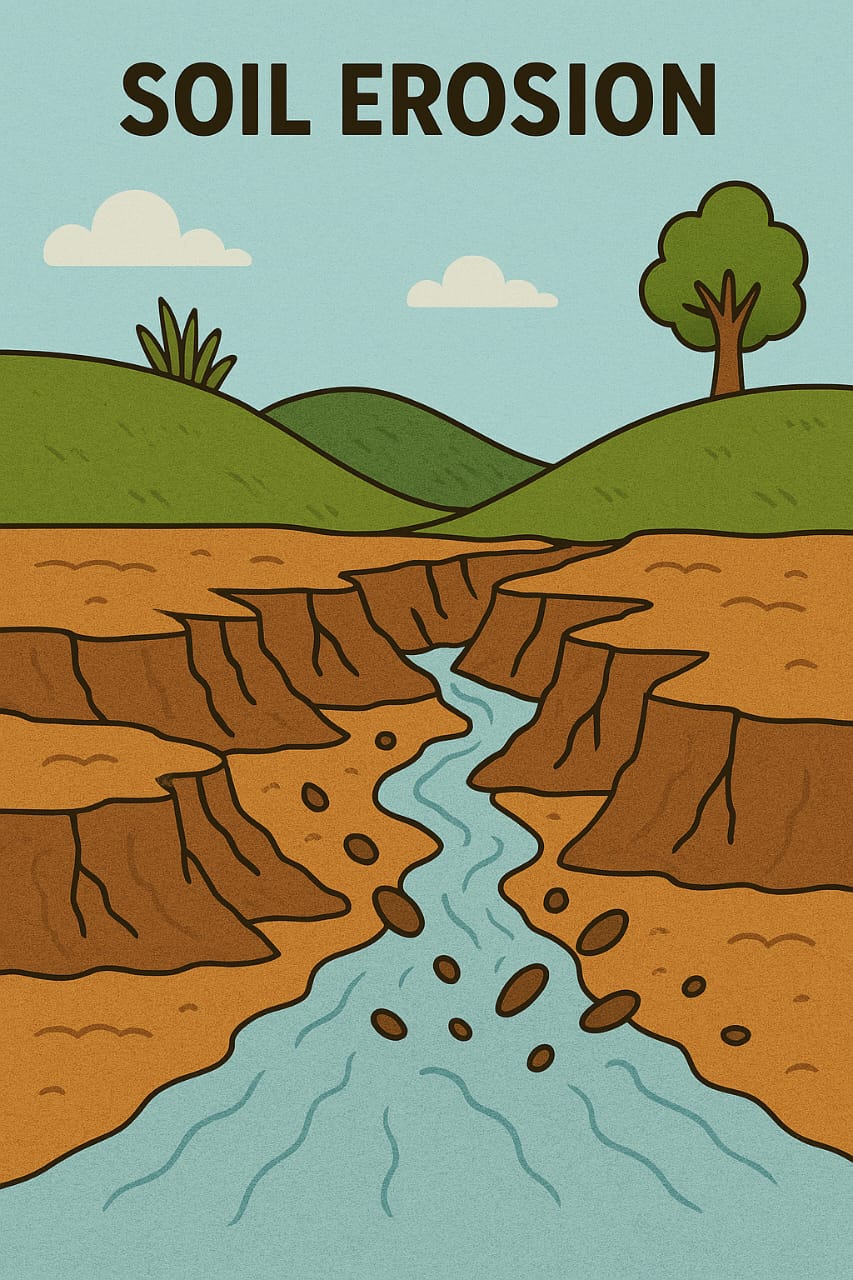
Soil erosion is the removal of the upper fertile layer by wind, water, or human activities like mining and deforestation. It results in reduced soil fertility, crop failure, silting of rivers, and desertification.
Prevention of Soil Erosion
- Grow vegetation cover on barren land.
- Practice terracing and contour farming on hills.
- Build check dams to prevent runoff.
- Avoid construction on slopes and forests.
Soil Testing
Soil testing involves laboratory analysis of soil samples to determine pH, moisture, mineral levels, and organic content. This helps farmers select appropriate crops and fertilizers for improved yield.
Fertility of Soil
Fertile soil is nutrient-rich, has good structure and moisture retention. It supports plant life effectively. Maintaining fertility involves adding manure, practicing crop rotation, and reducing chemical inputs.
Question & Answers
1: What does soil contain apart from rock particles?
Ans: Soil contains minerals, organic matter (humus), water, air, and microorganisms. These components are essential for supporting plant life and maintaining soil health.
2: Which soil has the highest water holding capacity?
Ans: Clayey soil has the highest water holding capacity because its particles are very fine and tightly packed, allowing less water to drain and more to be retained.
3: Match the Following:
| Column I | Column II |
|---|---|
| A home for living organisms | All kinds of soil |
| Upper layer of the soil | Dark in colour |
| Sandy soil | Large particles |
| Middle layer of the soil | Lesser amount of humus |
| Clayey soil | Small particles and packed tight |
4: How is soil formed?
Ans: Soil is formed by weathering of rocks. Weathering is the breaking down of rocks into smaller particles due to natural forces like wind, rain, heat, and plant roots. Over time, these particles mix with decayed organic matter to form soil.
5: How is clayey soil useful for crops?
- It has high water retention capacity, ideal for crops requiring more moisture.
- It is rich in organic matter and minerals.
- Cereals like wheat and rice grow well in clayey and loamy soils.
6: Differences between clayey and sandy soil:
| Clayey Soil | Sandy Soil |
|---|---|
| Fine particles | Large particles |
| Holds water well | Poor water retention |
| High in nutrients | Low in nutrients |
| Heavy and dense | Light and loose |
7: Sketch the cross-section of soil and label layers
8: What is percolation rate? Explaint he formula for Peercolation Rate Calculation
Given: 200 ml water, Time = 40 mins
Percolation rate = 200 ml / 40 min = 5 ml/min
Additional Question Answers
-
How can soil pollution and erosion be prevented?
- Soil Pollution: Reduce plastics, use compost, minimize chemical fertilizers and pesticides.
- Soil Erosion: Grow trees, prevent deforestation, use terrace farming.
-
What is humus, and why is it important for soil?
Answer: Humus is the dark, organic material formed from the decayed remains of plants and animals. It enhances soil fertility by providing nutrients, improves soil structure, and helps retain moisture.
-
Describe the soil profile and its main layers.
Answer: A soil profile is a vertical section of the soil showing different layers called horizons:
- A-horizon (Topsoil): Rich in humus and nutrients; supports plant growth.
- B-horizon (Subsoil): Contains minerals leached from above; less organic matter.
- C-horizon (Parent Rock): Composed of weathered rock fragments.
-
How does the particle size of soil components affect its properties?
Answer: Particle size affects water retention, aeration, and fertility. Sandy soils have large particles and drain quickly, while clayey soils have fine particles and retain water longer.
-
What is soil erosion, and what are its primary causes?
Answer: Soil erosion is the loss of the top fertile layer due to wind or water. It is caused by deforestation, overgrazing, improper farming, and construction.
-
Why is loamy soil considered ideal for agriculture?
Answer: Loamy soil has a balanced mix of sand, silt, and clay, offering good drainage, aeration, and fertility. It supports most types of crops effectively.
-
Explain the term 'percolation rate' of soil and its significance.
Answer: Percolation rate is the speed at which water moves through soil. It helps determine irrigation needs; for example, sandy soil has a high rate, requiring frequent watering.
-
How can soil pollution be prevented?
Answer: Soil pollution can be prevented by using organic manure, reducing chemical use, managing waste responsibly, and adopting sustainable farming practices.
-
What role do earthworms play in maintaining soil health?
Answer: Earthworms aerate the soil, decompose organic matter, and enrich the soil with nutrients, thus improving fertility and structure.
-
How does deforestation contribute to soil erosion?
Answer: Deforestation removes trees that hold soil together. Without roots, soil becomes loose and easily washed away by rain or blown away by wind.
-
What is the significance of soil air for plant roots?
Answer: Soil air contains oxygen needed for root respiration. Proper aeration supports nutrient absorption and healthy root development.