Lesson 13: Motion and Time
Take the Quiz on Motion and Time7th Sample Papers
Motion is the change in position of an object with respect to time Almost everything around us is in motion – from celestial bodies to tiny particle however, the natural state of a substance is inertia-rest.To bring an object from inertia to movement, one needs to apply force. Not every force can move every object; in other words; the motion of an object depends upon the magnitude of force and the weight or density of the object. Understanding motion helps us understand the behavior of physical objects and how forces affect them.
Key Concepts Describing Motion
Displacement
The change in position of an object, including direction.
Example: Moving 5 meters north.
Distance
The total length of the path an object travels, regardless of direction.
Example: Moving 5 meters total.
Velocity
The rate of change of displacement, including direction.
Example: Moving 5 meters north per second.
Speed
The rate at which an object moves, without regard to direction.
Example: Moving
2. Reasons for Motion of Objects
Objects move because of external forces applied to them. These forces can be natural (gravity, magnetism) or applied manually (push or pull). For instance, a football moves when kicked due to muscular force, and an apple falls from a tree due to gravity.
Factors Influencing the Motion of an Object
The motion of an object is determined by several key factors: force, mass, friction, gravity, and inertia. Each plays a distinct role in how an object moves or responds to external influences.
1. Force
- A force is a push or pull that can cause an object to accelerate, changing its speed or direction.
- The greater the net force, the greater the acceleration.
- According to Newton's Second Law: F = ma (Force = mass × acceleration)
2. Mass
- Mass measures an object's resistance to acceleration.
- Heavier objects require more force to move or stop than lighter ones.
- Mass is directly related to inertia.
3. Friction
- Friction opposes motion between two surfaces in contact.
- It can slow down or stop an object's motion.
- The amount of friction depends on:
- The texture of the surfaces.
- The force pressing the surfaces together.
4.Gravity
- Gravity is the force of attraction between two masses.
- On Earth, it gives objects weight and pulls them toward the ground.
- Acceleration due to gravity is approximately 9.8 m/s².
5. Inertia
- Inertia is the resistance to changes in an object’s state of motion.
- Objects stay at rest or in motion unless acted upon by a force.
- More massive objects have greater inertia which generally need more force to make them move .
Force and the Laws of Motion
What is Force?
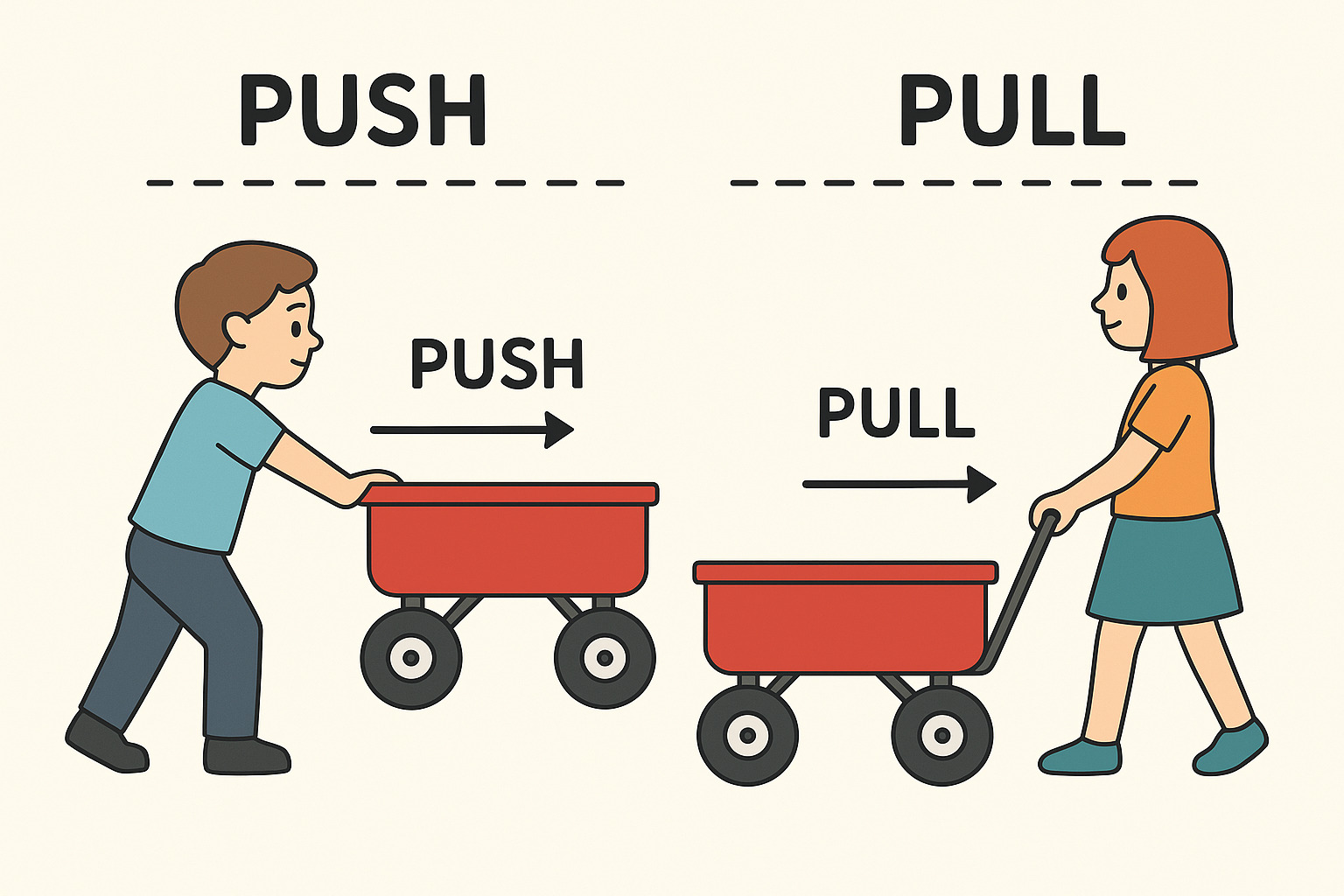
A force is a push or pull acting upon an object due to its interaction with another object. Force can:
- Move a stationary object
- Stop a moving object
- Change the speed or direction of a moving object
- Change the shape of an object
Types of Forces
- Balanced Forces: Do not change the object’s state of motion (net force is zero).
- Unbalanced Forces: Cause a change in motion (net force is non-zero).
Newton's Laws of Motion
1. First Law (Law of Inertia)
An object at rest stays at rest, and an object in motion stays in motion with the same speed and direction unless acted upon by an external force.
This law explains inertia. For example, a book remains on a table unless pushed.
2. Second Law (Law of Acceleration)
The rate of change of momentum of an object is directly proportional to the applied force and takes place in the direction of the force.
Formula: F = ma where:
- F = Force
- m = Mass
- a = Acceleration
Example: Pushing a heavier cart requires more force than pushing a lighter one.
3. Third Law (Action and Reaction)
For every action, there is an equal and opposite reaction.
Example: When you jump off a boat, the boat moves backward.
4. Directional and Non-directional Motion
Directional motion follows a specific path (e.g., a car going north). Non-directional motion is random, like dust particles moving in air.
5. Types of Motion with Examples
Rectilinear Motion
Motion along a straight line. Examples: car on a straight road, bullet from a gun.
Circular Motion
Movement along a circular path. Examples: fan blades, merry-go-round, planets orbiting the Sun.
Oscillatory Motion
To and fro motion. Examples: pendulum, swing, tuning fork.
| Type of Motion | Description | Examples |
|---|---|---|
| Rectilinear | Straight-line movement | Train on a straight track |
| Circular | Around a fixed path | Clock hands, fan |
| Oscillatory | Back-and-forth around a point | Pendulum, swing |
| Rotational | Spinning about an axis | Earth’s rotation |
Examples of Different Types of Motion
| Type of Motion | Examples |
|---|---|
| Rotatory Motion |
1. Fan blades rotating 2. Earth spinning on its axis 3. Drill machine in use 4. Spinning top 5. Motor shaft turning |
| Circular Motion |
1. Moon revolving around Earth 2. Car turning in a circular track 3. Electron revolving around nucleus 4. Giant wheel at a fair 5. Stone tied to a string and swung |
| Oscillatory Motion |
1. Pendulum of a clock 2. Swing in a playground 3. Vibrating tuning fork 4. Seesaw motion 5. Piston in a car engine |
| Periodic Motion |
1. Revolution of Earth around Sun 2. Hands of a clock 3. Vibration of guitar strings 4. Motion of a pendulum 5. Heartbeat rhythm |
| Random Motion |
1. Flying mosquito 2. Movement of dust in air 3. Gas molecules in a room 4. Movement of leaves in strong wind 5. Drunk person walking |
| Vibrational Motion |
1. Vibrating mobile phone 2. Tuning fork vibrations 3. Guitar string after plucking 4. Machine during operation 5. Speaker diaphragm vibrating |
Motion and Time – Summary and Key Points
Fast and Slow Objects: An object is called slow if it takes more time to cover a distance, and fast if it takes less time. For example, a bicycle taking 25 minutes to reach school is slower than a bus that takes only 10 minutes for the same distance.
Concept of speed: Speed is the distance an object travels in a unit of time. Formula: Speed = Distance / Time. For example, if a car covers 100 km in 2 hours, its speed is 50 km/h. This is considered the average speed.
Uniform and Non-uniform Motion:
- Uniform Motion: Constant speed in a straight line.
- Non-uniform Motion: Speed keeps changing.
Units of Speed: Standard unit is metre/second (m/s). Larger speeds use kilometre/hour (km/h), and smaller speeds use centimetre/second (cm/s).
Measuring Time: Today we use clocks and watches. In the past, natural events like sunrises or full moons were used. One year is the time Earth takes to revolve around the Sun.
Ancient Time Devices:
- Sundial: Uses the Sun’s shadow.
- Sand Clock: Uses flowing sand.
- Water Clock: Uses dripping water to measure intervals.
Simple Pendulum: A weight suspended by a string that swings back and forth, demonstrating periodic motion. Time period depends on the length of the pendulum.
Units of Time: Second (s) is the base unit. 1 min = 60 s, 1 hour = 60 min. Longer intervals include day, month, and year.
Modern Clocks: Quartz clocks use electric circuits and are highly accurate.
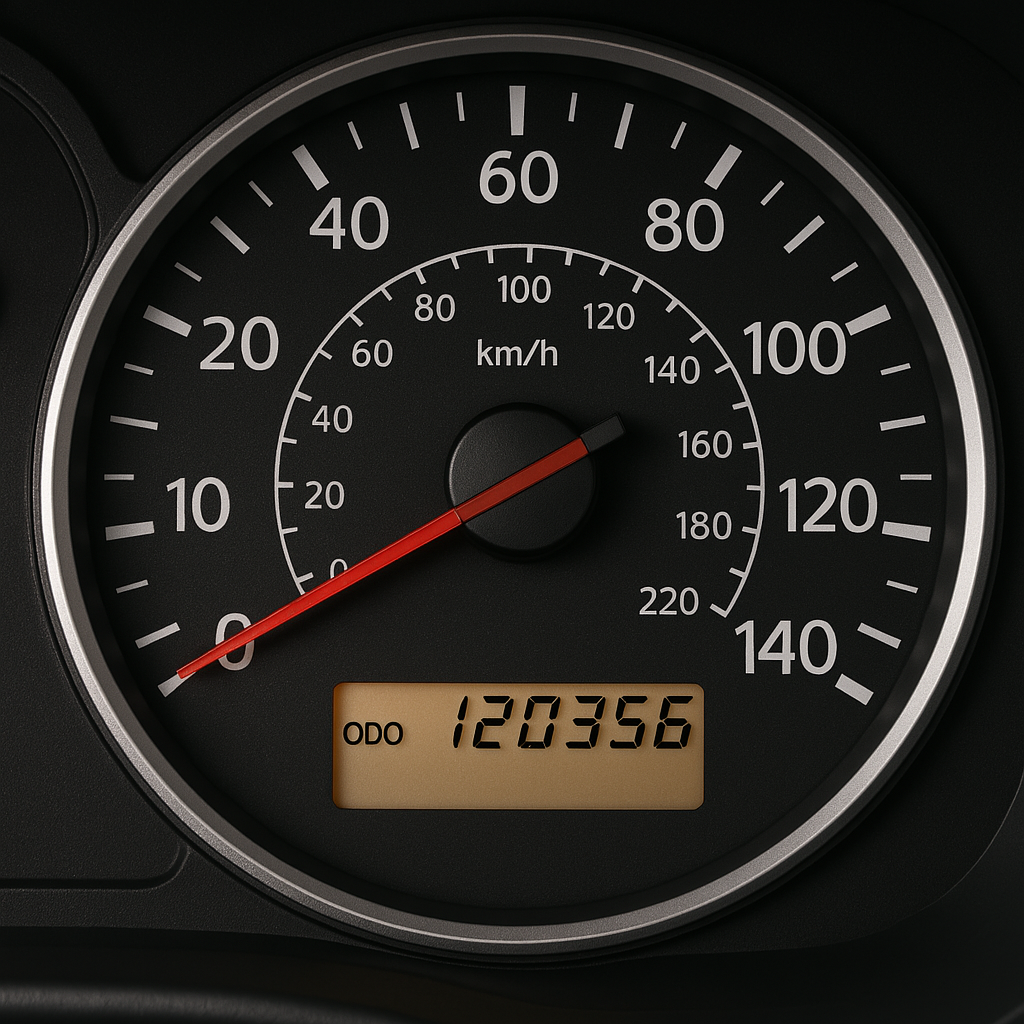
Speedometer and Odometer:
- Speedometer: Shows current speed in km/h.
- Odometer: Shows total distance covered in km.
Distance-Time Graph: Represents motion on a graph with time on the x-axis and distance on the y-axis. A straight line indicates uniform motion.
Other Graph Types: Bar graphs and pie charts are also used to display information in an easy-to-understand way.
Key Points
- Speed = Distance ÷ Time
- Uniform motion means constant speed; non-uniform means varying speed.
- Standard units: m/s (speed), s (time)
- Old time tools: sundials, water clocks, sand clocks
- Simple pendulum shows periodic motion; time period depends on length
- Speedometer shows current speed; odometer shows total distance
- Distance-time graph helps visualize motion
6. Units of Measurement
Motion is measured using standard units:
- Distance – metre (m), kilometer (km)
- Time – second (s), minute (min)
- Speed = Distance ÷ Time (units: m/s or km/h)
7. Motion-Time Graphs
Distance-time graphs help visualize motion. In the graph:
- Straight sloped line = uniform motion
- Curved line = non-uniform motion
- Flat line = object at rest
8. Different Types of Graphs in Motion
Types of graphs include:
- Uniform Motion: Straight line with constant slope
- Non-uniform Motion: Curved line
- Rest: Flat horizontal line
Textbook Questions and Answers
Question 1.Classify the following as motion along a straight line, circular or oscillatory motion:
(i) Motion of your hands while running.
Answer:Oscillatory motion.
(ii) Motion of a horse pulling a cart on a straight road.
Answer: Straight line motion.
(iii) Motion of a child in a merry-go-round.
Answer: Circular motion.
(iv) Motion of a child on a see-saw.
Answer:Oscillatory motion.
(v) Motion of the hammer of an electric bell.
Answer: Oscillatory motion.
(vi) The motion of a train on a straight bridge.
Answer: Straight-line motion.
Question 2. Which of the following are not correct?
(i) The basic unit of time is second.
Answer:Correct.
(ii) Every object moves at a constant speed.
Answer:Not Correct.
(iii) Distances between the two cities are measured in kilometres.
Answer: Correct.
(iv) The time period of a given pendulum is not constant.
Answer:Not Correct.
(v) The speed of a train is expressed in m/h.
Answer: Not Correct.
Question 3. A simple pendulum takes 32s to complete 20 oscillations. What is the time period of the pendulum?
Answer: Given that the number of Oscillations = 20
Total time taken to complete 20 oscillations = 32s. Time period = Number of oscillations divied by the Time taken in total. Therefore, it is 20/32= 0.6
Question 4.
The distance between two stations is 240 km. A train takes 4 hours to cover this distance. Calculate the speed of the train.
Answer: Given, distance between the two stations = 240 km. As per the formula, spedd=distance/time, which gives 60 kilometers per hour
Question 5.The odometer of a car reads 57321.0 km when the clock shows the time at 08 : 30 AM. What is the distance moved by car, if at 08:50 AM, the odometer reading has changed to 57336.0 km? Calculate the speed of the car in km/min during this time. Express the speed in km/h also.
Answer: Given,
The initial reading of the odometer of the car = 57321.0 km.
The final reading of the odometer of the car = 57336.0 km
Distance covered by the car = Final reading initial reading
= 57336.0 – 5 7321.0 = 15 km
The given car starts at 8 : 30 a.m. and stops at 8 : 50 a.m.
Therefore, the time taken by the car to cover the distance is (8 : 50 – 8 : 30) min = 20 min.
- e., distance = 15 km.
Time taken = 20 min
Question 6.Salina takes 15 minutes from her house to reach her school on a bicycle. If the bicycle has a speed of 2 m/s, calculate the distance between her house
Answer: Time taken by Salma to reach her school from her home = 15 min = 15 × 60 = 900s
Speed of her bicycle = 2m/ s
Question 7.Show the shape of the distance-time graph for die motion in the following cases:
Answer:
(i) A car moving at a constant speed.
(ii) A car parked on a side road.
Question 8. Which of dying following relations is correct?
- Speed=Distance/Time
- Speed =distance X Time
- Speed=Time/Distance
- Speed=1/Distance
Answer: A
Question 9. The basic unit of speed is:
Answer: (iv) m/s
Question 10. A car moves with a speed of 40 km/h for 15 minutes and then with a speed of 60 km/h for the next 15 minutes. The total distance covered by the car is:
Solution:(ii) 25 km
Case I: speed = 40 km / h
Time = 15 min = 16/60 hour
Distance = speed × Time
= 10 km,
Speed = 60 km/h
Time = 15 min = 15/60 hour
Distance = speed × Time = 15 km
Total distance = 10 km +15 km = 25 km
Question 11.Suppose the two photographs, shown in Fig. 13.1 and Fig. 13.2, had been taken at an interval of 10 seconds. If a distance of 100 meters is shown by 1 cm in these photographs, calculate the speed of the blue car.
Answer:
From figures 13.1 and 13.2 we conclude that the distance covered by the blue car is 2 cm.
So, the distance covered = 2 × 100 m = 200m
Time Taken = 10 seconds
Question 12.Fig. 13.15 shows the distance-time graph for the motion of two vehicles A and B. Which one of them is moving faster?
Answer: Vehicle A is moving faster than the vehicle
Speed is given by the relation.
This relation shows that the speed of a vehicle is greater if it covers a greater distances in a given interval of time. To compare the distance, draw a line perpendicular to the time – axis, as shown in the following distance-time graph.
From the graph, it is evident that for a given time t1, the distance covered by vehicle A is greater than that covered by vehicle B. Hence, vehicle A is moving faster than vehicle B.
Question 13. Which of the following distance-time graphs shows a truck moving with a speed which is not constant?
Additional Questions
Multiple Choice Questions
Question 1. What is the relation between distance and speed?
(a) Distance = Speed × Time
(b) Distance = Speed/Time
(c) Distance = Time/Speed
(d) None of the above
Answer:
(a) Distance = Speed × Time
Question 2. Two students were asked to plot a distance-time graph for the motion described by Table A and Table B.
|
Distance moved (m) |
0 |
10 |
20 |
30 |
40 |
50 |
|
Time (min) |
0 |
2 |
4 |
6 |
8 |
10 |
|
Distance moved (m) |
0 |
5 |
10 |
15 |
20 |
25 |
|
Time (min) |
0 |
1 |
2 |
3 |
4 |
5 |
The graph given in figure is true for
(a) Both A and B
(b) Only A
(c) Only B
(d) Neither A nor B
Answer: (a) Since, speed is constant for A and S, so graph for A and 6 will be a straight line.
Question 3. How will you convert the speed given in km/h to m/s?
(a) By multiplying with 5/16
(b) By multiplying with 6/5
(c) By multiplying with 18/5
(d) By multiplying with 5/18
Answer: (d) Conversion of km/h into m/s
Question 4.On which axis is dependent variable represented?
(a) x-axis
(b) y-axis
(c) On any axis
(d) Depends on the data
Answer: (b) y-axis
Question 5. If we denote speed by S, distance by D and time by T, the relationship between these Quantities is.
Answer: (d) S=1T×D
Question 6. Which one records the distance travelled by a vehicle?
(a) Speedometer
(b) Manometer
(c) Motometer
(d) Odometer
Answer:
(d) Odometer
Question 7. The correct symbol to represent the speed of an object is
(a) 5 m/s
(b) 5 m/m
(c) 5 m/s-1
(d) 5 s/m
Answer:
(a) 5 m/s
Question 8. The distance-time graph for the motion of an object moving with a constant speed is
(a) a curved line leaving towards x-axis
(b) a curved line inclined towards y-axis
(c) a straight line inclined at some angles towards x-axis
(d) None of the above
Answer:
(c) a straight line inclined at some angles towards x-axis
Question 9. Figure shows an oscillating pendulum.
Time taken by the bob to move from A to C is t1 and from C to O is t2. The time period of this simple pendulum is.
(a) (t1 + t2)
(b) 2(t1 + t2)
(c) 3 (t1 + t2)
(d) 4(t1 + t2)
Answer:
(d)As from A to O, 14th time of one full cycle of time is required, so time period will be 4 (t1 + t2.
Question 10. The distance-time graph for a vehicle standing on a road side will be
(a) straight line inclined by some angle to x-axis
(b) straight line parallel to x-axis
(c) straight line parallel to y-axis
(d) None of the above
Answer:
(b) straight line parallel to x-axis
Question 11. Boojho walks to his school which is at a distance of 3 km from his home in 30 min. Onreaching, he finds that the school is closed and comes back by a bicycle with his friend and reaches home in20 min. His average speed in km/h is.
(a) 8.3
(b) 7.2
(c) 5
(d) 3.6
Answer:
(b) Given, total distance = 3+ 3 = 6km, total time = 30 + 20 = 50 min
Question 12. A bus travels 54 km in 90 min. The speed of the bus is
(a) 0.6 m/s
(b) 10 m/s
(c) 5.4 m/s
(d) 3.6 m/s
Answer:
Question 13. Observe the given figure.
The time period of a simple pendulum is the time taken by it to travel from
(a) A to 8 and back to A
(b) O to A, A to 8 and 8 to A
(c) 8 to A, A to 8 and 8 to O
(d) A to 8
Answer:(a) Time period of a simple pendulum is the total time taken to complete one full cycle.
Question 14. Which of the following cannot be used for the measurement of time?.
(a) A leaking tap
(b) Simple pendulum
(c) Shadow of an object during the day
(d) Blinking of eyes
Answer:
(d) Blinking of eyes
Question 15. Two clocks A and B are shown in figure. Clock A has an hour and a minute hand whereas clock B has an hour hand, minute hand as well as a second hand. Which of the following statement is correct for these clocks?.
(a) A time interval of 30 s can be measured by clock A.
(b) A time interval of 30 s cannot be measured by clock B
(c) Time interval of 5 min can be measured by both A and B
(d) Time interval of 4 min 10 s can be measured by clock A
Answer:
(c) Time interval of 5 min can be measured by both A and B
Fill in the Blanks
1. The distance covered by an object in a ……………….. is called its speed.
2. Time between one sunrise and the next sunrise was called a ……………….. .
3. In a simple pendulum, the metallic ball suspended by thread is called its ……………….. .
4. Time period of a pendulum depends on its ……………….. .
5. The symbols of all units are written in ……………….. .
6. A ……………….. is one billionth of a second.
7. Motion of objects can be represented in the pictorial form by their ……………….. graph.
8. The distance-time graph for the motion of an object moving with a constant speed is a ………………..
Answers:
1. unit time
2. day
3. bob
4. length
5. singular
6. nanosecond
7. distance-time
8. straight line
True/False
1. The motion of a spinning top is rotational motion.
2. The smallest time interval that can be measured with commonly available clocks and watches is one second.
3. The time period of simple pendulum is not constant.
4. Faster vehicle has a higher speed.
5. All the clocks make use of some periodic motion.
6. The basic unit of speed is km/h.
7. The symbols of all units are written in singular.
8. The basic unit of time is second.
9. The distance-time graph of standing vehicle is a straight line parallel to x-axis.
10. Periodic events are used for the measurement of time.
Answers:
1. True
2. True
3. True
4. True
5. True
6. False, because the basic unit of speed is m/s
7. True
8. True
9. True
10. True
Match the Columns
Question 1.
Match the Column I with Column II.
|
Column I |
Column II |
|
(a) Years |
(i) rotation period of the earth on its axis |
|
(b) Hour |
(ii) time to complete 100 m race |
|
(c) Minute |
(iii) gestation period in humans |
|
(d) Days |
(iv) age of a person |
|
(e) Second |
(v) in scientific research |
|
(f) Month |
(vi) time to reach your school |
|
(g) Microseconds |
(vii) train reaches from one city to other |
Answers:
1.
(a)-(iv)
(b)-(viii)
(c)-(vi)
(d)-(i)
(e)-(ii)
(f)-(iii)
(g)-(v)