A journey throgh the states of water
Water is all around us. Pure water is clear, tasteless and odourless liquid. – Most of the water is found in oceans, but the major source of the water is the rain. After the rain, water moves to ponds, wells, tanks, rivers, and finally to oceans. Our body also has a lot of water. Water moves from one place to another in an endless cycle! Sometimes, it's a liquid flowing in streams; other times, it becomes ice in the freezer or turns into steam rising from a boiling kettle. This amazing ability of water to change its state — from solid to liquid to gas and back again — is what makes it so important for life on Earth. This journey happens every day, around us and inside us. In this lesson, we will explore the 3 states of water: solid (ice), liquid (water), and gas (water vapor) and how heating and cooling change water from one form to another. We also understand the fundamentals of water cycle, where water travels through the sky, land, and oceans.
Different States of Water
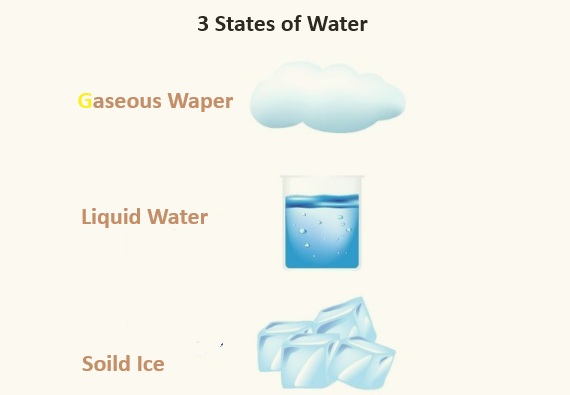
Water exists in three different forms, also called states, they are ice, liquid and vapour(gas):
When water is cooled below 0°C, it freezes and becomes ice.Ice is hard and has a fixed shape. Examples: Ice cubes, snow, frost. Therefore, freezing liquid water turns it into solid ice. Liquid is the form we use most often. Liquid water has no fixed shape, but it takes the shape of its container. Examples: Water in bottles, rivers, lakes, and rain. The process of melting – the ice above 0°C gradually forms liquid water . Gas (Water Vapour) occurs when water is heated above 100°C, it evaporates and becomes an invisible gas called water vapour. It spreads out and fills the space around it. Examples: Steam from boiling water, water vapour in the air. The process of conversion of liquid water into gas is called evaporation – Water changes into vapour when heated. Condensation is the opposite to vaporization. It is a process where water vapour cools down to become liquid again.
| State | Name | Process to Reach This State | Example |
|---|---|---|---|
| Solid | Ice | Freezing (from liquid) | Ice cubes, snow |
| Liquid | Water | Melting (from solid) or Condensing (from gas) | River, tap water |
| Gas | Water Vapour | Evaporation or Boiling (from liquid) | Steam, clouds (vapour) |
Investigating Water’s Disappearing Act
Have you ever left a glass of water exposed to sunlight and noticed that after some time, the water level goes down — even though no one drank it? This can be explained by the “disappearing act” of water! The water kept in the glass actually didn’t vanish but the liquid state of water got changed into water vapour and mixed with the air. This process is called evaporation. Evaporation is a very useful process , the wet clothes drying in the sun. and the water found in the salt water disappears to leave behind the crystals of salt are few examples .
The water sprinkled on the hot pan gets converted into steam, which is actually water vapor. Some of this vapor condenses back into water droplets.
Evaporation: Water Turning into Vapor
- The process of converting water into its vapor state is called evaporation.
- Evaporation occurs continuously, even at room temperature.
- Examples include drying wet clothes, mopping the floor, and sweat evaporating from our body.
Reason for Water Disappearing from Puddles
Is it because of:
- water seeping into the ground,
- evaporation of water, or
Water Vapour in Steam
Water vapour is not visible on its own. However, when it condenses into tiny droplets of water, as seen in steam, it becomes visible.
Another Mystery
Water droplets form on the cold water bottle because water vapor in the air touches the cold surface and changes into liquid water. This process is called condensation.
What is Condensation?
- The water droplets form because water vapor in the air comes into contactwith the cold surface of the glass tumbler and condenses into liquid water. This process is known as condensation.
- For example,when warm, moist air from the plants cools down quickly, like on a cold glass or a leaf, the water vapor loses energy and changes back into liquid water. This is why you see water droplets on cold surfaces in the morning.
Understanding Humidity: A Yearly Study
- Humidity: Humidity refers to the amount of water vapor present in the air.
- Humidity Measured:The daily humidity levels in your area are measured and reported by newspapers and other sources.
- Study Humidity Data:By compiling the humidity data for the entire year, you can look for patterns and trends in how humidity changes throughout the seasons.
Different States of Water
Water can be seen in three different states in our daily life, solid, liquid, and gas.
- Ice (Solid State): Ice keeps its shape no matter what container it is in. It does not flow or spread. For examplestones, wood, and glass
- Water (Liquid State): Water takes the shape of its container, flows, and spreads. It has a constant volume but can change shape. Water can also spread while keeping its volume the same.For examplesmilk and oil.
- Water Vapour (Gaseous State): Water vapour spreads out to fill the entire space available. Gases do not have a fixed shape. Water vapour is present in the air around us, even at room temperature, although we cannot see it. It is produced when water evaporates, such as when clothes dry or floors are mopped.For example, oxygen and carbon dioxide
How can we Change the States of Water?
We can change the state of water by adding or removing heat. When we heat water, it turns into steam (gas). When we cool water, it turns into ice (solid). By changing the temperature, we can make water switch between liquid, gas, and solid states.
Melting and freezing
- Melting: Melting is the process of changing from a solid state (ice) to a liquid state (water).
- Freezing: Freezing is the process of changing from a liquid state (water) to a solid state (ice).
Atmospheric Water Generator (AWG) Machine
- An Atmospheric Water Generator (AWG) machine is a device that produces drinkable water by collecting moisture from humid air.
- How Does it Work?: The AWG machine works by cooling the air, which causes the water vapor in the air to condense into liquid water. This process is similar to the way droplets of water form on the outside of a cold glass of ice water.
How can water be Evaporated Faster or Slower?
Clothes dry faster on a windy day because the moving air helps increase the rate of evaporation, making the water in the clothes evaporate more quickly.
Factors affecting Evaporation
- Water evaporates faster with higher temperatures, wind, and a larger surface area.
- To slow down evaporation, we can lower the temperature, reduce airflow, and cover the surface of the water.
- These factors control how quickly water changes from liquid to gas.
Humidity on Rainy Days
- Humidity refers to the amount of water vapor present in the air.
- On rainy days, the air contains more water vapor, which increases humidity.
- This is why rainy days often feel more humid compared to dry days.
Cooling Effect of Evaporation
We feel cooler under a fan because the moving air helps evaporate sweat from our skin, which cools us down.
When water evaporates, it absorbs heat from its surroundings, causing a cooling effect. This phenomenon can be observed in various daily activities and objects.
Examples:
- Sweating:When we sweat, the evaporation of sweat from our skin takes away body heat, cooling us down.
- Earthen Pots: Water seeps through the porous surface of earthen pots and evaporates, keeping the stored water cool.
- Sprinkling Water: Sprinkling water on the floor or roof in summer can cool the area as the water evaporates.
How do Clouds give us Rain?
Role of Condensation in the Water Cycle
- Condensation is crucial for returning evaporated water to the Earth's surface.
- As air rises above the Earth's surface, it cools down. When the air cools to a certain point, the water vapor in it condenses into tiny droplets. These droplets usually form around dust particles.
- The tiny droplets gather together to form clouds. When these droplets combine and become larger, they eventually fall as rain.
Water Availability and Conservation
- A small portion of Earth's water is suitable for use by plants, animals, and humans. Most of the water is in the oceans and is not directly usable.
- Water is essential for drinking and various activities. With the rising population, the demand for water is increasing, leading to shortages in many areas.
- It is important to use water wisely, avoid wastage, and keep water bodies free from pollution.
Why Does Water Vapour in the Air Rise?
When air contains a lot of water vapour, it becomes lighter than the surrounding air. This is similar to how gas balloons filled with lighter gases rise in the atmosphere. The water vapour in the air makes it less dense, allowing it to rise higher in the atmosphere.
Key Points
- Evaporation: The process where liquid water changes into water vapour.
- Condensation: The process where water vapour changes back into liquid water.
- States of Water: Solid (ice), liquid (water), gas (water vapour).
- State Changes: Melting (solid to liquid), freezing (liquid to solid), evaporation (liquid to gas), condensation (gas to liquid).
- Factors Affecting Evaporation: Temperature, surface area, air movement, and humidity.
- Cooling Effect: Caused by the evaporation of water, taking heat from the surroundings.
- Cloud and Rain Formation: Through the condensation of water vapour and the combination of water droplets.
QUESTION ANSWERS
Question 1. Why does air containing water vapour go up in the atmosphere (thin layer of air
that surrounds the Earth)?
Answer
Air containing water vapor rises in the atmosphere primarily because it becomes less dense than the surrounding dry air when it is heated. This density difference causes the moist air to rise upwards. This process is crucial for the water cycle and weather patterns
Let us enhance our learning
- Which of the following best describes condensation?
(A) The conversion of water into its vapour state.
(B) The process of water changing from a liquid into gaseous state.
(C) The formation of clouds from tiny water droplets.
(D) The conversion of water vapour into its liquid state.
Answer
(D) The conversion of water vapour into its liquid state.
- Identify in which of the given processes, evaporation is very important—
(i) Colouring with
(a) crayons
(b) water colours
(c) acrylic colours
(d) pencil colours
(ii) Writing on paper with
(a) pencil
(b) ink pen
(c) ball point pen
Answer
(i) (b) Evaporation is very important in colouring with water colours.
(ii) (b) Evaporation is very important in writing on paper with ink pen.
- We see green coloured plastic grass at many places these days. Space around natural grass feels cooler than space around the plastic grass. Can you find out why?
Answer
Natural grass produces a cooling effect through the processes of transpiration and evaporation. Natural grass absorbs moisture from air and this water then evaporates by absorbing heat from the surroundings. The temperature of surrounding decreases when the water evaporates which creates a cooling effect. On the other hand, plastic grass doesn't exhibit these properties.
- Give examples of liquids other than water, which evaporate.
Answer
Some of the examples of liquid which evaporate:
- Alcohol
- Oil
- Petrol
- Acetone
- Sanitizer
- Milk
- Fans move air around, creating a cooling sensation. It might seem strange to use a fan to dry wet clothes since fans usually make things cooler, not warmer. Normally, when water evaporates, it requires heat, not cold air. What do you think about this?
Answer
The rate of evaporation increases when air is moving. When we turn on the fan, the air moving across the wet clothes carry away the water vapour from them creating a drier environment around the cloth. This air-flow helps to reduce the humidity and hence speeds up the rate of evaporation. This help in drying the cloth under the fan.
- Usually, when sludge is removed from drains, it is left in heaps next to the drain for 3–4 days. Afterward, it is transported to a garden or a field where it can be used as manure. This approach reduces transportation cost of the sludge and enhances the safety of individuals handling it.Reflect upon it and explain how.
Answer
The sludge removed from the drain is wet and leaving them next to the drain for 3-4 days helps water evaporate from it. This process makes the sludge lighter and easier to transport. As a result, transportation costs are reduced.
- Observe the activities in your house for a day. Identify the activities that involve evaporation. How does understanding the process of evaporation help us in our daily activities?
Answer
Some daily activities that involve evaporation:
- Drying clothes
- Cooling milk
- Mopping the floor
- Sweating
- Cooking
Knowing that water evaporates faster in sunlight and with increased air movement, and that the rate of evaporation decreases with higher humidity, helps us in our daily activities.
- How is water present in the solid state in nature?
Answer
Water exists in the solid state in nature as:
- Glaciers
- Snow
- sea
- Frost
- Ice caps
- Hail
- Reflect on the statement “Water is our responsibility before it is our right.” Share your thoughts.
Answer
The statement "Water is our responsibility before it is our right" emphasizes that access to water is a basic human right, as it is essential for drinking and other daily activities. However, with the rise in population, the demand for water is increasing. Therefore, it is crucial to use water wisely and avoid wasting it. It is also our responsibility to keep water bodies free from pollution.
- The seat of a two-wheeler parked on a sunny day has become very hot. How can you cool it down?
Answer
The hot seat of a two-wheeler parked on a sunny day can be cooled down by sprinkling water on it or keeping wet cloth on the seat. The water evaporates absorbing the heat from the seat thereby cooling it down.