Lesson 1. Is Matter Around Us Pure?
Take the QuizPure Substances
- Pure substancesare elements or compounds made up of only one kind of entity.
- They cannot be broken down into simpler entities by chemical or physical methods.
- They have a fixed composition. Example: Diamond, carbon dioxide.
- A substance that only contains one type or class of atom is said to be an element. Since it cannot be altered through physical or chemical means to break down or create new substances, an element is a pure material. The majority of elements are metals, nonmetals, or metalloids.
- Pure substances typically only include one type of atom or molecule and are homogeneous in nature.
- Most of the time, the composition of these chemicals is constant or uniform.
- The boiling and melting points of the substances are constant.
- In a chemical reaction, a pure substance often takes part to produce predictable results.
Compounds
Compounds are the substances consisting of two or more different types of elements in a fixed ratio of its atoms.
Difference between Mixtures and Compounds
| Compound | Mixture |
|---|---|
| Compounds are substances which can be formed by chemically combining two or more elements. | Mixtures are substances that are formed by physically mixing two or more substances. |
| Compounds fall under pure substances. | Mixtures can be categorized as impure substances. |
| The chemical composition of compounds is always fixed. | A mixture can have a variable composition of the substances forming it. |
| Compounds are always homogeneous in nature. | Mixtures can either be homogeneous or heterogeneous in nature. |
| A new substance is formed after the constituents are chemically combined. So, a compound has different properties from its constituents. | No new substances are formed in mixtures and their properties are dependent on the properties of their respective constituents. |
Example of compounds includes water (H2O), Hydrogen Peroxide (H2O2), etc. You can see water’s chemical formula, it says it has 2 atoms of Hydrogen combined with 1 atom of oxygen and in hydrogen peroxide, it has 2 atoms of hydrogen and two atoms of oxygen.
Elements
- Elements are species of atoms which have the same number of protons in their atomic nuclei.
- Elements are represented by symbols e.g.Hydrogen (H), Boron (B), Carbon (C), Silicon (Si) etc.
Metals
- Metal is a solid material which is typically hard, shiny, malleable, fusible, and ductile, with good electrical and thermal conductivity.
- Examples: Aluminium, Copper, Iron, Tin, Gold
Nonmetals
- Non-metals are brittle and are not malleable or ductile.
- They are poor conductors of heat and electricity.
- Examples: Carbon, Boron etc.
Pure Elements and Compounds
| Category | Examples |
|---|---|
| Pure Elements | - Iron (Fe) - Oxygen (O₂) - Gold (Au) - Copper (Cu) - Carbon (C) - Nitrogen (N₂) - Helium (He) - Aluminum (Al) |
| Pure Compounds | - Water (H₂O) - Sodium chloride (NaCl) - Carbon dioxide (CO₂) - Methane (CH₄) - Sulfur dioxide (SO₂) - Calcium carbonate (CaCO₃) - Hydrochloric acid (HCl) |
Key Points:
-
Pure Elements: These are made up of only one type of atom. Examples are metals (like Iron and Gold) and non-metals (like Oxygen and Nitrogen).
-
Pure Compounds: These are substances formed from two or more types of atoms chemically bonded together. Examples include water (H₂O), carbon dioxide (CO₂), and sodium chloride (NaCl).
Metalloids
- Metalloids exhibit some properties of metals as well as of non-metals.
- Examples: Boron, silicon, germanium, arsenic, antimony, and tellurium
Mixtures
A mixture in chemistry is a substance made up of two or more unrelated chemical components. A mixture is a physical combination of two or more distinct substances that can take the form of solutions, suspensions, or colloids.
- Crude oil: A mixture of organic compounds (mainly hydrocarbons)
- Seawater: A mixture of various salt and water.
Mixtures are formed by just mixing two or more pure substances (components) such that each substance retains its own chemical identity.
Types of Mixtures:
Heterogeneous and homogeneous mixtures are the two types of mixtures. While homogeneous mixtures seem consistent throughout, heterogeneous mixtures have clearly discernible components. A solution, which can be a solid, liquid, or gas, is the most typical kind of homogenous mixture.
1. Homogeneous Mixture
A mixture which has a uniform composition throughout is called a homogeneous mixture or solution.
- Examples: sugar in water, salt in water.
Heterogeneous Mixture
A mixture which contains physically distinct parts and has a non-uniform composition is called a heterogeneous mixture. Examples: Mixture of salt and iron filings, sand and sugar.
Physical vs Chemical Changes
The nature of the substance, the particles that make up it, and the quantity of particles all stay unaltered after a physical change. Chemical changes result in new compounds with different properties from the original ones, as well as new particles and maybe altered particle numbers.
Physical and Chemical Changes
- A substance is said to undergo aphysical change when only the physical properties, such as the shape, size, colour or state of the substance, change. No new substance is formed.
- Example: Melting of ice, boiling water.
- A substance is said to undergo achemical change when a new substance with completely new properties (physical and chemical) is formed.
- Example: Burning of wood or paper, souring of milk.
Solutions and Their Properties
- Anything dissolved in a solution is referred to as a solute. In a fluid solution, the amount of solvent always outweighs the amount of solute. Two of the most prevalent solutes in our daily lives are salt and water. Salt is a solute because it dissolves in water.
- Examples of solutes include sugar, dissolved carbon dioxide, oxygen, water vapour, carbon dioxide, argon, etc.
- Solvent refers to the component of a solution that is most prevalent. It is the fluid in which the solute has been dissolved. Typically, a solvent is a liquid. The Latin term solv, which means “to loosen or untie,” is the source of the English word “solvent.”
- Examples of the solvent include water, ethanol, methanol, acetone, tetrachloroethylene, toluene, methyl acetate, and ethyl acetate.
- A solution is a homogeneous mixture of two or more substances.
Properties
- Its particles are too tiny and have a diameter of less than 1 nm.
- The particles are not visible to the naked eyes.
- Particles do not scatter a beam of light passing through them and hence do not show the Tyndall effect.
- The solute particles never settle down on keeping undisturbed.
- The components of a solution cannot be separated using filtration.
Alloys
Alloys are homogeneous mixtures of metals or a mixture of a metal and another element that cannot be separated into their components by physical methods.
Examples:
- Steel – a combination of iron (metal) and carbon (non-metal).
- Bronze – a combination of copper (metal) and tin (metal).
- Brass – a mixture of copper (metal) and zinc (metal).
Concentration of Solutions
The amount of solute that has dissolved in a specific amount of solvent or solution is measured as solution concentration. A concentrated solution is one that has a significant amount of dissolved solute in it. A diluted solution is one that has a small amount of dissolved solute in it.
Solubility
Unsaturated solutions, on the other hand, are those that contain less solute than the maximum that can be dissolved. A saturated solution is one that contains the maximum quantity of solute that can be dissolved. The amount of a solute that dissolves in a solvent is known as its solubility. The majority of solutes become more soluble when the solvent’s temperature rises.
- Solubility is the property showing the ability of a given substance, which is the solute, to dissolve in a solvent.
- It is measured in terms of the maximum amount of solute dissolved in a solvent at equilibrium.
- The resulting solution is called a saturated solution.
Factors Affecting Solubility:
- Temperature – Solubility increases with temperature. The situation is different for gases. With the increase in temperature, they became less soluble in each other and in water but more soluble in organic solvents.
- Pressure – For the majority of solid and liquid solutes, pressure does not affect solubility. The solubility of gas is directly proportional to the pressure of this gas.
Types of Solutions based on the Concentration of the Solution
There are 2 main types of solutions based on the definition. A dilute Solution is a solution that contains a small amount of solute. A concentrated Solution is a solution that contains a lot of solutes. Three types of solutions exist based on the concentration of the solution:
- Dilute
- Concentrated
- Saturated solution.
Ways of Representing the Concentration of a Solution
The concentration of a solution can be represented in many ways
(i) Mass by the mass percentage of a solution = (Mass of solute / Mass of solution) × 100
(ii) Mass by volume percentage of a solution = (Mass of solute/ volume of solution)×100
For example, if a solution of NaCl in water is said to be 10 % by volume that means a 100 ml solution will contain 10 ml NaCl.
Suspensions
Suspension and Its Properties
A suspension is a heterogeneous mixture in which the solute particles do not dissolve but remain suspended throughout the bulk of the medium.
- The solute particles settle down when a suspension is left undisturbed.
- They can be separated from the mixture by filtration.
- A suspension is a heterogeneous mixture.
- The size of solute particles in a suspension is quite large. It is larger than 100 mm in diameter.
- The particles of a suspension can be seen easily.
- The particles of a suspension do not pass through a filter paper. So a suspension can be separated by filtration.
Colloids
Types of Mixtures based on Particle Size
Classified into:
- Solution
- Suspension.
- Colloidal solution.
Colloidal Solutions
A colloidal solution is a mixture in which the substances are regularly suspended in a fluid.
Properties of colloids and their variation are a well-known area ever since the primitive age. The best example to prove their familiarity with us is that we know from very early times that coagulation of milk results in the formation of curd.
- Classified into: Foam, Emulsion, Sol
Tyndall Effect
Tyndall effect is the scattering of light by particles in a colloid or else particles in a very fine suspension.
- e.g.It can be observed when sunlight passes through the canopy of a dense forest.
Dispersed Phase
The solute-like component of the dispersed particles in a colloid form the dispersed phase.
Dispersion Medium
The component in which the dispersed phase is suspended is known as the dispersing medium.
Aerosol
A colloidal solution with dispersed phase solid/liquid and dispersing medium gas is called Aerosol. e.g. clouds
Foam
A colloidal solution with dispersed phase gas and dispersing medium solid/liquid is called Foam. e.g.Shaving cream.
Sols
A colloidal solution with dispersed phase solid and dispersing medium liquid is called Sol. e.g. Milk of magnesia, mud.
Gels and Emulsions
- A colloidal solution with dispersed phase liquid and dispersing medium solid is called Gel.
- A colloidal solution with dispersed phase liquid and dispersing medium liquid is called Emulsion.
Emulsion and gel are two distinct chemical compounds. A gel is a semisolid substance, but an emulsion is a liquid, which is the main distinction between the two. Nevertheless, depending on their intended use, some emulsions can exist in a semisolid condition. Fruit jellies, a gelatinous substance, creams, etc.
Evaporation
The process of conversion of water into water vapour is known as evaporation.
Examples: Clothes drying in the sun. Tea and other hot liquids are cooled down. Dry Floors
Ice cubes melting.
- It can be used to separate the volatile component (solvent) from its non-volatile solute.
Separation of Components of a Mixture
- Heterogeneous mixtures can be separated into their constituents by simple physical methods.
- Methods include handpicking, sieving, and filtration.
Separation of a Mixture of Two Immiscible Liquids
- The separation of a mixture of two immiscible liquids is done by using a separating funnel.
- Applications: To separate a mixture of oil and water in the extraction of iron from its ore.
Immiscible liquids break out into layers according to their densities, which is the basic idea behind the separation of immiscible liquids using a separating funnel.
Centrifugation
- Centrifugation uses centrifugal force for the separation of two liquids in a mixture.
- Here, a denser component of the mixture migrates away from the axis, and a lighter component migrates towards the axis.
Applications
- Used for blood and urine tests in diagnostic facilities.
- Used to separate butter from cream in dairies and at home.
- Utilized washing machines to extract water from drenched clothing.
Sublimation
Sublimation is the transition of a substance from solid phase to gaseous phase without changing into liquid phase.
- Example: Naphthalene balls undergo sublimation.
Solid undergoing sublimation
Chromatography
- Chromatography is used to separate the different components in a liquid mixture.
- It is based on the different properties of compounds in two phases: stationary and mobile phase.
Applications
- The technique of chromatography is extensively employed in the pharmaceutical industry in order to analyze and identify the presence of any trace amounts of chemicals and elements in a given sample.
- In the food industry, the technique of chromatography plays a vital role in the determination of the shelf life of food substances by helping in the analysis of the point at which food spoils.
- In the field of molecular biology, the study of proteomics and metabolomics often involves the use of various hyphenated chromatographic techniques (the most notable of which being EC-LC-MS).
Distillation
Distillation is a method for separating the component substances from a liquid mixture by selective evaporation and condensation.
- Used in: Production of gasoline, distilled water, xylene, alcohol, paraffin, kerosene etc.
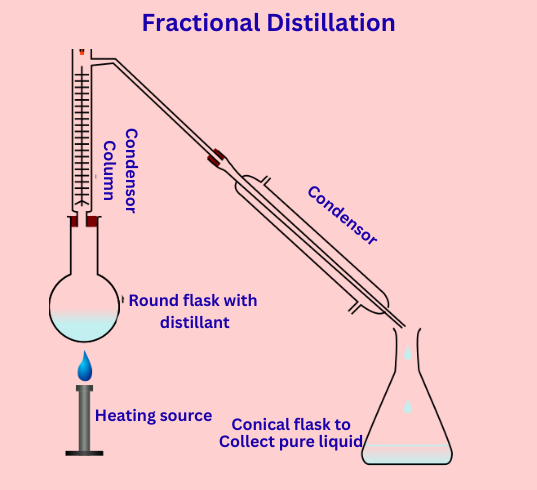
Fractional Distillation
Fractional Distillation is the separation of a mixture into its component parts or fractions by their melting points.
- This is the process of separation of chemical compounds by their boiling point.
- The mixture is heated to a temperature at which one or more fractions will vaporize.
Separation of Air into Its Components
Process of Obtaining Different Gases from the Air
Air is a homogeneous mixture and can be separated into its components by fractional distillation.
Mixtures are substances made up of two or more different kinds of material. Homogeneous and heterogeneous mixtures are the two types of mixtures. There is no particle level homogeneity and the components in a heterogeneous mixture are not dispersed uniformly. As a result, we may simply divide a heterogeneous mixture into its various components.
A few popular separation methods for the heterogeneous mixture include sieving, filtration, hand-picking, etc. We must employ specialised separation procedures when dealing with homogeneous mixtures, as well as occasionally heterogeneous mixtures. Special separation techniques include evaporation, centrifugation, chromatography, sublimation, separating funnels, etc.
Fractional distillation
Crystallization
- Crystallisationis a separation technique in which solids are separated from a solution.
- In this technique, the solvent molecules start evaporating, leaving behind the solutes when the solution is heated in an open container.
Crystallisation is better than evaporation because during evaporation, some solids decompose or some, like sugar, may get charred on heating to dryness. Some impurities may remain dissolved in the solution even after filtration which on evaporation contaminates the solid.
Applications of Crystallisation
Purification of seawater, separation of alum crystals from impure samples etc.
Textbook Solutions
- What is meant by a substance?
,A substance is a pure single form of matter. It has definite properties and compositions. Example: Iron
- List the points of difference between homogeneous and heterogeneous mixtures.
Answer:
Difference between Homogeneous and Heterogeneous Mixtures
| Homogeneous Mixture | Heterogeneous Mixture |
|---|---|
| Particles are uniformly distributed throughout the mixture. | Particles are not uniformly distributed and can be distinguished with the naked eye or microscope. |
| Has a uniform composition. | Irregular composition. |
| No apparent boundaries of separation. | Noticeable boundaries of separation. |
Exercise 2.2 – Page 18
Difference between Homogeneous and Heterogeneous Mixtures
| Homogeneous Mixture | Heterogeneous Mixture |
|---|---|
| Particles are uniformly distributed throughout the mixture. | Particles are not uniformly distributed and can be distinguished with the naked eye or microscope. |
| Has a uniform composition. | Irregular composition. |
| No apparent boundaries of separation. | Noticeable boundaries of separation. |
Exercise 2.2 – Page 18
- Differentiate between homogeneous and heterogeneous mixtures with examples.
Answer: The following are the differences between heterogeneous and homogeneous mixtures:
| Heterogeneous Mixture | Homogeneous Mixture |
|---|---|
| Particles can be seen and separated easily with the naked eye or under a microscope. | Particles are uniformly distributed and not visible separately. |
| Irregular composition. | Uniform composition. |
| Noticeable boundaries of separation. | No visible boundaries. |
| Examples: Seawater, blood, sand in water. | Examples: Saltwater, vinegar, air. |
- How are sol, solution, and suspension different from each other?
Answer:
| Attributes | Sol | Solution | Suspension |
|---|---|---|---|
| Type of mixture | Heterogeneous | Homogeneous | Heterogeneous |
| Size of particles | 10⁻⁷ – 10⁻⁵ cm | Less than 1 nm | More than 100 nm |
| Tyndall effect | Exhibited | Not exhibited | May or may not be exhibited |
| Appearance | Glassy and clear | Unclouded and clear | Cloudy and opaque |
| Visibility | Visible with ultramicroscope | Not visible | Visible with naked eye |
| Diffusion | Diffuses slowly | Diffuses rapidly | Does not diffuse |
| Stability | Stable | Highly stable | Unstable |
| Settling | Settle during centrifugation | Do not settle | Settle on their own |
| Examples | Milk, blood, smoke | Salt solution, sugar in water | Sand in water, dusty air |
Answer:
Mass of solute (NaCl) = 36 g
Mass of solvent (H2O) = 100 g
Mass of , (NaCl + H2O) = 136 g
Concentration = Mass of solute/Mass of solvent, x 100
Concentration = 36/136 x 100 = 26.47%
Hence, the concentration of the , is 26.47%
Exercise-2.3 Page: 24
- How will you separate a mixture containing kerosene and petrol (the difference in their boiling points is more than 25°C), which are miscible with each other?
According to the question, kerosene and petrol are miscible, and their boiling points differ by more than 25 degrees Celsius, which is a significant difference. Therefore they can be separated using a simple distillation procedure.
Distillation can separate kerosene and petrol since their boiling points differ by more than 25 degrees Celsius. The kerosene and petrol combination will be poured into a hot distillation flask. Because petrol has a lower boiling point, it will evaporate and create vapours first as the temperature of the mixture rises. A condenser condenses the vapours of gasoline and collects them through the condenser output. In the distillation flask, kerosene with a higher boiling point will be left behind.
Because their vapours will develop within the same temperature range if the difference in boiling points of two liquids is not great, a simple distillation procedure cannot be utilised to separate them. Fractional distillation separates these liquids by passing the vapours through a fractionating column before condensation.
- Name the techniques used to separate the following:
(a) Butter from curd
(b) Salt from seawater
(c) Camphor from salt
Answer:
- a) A process known as centrifugation is used to separate butter from curd. The process is governed by the principle of density.
- b) We can use the simple evaporation technique to separate salt from seawater. Distillation causes water to evaporate, leaving solid salt behind, hence the production of salt.
- c) Sublimation can be used to separate camphor from salt, as during the phase change, camphor does not undergo a liquid phase.
- What types of mixtures are separated by the technique of crystallization?
Answer:
The technique of crystallisation is used to separate solids from a liquid ,. It is linked to precipitation, but in this technique, the precipitate is achieved in a crystal form which exhibits extremely high levels of purity. The principle of crystallisation can be applied to purify impure substances.
Exercise-2.4 Page: 24
- Classify the following as physical or chemical changes:
- Cutting of trees
- Melting of butter in a pan
- Rusting of Almira
- Boiling of water to form steam
- Passing of electric current through water and water breaking into hydrogen and oxygen gases.
- Dissolving common salt in water
- Making a fruit salad with raw fruits, and
- Burning of paper and wood
Answer:
The following is the classification into physical and chemical change:
Difference between Mixtures and Compounds
| Compound | Mixture |
|---|---|
| Formed by chemically combining two or more elements. | Formed by physically mixing two or more substances. |
| Pure substance. | Impure substance. |
| Fixed composition. | Variable composition. |
| Always homogeneous. | Can be homogeneous or heterogeneous. |
| New substance formed with different properties. | No new substance formed; properties remain individual. |
Difference between Homogeneous and Heterogeneous Mixtures
| Homogeneous Mixture | Heterogeneous Mixture |
|---|---|
| Particles are uniformly distributed. | Particles can be distinguished easily. |
| Uniform composition. | Irregular composition. |
| No visible boundaries. | Visible boundaries between components. |
Examples of Physical and Chemical Changes
| Physical Change | Chemical Change |
|---|---|
|
• Cutting trees • Boiling water • Melting butter • Making fruit salad • Dissolving salt in water |
• Rusting of iron • Electrolysis of water • Burning wood or paper |
Pure Substances and Mixtures
| Pure Substance | Mixture |
|---|---|
| Water | Soil |
| Salt | Salad |
| Iron | Air |
| Diamond | Steel |
Exercise Page: 28
- Which separation techniques will you apply for the separation of the following?
(a) Sodium chloride from its , in water.
(b) Ammonium chloride from a mixture containing sodium chloride and ammonium chloride.
(c) Small pieces of metal in the engine oil of a car.
(d) Different pigments from an extract of flower petals.
(e) Butter from curd.
(f) Oil from water.
(g) Tea leaves from tea.
(h) Iron pins from sand.
(i) Wheat grains from husk.
(j) Fine mud particles suspended in water.
Answer:
(a) In water, sodium chloride in its , can be separated through the process of Evaporation.
(b) The technique of sublimation is apt as Ammonium chloride supports Sublimation.
(c) Tiny chunks of metal pieces in the engine oil of a car can be manually filtered.
(d) Chromatography can be used for the fine segregation of various pigments from an extract of flower petals.
(e) The technique of centrifugation can be applied to separate butter from curd. It is based on the concept of difference in density.
(f) To separate oil from water, which are two immiscible liquids which vary in their densities, using a funnel can be an effective method.
(g) Tea leaves can be manually separated from tea using simple filtration methods.
(h) Iron pins can be separated from sand either manually or with the use of magnets as the pins exhibit strong magnetic quality, which can be a key characteristic taken into consideration.
(i) The differentiating property between husk and wheat is that there is a difference in their mass. If treated with a small amount of wind energy, a remarkable variation in the moving distance is noticed. Hence, to separate them, the sedimentation/winnowing procedure can be applied.
(j) Due to the property of water, sand or fine mud particles tends to sink in the bottom as it is denser provided they are undisturbed. Through the process of sedimentation/decantation, water can be separated from fine mud particles, as the technique is established on obtaining clear water by tilting it out.
- Write the steps you would use for making tea. Use the words solvent, solute, dissolve, soluble, insoluble, filtrate, and residue.
Answer:
(a) Into a vessel, add a cup of milk, which is the solvent, and supply it with heat.
(b) Add tea powder or tea leaves to the boiling milk, which acts as a solute. Continue to heat.
(c) The solute, i.e., the tea powder, remains insoluble in the milk, which can be observed while it is still boiling.
(d) At this stage, add some sugar to the boiling , while stirring.
(e) Sugar is a solute but is soluble in the solvent.
(f) Continuous stirring causes the sugar to dissolve completely in the tea ,reaching saturation.
(g) Once the raw smell of tea leaves vanishes and the tea , is boiled enough, take the , off the heat, filter or strain it to separate the tea powder and the tea ,. The insoluble tea powder remains as a residue while the solute (sugar) and the solvent (essence milk ,) strain through the filter medium, which is collected as the filtrate.
- Pragya tested the solubility of three different substances at different temperatures and collected the data as given below (results are given in the following table, as grams of a substance dissolved in 100 grams of water to form a saturated ,).
|
Substance dissolved |
Temperature in K |
||||
|
283 |
293 |
313 |
333 |
353 |
|
|
Solubility |
|||||
|
Potassium nitrate |
21 |
32 |
62 |
106 |
167 |
|
Sodium chloride |
36 |
36 |
36 |
37 |
37 |
|
Potassium chloride |
35 |
35 |
40 |
46 |
54 |
|
Ammonium chloride |
24 |
37 |
41 |
55 |
66 |
(a) What mass of potassium nitrate would be needed to produce a saturated solution of
potassium nitrate in 50 grams of water at 313K?
(b) Pragya makes a saturated , of potassium chloride in water at 353 K and leaves the
, to cool at room temperature. What would she observe as the , cools? Explain.
(c) Find the solubility of each salt at 293 K. Which salt has the highest solubility at this
temperature?
(d) What is the effect of change of temperature on the solubility of a salt?
Answer:
(a) Given: Mass of potassium nitrate required to produce a saturated solution in 100 g of water at 313 K = 62g
To find: Mass of potassium nitrate required to produce a saturated solution in 50 g of water =?
Required amount = 62 x 50/100 = 31. Hence, 31 g of potassium nitrate is required.
(b) The solubility of potassium chloride in water is decreased when a saturated , of potassium chloride loses heat at 353 K. Consequently, Pragya would observe crystals of potassium chloride, which would have surpassed its solubility at low temperatures.
(c) As per the given data, that is
Solubility of potassium nitrate at 293K = 32 g
Solubility of sodium chloride at 293K = 36 g
Solubility of potassium chloride at 293K = 35 g
Solubility of ammonium chloride at 293K = 37g
We can observe from this data that ammonium chloride has the highest solubility at 293K.
(d) Effect of change of temperature on the solubility of salts:
The table clearly depicts that the solubility of the salt is dependent upon the temperature and increases with an increase in temperature. With this, we can infer that when a salt arrives at its saturation point at a specific temperature, there is a propensity to dissolve more salt through an increase in the temperature of the
- Explain the following, giving examples.
(a) Saturated solution
(b) Pure substance
(c) Colloid
(d) Suspension
Answer:
(a) Saturated ,: It is the state in a , at a specific temperature when a solvent is no more soluble without an increase in temperature. Example: Excess carbon leaves off as bubbles from a carbonated water , saturated with carbon.
(b) Pure substance: A substance is said to be pure when it comprises only one kind of molecule, atom or compound without adulteration with any other substance or any divergence in the structural arrangement. Examples: Sulphur, diamonds etc.
(c) Colloid: A Colloid is an intermediate between , and suspension. It has particles of various sizes that range between 2 to 1000 nanometers. Colloids can be distinguished from ,s using the Tyndall effect. Tyndall effect is defined as the scattering of light (light beam) through a colloidal ,. Examples: Milk and gelatin.
(d) Suspension: It is a heterogeneous mixture that comprises solute particles that are insoluble but are suspended in the medium. These particles that are suspended are not microscopic but visible to bare eyes and are large enough (usually larger than a micrometre) to undergo sedimentation.
- Classify each of the following as a homogeneous or heterogeneous mixture.
soda water, wood, air, soil, vinegar, filtered tea.
Answer:
The following is the classification of the given substances into homogenous and heterogenous mixtures.
|
Homogenous mixture |
Heterogeneous mixture |
|
Soda water |
wood |
|
vinegar |
soil |
|
Filtered tea |
|
|
Air |
- How would you confirm that a colourless liquid given to you is pure water?
Answer:
We can confirm if a colourless liquid is pure by setting it to boil. If it boils at 100°C, it is said to be pure. But if there is a decrease or increase in the boiling point, we infer that water has added impurities, hence not pure.
- Which of the following materials fall into the category of “pure substance”?
(a) Ice
(b) Milk
(c) Iron
(d) Hydrochloric acid
(e) Calcium oxide
(f) Mercury
(g) Brick
(e) Wood
(f) Air.
Answer:
Following substances from the above-mentioned list are pure substances:
- Iron
- Ice
- Hydrochloric acid
- Calcium oxide
- Mercury
- Identify the, solutions among the following mixtures.
(a) Soil
(b) Sea water
(c) Air
(d) Coal
(e) Soda water
Answer:
The following are the solutions from the above-mentioned list of mixtures:
- Sea water
- Air
- Soda water
- Which of the following will show the “Tyndall effect”?
(a) Salt ,
(b) Milk
(c) Copper sulphate ,
(d) Starch ,
Answer:
Tyndall effect is exhibited by only milk and starch , from the above-mentioned list of ,s.
- Classify the following into elements, compounds and mixtures.
(a) Sodium (b) Soil (c) Sugar (d) Silver (e) Calcium carbonate (f) Tin (g) Silicon (h) Coal (i) Air (j) Soap (k) Methane
(l) Carbon dioxide (m) Blood
Answer:
|
Elements |
Compounds |
Mixture |
|
Sodium |
Calcium carbonate |
Soil |
|
Silver |
Carbon dioxide |
Sugar , |
|
Tin |
Methane |
Coal |
|
Silicon |
Air |
|
|
Blood |
||
|
Soap |
- Which of the following are chemical changes?
(a) Growth of a plant
(b) Rusting of iron
(c) Mixing of iron filings and sand
(d) Cooking of food
(e) Digestion of food
(f) Freezing of water
(g) Burning of candle
Answer:
Out of the given list, the following are chemical changes:
Growth of a plant, rusting of iron, cooking of food, digestion of food and burning of candles.