Human Eye and the Colorful World (class10)
Take the QuizIn the previous lesson we have studied about the light and its behaviour. To sense the effects of light, we need sense organs. Among all the sense organs, human eye is a distinct and wonderful organ.It is one of the most remarkable and sensitive sense organs that allows us to perceive the world around us in all its colors and beauty. It resembles a natural camera, capturing light from objects and sending signals to the brain to form images. This lesson explores how the structure and functions of eye, how it adjusts to focus on objects at different distances, and what enables us to see in bright and dim light. In addition, we study the phenomena related to light such as the formation of rainbows, scattering of light, atmospheric refraction, and the reason behind the blue sky and red sunset. Understanding how the human eye works and how light behaves as it travels through different mediums helps us appreciate the science
Fun Fact
The human eye can detect a candle flame from over 2.5 kilometers away in complete darkness! It can differentiate around 10 million different colors.
Structure and Functions of the Human Eye

The human eye is one of the most sophisticated sensory organs that allows us to perceive the surrounding environment by detecting light and converting it into electrical signals interpreted by the brain. It works similarly to a camera, focusing light and forming clear images. The eye is protected, nourished, and supported by various parts working together seamlessly.
Anatomy of the Human Eye (Detailed Notes)
The human eye is a sense organ that helps us see objects by detecting light and converting it into nerve signals.
1. Sclera
-
The outermost white layer of the eye.
-
It is tough and protective in nature.
-
Gives shape to the eyeball and protects the inner delicate parts.
2. Cornea
-
The transparent, curved front part of the eye.
-
Light enters the eye through the cornea.
-
It bends (refracts) light rays and helps in focusing them on the retina.
3. Aqueous Humour
-
A clear, watery fluid present between the cornea and the lens.
-
Supplies nutrients to the cornea and lens.
-
Maintains the internal pressure of the eye.
4. Iris
-
The coloured circular part of the eye (blue, brown, black, etc.).
-
Contains muscles that control the size of the pupil.
-
Helps regulate the amount of light entering the eye.
5. Pupil
-
A small circular opening at the centre of the iris.
-
Appears black because light entering it is absorbed.
-
Expands in dim light and contracts in bright light to control light entry.
6. Eye Lens
-
A transparent, elastic, biconvex lens.
-
Focuses light rays onto the retina to form a clear image.
-
Changes its shape with the help of ciliary muscles (accommodation).
7. Ciliary Muscles
-
Ring-shaped muscles attached to the lens.
-
Help in changing the curvature of the lens.
-
Enable the eye to see near and distant objects clearly.
8. Vitreous Humour
-
A jelly-like transparent substance filling the space behind the lens.
-
Maintains the shape of the eyeball.
-
Keeps the retina in position.
9. Retina
-
The innermost, light-sensitive layer of the eye.
-
Contains rod cells (for dim light vision) and cone cells (for colour vision).
-
A real and inverted image is formed on the retina.
10. Optic Nerve
-
A thick nerve emerging from the back of the eye.
-
Carries visual impulses from the retina to the brain.
-
The brain interprets these impulses as images.
11. Blind Spot
-
The point on the retina where the optic nerve leaves the eye.
-
No rods or cones are present here.
-
Hence, no image is formed at this point.
12. Yellow Spot (Fovea)
-
A small area near the centre of the retina.
-
Contains a high concentration of cone cells.
-
Responsible for sharp and detailed vision.
Functioning of the Eye
When light from an object enters the eye, it first passes through the cornea, which bends the light toward the pupil. The iris adjusts the pupil size to control the amount of light entering. The light then travels through the aqueous humor and reaches the lens, which focuses the light rays exactly onto the retina. Photoreceptor cells in the retina (rods and cones) detect this light and convert it into electrical signals. These signals are transmitted via the optic nerve to the visual cortex of the brain, where the information is processed and interpreted into a recognizable image.
Power of Accommodation
The power of accommodation refers to the eye’s remarkable ability to adjust its focal length to maintain a clear image of objects at varying distances. This ability is primarily controlled by the ciliary muscles, which alter the shape of the lens. When viewing distant objects, the ciliary muscles relax, causing the lens to flatten and reduce its curvature, which decreases its optical power. Conversely, when focusing on nearby objects, the ciliary muscles contract, making the lens more convex (rounded), thereby increasing its refractive power. This dynamic adjustment ensures that the light rays entering the eye are precisely focused onto the retina, allowing for sharp vision across different distances. The effectiveness of this process is measured in diopters, and the power of accommodation is defined as the difference between the eye’s refractive power for near vision and distant vision. In a young, healthy adult, the eye typically has a high accommodative power (around 10–14 diopters), but this ability diminishes with age in a condition known as presbyopia, where the lens loses its flexibility and the near point of vision recedes. A cataract is a medical condition in which the lens of the eye becomes cloudy or opaque, leading to blurred or diminished vision. Accommodation is essential not only for everyday activities like reading or driving but also for the eye’s natural adaptation to changing visual environments.
Mechanism od Accomodation
- Distant vision: Ciliary muscles relax, lens becomes flatter, decreasing refractive power.
- Near vision: Ciliary muscles contract, lens becomes rounder, increasing refractive power.
Formula: Accommodation Power = 1 / Near Point (in meters)
Example: For a near point of 25 cm → 1 / 0.25 = 4 diopters
Defects of Vision and Their Correction

1. Myopia (Nearsightedness)
Myopia, also known as nearsightedness, is a common refractive error in which close objects are seen clearly, while distant objects appear blurry. This condition occurs when the eyeball is too long or the cornea is too curved, causing light rays to focus in front of the retina instead of directly on it. As a result, individuals with myopia often experience difficulty seeing distant objects, frequent squinting, eye strain, and headaches. Myopia is typically corrected with concave (diverging) lenses, which help spread out light rays so they focus properly on the retina, restoring clear distance vision.
2. Hypermetropia (Farsightedness)
Hypermetropia, or farsightedness, is a refractive error in which distant objects are seen more clearly than nearby ones. This condition arises when the eyeball is shorter than normal or the cornea has too little curvature, causing incoming light to focus behind the retina instead of directly on it. People with hypermetropia may experience blurry vision when reading or doing close work, along with eye strain, fatigue, and headaches. Correction typically involves the use of convex (converging) lenses, which bend light rays inward, allowing them to focus correctly on the retina for clearer near vision.
3. Astigmatism
Astigmatism is a common refractive error caused by an irregular curvature of the cornea or lens, resulting in distorted or blurred vision at all distances. Instead of being perfectly spherical, the surface of the cornea or lens in astigmatism is shaped more like a football, which prevents light from focusing evenly on the retina. This uneven focus leads to symptoms such as blurred or distorted vision, difficulty seeing clearly at night, eye strain, and headaches. Cylindrical lenses are typically used to correct astigmatism by compensating for the uneven curvature, allowing light to focus properly on the retina.
4. Presbyopia
Presbyopia is an age-related vision condition in which the eye gradually loses its ability to focus on close objects. This occurs due to the natural aging process, which reduces the elasticity of the eye’s lens, making it less flexible and unable to change shape easily for near focusing. As a result, individuals with presbyopia often struggle to read small print, need to hold reading materials at arm’s length, and may experience eye strain or headaches during close-up tasks. The condition is typically corrected using bifocal or progressive lenses, which provide multiple focal points to enable clear vision at various distances.
Donation of Eyes
Eye donation is a noble act of giving the gift of sight to those who are visually impaired due to corneal blindness. After a person’s death, their healthy corneas can be donated to restore vision in individuals with damaged or diseased corneas. The process begins with a donor pledging their eyes during their lifetime or the consent of their family after death. After the donor passes away, the eyes must be retrieved within 4 to 6 hours by trained professionals. The corneas are carefully removed, preserved, and evaluated in an eye bank before being transplanted into a recipient. One pair of donated eyes can help two people regain vision. Eye donation does not cause disfigurement and does not delay funeral rituals. The donated cornea, if well-preserved, can remain viable for up to 14 days. Eye donation is completely voluntary, safe, and supported by major religions. By donating eyes, one can give a new lease of life and hope to someone. An eye bank is a specialized organization that collects, processes, evaluates, stores, and distributes donated eye tissue, primarily the cornea, for transplantation, research, and education. Eye banks play a critical role in the eye donation process by ensuring that donated tissues are safe and suitable for use. After a donor’s death, the eye bank dispatches trained personnel to retrieve the eyes or corneas within a few hours. The tissues are then tested for infections, assessed for quality, and preserved under strict medical standards. Once cleared, the corneas are matched with patients in need of transplants to restore vision.
Dispersion of Light by Prism
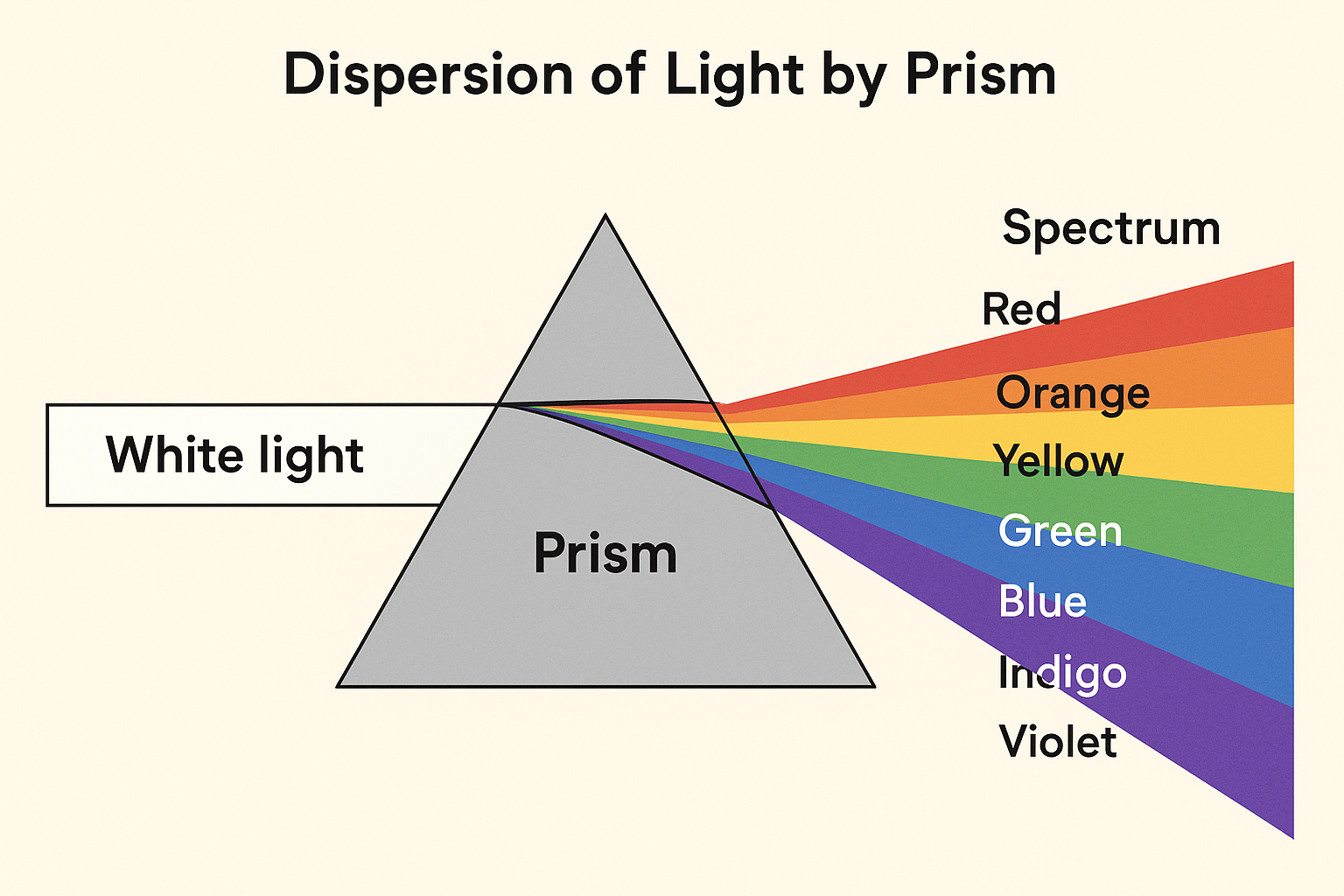
 Dispersion is the separation of light into different colors (wavelengths) due to their different speeds in a medium.
When the white light (like sunlight) enters the prism at an angle, the light slows down and bends (refracts) when it
enters the prism because of the change in medium (air to glass).Each color in white light gets refracted
by a different amount as each wavelength travels at a different speed in the prism material. Violet bends the most (shortest wavelength, slowest in glass).
Red bends the least (longest wavelength, fastest in glass). As the light exits the prism, it refracts again and spreads further.
This forms a spectrum of colors: Red, Orange, Yellow, Green, Blue, Indigo, Violet (ROYGBIV).
Dispersion is the separation of light into different colors (wavelengths) due to their different speeds in a medium.
When the white light (like sunlight) enters the prism at an angle, the light slows down and bends (refracts) when it
enters the prism because of the change in medium (air to glass).Each color in white light gets refracted
by a different amount as each wavelength travels at a different speed in the prism material. Violet bends the most (shortest wavelength, slowest in glass).
Red bends the least (longest wavelength, fastest in glass). As the light exits the prism, it refracts again and spreads further.
This forms a spectrum of colors: Red, Orange, Yellow, Green, Blue, Indigo, Violet (ROYGBIV).
🌈 Rainbow Formation by Refraction

Rainbow formation involves:
- Refraction: When sunlight enters a spherical raindrop, it slows down and bends because it moves from air (a less dense medium) into water (a denser medium). This bending of light is called refraction.
- Dispersion:Inside the droplet, light is dispersed (splits into different colors) based on the wavelengths). where violet bends the most Red bends the least This creates a spectrum of colors inside the droplet..
- Internal Reflection: The dispersed light hits the back of the droplet and reflects internally.
- Refraction Again: When the light exits the droplet, it refracts again as it moves from water back to air, spreading the colors even more.
- Observer: You see the rainbow only if you’re looking at droplets at a specific angle (usually around 42° for red and 40° for violet), with the sun behind you.
Atmospheric Refraction
Atmospheric Refraction refers to the bending of light rays as they pass through Earth’s atmosphere, which is made up of layers with varying densities. This bending occurs because the refractive index of air changes with altitude due to variations in temperature and pressure. Light travels faster in less dense air (higher altitudes) and slower in denser air (near Earth's surface). As light moves from one layer to another, it bends gradually causing refraction. Because the atmosphere has a non-uniform density, refraction is continuous and curved.
Key Effects of Atmospheric Refraction
- Atmospheric refraction causes the Sun, Moon, and stars appear slightly higher in the sky than their actual position.Example: The Sun is visible even when it is geometrically below the horizon, causing sunrise to appear early and sunset to appear late.
- Atmospheric refraction allows Twinkling of Stars (Scintillation) caused by rapid refraction through turbulent air layers while planets do not twinkle much as they appear as disks, not points.
- Advanced Sunrise and Delayed Sunse occurs due to atmospheric refraction, in which the Sun becomes visible about 2 minutes before it actually rises and remains visible about 2 minutes after it has set.
- Flattening of the Sun at Sunset/Sunrise: The bottom of the Sun is refracted more than the top, making it appear oval.
🌟 Twinkling of Stars
The twinkling of stars, also known as stellar scintillation, occurs due to atmospheric refraction. As starlight travels through Earth’s atmosphere, it passes through layers of air that vary in temperature, density, and motion. These layers have different refractive indices, causing the light to bend in slightly different directions as it moves toward the observer. Because stars are so far away, they appear as point sources of light, and even slight changes in the path of their light can cause rapid fluctuations in their apparent brightness and position. This makes them appear to twinkle. In contrast, planets do not twinkle as noticeably because they appear as small discs, and the light from different parts of the disc averages out these variations.
Scattering of Light and Tyndal effect

Scattering of light is a phenomenon where light rays deviate from their straight path when they strike small particles or molecules in a medium, such as air or water. This scattering depends on the size of the particles and the wavelength of the light. Shorter wavelengths (like blue and violet) scatter more than longer wavelengths (like red), which is why the sky appears blue during the day. A related effect is the Tyndall effect, which refers to the scattering of light by particles in a colloidal solution. When a beam of light passes through a colloid, the path of the light becomes visible due to scattering, as seen when sunlight filters through a dusty room or when a flashlight shines through fog. Both phenomena demonstrate how the interaction of light with particles can affect its direction and visibility.
Why is the colour of the clear Sky Blue?

The colour of the clear sky is blue due to the scattering of sunlight by the Earth's atmosphere, specifically a phenomenon known as Rayleigh scattering.Sunlight is white light, which contains all colors (wavelengths) of visible light. As sunlight passes through the atmosphere, it interacts with small molecules of air (like nitrogen and oxygen). Rayleigh scattering occurs when light interacts with particles much smaller than its wavelength. Shorter wavelengths (blue and violet) are scattered much more effectively than longer wavelengths (red and yellow). Although violet light is scattered even more than blue, our eyes are more sensitive to blue, and much of the violet is absorbed by the upper atmosphere.As a result, we perceive the sky as blue.
TEXTBOOK SOLUTIONS
- What is meant by power of accommodation of the eye?
Answer: The power of accommodation of the eye is the ability of the eye lens to change its focal length so that it can clearly see objects placed at different distances. This is done by the ciliary muscles, which adjust the curvature of the lens.
- A person with a myopic eye cannot see objects beyond 1.2 m distinctly. What should be the type of corrective lens used to restore proper vision?
Answer: A person with a myopic (short-sighted) eye cannot see distant objects clearly. To correct this defect, a concave lens (diverging lens) is used. Concave lenses help by diverging the incoming light rays so that they appear to come from the person’s far point, allowing the image of distant objects to form on the retina.
- What is the far point and near point of the human eye with normal vision?
Answer: For a human eye with normal vision, near point is 25 cm (the closest distance at which the eye can see objects clearly) and the far point is the infinity (the farthest distance at which the eye can see objects clearly)
- A student has difficulty reading the blackboard while sitting in the last row. What could be the defect the child is suffering from? How can it be corrected?
Answer: A student struggling to see clearly from the last row is suffering from shortsightedness or myopia. Myopia can be corrected by the use of concave or diverging lens of an appropriate power.
TextbookExercises
- The human eye can focus objects at different distances by adjusting the focal length of the eye lens. This is due to
- presbyopia
- accommodation
- near-sightedness
- far-sightedness
Answer: (B) accommodation, due to accommodation the human eye can focus objects at different distances by adjusting the focal length of the eye lens.
- The human eye forms an image of an object at its
- cornea
- iris
- pupil
- retina
Answer – (D) retina because, the retina is the layer of nerve cells lining the back wall inside the eye. This layer senses light and sends signals to the brain so you can see.
- The least distance of distinct vision for a young adult with normal vision is about
- 25 m
- 5 cm
- 25 cm
- 5 m
Answer –
(C) 25 cm because 25 cm is the least distance of distinct vision for a young adult with normal vision.
- The change in focal length of an eye lens is caused by the action of the
- pupil
- retina
- ciliary muscles
- iris
Answer: (c) ciliary muscles, because the action of the ciliary muscles changes the focal length of an eye lens
- A person needs a lens of power -5.5 dioptres for correcting his distant vision. For correcting his near vision he needs a lens of power +1.5 dioptre. What is the focal length of the lens required for correcting (i) distant vision, and (ii) near vision?
Answer: The power (P) of a lens of focal length f is given by the relation
Power (P) = 1/f
(i) Power of the lens (used for correcting distant vision) = – 5.5 D
Focal length of the lens (f) = 1/P
f = 1/-5.5
f = -0.181 m
The focal length of the lens (for correcting distant vision) is – 0.181 m.
(ii) Power of the lens (used for correcting near vision) = +1.5 D
Focal length of the required lens (f) = 1/P
f = 1/1.5 = +0.667 m
Therefore, the focal length of the lens (for correcting near vision) is 0.667 m.
- The far point of a myopic person is 80 cm in front of the eye. What is the nature and power of the lens required to correct the problem?
Answer: The individual is suffering from myopia. In this defect, the image is formed in front of the retina. Therefore, a concave lens is used to correct this defect of vision.
Object distance (u) = infinity = ∞
Image distance (v) = – 80 cm
Focal length = f
According to the lens formula,
A concave lens of power – 1.25 D is required by the individual to correct his defect.
- Make a diagram to show how hypermetropia is corrected. The near point of a hypermetropic eye is 1 m. What is the power of the lens required to correct this defect? Assume that the near point of the normal eye is 25 cm.
Answer: An individual suffering from hypermetropia can see distinct objects clearly but he or she will face difficulty in clearly seeing objects nearby. This happens because the eye lens focuses the incoming divergent rays beyond the retina. This is corrected by using a convex lens. A convex lens of a suitable power converges the incoming light in such a way that the image is formed on the retina, as shown in the following figure.
The convex lens creates a virtual image of a nearby object (N’ in the above figure) at the near point of vision (N) of the individual suffering from hypermetropia.
The given individual will be able to clearly see the object kept at 25 cm (near point of the normal eye), if the image of the object is formed at his near point, which is given as 1 m.
Object distance, u= – 25 cm
Image distance, v= – 1 m = – 100 m
Focal length, f
Using the lens formula,
A convex lens of power +3.0 D is required to correct the defect.
- Why is a normal eye not able to see clearly the objects placed closer than 25 cm?
Answer: A normal eye is not able to see the objects placed closer than 25 cm clearly because the ciliary muscles of the eyes are unable to contract beyond a certain limit.
- What happens to the image distance in the eye when we increase the distance of an object from the eye?
Answer: The image is formed on the retina even on increasing the distance of an object from the eye. The eye lens becomes thinner and its focal length increases as the object is moved away from the eye.
- Why do stars twinkle?
Answer: The twinkling of a star is due to atmospheric refraction of starlight. The starlight, on entering the earth’s atmosphere, undergoes refraction continuously before it reaches the earth. The atmospheric refraction occurs in a medium of gradually changing refractive index.
- Explain why the planets do not twinkle.
Answer:
Unlike stars, planets don’t twinkle. Stars are so distant that they appear as pinpoints of light in the night sky, even when viewed through a telescope. Since all the light is coming from a single point, its path is highly susceptible to atmospheric interference (i.e. their light is easily diffracted).
- Why does the Sun appear reddish early in the morning?
Answer: White light coming from the sun has to travel more distance in the atmosphere before reaching the observer. During this, the scattering of all coloured lights except the light corresponding to red colour takes place and so, only the red coloured light reaches the observer. Therefore, the sun appears reddish at sunrise and sunset.
- Why does the sky appear dark instead of blue to an astronaut?
Answer: The sky appears dark instead of blue to an astronaut, as scattering of light does not take place outside the earth’s atmosphere.
Lesson Based Assessment(LBA)
Learning Points
- Human Eye
- Accommodative Ability of the Eye
- Visual Defects and Their Solutions
- Refraction of Light through a Plate
- Refraction of Light through a Glass Plate
- Scattering of Light – Tyndall Effect, Why is the Color of a Clear Sky Blue?
Weightage
| SL NO | Difficulty Level | Number of Questions | Marks | Percentage |
| 1 | Easy | 22 | 27 | 30% |
| 2 | Average | 26 | 46 | 50% |
| 3 | Difficult | 09 | 18 | 20% |
I. Multiple Choice Questions (1 Mark)
- The area where the image is formed in the eye:
A) Cornea
B) Retina
C) Iris
D) Lens - The part of the eye that forms an inverted real image of the object on the retina:
A) Eyelens
B) Pupil
C) Iris
D) Cornea - The lens used to correct nearsightedness:
A) Biconvex lens
B) Plano-convex lens
C) Concave lens
D) None of the above - In old age, sometimes the eye lens becomes cloudy and whitish like milk. This condition is called:
A) Hypermetropia
B) Myopia
C) Presbyopia
D) Cataract - A person can only see objects clearly that are between 40 cm and 80 cm from their eyes. What is the defect?
A) Nearsightedness and use of concave lens
B) Farsightedness and use of appropriate convex lens
C) Presbyopia and use of appropriate bifocal lens
D) Eye surgery - Structure that controls the change in focal length of the eye lens:
A) Ciliary muscles
B) Eyelid
C) Retina
D) Iris - Why the sun is visible two minutes before actual sunrise and after actual sunset:
A) Refraction of light
B) Reflection of light
C) Scattering of light
D) Dispersion of light - Colour of the sky seen from the surface of the moon is:
A) Blue
B) Red
C) Black
D) Violet - Colour that bends the least in a glass prism:
A) Violet
B) Blue
C) Green
D) Red - The following change in the eye takes place while viewing distant objects:
A) Decrease in focal length of the eye lens
B) Increase in curvature of the lens
C) Increase in focal length of the eye lens
D) Relaxation of ciliary muscles - The correct statement regarding scattering of light and particle size is (April-2024):
A) Small particles scatter red light
B) Large particles scatter blue light
C) Large particles scatter violet light
D) Very large particles scatter all colours equally - Nature of the image formed by the eye lens on the retina (MP–2023):
A) Real and inverted
B) Virtual and upright
C) Real and upright
D) Virtual and inverted - The colour that is least scattered by fog and smoke is:
A) Orange
B) Blue
C) Red
D) Violet - Identify the wrong statement among the following statements regarding refraction and dispersion of light:
A) Stars twinkle
B) Sky appears blue to an astronaut flying at very high altitudes
C) The sun is visible to us about two minutes before the actual sunrise
D) Planets do not twinkle
MCQs -Answers
- The area where the image is formed in the eye:
Answer: B) Retina - The part of the eye that forms an inverted real image on the retina:
Answer: A) Eye lens - The lens used to correct nearsightedness:
Answer: C) Concave lens - Cloudy and whitish eye lens in old age is called:
Answer: D) Cataract - Person can see clearly only between 40 cm and 80 cm:
Answer: C) Presbyopia and use of appropriate bifocal lens - Structure that controls change in focal length of eye lens:
Answer: A) Ciliary muscles - Sun visible two minutes before sunrise and after sunset due to:
Answer: A) Refraction of light - Colour of sky seen from the surface of the moon:
Answer: C) Black - Colour that bends the least in a glass prism:
Answer: D) Red - Change in the eye while viewing distant objects:
Answer: D) Relaxation of ciliary muscles
(Also leads to increase in focal length) - Correct statement regarding scattering and particle size:
Answer: D) Very large particles scatter all colours equally - Nature of image formed by eye lens on retina:
Answer: A) Real and inverted - Colour least scattered by fog and smoke:
Answer: C) Red - Wrong statement regarding refraction and dispersion:
Answer: B) Sky appears blue to an astronaut flying at very high altitudes
II. Answer the following questions (1 Mark)
- What is the near point of the eye? State the value of near point for the normal eye.
- What is the far point of the eye? State the value for the normal eye.
- What is the spectrum of white light?
- What are common defects of vision?
- What is the angle of deviation?
- What is the angle of prism?
- What is the emergent angle?
- Name the eye part of the following:
- a) It forms the transparent bulge on the front surface of the eyeball.
- b) It is a dark muscular diaphragm.
- Identify the eye in the image and mention its remedy.
- What is light dispersion?
- Can this phenomenon be observed on the moon? Justify your answer.
- What are the near point and far point of a person with normal vision? (June 2019, March 2024)
- Name any two atmospheric phenomena caused by light refraction (March 2019, 2024).
- What is accommodation of the eye? (June 2019)
- What colour is used in danger signals and why?
- A student at the backbench struggles to read the blackboard. What is the defect and how can this defect be corrected? (June 2024)
Identify the eye defect shown in the image and suggest a remedy.
- What is the function of the pupil in the human eye? (June 2019)
- Observe the below figure showing the refraction of light through a glass prism.Name the angle represented as angle X and give a reason for the formation of that angle.
- What is cataract? (March-2024)
- After the light is split in a prism, state the colour of the light that is least bent and the colour of the light that is most bent. (March 2019, 2023, June 2019)
- Glass prisms A, B, and C are arranged as shown in the figure below. When a beam of white light is passed through the prism A, will a spectrum of light be produced on the screen? Give the reason. (May 2025)
1 Mark-Answers
15. Near point is the nearest point at which an object can be seen clearly without strain. BFor a normal eye, it is 25 cm.
16. Far point is the farthest point at which an object can be seen clearly.
For a normal eye, it is infinity (∞).
17. The band of seven colours obtained on dispersion of white light is called the spectrum of white light.
18.Common defects of vision are:
-
Myopia
-
Hypermetropia
-
Presbyopia
19.The angle between the incident ray and the emergent ray in a prism is called the angle of deviation.
20.The angle between the two refracting surfaces of a prism is called the angle of prism.
21.The angle between the emergent ray and the normal at the second surface of the prism is called the angle of emergence.
22.
-
a) Transparent bulge on the front surface of the eyeball → Cornea
b) Dark muscular diaphragm → Iris
23.
-
Image formed in front of retina → Myopia → Corrected by concave lens
-
Image formed behind retina → Hypermetropia → Corrected by convex lens
24.The splitting of white light into its constituent colours when it passes through a prism is called dispersion of light.
25.No. This phenomenon cannot be observed on the moon because the moon has no atmosphere, so there is no refraction or dispersion due to air or water droplets.
26.Near point = 25 cm. Far point = Infinity (∞)
27.Two atmospheric phenomena caused by refraction:
-
Twinkling of stars
-
Mirage
28.Accommodation of the eye is the ability of the eye lens to change its focal length to focus near and distant objects clearly on the retina.
29.Red colour is used in danger signals because it has the longest wavelength and is least scattered, so it can be seen from a long distance.
30.Defect: Myopia (short-sightedness). Correction: Using a concave lens
31
-
Image in front of retina → Myopia → Concave lens
-
Image behind retina → Hypermetropia → Convex lens
32.The pupil controls the amount of light entering the eye.
33.Angle X is the angle of deviation.
It is formed because light bends at both refracting surfaces of the prism due to refraction.
34.Cataract is the clouding of the eye lens that causes blurred vision.
35.Least bent colour → Red
Most bent colour → Violet
36.If another identical prism is placed inverted after prism A, the colours recombine to form white light.So, no spectrum will be seen, because the second prism recombines the dispersed colours.
III. Answer the following questions (2 Marks)
- What is hypermetropia? What are its causes?
- What is myopia? What are its causes?
- Explain the formation of a rainbow in nature. (June 2019, March 2023, June 2023)
- Explain the experiment that Newton did to determine that white light consists of seven colors. (March 2020)
- Describe Newton’s experiment to show the recombination of white light. (March 2020, April 2025)
- Write the differences between the myopic eye and hypermetropic eye. (April 2025)
- Identify and justify the type of eye shown in the diagrams: normal, nearsightedness, farsightedness.
- A person with eye defect purchases spectacles with a lens power of -2.0 D. Which lens is suitable for the given eye defect? Analyze. (April 2024)
- Explain how the human eye lens adjusts for viewing near and distant objects. (March 2023, June 2023, August 2024)
- Observe the given figure. Identify the eye defect indicated in this figure
- Presbyopia
- Hypermetropia
- Myopia
- Cataract
2 Mark Answers
- What is hypermetropia? What are its causes?
Hypermetropia (long-sightedness) is a defect of vision in which a person can see distant objects clearly but cannot see nearby objects clearly.
Causes:
• Eyeball is shorter than normal.
• Focal length of the eye lens is too large (less converging power). - What is myopia? What are its causes?
Myopia (short-sightedness) is a defect of vision in which a person can see nearby objects clearly but cannot see distant objects clearly.
Causes:
• Eyeball is elongated.
• Focal length of the eye lens is too short (more converging power).
- Explain the formation of a rainbow in nature.
A rainbow is formed due to refraction, dispersion, and total internal reflection of sunlight in raindrops.
When sunlight enters a raindrop, it refracts and disperses into seven colours. The light undergoes total internal reflection inside the drop and refracts again while coming out, forming a spectrum in the sky. - Explain Newton’s experiment to show that white light consists of seven colours.
Isaac Newton passed a narrow beam of sunlight through a glass prism in a dark room.
He observed that white light split into seven colours (VIBGYOR) on a screen.
This proved that white light is made up of seven colours. - Describe Newton’s experiment to show recombination of white light.
Isaac Newton placed a second prism inverted to the first prism.
The seven colours obtained from the first prism were passed through the second prism.
The colours recombined to form white light again, proving that dispersion is reversible. - Differences between myopic eye and hypermetropic eye
|
Myopic Eye |
Hypermetropic Eye |
|
Cannot see distant objects clearly |
Cannot see nearby objects clearly |
|
Image forms in front of retina |
Image forms behind retina |
|
Corrected by concave lens |
Corrected by convex lens |
- Identify and justify the type of eye (normal, myopia, hypermetropia).
• Normal eye: Image forms exactly on the retina.
• Myopia: Image forms in front of the retina.
• Hypermetropia: Image forms behind the retina. - Lens power = –2.0 D. Which lens is suitable? Analyze.
Power is negative, so the lens used is a concave lens.
It is used to correct myopia (short-sightedness).
- Explain how the human eye lens adjusts for viewing near and distant objects.
This adjustment is called accommodation.
• For distant objects – ciliary muscles relax, focal length increases, lens becomes thin.
• For near objects – ciliary muscles contract, focal length decreases, lens becomes thick.
- Identify the eye defect shown in the figure.
a) Presbyopia – difficulty in seeing nearby objects due to ageing.
b) Hypermetropia – image forms behind retina.
c) Myopia – image forms in front of retina.
d) Cataract – eye lens becomes cloudy.
IV. Answer the following questions (3 Marks)
- What is the Tyndall effect? Give two examples.
- Why is the clear sky blue in colour? Explain. (A)
- Draw the diagram to show the recombination of white light. (June 2024)
- Why do stars twinkle but planets do not? Explain. (August 2024)
- What is presbyopia? What are its causes? Mention the remedy.
- A doctor prescribes a lens with power -0.5 D. Find its focal length. Is it a converging or diverging lens? Justify. How does a concave lens correct nearsightedness? (March 2020)
- a) Why can’t we see objects clearly closer than 25 cm with a normal eye?
- b) Explain the relationship between the colour of light scattered in the atmosphere and the size of the scattering particles.
- a) What is the reason for the whiteness of the sun’s rays on the scalp in the afternoon?
- b) What is the working principle of the human eye?
- Write the main function of each of the following:
a)iris b)pupil c)cornea
3 Mark-Answers
47. What is the Tyndall effect? Give two examples.
The Tyndall effect is the scattering of light by colloidal particles present in a medium.
Examples:
- Sunlight entering a dark room through a small hole becomes visible due to dust particles.
- Car headlights become visible in fog or mist.
48. Why is the clear sky blue in colour? Explain.
The sky appears blue due to scattering of sunlight by atmospheric particles. The molecules in the atmosphere scatter shorter wavelengths (blue light) more than longer wavelengths (red light).
Since blue light is scattered more, the sky appears blue.
49. Draw the diagram to show the recombination of white light.
Recombination of white light was demonstrated by Isaac Newton using two prisms.
White Light → △ (Prism 1) → VIBGYOR → ▽ (Prism 2) → White Light
The first prism disperses white light into seven colours.
The second inverted prism recombines the colours to form white light again.
50. Why do stars twinkle but planets do not? Explain.
Stars twinkle due to atmospheric refraction.As starlight passes through different layers of the atmosphere, its path keeps changing due to varying density, causing fluctuations in brightness.Planets do not twinkle because they are closer to Earth and appear as extended sources of light. The variations average out, so they shine steadily.
51. What is presbyopia? What are its causes? Mention the remedy.
Presbyopia is an age-related defect of vision in which a person cannot see nearby objects clearly.
Causes:
• Weakening of ciliary muscles.
• Loss of elasticity of the eye lens.
Remedy:Corrected using bifocal lenses.
52. A doctor prescribes a lens with power –0.5 D.
Power (P) = –0.5 D
Formula: f=1/P
f = 1/-0.5
f=2 m . Therefore, focal length = –2 m. Since power is negative, it is a concave (diverging) lens. How concave lens corrects myopia: It diverges the incoming parallel rays so that they appear to come from the far point of the myopic eye. Thus, the image forms on the retina.
53.
-
a) Why can’t we see objects clearly closer than 25 cm with a normal eye?
Because the ciliary muscles cannot contract further to decrease the focal length beyond a limit. Hence, objects closer than 25 cm cannot be focused on the retina.
-
b) Relationship between colour scattered and particle size:
Very small particles scatter shorter wavelengths (blue) more.
• Larger particles scatter all colours almost equally (white light).
54.
-
a) Reason for whiteness of the sun’s rays at noon:
At noon, sunlight travels a shorter distance through the atmosphere.
Very little scattering occurs, so all colours reach the eye, making the Sun appear white.
-
b) Working principle of the human eye:
The human eye works on the principle of refraction of light through a convex lens to form a real and inverted image on the retina.
55. Main functions
-
a) Iris: Controls the size of the pupil.
b) Pupil: Regulates the amount of light entering the eye.
c) Cornea: Transparent front part that refracts most of the incoming light.