Heredity
Heredity and Evolution are fundamental biological concepts that explain how traits are passed from one generation to the next and how living organisms have changed over time. Heredity refers to the transmission of genetic information from parents to offspring through genes, which are segments of DNA located on chromosomes. These genes determine the physical and functional characteristics of an organism, such as eye color, height, or the ability to digest certain foods. The study of heredity began with Gregor Mendel, known as the "Father of Genetics," who discovered patterns of inheritance through experiments with pea plants. His work laid the foundation for modern genetics, explaining how dominant and recessive traits are inherited independently. Evolution, on the other hand, deals with the gradual changes in living organisms over long periods of time. It explains the diversity of life on Earth and is driven by mechanisms such as natural selection, genetic variation, mutation, and reproductive success. The theory of evolution was first scientifically formulated by Charles Darwin, who proposed that species evolve over time due to the survival of the fittest individuals in a given environment.This lesson combines the principles of heredity and evolution to explain how inherited traits contribute to variation within species, and how these variations play a key role in the evolutionary process. It also highlights the connection between genetic inheritance and the appearance of new traits over generations, helping us understand the origin and development of biodiversity.
Important Terminologies
Understanding key genetic terms is essential to grasp the concepts of heredity, inheritance, and variation in living organisms. Below is a list of important terms used in the study of genetics and their meanings.
Example: The gene for eye color determines whether a person has brown, blue, or green eyes.
Example: The gene for height in pea plants has two alleles: T (tall) and t (dwarf).
Example: Hair color, blood type, flower color, or beak shape in birds.
Example: In humans, brown eyes (B) are dominant over blue eyes (b).
Example: A child will have blue eyes only if both alleles are 'b' (bb).
Example: TT (homozygous tall), Tt (heterozygous tall), or tt (homozygous dwarf).
Example: A plant with genotype Tt or TT will have a tall phenotype.
Example: TT (tall) or tt (dwarf) are homozygous genotypes.
Example: Tt is a heterozygous condition resulting in a tall plant.
Example: A mutation in skin cells may cause albinism or cancer.
Example: Humans have 23 pairs of chromosomes; the 23rd pair determines sex (XX or XY).
Example: DNA carries the genes for traits such as eye color, height, or blood type.
Structure of DNA
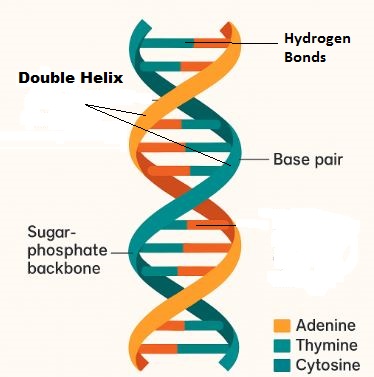
DNA (Deoxyribonucleic Acid) is the molecule that stores genetic instructions used in the development and functioning of all living organisms. It was discovered by Watson and Crick in 1953, based on the research of Rosalind Franklin. DNA is found in the nucleus of cells and has a unique structure called a double helix, which looks like a twisted ladder or spiral staircase. Each strand of DNA is made up of repeating units called nucleotides. A nucleotide is made of a sugar, a phosphate group, and a nitrogen base. Two strands of nucleotides run in opposite directions (antiparallel) and coil into a double helix. The exact sequence of nitrogen bases along the DNA determines the organism's genetic code.
Components of DNA:
DNA, or deoxyribonucleic acid, is composed of three essential components: a phosphate group, a deoxyribose sugar, and a nitrogenous base. The phosphate and sugar molecules form the backbone of the DNA strand, giving it structural stability. Each sugar molecule is attached to one of four nitrogenous bases—adenine (A), thymine (T), cytosine (C), or guanine (G). These bases pair specifically (A with T, and C with G) through hydrogen bonds, creating the rungs of the DNA double helix ladder. The sequence of these nitrogenous bases carries genetic information, which is used to control all biological functions and inheritance. Together, these components form the fundamental structure of DNA, allowing it to replicate, store, and transmit genetic information across generations.
Base Pairing Rule:
The base pairing rule explains how nitrogenous bases in DNA pair with each other to form the rungs of the DNA double helix. According to this rule, adenine (A), a purine, always pairs with thymine (T), a pyrimidine, using two hydrogen bonds, while cytosine (C), a pyrimidine, always pairs with guanine (G), a purine, through three hydrogen bonds. This complementary base pairing ensures that the two strands of DNA are held together in a precise and stable manner. The rule is crucial for the accurate replication of DNA during cell division, as each strand can serve as a template to produce a new complementary strand, preserving the genetic code. This specific pairing also maintains the uniform width of the DNA molecule and ensures that genetic information is copied faithfully.
Did you know?
If you stretch out all the DNA in a single human cell,it would measure about 2 meters long! And yet, it fits inside the tiny nucleus of a microscopic cell, thanks to its coiled and folded structure.
Genes and Heredity
Genes are fundamental units of heredity that carry the instructions for the development, functioning, and traits of all living organisms. Located on chromosomes within the nucleus of each cell, genes are made up of DNA (deoxyribonucleic acid), which contains coded information in the form of sequences of nucleotides. Each gene controls a specific characteristic, such as eye color, blood type, or the ability to produce certain enzymes. Genes are passed from parents to offspring during reproduction, ensuring that traits are inherited from one generation to the next. The unique combination of genes in each individual contributes to genetic diversity within a population, making genes essential not only for individual development but also for evolution and survival.
Traits
Traits are specific characteristics or features of an organism that can be observed or measured, such as height, eye color, blood group, or the shape of a leaf. These traits are determined by the genetic makeup (genotype) of organisms and, in some cases, influenced by environmental factors. Traits are inherited from parents through genes, which carry the instructions for building and maintaining the body. Some traits are controlled by a single gene, while others are influenced by multiple genes working together. Traits can be dominant, or recessive. In genetics, traits are determined by pairs of alleles (versions of a gene) inherited from the parents. These alleles can be either dominant or recessive. The combination of these alleles determines which trait will be physically expressed in the organism, also known as the phenotype.
Dominant Traits
Dominant traits are characteristics that are expressed in an organism even when only one copy of the responsible allele is present. These traits mask the effect of recessive alleles and are represented by uppercase letters in genetic notation (e.g., T for tallness in pea plants). If an organism inherits one dominant and one recessive allele for a trait (heterozygous), the dominant trait will appear in the physical expression, or phenotype. For example, in Mendel’s experiments, crossing a tall plant (Tt) with a short one (tt) often resulted in tall offspring, because the tall allele (T) is dominant. Dominant traits do not mean they are more common, but simply that they are more likely to be expressed when present.
Recessive Traits
Recessive traits are those that are expressed only when both alleles for a particular gene are recessive. They are masked by the presence of a dominant allele and are typically represented by lowercase letters in genetic notation (e.g., t for dwarfness in pea plants). An organism must inherit the recessive allele from both parents (homozygous recessive, e.g., tt) for the recessive trait to appear in its phenotype. If a dominant allele is present, it will override the expression of the recessive trait. For example, a pea plant will only be dwarf if it inherits the "t" allele from both parents. Recessive traits often reappear in subsequent generations when two carriers (heterozygotes) reproduce.
Comparison Table: Dominant vs Recessive Traits
| Aspect | Dominant Trait | Recessive Trait |
|---|---|---|
| Definition | Trait that appears even if one dominant allele is present | Trait that appears only if both alleles are recessive |
| Representation | Uppercase letter (e.g., T, B, F) | Lowercase letter (e.g., t, b, f) |
| Expression | Expressed in both homozygous (TT) and heterozygous (Tt) conditions | Expressed only in homozygous recessive (tt) condition |
| Examples | Tall plant, Brown eyes, Free earlobes | Dwarf plant, Blue eyes, Attached earlobes |
Gregor Johann Mendel(The Father of Genetics)
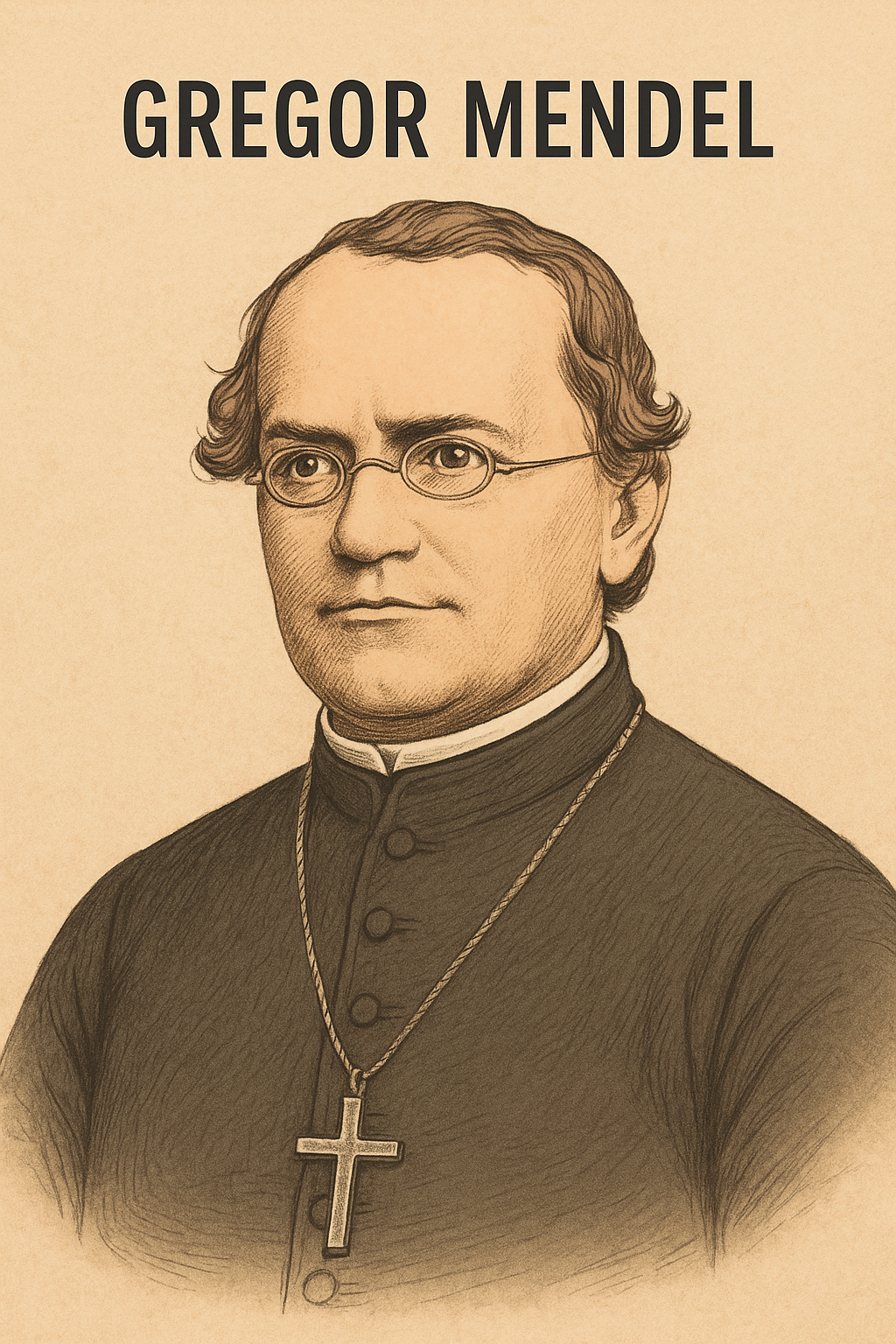
Gregor Johann Mendel was an Austrian monk and scientist who is widely regarded as the Father of Genetics for his pioneering work in the field of heredity. In the mid-1800s, Mendel conducted detailed experiments on pea plants in the monastery garden to study how traits are inherited from one generation to the next. He observed characteristics such as plant height, flower color, seed shape, and pod color.
Mendels use of mathematical ratios and statistical analysis in biology was revolutionary. Although his work was not recognized during his lifetime, it was rediscovered in the early 20th century and became the foundation of modern genetics. His discoveries help explain how traits are passed down and how variation arises in living organisms.
Mendelian Laws of Heredity
Gregor Johann Mendel, through his experiments on pea plants, formulated three fundamental principles that explain how traits are inherited from parents to offspring. These are known as the Law of Dominance, the Law of Segregation, and the Law of Independent Assortment. These laws laid the foundation of classical genetics and are still used to predict inheritance patterns in living organisms.
1. Law of Dominance
The Law of Dominance states that when two different alleles for a trait are present in an individual, one allele (called the dominant allele) will express itself over the other allele (the recessive allele). The trait associated with the dominant allele will be visible in the organism, while the recessive trait remains hidden unless both alleles are recessive.
Example 1: In pea plants, the allele for tallness (T) is dominant, while the allele for dwarfness (t) is recessive. A plant with genotype Tt or TT will be tall, while only tt will result in a dwarf plant.
Example 2: In humans, the allele for brown eyes (B) is dominant over the allele for blue eyes (b). So, a person with genotype Bb or BB will have brown eyes.
2. Law of Segregation
The Law of Segregation states that every individual carries two alleles for each trait, and these alleles separate (segregate) during the formation of gametes (sperm or egg cells). As a result, each gamete carries only one allele for each gene. During fertilization, the offspring inherits one allele from each parent, restoring the pair.
Example 1: A plant with genotype Tt will produce two types of gametes: one with the T allele and one with the t allele. When crossed with another Tt plant, the possible genotypes of the offspring are TT, Tt, and tt, following a 1:2:1 ratio.
Example 2: In humans, if both parents have genotype Bb (brown eyes), the offspring can have BB (brown), Bb (brown), or bb (blue) eyes in a 1:2:1 genotypic ratio and 3:1 phenotypic ratio.
3. Law of Independent Assortment
The Law of Independent Assortment states that alleles of different genes are inherited independently of each other, provided the genes are located on different chromosomes. This means that the inheritance of one trait does not affect the inheritance of another, leading to genetic variation in offspring.
Example 1: In a dihybrid cross involving seed shape (Round - R, Wrinkled - r) and seed color (Yellow - Y, Green - y), crossing two heterozygous plants (RrYy X RrYy) produces offspring with combinations such as Round Yellow, Round Green, Wrinkled Yellow, Wrinkled Green, in a 9:3:3:1 ratio.
Example 2: In fruit flies, wing shape and body color are two different traits. If the gene for wing shape is not linked to body color, the traits can assort independently, resulting in a mix of all trait combinations in the offspring.
Summary Table: Mendelian Laws
| Law | Description | Key Concept | Example(s) |
|---|---|---|---|
| Law of Dominance | One allele masks the effect of another in a heterozygous pair | Dominant trait is expressed, recessive is hidden | Tt--->Tall (pea plant), Bb ? Brown eyes (human) |
| Law of Segregation | Alleles separate during gamete formation and recombine during fertilization | Each gamete receives only one allele | Tt X Tt--->TT, Tt, tt (pea plant), Bb X Bb ? BB, Bb, bb |
| Law of Independent Assortment | Alleles of different genes assort independently during gamete formation | Traits are inherited independently | RrYyX RrYy--->9:3:3:1 ratio (pea seeds), fly body color vs wing type |
Punnett Square
A Punnett Square is a diagram used in genetics to predict the outcome of a genetic cross between two individuals. It helps visualize how alleles from each parent can combine in the offspring. This tool is widely used to study dominant and recessive traits, especially in monohybrid and dihybrid crosses. Developed by Reginald Punnett
Punnett Square – Law of Dominance (Tt × Tt)
Genotypes: TT (Tall), Tt (Tall), tt (Dwarf)
Phenotypic Ratio: 3 Tall : 1 Dwarf
Genotype: TT
Phenotype: Tall
Genotype: Tt
Phenotype: Tall
Genotype: Tt
Phenotype: Tall
Genotype: tt
Phenotype: Dwarf
Punnett Square – Law of Segregation (Bb × Bb)
Genotypes: BB (Brown), Bb (Brown), bb (Blue)
Phenotypic Ratio: 3 Brown Eyes : 1 Blue Eyes
Genotype: BB
Phenotype: Brown
Genotype: Bb
Phenotype: Brown
Genotype: Bb
Phenotype: Brown
Genotype: bb
Phenotype: Blue
Monohybrid and Dihybrid Crosses
Monohybrid Cross
A monohybrid cross is a genetic cross between two individuals focusing on a single trait controlled by a single gene with two alleles. It shows how alleles segregate and recombine in the next generation.
Example: Crossing two pea plants heterozygous for plant height (Tt X Tt), where T = tall and t = dwarf.
| T | t | |
|---|---|---|
| T | TT (Tall) | Tt (Tall) |
| t | Tt (Tall) | tt (Dwarf) |
Genotypic Ratio: 1 TT : 2 Tt : 1 tt
Phenotypic Ratio: 3 Tall : 1 Dwarf
Dihybrid Cross
A dihybrid cross involves two traits controlled by two different genes, each having two alleles. This type of cross helps explain the Law of Independent Assortment, where alleles of different genes are inherited independently.
Example: Crossing two pea plants heterozygous for seed shape and color (RrYy X RrYy), where R = round, r = wrinkled, Y = yellow, y = green.
| RY | Ry | rY | ry | |
|---|---|---|---|---|
| RY | RRYY | RRYy | RrYY | RrYy |
| Ry | RRYy | RRyy | RrYy | Rryy |
| rY | RrYY | RrYy | rrYY | rrYy |
| ry | RrYy | Rryy | rrYy | rryy |
Phenotypic Ratio: 9 Round Yellow : 3 Round Green : 3 Wrinkled Yellow : 1 Wrinkled Green
Evolution
Evolution is the process by which living organisms have gradually developed and diversified from earlier forms over millions of years. It explains the gradual change in the characteristics of species over generations due to genetic variation, natural selection, and environmental pressures. This process helps us understand the origin of biodiversity on Earth and how all life forms are connected through common ancestry. The theory of evolution, first proposed by Charles Darwin, highlights the survival of the fittest, where organisms best suited to their environment are more likely to survive and reproduce, passing on favorable traits to future generations.
Sex determination in Humans
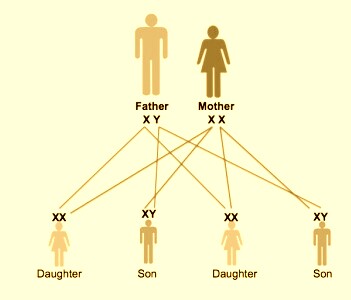
Sex determination or gender determination in humans refers to the process by which the biological sex (male or female) of an individual is decided at the time of fertilization. Humans have 46 chromosomes: 22 pairs of autosomes + 1 pair of sex chromosomes. The difference in the Sex chromosomes among make and female determines the gender because a female has XX set but male: has XY set
Mechanism
-
Gametes (sperm and egg)
-
Female egg: Always X
-
Male sperm: Either X or Y
-
-
Fertilization
-
X (sperm) + X (egg) → XX → Female
-
Y (sperm) + X (egg) → XY → Male
-
Thus, the sex of a child depends on whether the sperm carrying X or Y fertilizes the egg.
| Parent Gamete | Offspring Chromosome | Gender |
|---|---|---|
| X (sperm) + X (egg) | XX | Female |
| Y (sperm) + X (egg) | XY | Male |
Textbook Solutions
Heredity class10- Question Answers
- If a trait A exists in 10% of a population of an asexually reproducing species and trait B exists in 60% of the same population, which trait is likely to have arisen earlier?
Answer: In an asexual species, new traits spread when individuals with the trait make copies of themselves. Since trait A is found in 10% of the population and trait B is found in 60%, trait B is more common and has likely been around longer. It has had more time to spread through the population, so trait B probably arose earlier than trait A.
- How does the creation of variations in a species promote survival?
Answer: The creation of variations in a species helps promote survival because it makes the population more adaptable to changes in the environment. When individuals have different traits, some may be better suited to survive diseases, climate changes, or shortages of food and water. If the environment changes, the individuals with helpful variations are more likely to survive and reproduce, passing those traits on to their offspring. This way, variation increases the chances that at least some members of the species will survive difficult conditions, helping the species continue to exist.
- How do Mendel’s experiments show that traits may be dominant or recessive?
Answer: Mendel’s experiments with pea plants showed that traits can be dominant or recessive through his study of how traits are passed from one generation to the next. When he crossed two pure (true-breeding) plants with contrasting traits—such as tall and short plants—all the offspring in the first generation (F₁) were tall. This showed that the “tall” trait was dominant because it masked the “short” trait. However, when Mendel allowed the F₁ plants to self-pollinate, the short plants reappeared in the second generation (F₂) in a ratio of about 3 tall to 1 short. This showed that the “short” trait was not lost but recessive, meaning it could be hidden in one generation and reappear in the next.
- How do Mendel’s experiments show that traits are inherited independently?
Answer: Mendel’s experiments showed that traits are inherited independently through his dihybrid cross experiments, where he studied two different traits at the same time — for example, seed shape (round or wrinkled) and seed color (yellow or green). When he crossed plants that were pure for both traits (round yellow × wrinkled green), all the F₁ offspring showed round yellow seeds. But when these F₁ plants were allowed to self-pollinate, the F₂ generation showed new combinations like round green and wrinkled yellow seeds, along with the parental types. This showed that the inheritance of one trait (seed shape) did not affect the inheritance of the other trait (seed color). Mendel concluded that traits are inherited independently of each other, a principle now known as the Law of Independent Assortment.
- A man with blood group A marries a woman with blood group O, and their daughter has blood group O. Is this information enough to tell you which of the traits – blood group A or O – is dominant? Why or why not?
Answer: No, this information alone is not enough to tell which blood group—A or O—is dominant. This is because we only know the blood groups of the parents and the child, not their exact genetic makeup (genotypes). Blood group A can be due to two possible genotypes: AA or AO, while blood group O has the genotype OO. In this case, since the man with blood group A and the woman with blood group O have a daughter with blood group O, the father must have the genotype AO. This shows that the O allele can be passed on, but it does not by itself prove which allele is dominant. However, from established knowledge, we know that A is dominant and O is recessive, but this particular family’s information alone cannot prove that without prior understanding of how blood groups are inherited.
- How is the sex of the child determined in human beings?
Answer: The sex of the child in humans is determined by the males. Males have XY chromosomes, while females have XX chromosomes. Hence, if the male’s X chromosomes combine with the female’s X chromosomes, the mother gives birth to a girl. The male’s Y chromosome combines with the female’s X chromosome, the mother gives birth to a boy
Exercise-3
- A Mendelian experiment consisted of breeding tall pea plants bearing violet flowers with short pea plants bearing white flowers. The progeny all bore violet flowers, but almost half of them were short. This suggests that the genetic makeup of the tall parent can be depicted as
(a) TTWW
(b) TTww
(c) TtWW
(d) TtWw
Answer: (c) TtWW
Tall pea plants with violet flowers × short pea plants with white flowers. All progeny has violet flowers, but half are tall and half are short.
- A study found that children with light-coloured eyes are likely to have parents with light-coloured eyes. On this basis, can we say anything about whether the light eye colour trait is dominant or recessive? Why or why not?
Answer: Knowledge of at least 3 generations is required to find if an attribute is dominant or recessive. Hence, it is not possible to identify if the given trait is dominant or recessive.
- Outline a project which aims to find the dominant coat colour in dogs.
Answer: Identify pairs of dogs with contrasting coat color (e.g., black vs. brown, or black vs. white) and note their coat colors and, if possible, their genotypes. Now record the coat colors of all offspring from each pair as well as the number of each coat color in the litter. Compare offspring coat colors with parental color and look for consistent patterns where one coat color appears more frequently, especially in the first-generation offspring (F₁). If one coat color appears in all or most F₁ offspring, it is likely dominant while the coat colors that skip generations or appear in fewer numbers are likely recessive. If possible, allow F₁ dogs to breed and record F₂ offspring and check if recessive coat colors reappear in expected ratios (e.g., 3:1), confirming dominance patterns. The table below provides track of traits.
Punnett Square:
|
B (Parent 2) |
b (Parent 2) |
|
|
B (Parent 1) |
BB – Black |
Bb – Black |
|
b (Parent 1) |
Bb – Black |
bb – Brown |
Offspring Genotypes and Phenotypes:
|
Genotype |
Phenotype |
Probability |
|
BB |
Black |
25% |
|
Bb |
Black |
50% |
|
bb |
Brown |
25% |
Expected Outcome has one coat color consistently appears in F₁ offspring which is a dominant coat color while recessive coat colors appear in lower frequency or in specific ratios in F₂
- How is the equal genetic contribution of male and female parents ensured in the progeny?
Answer: Equal genetic contribution of male and female parents is ensured in progeny through the inheritance of equal numbers of chromosomes from both parents. There are 23 pairs of chromosomes, but not all are paired. The 22 pairs are called autosomes, while the remaining 1 pair is called the sex chromosomes (represented as X and Y.). Females have two sets of X-chromosomes, while males have one X-chromosome and one Y-chromosome.During the process of reproduction, fertilisation takes place, where the male gamete fuses with the female gamete, and it results in the formation of a diploid zygote. Furthermore, the zygote receives an equal contribution of genetic material from both parents. The male contributes 22 autosomes plus one X or Y chromosome. The female contributes 22 autosomes plus one X-chromosome.
LBA on Heredity
Learning Points
- Combination of differences during reproduction
- Heredity-Inheritedtraits
- Traits Laws o fInheritance-Mendel's contributions
- Sex determination
Weightage
Weightage/Difficulty level
| SL NO | Difficulty Level | Number of Questions | Marks | Percentage |
|---|---|---|---|---|
| 1 | Easy | 16 | 20 | 30% |
| 2 | Average | 17 | 33 | 50% |
| 3 | Difficult | 08 | 13 | 20% |
I. Multiple Choice Questions
1. He is called the father of modern genetics.
- A) Mendeleev
B) Gregor Mendel
C) Lamarck
D) Charles Darwin
Answer: B) Gregor Mendel
Explanation: Gregor Mendel is called the Father of Modern Genetics because he explained the basic laws of inheritance through pea plant experiments.
2. The plant used by Mendel for his experiment
- A) Rose
B) Pea
C) Hibiscus
D) Sunflower
Answer: B) Pea
Explanation: Mendel selected the pea plant because it has clear contrasting characters and short life cycle.
3. The ratio of tall and short plants obtained in Mendel's monohybrid experiment was
- A) 2:1
B) 9:3:3:1
C) 3:1
D) 1:1
Answer: C) 3:1
Explanation: In F₂ generation, 3 plants were tall and 1 plant was short.
4. When a pure tall (TT) plant is crossed with a pure short (tt) plant, what is the ratio of pure tall to pure short plants in F₂ generation?
Answer: 1 : 1 Explanation:
F₂ Genotypic ratio = 1 TT : 2 Tt : 1 tt
Pure tall (TT) = 1
Pure short (tt) = 1
5. The transfer of traits from parents to next generation is called
Answer: Heredity. Explanation: Heredity is the transmission of genetic characters from parents to offspring.
6. Factors that determine the sex of a male child
Answer: XY
Explanation: Male child has XY chromosomes.
7. When tall plant is crossed with short plant, all offspring are tall because
Answer: Tall trait is dominant.
8. Genetics of tall plant in given cross
Answer: TtWw
9. A trait found in many generations of offspring is
Answer: Dominant trait
10. Source of information for production of proteins
Answer: Gene
Explanation: A gene contains DNA sequence that controls protein synthesis.
11. Mendel used which type of reproduction to obtain F₂ generation?
Answer: Self-pollination
12. In which generation did Mendel use cross-pollination?
Answer: F₁ generation
13. Round yellow × Wrinkled green → Number of round green plants in F₁
Answer: 0
14. RRyy × rrYY → F₁ seeds
Answer: Round and green
15. RR × rr → Percentage of RR plants in F₁
Answer: 0%
II. One Mark Question Answers)
16. Indicator of green seeds and flowers at top
Green = G
Top of stem = a
Answer: Ga
17. Sex of child if father gives X chromosome
Answer: Female, Because XX = Female.
18. Why only father determines sex?
Mother produces only X gametes.
Father produces X and Y gametes.
If father gives X → Girl
If father gives Y → Boy
19. Ratio of expressed form in monohybrid cross
Answer: 3 : 1
20. Gene pattern ratio in monohybrid cross
Answer: 1 : 2 : 1
21. Is cross-pollination possible in flowers with only stamens?
No, Because such flowers lack female reproductive part (carpel).
22. Why offspring are not identical in sexual reproduction?
Because genes from two parents combine, causing variation.
23. What is a gene?
A gene is the unit of heredity present on chromosome that controls a specific trait.
24. Meaning of heredity
Transmission of characters from parents to offspring.
25. How is male child determined?
If sperm carrying Y chromosome fertilizes ovum, male child is produced.
III. Two Mark Questions
26. What is monohybrid cross?
A cross involving one pair of contrasting characters.
Example: Tall × Short
F₂ Phenotypic Ratio = 3 Tall : 1 Short
27. What is dihybrid cross?
A cross involving two pairs of contrasting characters.
Example: Round Yellow × Wrinkled Green
F₂ Ratio = 9:3:3:1
28. Dominant and Recessive traits
Dominant trait → Expressed in F₁ generation
Recessive trait → Hidden in F₁ but appears in F₂
29. TTRR × ttrr
F₁ Generation:
All TtRr (Tall Red)
F₂ Generation Ratio:
9 Tall Red
3 Tall White
3 Short Red
1 Short White
Ratio = 9:3:3:1
30. Why sexual reproduction produces more variation?
- Involves two parents
• Genetic recombination occurs
• Produces better adaptability
• Helps in evolution
31. Differences between male and female chromosomes
|
Male |
Female |
|
XY |
XX |
|
Two different chromosomes |
Two identical chromosomes |
|
Determines sex |
Does not determine sex |
32. Dog Cross (B = Black, b = White)
Genotype Ratio = 1 BB : 2 Bb : 1 bb
- a) Pure white dogs = 1
b) Types: BB (pure black), Bb (hybrid black), bb (pure white)
VI. Three Mark Questions
33. TT × tt (Monohybrid Cross)
F₁: All Tt (Tall)
F₂:
|
T |
t |
|
|
T |
TT |
Tt |
|
t |
Tt |
tt |
Genotypic Ratio = 1 TT : 2 Tt : 1 tt
Phenotypic Ratio = 3 Tall : 1 Short
34. RrYy × RrYy (Dihybrid Cross)
F₂ Phenotypic Ratio:
9 Round Yellow
3 Round Green
3 Wrinkled Yellow
1 Wrinkled Green
35. Why F₁ red flowers differ from parent?
Parent: TTRR (pure)
F₁: TtRr (hybrid)
Though red appears, F₁ contains recessive genes.
36. RR × rr
F₁ = Rr (Hybrid Red)
They differ genetically because they carry recessive allele.
37. Explain sex determination
In humans:Male = XY. Female = XX
If sperm carries Y → Male child
If sperm carries X → Female child
Thus father determines sex.
38. How Mendel proved dominance?
In F₁ generation only tall plants appeared.
Short trait reappeared in F₂.
This proves dominant and recessive traits.
39. Rr × rr
Punnett Square:
|
r |
r |
|
|
R |
Rr |
Rr |
|
r |
rr |
rr |
Genotype Ratio = 1 Rr : 1 rr
Phenotype Ratio = 1 Round : 1 Wrinkled
40 & 41. TTRR × ttrr
F₂ Ratio = 9:3:3:1
9 Tall Round
3 Tall Flat
3 Short Round
1 Short Flat