Chapter 2. Exploring Substances-Acids, Bases,Salts
Introduction
Everything around us is made of different substances. These substances have different properties. Some substances taste sour, some feel soapy, while others show neither of these characteristics. Based on their properties, substances can be classified as:
- Acidic substances (Acids)
- Basic substances (Bases)
- Neutral substances
Understanding these substances helps us explain many everyday phenomena such as digestion, cleaning, farming, and food preservation.
Acids
Definition; Acids are substances that generally have a sour taste and produce hydrogen ions when dissolved in water.The word "acid" comes from the Latin word acidus, meaning "sour."
Common Characteristics of Acids
- Sour in taste.
- Turn blue litmus paper red.
- React with metals to produce hydrogen gas.
- Can be corrosive if concentrated.
- Conduct electricity when dissolved in water.
Examples of Acids
|
Acid |
Found In |
|
Citric Acid |
Lemon, Orange |
|
Acetic Acid |
Vinegar |
|
Tartaric Acid |
Tamarind, Grapes |
|
Lactic Acid |
Curd |
|
Formic Acid |
Ant sting |
|
Hydrochloric Acid |
Stomach |
Uses of Acids
- Used in medicines.
- Food preservation.
- Manufacturing fertilizers.
- Cleaning metals.
- Digesting food in the stomach.
Bases- Bases are substances that are bitter in taste and feel soapy or slippery to touch.When dissolved in water, bases form alkaline solutions.
Characteristics of Bases
- Bitter in taste.
- Soapy or slippery feel.
- Turn red litmus paper blue.
- Neutralize acids.
- Some bases are corrosive.
Examples of Bases
|
Base |
Found In |
|
Sodium Hydroxide |
Soap making |
|
Calcium Hydroxide |
Whitewashing |
|
Magnesium Hydroxide |
Antacids |
|
Potassium Hydroxide |
Fertilizers |
|
Ammonium Hydroxide |
Cleaning solutions |
Uses of Bases
- Manufacturing soap and detergents.
- Whitewashing walls.
- Treating acidic soil.
- Preparing medicines.
Neutral Substances
Definition: Substances that are neither acidic nor basic are called neutral substances.They do not change the colour of red or blue litmus paper.
Examples
- Pure water
- Salt solution
- Sugar solution
Characteristics
- Neither sour nor bitter.
- Do not affect litmus paper.
- Have a pH close to 7.
Indicators
Definition- Indicators are substances that help us identify whether a substance is acidic, basic, or neutral by showing a colour change. Indicators are very useful in science laboratories and industries.
Types of Indicators
- Litmus
Litmus is obtained from lichens.
Effect on Litmus
|
Substance |
Blue Litmus |
Red Litmus |
|
Acid |
Turns Red |
No Change |
|
Base |
No Change |
Turns Blue |
|
Neutral |
No Change |
No Change |
- Turmeric Indicator- Turmeric is a natural indicator.
Colour Change
|
Substance |
Colour |
|
Acid |
Yellow |
|
Base |
Reddish-Brown |
|
Neutral |
Yellow |
Example: When soap solution is added to turmeric, it turns reddish-brown.
- China Rose Indicator- China Rose (Hibiscus) petals can be used as a natural indicator.
Colour Change
|
Substance |
Colour |
|
Acid |
Dark Pink/Magenta |
|
Base |
Green |
|
Neutral |
No Significant Change |
Neutralization
Definition: The reaction between an acid and a base to form salt and water is called neutralization..General Equation is written asAcid + Base → Salt + WaterExample: Hydrochloric Acid + Sodium Hydroxide → Sodium Chloride + Water. Neutralization is usually accompanied by the release of heat.
Importance of Neutralization in Daily Life
- Indigestion- Our stomach produces hydrochloric acid to digest food. Sometimes excess acid causes indigestion and acidity.
Remedy-Antacids containing bases such as magnesium hydroxide neutralize excess acid.
- Ant Sting- An ant sting injects formic acid into the skin.
Remedy- Applying baking soda solution neutralizes the acid and reduces irritation.
- Soil Treatment- Some soils become too acidic and unsuitable for crops.
Remedy: Farmers add slaked lime or quicklime to neutralize the acidic soil.
- Factory Waste- Industrial waste may contain harmful acids.Before disposal, these wastes are neutralized using bases to reduce environmental damage.
Everyday Examples of Acids and Bases
|
Item |
Nature |
|
Lemon Juice |
Acidic |
|
Vinegar |
Acidic |
|
Curd |
Acidic |
|
Tomato Juice |
Acidic |
|
Soap Solution |
Basic |
|
Toothpaste |
Basic |
|
Baking Soda Solution |
Basic |
|
Distilled Water |
Neutral |
Difference Between Acids and Bases
|
Acids |
Bases |
|
Sour taste |
Bitter taste |
|
Turn blue litmus red |
Turn red litmus blue |
|
Produce hydrogen ions |
Produce hydroxide ions |
|
Examples: Lemon, Vinegar |
Examples: Soap, Lime Water |
|
Usually corrosive |
Can also be corrosive |
Key Terms
- Acid- A substance that is sour and turns blue litmus red.
- Base- A substance that is bitter and turns red litmus blue.
- Neutral Substance- A substance that is neither acidic nor basic.
- Indicator- A substance that changes colour to identify acids and bases.
- Neutralization- A reaction between an acid and a base producing salt and water.
- Litmus- A natural indicator obtained from lichens.
Antacid - A medicine used to neutralize excess acid in the stomach.
Important Points to Remember
- Acids taste sour.
- Bases taste bitter and feel soapy.
- Litmus is a natural indicator obtained from lichens.
- Acids turn blue litmus red.
- Bases turn red litmus blue.
- Turmeric turns reddish-brown in a base.
- China rose indicator turns dark pink in acids and green in bases.
- Neutralization produces salt and water.
- Antacids help relieve acidity.
- Farmers use lime to treat acidic soil.
- Pure water is a neutral substance.
- Soap solution is basic in nature.
- Lemon juice and vinegar are acidic in nature.
Quick Revision
- Acid → Sour → Blue Litmus to Red
- Base → Bitter/Soapy → Red Litmus to Blue
- Neutral → No change in Litmus
- Neutralization → Acid + Base = Salt + Water
TEXT BOOK QUESTION ANSWERS
Question1.What are the red and blue litmus paper strips made of? Why do they change colour when drops of some samples are put on them? (Page 10)
Answer: Red and blue litmus paper strips are made from paper soaked in an extract of lichens. They change colour when they come in contact with acidic or basic substances. Acidic substances turn blue litmus to red, and basic substances turn red litmus to blue.
Question2.Do you find lichens on trees in your neighbourhood? (Page 10)
Answer: Yes, lichens can be found growing on trees, especially in areas with clean air and good rainfall.
Question3.If litmus is not available, are there some other natural substances that can serve as acid- base indicators? (Page 11)
Answer: Yes, there are other natural substances that can be used as acid-base indicators, such as red cabbage juice, turmeric, and rose extract. These substances also change colour in the presence of acids or bases.
Question4.Are there any substances whose odours change on adding acidic or basic substances? (Page 16)
Answer: Yes, there are substances like onion and vanilla extract whose odours change when exposed to acidic or basic substances are known as olfactory indicators.
Question5.What remedies do people use to treat ant bites in your region? (Page 18)
Answer: People often use natural remedies like applying a paste of baking soda and water, using a cold compress to reduce pain and swelling caused by ant bites.
Question 6-If the factory waste is acidic in nature, what could be done to save the fish in the lake? (Page 19)
Answer: To save the fish in the lake, neutralising the acidic waste by adding a base like lime before releasing it into the water could help restore the neutral nature of water, making it safer for the fish.
Question7.Do you think that one possibility could be using a turmeric solution for the spraying liquid and a soap solution for writing on the paper? (Page 19)
Answer: Yes, turmeric solution can be used as an indicator for spraying, as it changes colour from yellow to red in basic solutions, while a soap solution could be used for writing on the paper, since soap is basic in nature.
Let Us Enhance Our Learning
Question 1.A solution turns the red litmus paper to blue. Excess addition of which of the following solution would reverse the change?
(i) Lime water
(ii) Baking soda
(iii) Vinegar
(iv) Common salt solution
Answer: (iii) The solution turns from red to blue, it means it is basic. To reverse this, an acid is needed. Lime water and baking soda are basic, and the common salt solution is neutral, so they will not reverse the change. Vinegar is acidic, so it will change the colour back to red.
Question2.You are provided with three unknown solutions labelled A, B, and C, but you do not know which of these are acidic, basic, or neutral. Upon adding a few drops of red litmus solution to solution A, it turns blue. When a few drops of turmeric solution are added to solution B, it turns red. Finally, after adding a few drops of red rose extract to solution C, it turns green. Based on the observations, which of the following is the correct sequence for the nature of solutions A, B, and C?
(i) Acidic, acidic, and acidic
(ii) Neutral, basic, and basic
(iii) Basic, basic, and acidic
(iv) Basic, basic, and basic
Answer: (iv) Solution A turns red litmus to blue – Basic in nature Solution B turns turmeric solution to red – Basic in nature Solution C turns rose extract to green – Basic nature Thus, the correct sequence for the nature of solutions A, B and C is basic, basic and basic.
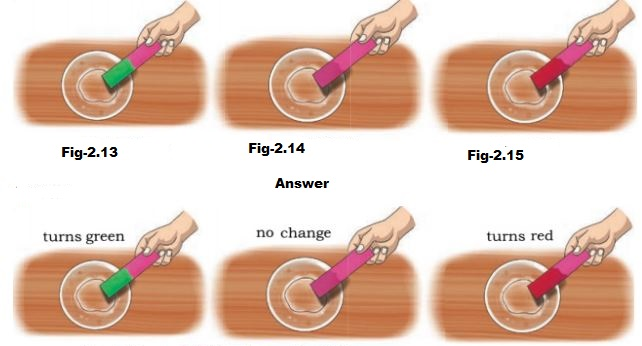
Question3.Observe and analyse Figs. 2.13, 2.14, and 2.15, in which red rose extract paper strips are used. Label the nature of solutions present in each of the containers.
Answer:
The red rose extract turns red in acidic solutions and green in basic solutions. In Fig. 2.13, the red rose extract paper strip turns green, indicating that the solution in this container is basic in nature. In Fig. 2.14, there is no change in the colour of the strip, which shows that the solution is neutral. However, in Fig. 2.15, the strip turns red, indicating that the solution is acidic in nature.
Question 4.A liquid sample from the laboratory was tested using various indicators:
|
Indicator |
Red litmus |
Blue litmus |
Turmeric |
|
Change |
No change |
Turned red |
No change in colour |
Answer: The given liquid sample is acidic in nature. It does not affect red litmus paper, but it turns blue litmus paper red, which is an indication of acidic nature. Also, there is no change in the turmeric indicator, confirming its acidic nature.
Question5.Manya is blindfolded. She is given two unknown solutions to test and determine whether they are acidic or basic. Which indicator should Manya use to test the solutions and why?
Answer: Manya should use an olfactory indicator to test the solutions. Olfactory indicators change their smell in acidic or basic solutions. For example, substances like onion produce a strong smell in a basic solution and a mild smell in an acidic solution.
Question6.Could you suggest various materials which can be used for writing the message on the white sheet of paper (given at the beginning of the chapter) and what could be in the spray bottle? Make a table of various possible combinations and the colour of the writing obtained.
Answer: The colour of the writing will depend on the nature of the writing material (acidic or basic) and the solution in the spray bottle (acidic or basic). Below is the table of possible combinations.
|
Writing Material |
Substance in Spray Bottle |
Colour of Writing (on paper) |
|
Lemon juice |
Blue litmus solution |
Red |
|
Baking soda solution |
Red litmus solution |
Blue |
|
Baking soda solution |
Rose extract |
Green |
|
Vinegar |
Rose extract |
Red |
|
Soap solution |
Turmeric solution |
Red |
|
Amla juice |
Indian blackberry juice |
Pink |
|
Lime water |
Indian blackberry juice |
Purple |
|
Grapes juice |
Beetroot extract |
Red |
|
Washing powder solution |
Beetroot extract |
Blue |
|
Tamarind water |
Red hibiscus extract |
Pink |
|
Soap solution |
Red hibiscus extract |
Green |
Question7.Grape juice was mixed with red rose extract; the mixture got a tint of red colour. What will happen if baking soda is added to this mixture? Justify your answer.
Answer: When baking soda (a base) is added to the mixture of grape juice and red rose extract, the basicity increases. In basic conditions, red rose extract turns green. So, after adding baking soda, the mixture will turn green.
Question8.Keerthi wrote a secret message to her grandmother on her birthday using orange juice. Can you assist her grandmother in revealing the message? Which indicator would you use to make it visible?
Answer: Keerthi’s grandmother can reveal the secret message by using acid-base indicators, as orange juice is acidic in nature. She can use rose extract or beetroot juice (which will turn red) or Indian blackberry extract (which will turn pink) to make the message visible.
Question9.How can natural indicators be prepared? Explain by giving an example.
Answer: Natural indicators can be made using plant materials with pigments that change colour with acid or base. For example, to make red rose extract:
- Wash and crush rose petals.
- Place them in a glass tumbler and add hot water.
- Let it sit for 5-10 minutes, then filter the mixture.
The resulting liquid is a natural indicator that turns red in acids and green in bases.
Question10.Three liquids are given to you. One is vinegar, another is a baking soda solution, and the third is a sugar solution. Can you identify them only using turmeric paper? Explain.
Answer: Using turmeric paper, we can identify a basic solution but not an acidic or neutral solution. When baking soda solution (basic) is tested, the turmeric paper will turn red. However, both vinegar (acidic) and sugar solution (neutral) will leave the paper yellow, as turmeric paper does not change colour in acidic or neutral solutions. Therefore, turmeric paper can only identify a basic solution.
Question11.The extract of red rose turns the liquid X to green. What will the nature of liquid X be? What will happen when excess of amla juice is added to liquid X?
Answer: If the extract of red rose turns the liquid X to green, it indicates that liquid X is basic. Red rose extract acts as an indicator, turning red in acidic solutions and green in basic solutions. When excess amla juice (which is acidic) is added to liquid X, it will neutralise the base. The green colour of the liquid will turn to red as the solution becomes more acidic due to the addition of the acidic amla juice.
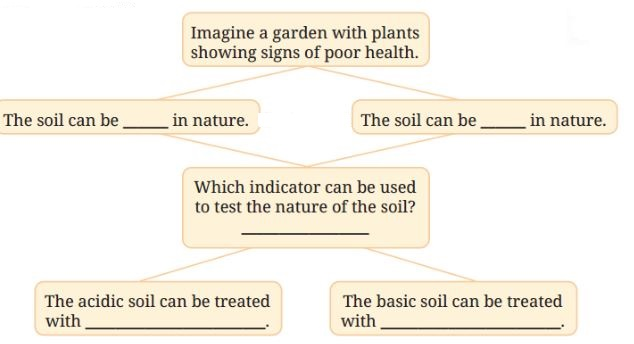
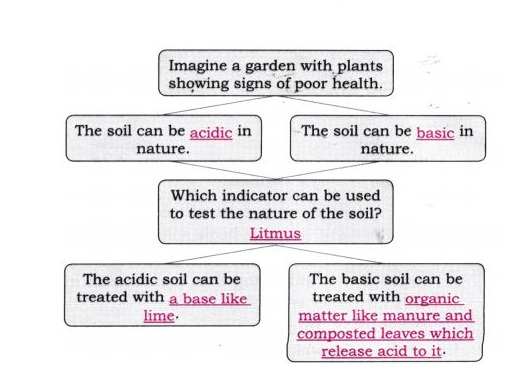
Question12.Observe and analyse the information given in the following flowchart. Complete the missing information.
Answer:
The complete flowchart is as follows:
(Activities)
Table 2.1: Testing the nature of samples with blue and red litmus papers
|
Name of the Sample |
Colour of blue litmus paper after putting a drop of sample |
Colour of red litmus paper after putting a drop of sample |
|
Lemon juice |
Red |
Red |
|
Soap solution |
Blue |
Blue |
|
Amla juice |
Red |
Red |
|
Tamarind water |
Red |
Red |
|
Vinegar |
Red |
Red |
|
Baking soda solution |
Blue |
Blue |
|
Lime water |
Blue |
Blue |
|
Tap water |
Blue |
Red |
|
Washing powder solution |
Blue |
Blue |
|
Sugar solution |
Blue |
Red |
|
Salt solution |
Blue |
Red |
|
Orange juice |
Red |
Red |
Table 2.2: Grouping of samples tested in Table 2.1
|
Group A |
Group B |
Group C |
|
Lemon juice, Amla juice, Tamarind water, Vinegar, Orange juice |
Soap solution, Baking soda solution, Lime water, Washing powder solution |
Tap water, Sugar solution, Salt solution |
Observation and conclusion: Substances in Group A, like lemon juice and vinegar, are acidic as they turn blue litmus paper red. Group B substances, like soap and baking soda, are basic as they turn red litmus paper blue. Group C substances, like tap water and sugar solution, are neutral because they do not change the litmus paper colour.
Activity 2.2: Let Us Relate and explore (Page 11)
All the substances in Group A – lemon juice, amla juice, tamarind water, vinegar and orange juice are edible. They all have a sour taste because they contain acids and are acidic in nature. The common acids found in these substances are:
- Lemon: Citric acid
- Curd: Lactic acid
- Tamarind: Tartaric acid
- Vinegar: Acetic acid
Activity 2.3: Let Us Prepare (Page 12)
Answer: Do it yourself.
Table 2.3: Testing the nature of samples with red rose extract
|
Name of the Sample |
The colour of the red rose extract after adding the sample |
Nature of substance |
|
Lemon juice |
Red |
Acidic |
|
Soap solution |
Green |
Basic |
|
Amla juice |
Red |
Acidic |
|
Baking soda solution |
Green |
Basic |
|
Vinegar |
Red |
Acidic |
Observation and conclusion: The rose extract gives a red colour in an acidic solution and a green colour in a basic solution.
Activity 2.5: Let Us Prepare (Pages 14-15)
Table 2.4: Testing the nature of samples with turmeric paper
|
Name of the Sample |
The colour of the turmeric paper after putting a drop of sample |
|
Lemon juice |
Yellow |
|
Soap solution |
Red |
|
Amla juice |
Yellow |
|
Baking, soda solution |
Red |
|
Sugar solution |
Yellow |
Observation and conclusion: Turmeric paper changes colour from yellow to red in a basic solution but shows no change in acidic or neutral solutions.
Activity 2.6: Let Us Lnvestigate (Page 16)
Answer: Do it yourself.
Activity 2.7: Let Us Experiment (Page 17)
Answer: Do it yourself.