Lesson 4 Exploring Magnets Notes
A magnet is an object that can attract certain materials like iron, nickel, and cobalt. The force exerted by a magnet towards these materials is called magnetic force. Magnetic force creates region around the magnet known as the magnetic field. Magnets have a solid history for centuries as they were used by sailors in ancient times to navigate their ships. Magnets are used in various applications, from compasses to electronics. Apart from the natural magnets, we can make temporary or artificial magnets by using various methods. In this lesson, we will be exploring various concepts magnetic properties and their uses.
Magnetic and Non-magnetic Materials
Magnetic Materials
are those materials that are attracted by a magnet. They contain substances like iron, nickel, or cobalt in them. Some examples: Iron nails, Steel spoon, Nickel coin and Cobalt rods. Non-Magnetic Materials are those that doesn’t get attracted by a magnet as they do not contain magnetic substances. . Some examples are wood, paper, trees, plastic, rubberClassification of magnets
Magnets are classified into natural and artificial magnets. They are also classified based on the shapes. The tables below illustrates the variety of magnets.
|
Type of Magnet |
Description |
Examples |
|
Natural Magnets |
Found in nature; occur naturally in certain rocks. |
Magnetite (Lodestone) |
|
Artificial Magnets |
Man-made magnets with stronger and controlled magnetism. |
Bar magnet, horseshoe magnet |
Magnets based on shapes
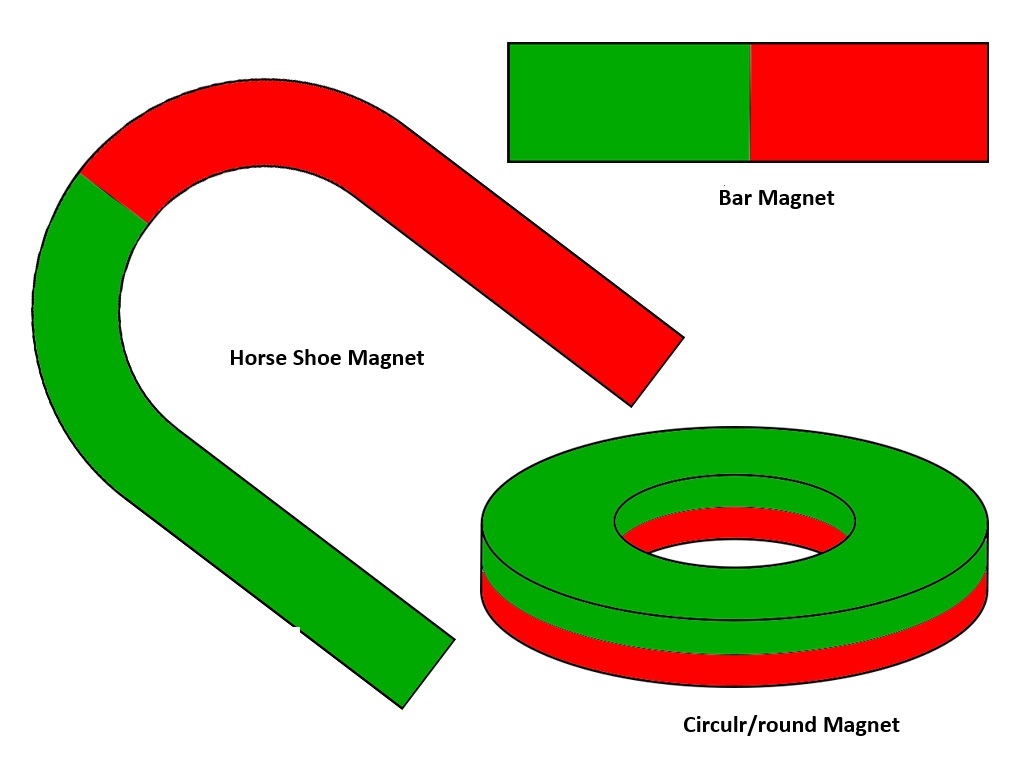
|
Shape/Type |
Description |
Common Uses |
|
Bar Magnet |
Rectangular shape, poles at the ends. |
Science experiments, fridge magnets |
|
Horseshoe Magnet |
U-shaped, poles closer together, stronger pull. |
Lifting heavy objects |
|
Cylindrical Magnet |
Shaped like a cylinder or rod. |
Electric motors, sensors |
|
Ring Magnet |
Donut-shaped, hole in the center. |
Loudspeakers, magnetic levitation |
|
Disc Magnet |
Thin, flat, round magnets. |
Electronics, toys |
Poles of magnets

A magnet has two special ends where its magnetic force is the strongest. These ends are called the poles, and they are North Pole (N) and the South pole. North pole is the end of the magnet that points towards the Earth's North when freely suspended while South Pole (S) points towards the Earth's South pole when suspended
Important Facts about Magnetic Poles:
- Poles always come in pairs. If you cut a magnet in to 2 pieces , you don’t get a single pole instead you get two smaller magnets with each piece having North and South pole.
- Like poles repel while unlike poles attract each other. In other words, North Pole vs North Pole or South pole vs South pole leads to repulsion whereas South Pole vs North Pole produces attraction.
Methods to Identify the Poles of a Magnet:
- 1. Take a bar magnet whose poles are already marked. Bring one end of the unknown magnet near the known North Pole. If it attracts, the unknown end is likely the South Pole. If it repels, the unknown end is also a North Pole. Repeat the test with the other end.
- 2. Take a compass needle. Bring one end of the magnet near a magnetic compass needle. If the compass needle repels, that end is the same pole as the compass needle (usually North). If it attracts, it is the opposite pole.
- 3. Suspend the magnet freely using a thread or float it on water. The end that points north is the North Pole, and the other is the South Pole.
How to find directions using a Magnet?
You can use a magnet to find directions by making a simple magnetic compass. This works because a freely suspended magnet always aligns itself with the Earth’s magnetic field. Take a bar magnet and tie a string at its center. Suspend it freely in the air so it can rotate without touching anything and wait for it to settle. The magnet will come to rest in a north-south direction. The end pointing north is the North Pole, and the other end is the South Pole.
Why there is North and South Pole?
When a magnet is freely suspended, it always settles in the north-south direction, this happens because the Earth itself acts like a giant magnet with a magnetic field. The ability of a freely suspended magnet to always align itself in the north-south direction is used to determine directions with the help of a magnetic compass.
Magnetic Compass
A magnetic compass is typically a small needle-shaped magnet placed on a pin that stands at the bottom. This needle is balanced on the pin in such a way that it can easily rotate or move freely around this point. The end of the needle that points toward the North is usually painted red. Beneath the needle, there is a dial with directions marked on it. For centuries one small device called a magnetic compass was used to find the directions by the sailors. The compass is a needle-shaped magnet that can rotate freely and settles finally at north-south direction. To use the compass, place it where you want to decide the directions and freely suspend it. After a short while, the needle will settle in the north-south direction. Navigation by sailors, pilots, and travellers. Tourists while trekking in unfamiliar areas, in maps and geography studies to orient directions, also use magnetic compass.
Making a Simple Compass
Materials Needed:
- A sewing needle or small pin (made of iron or steel)
- A magnet (bar magnet or fridge magnet)
- A small piece of foam, cork, or a leaf
- A bowl of water
- (Optional) A thread if suspending the needle
Steps to make the magnetic compass:
- Magnetize the needle by rubbing one end of the needle with a magnet in one direction only. Continue this for about 20–30 seconds. This helps in making the needle a tiny magnet.
- Prepare the float by inserting the needle through the small piece of foam or place it gently on a leaf.
- Gently place the foam or leaf (with the needle on it) in a bowl of water so it floats freely.
- Now the needle will slowly turn and align itself in the north-south direction. The end that was rubbed with the magnet will point towards the north.
Comparison between a Freely suspended Magnet and a Magnetic Compass
|
Feature |
Freely Suspended Magnet |
Magnetic Compass |
|
Basic Definition |
A bar magnet hung freely so it can rotate. |
A device with a magnetized needle fixed over a dial. |
|
Structure |
Just a magnet suspended by thread or pivot. |
Enclosed box with a magnetic needle and direction dial. |
|
Direction Indication |
Points only in north-south direction. |
Shows all four main directions: N, S, E, W. |
|
Ease of Use |
Not convenient for daily use or travel. |
Portable and easy to use in navigation. |
|
Accuracy |
Less precise (no direction labels). |
More precise (calibrated dial for directions). |
|
Used In |
Science experiments and demonstrations. |
Navigation, trekking, sailing, and maps. |
How to store or preserve magnets
- Store Magnets in Pairs (for Bar Magnets)
- Keep two bar magnets together with opposite poles facing each other (North facing South).
- Place a soft piece of wood or a spacer between them to avoid direct contact.
- Use Keepers (Soft Iron Strips)
- Place a keeper (a piece of soft iron) across the ends of the magnets.
- This helps maintain the magnetic field and prevents loss of magnetism.
- Avoid Heat and Strong Impacts
- Do not expose magnets to high temperatures or mechanical shock (like dropping them), as this can demagnetize them.
- Keep Away from Electronics
- Store magnets away from mobile phones, computers, credit cards, and TVs to avoid damage from magnetic interference.
- Use Proper Storage Boxes
- Use magnet-safe containers made of non-magnetic materials like plastic or wood.
- Label them clearly if they’re strong magnets.
- Separate Different Types
- Store different types of magnets (bar, disc, ring, horseshoe) separately to avoid unwanted attraction or damage.
Glossary
|
Term |
Definition |
|
Magnet |
A material that attracts iron and produces a magnetic field. |
|
Magnetic Materials |
Substances that are attracted to magnets (e.g., iron, cobalt, nickel). |
|
Non-Magnetic Materials |
Substances that are not attracted to magnets (e.g., plastic, wood, rubber). |
|
Poles of a Magnet |
The two ends of a magnet where the magnetic force is the strongest – North Pole (N) and South Pole (S). |
|
Attraction |
A force that pulls magnetic materials toward a magnet or brings opposite poles together. |
|
Repulsion |
A force that pushes like poles of two magnets away from each other. |
|
Magnetic Field |
The area around a magnet where its magnetic force can be felt. |
|
Magnetic Compass |
A device with a freely suspended magnetic needle used to find directions. It always points toward the magnetic North. |
|
Lodestone |
A naturally occurring magnetic rock (also called magnetite). |
|
Artificial Magnet |
A man-made object that acts like a magnet (e.g., bar magnet, horseshoe magnet). |
|
Temporary Magnet |
A material that behaves like a magnet only when it is in a magnetic field. |
|
Permanent Magnet |
A material that retains its magnetic properties for a long time. |
|
Induced Magnetism |
The process by which a magnetic material becomes a magnet when placed near a magnet. |
|
Magnetisation |
The process of making a material magnetic. |
|
Demagnetisation |
The process of removing magnetic properties from a magnet. |
|
Freely Suspended Magnet |
A magnet hung freely so it can rotate and align itself in the North–South direction. |
|
Compass Needle |
A small bar magnet fixed in the center of a compass and allowed to rotate freely. |
|
Bar Magnet |
A straight, rectangular-shaped magnet with two poles (North and South) at the ends. |
|
Magnetic Field |
The invisible area around a magnet where its magnetic forces can be felt. |
Exploring Magnets-Question Answers
- Do magnets stick to objects made of certain materials only?
Answer: Yes, magnets attract only specific materials. Materials like iron, nickel, and cobalt are attracted to magnets and are called magnetic materials. Other materials, such as aluminium, copper, brass, gold, silver, and lead, do not attract magnets and are considered non-magnetic.
- Do all parts of a magnet attract magnetic materials equally?
Answer: No, the magnetic strength is not uniform throughout the magnet. The poles of the magnet have a stronger magnetic field compared to the middle part. In a bar magnet, the ends have a stronger magnetic field, and the same applies to the poles of a horseshoe magnet.
- Can we find a magnet with a single pole?
Answer: No, a magnet always has two poles: a North Pole and a South Pole. Even if a magnet is broken into smaller pieces, each piece will still have both a North and South Pole.
Let us enhance our learning
-
Fill in the blanks
- Unlike poles of two magnets ______ each other, whereas like poles ______ each other.
- The materials that are attracted towards a magnet are called ______.
- The needle of a magnetic compass rests along the ______ direction.
- A magnet always has ______ poles.
Answers:
- attract, repel
- magnetic materials
- north-south
- two
-
State whether the following statements are True (T) or False (F).
- Similar poles of a magnet repel each other.
Answer: True - A magnet can be broken into pieces to obtain a single pole.
Answer: False - Iron filings mostly stick in the middle of a bar magnet when it is brought near them.
Answer: False - A freely suspended bar magnet always aligns with the north-south direction.
Answer: True
Column I shows different positions in which one pole of a magnet is placed near that of the other. Column II indicates the resulting actions
|
Column I |
Column II |
|
N – N |
Repulsion |
|
N-S |
Attraction |
|
S-N |
Attraction |
|
S – S |
Repulsion |
Answers
|
Column I |
Column II |
|
N – N |
________ |
|
N-__ |
Attraction |
|
S-N |
________ |
|
_- S |
Repulsion |
-
1. Atharv has performed an experiment in which he took a bar magnet and rolled it over a heap
of
steel U-clips as shown in the picture below. According to you, which of the options given in the table
is
likely to be his observation?Table: Number of pins attracted by the magnet at its
various
positions

|
Options |
Position -A |
Position -B |
Position -C |
|
i. |
10 |
2 |
10 |
|
ii. |
10 |
10 |
2 |
|
iii. |
2 |
10 |
10 |
|
iv. |
10 |
10 |
10 |
Answer: From the figure, it is clear that the ends of the magnet have more iron fillings attached to them. This is because the magnet's strength lies more at the ends of the magnet. Hence option (i) is correct.
2. Reshma bought three identical metal bars from the market. Out of these bars, two were magnets and one was just a piece of iron. How will she identify which two amongst the three could be magnets (without using any other material)?
Answer: Reshma can identify the magnets through the principle of repulsion. Magnets repel other magnets when poles are brought close. The iron bar will only be attracted but won't show repulsion, helping her identify the magnets.
3. You are given a magnet that does not have the poles marked. How can you find its poles with the help of another magnet that has its poles marked?
Answer: By bringing the marked magnet near the unmarked one, if the two ends attract, the unmarked magnet's pole is the opposite of the marked magnet's pole. If they repel, the poles are similar.
4.A bar magnet has no markings to indicate its poles. How would you find out near which end its North Pole is located without using another?
Answer: Suspend the magnet freely, and it will align itself in the north-south direction. The end pointing towards the north is the North Pole, and the end pointing towards the south is the South Pole.
5.If the earth is itself a magnet, can you guess the poles of the earth’s magnet by looking at the direction of the magnetic compass?
Answer: Yes, we can guess the poles of Earth’s magnet by looking at the direction of the magnetic compass. The north-seeking end of the compass needle points towards the geographic North Pole of the Earth.
6.While a mechanic was repairing a gadget using a screwdriver, the steel screws kept falling. Suggest a way to solve the problem of the mechanic based on what you have learnt in this chapter.
Answer: The mechanic can magnetise a screwdriver by rubbing a magnet along its length several times. This will allow the screwdriver to hold the screws securely while working.
7.Two ring magnets X and Y are arranged as shown in Fig. (below). It is observed that the magnet X does not move down further. What could be the possible reason? Suggest a way to bring the magnet X in contact with magnet Y, without pushing either of the magnets.

Answer: Magnet X must be floating because the like poles are facing each other (like poles repel each other). If we change the direction of the magnet X by rotating it the unlike poles will face each other and the magnets will come closer. Magnet X is likely repelling magnet Y because their like poles are facing each other. By rotating magnet X, so that opposite poles face each other, the magnets will attract and move closer.
8.Three magnets are arranged on a table in the form of the shape shown in Fig. (below). What is the polarity, Nor S, at the ends 1, 2, 3, 4, and 6 of the magnets? The polarity of one end (5) is given to you.
|
Point |
Polarity |
|
1 |
N |
|
2 |
S |
|
3 |
N |
|
4 |
S |
|
6 |
S |
Additional questions:
(i) Which is an example of a magnetic substance?
(a) Iron (b) Nickel (c) Cobalt (d) All of these
Answer: (d) All of these are attracted towards a magnet.
(ii) Magnets have a shape?
(a) cylindrical (b) ball ended (c) horse shoe (d) all of these
Answer: (d) Magnets may be of various shapes including bar magnets.
(iii) When a bar magnet is brought near iron dust, most of the dust sticks
(a) near the middle (b) equally everywhere (c) near two ends (d) at the middle and ends
Answer: (c) Magnetic field intensity is maximum at the poles of a bar magnet.
(iv) A freely suspended bar magnet rests in
(a) north-south directions (b) east-west directions (c) upside down (d) any direction by chance
Answer: (a) A bar magnet always rests in N-S directions when suspended freely.
(v) Attraction is seen between the poles of two bar magnets in the case of
(a) N-pole of one magnet with N-pole of other
(b) N-pole of one magnet with S-pole of other
(c) S-pole of one magnet with S-pole of other
(d) all of these cases will show attraction
Answer: (b) Unlike poles attract and like poles repel each other.
(vi) Which is a natural magnet?
(a) Magnetite (b) Haemetite (c) Bakelite (d) Copper
Answer: (a) Magnetite is a natural magnet.
(vii) Choose the wrong statement
(a) Heat can destroy magnetic properties of a magnet. ‘
(b) Magnets are made up of different materials and different shapes.
(c) There is a maximum attraction in middle of a magnet.
(d) Magnetite does not show magnetic properties.
Answer: (d) Magnetite does not show magnetic properties.
(viii) The magnetic properties of a magnet cannot be destroyed by
(a) hammering (b) heating (c) dropping on a hard surface (d) boiling
Answer: (d) Magnetic properties of a magnet cannot be destroyed by boiling, because magnetic properties are destroyed by hammering, dropping on hard surface and by heating.
(ix) Which two ends of a magnet are called magnetic poles?
(a) North pole (b) South pole (c) North and south pole (d) Self demagnetisation
Answer: (c) Magnetic poles (North pole and South pole)
(x) Magnets attract
(a) wood (b) plastic (c) paper (d) iron
Answer: (d) Iron is attracted by magnet.