Magentic Effects of Current
Take the QuizThe Story of Magnets
A long time ago, around 2,000 years back in a place called Magnesia (in present-day Turkey), a shepherd named Magnes was walking through the hills with his flock of sheep. One day, while climbing a rocky mountain, he suddenly felt that the metal tip of his staff and the nails in his sandals were getting stuck to a rock! Surprised and curious, Magnes started digging around the rock. He found that the stone had the strange power to attract iron. This magical stone was later named "magnetite", and the force it produced became known as magnetism. As time passed, people began studying this mysterious stone. They discovered that magnetite could also make other pieces of iron magnetic. Over time, scientists learned to make artificial magnets and eventually used magnetism in many important inventions like compasses, electric motors, and generators. And so, what started with a curious shepherd became one of the most important forces in physics today!
Electricity and magnetism
Electricity and magnetism are closely related. When an electric current flows through a conductor, it creates a magnetic field around it. This phenomenon is known as the magnetic effect of electric current. It was first discovered by Hans Christian Oersted in 1820, when he observed that a compass needle deflects near a current-carrying wire. This discovery led to the development of electromagnets, electric motors, and many other modern devices. This chapter explores:
- How electric current produces magnetic fields.
- The characteristics and direction of magnetic fields.
- Applications like electromagnets and electric motors.
- The concept of electromagnetic induction.
Properties of Magnet
- Every magnet has two poles i.e. North and South.
- Like poles repel each other.
- Unlike poles attract each other.
- A freely suspended bar magnet aligns itself in nearly north-south direction, with its north pole towards north direction.
Characteristics of Magnetic Field Lines
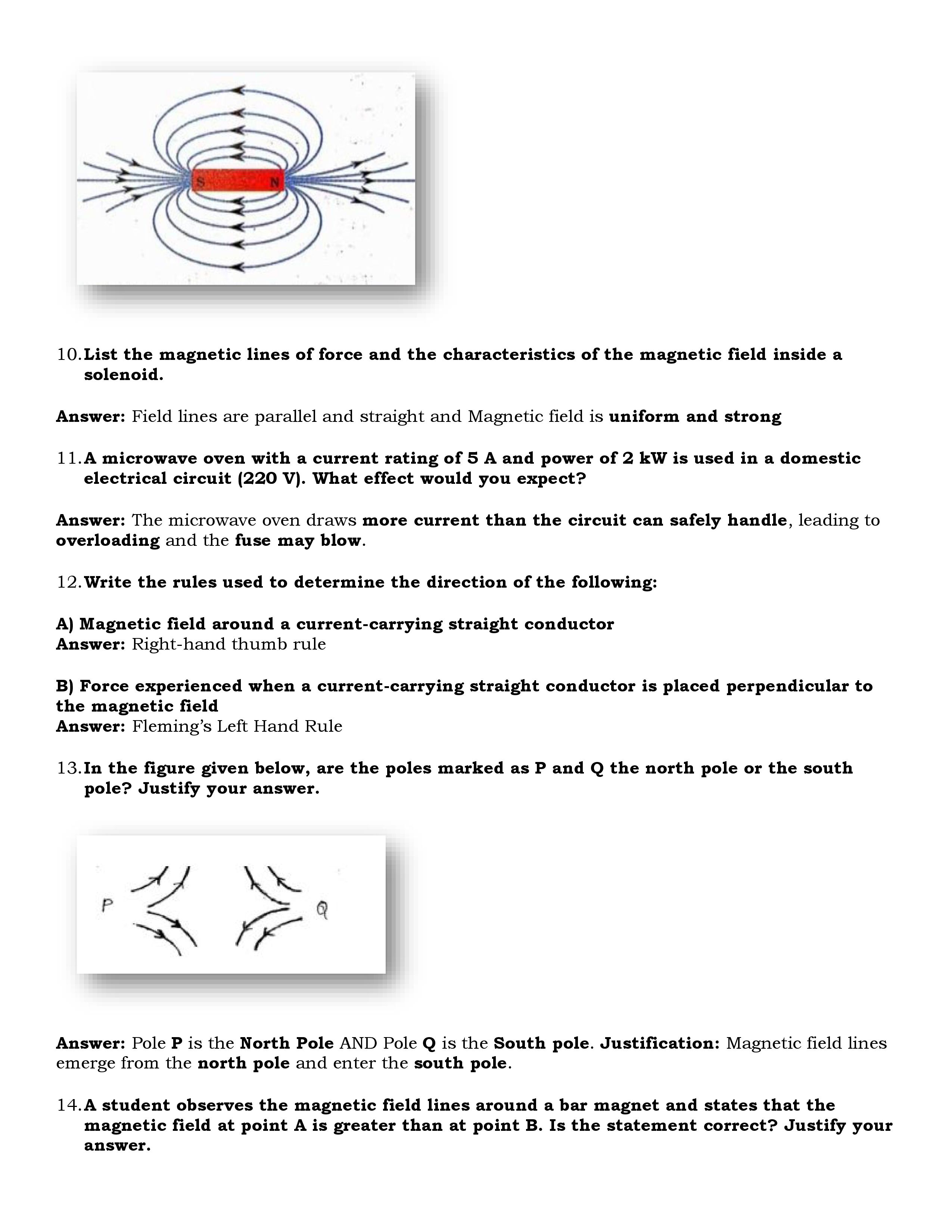
- Field lines arise from North pole and end into South pole of the magnet.
- Field lines are closed curves.
- Field lines are closer in stronger magnetic field.
- Field lines never intersect each other as for two lines to intersect, there must be two north directions at a point, which is not possible.
- Direction of field lines inside a magnet is from South to North.
- The relative strength of magnetic field is shown by degree of closeness of field lines.
Electromagnetism
When an electric current passes through a conductor (like a wire), it produces a magnetic field around it. This link between electricity and magnetism is called electromagnetism. This was first discovered by Hans Christian Oersted in 1820, showing that electricity can create magnetism. An electromagnet is a magnet made by passing electric current through a coil of wire wrapped around a soft iron core.When current flows through a coi, a magnetic field is created around the coil.The soft iron core gets magnetized and becomes a strong magnet.This type of magnetism is temporary as it disappears when the current is switched off. Electromagnets are used in electric bells, loudspeakers,electric motors and Magnetic cranes (to lift heavy scrap metal)
Types of Magnets
1. Natural Magnets
These magnets are found in nature. Example: Magnetite. They have weak magnetic strength and irregular shapes.
2. Artificial Magnets
These are man-made magnets and can be designed in different shapes and strengths. They are classified into:
- Permanent Magnets: Retain their magnetism over time (e.g., bar magnet, horseshoe magnet).
- Temporary Magnets: Show magnetism only when in a magnetic field or electric current (e.g., electromagnets).
Magnet types
| Type | Description | Examples |
|---|---|---|
| Natural Magnet | Found in nature, weak magnetic power | Magnetite (lodestone) |
| Permanent Magnet | Man-made, retains magnetism | Bar magnet, horseshoe magnet |
| Temporary Magnet | Works only under magnetic field or current | Electromagnet (iron nail + coil) |
Magnets based on Shape and Use
- Bar magnet – straight and rectangular.
- Horseshoe magnet – U-shaped, strong at the poles.
- Disc magnet – circular, often used in electronics.
- Ring magnet – doughnut-shaped, used in loudspeakers.
- Electromagnet – magnetized using electric current; strength can be controlled.
Magnetic Field
A magnetic field is the region around a magnet or a current-carrying conductor where magnetic forces can be experienced. It is an invisible area of influence that affects materials like iron, cobalt, and nickel. The presence of a magnetic field can be detected using a compass needle, which aligns itself along the field's direction. Magnetic fields are represented by magnetic field lines, which show the direction and strength of the field. The concept of magnetic fields is fundamental in understanding how magnets and devices like electric motors, generators, and electromagnets work.
Poles and Filedlines of Magnet
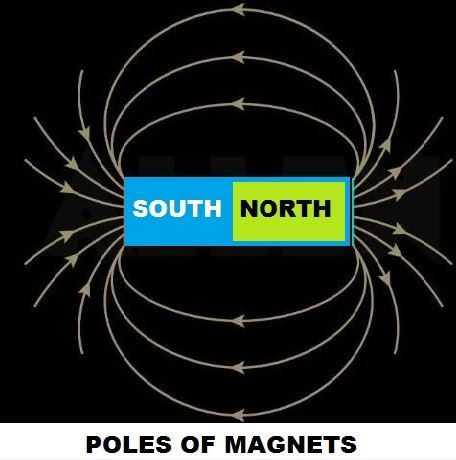
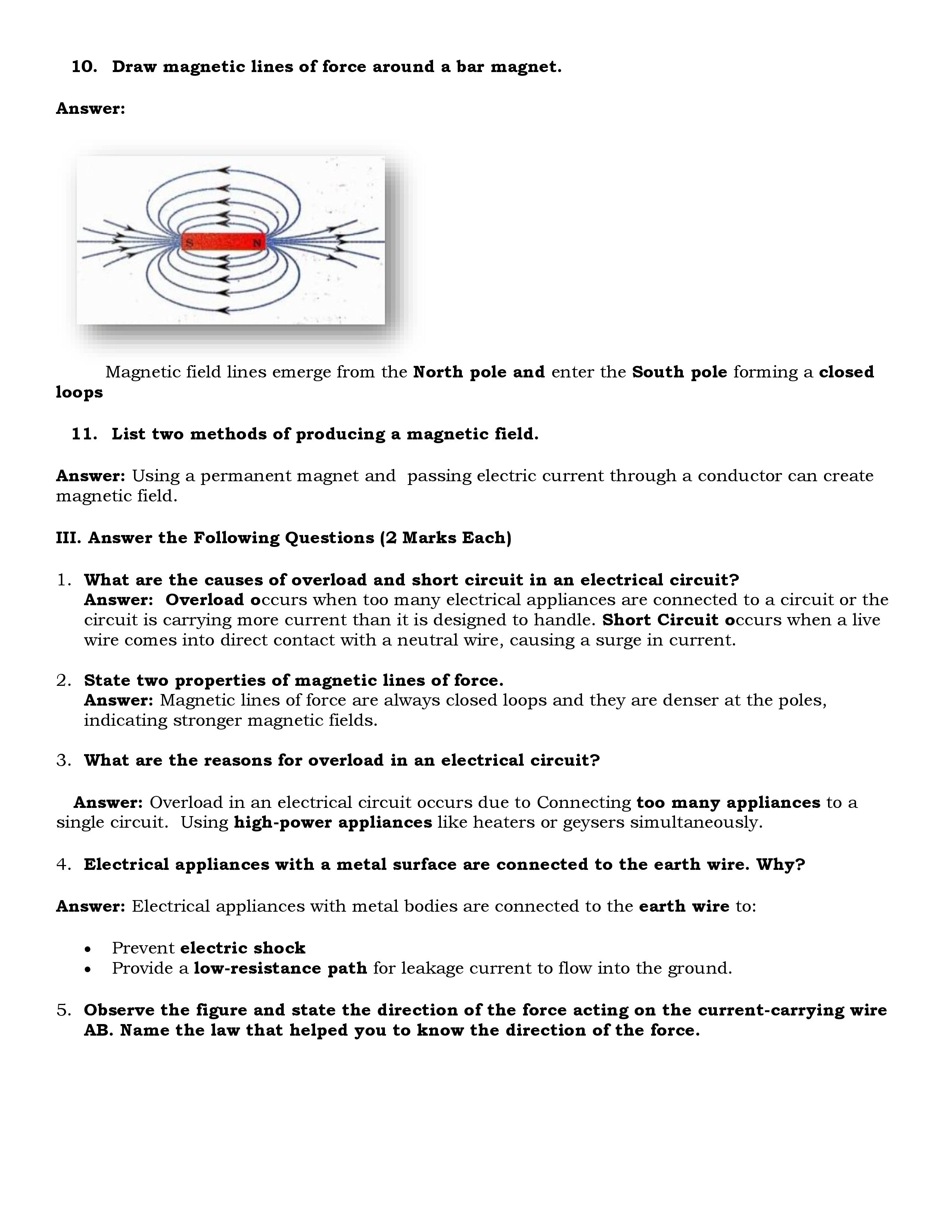
A bar magnet has north (N) and south (S) poles as shown below. Curved lines are shown going from the north pole to the south pole outside the magnet. These are magnetic field lines, which represent the direction and strength of the magnetic field. The lines are denser near the poles, indicating that the magnetic field is strongest at the poles. Inside the magnet, field lines go from south to north, completing a closed loop. The direction of arrows on the lines shows how a north pole of a compass needle would point from N to S outside the magnet.
Magnetic Field Lines
Magnetic field lines are imaginary lines used to represent the direction and strength of a magnetic field. They originate from the north pole of a magnet and curve around to enter the south pole, forming closed loops. These lines are closer together where the magnetic field is stronger and spread out where the field is weaker. The direction of the field at any point is given by the tangent to the field line at that point. Magnetic field lines never intersect because at any given point, the magnetic field has only one direction. This mechanism helps visualize how magnetic forces act in space and plays a key role in understanding the behavior of magnets and electromagnetic devices.
Oersted’s Experiment

Hans Christian Oersted’s Experiment (1820) In 1820, Hans Christian Oersted, a Danish physicist, made a groundbreaking discovery that showed a direct link between electricity and magnetism.Oersted set up a simple circuit with a straight conducting wire connected to a battery and a compass needle placed just below the wire. When there was no current flowing, the compass needle pointed north, as usual. However, when Oersted allowed current to flow through the wire, he noticed that the compass needle deflected, meaning it moved away from the north direction. Oersted concluded that,electric current produces a magnetic field around the wire and the direction of the compass deflection depends on the direction of the current. This experiment was the first evidence that electricity and magnetism are related, laying the foundation for the field of electromagnetism.
Magnetic Field due to Current through a Straight Conductor
Magnetic Field due to Current through a Straight Conductor can be represented by concentric circles at every point on conductor. Direction can be given by right hand thumb rule or compass. Circles are closer near the conductor. Magnetic field is directly proportional to the strength of current while it is inversely proportional to the distance from the conductor.
Right-Hand Thumb Rule
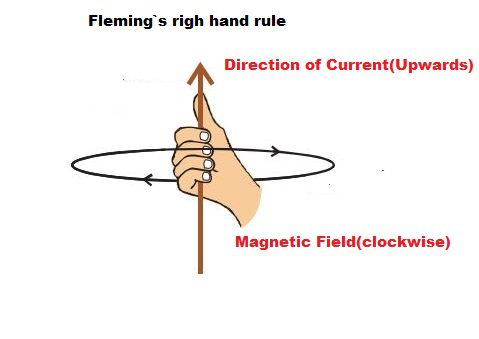
“If you hold a current-carrying straight conductor in your right hand such that the thumb points in the direction of the electric current, then the fingers curled around the conductor will give the direction of the magnetic field lines.” Therefore, the thumb of the right hand → points in the direction of current (I) The curled fingers → show the direction of the magnetic field (B) around the wire (in circular loops). If current is flowing upward through a vertical wire: Thumb → up (direction of current) Fingers → curl anticlockwise around the wire ➡ So, magnetic field is anticlockwise around the wire.
Magnetic Field Due to Current in a Circular Loop
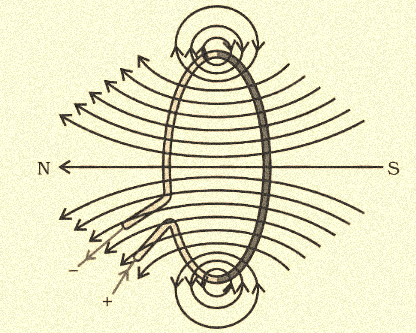
When current flows through a circular conducting wire, a magnetic field is produced around it. The magnetic field lines are concentric near the wire but become nearly straight and uniform at the center of the loop. At the center of the loop, magnetic field lines are nearly straight and point in the same direction, forming a strong magnetic field. The strength of the magnetic field is greatest at the center of the loop and decreases as you move further away. The field strength also depends on the radius of the circular loop, the current flowing through the loop, and the number of turns. If you curl your right hand fingers in the direction of the current, your thumb will point in the direction of the magnetic field.
The magnetic field due to the current in a solenoid
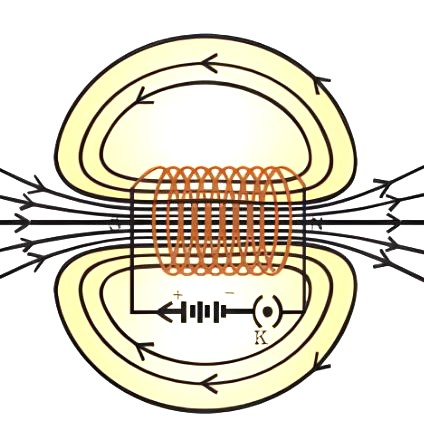
A solenoid is:
A long coil of wire, usually cylindrical, that generates a nearly uniform magnetic field inside when electric current
flows through it. The magnetic field inside a long solenoid is uniform and parallel to the axis of the solenoid.
The field outside the solenoid is very weak (ideally zero).
The direction of the field follows the right-hand rule: if the fingers of your right hand curl in the direction of
the current
through the coils, your thumb points in the direction of the magnetic field. The principles of magnetic fied in a selenoid is used
in electromagnets, magnetic locks, inductors and transformers, MRI machines and automotive starter systems.
The formula for the magnetic field of a solenoid is given by,
B = μoIN / L
Where,
N = number of turns in the solenoid
I = current in the coil
L = length of the coil.
Fleming’s Left-Hand Rule

It is a simple way to find the direction of force (motion) on a current-carrying conductor placed in a magnetic field. The rule states that “If we stretch the thumb, forefinger, and middle finger of the left hand mutually perpendicular to each other, the forefinger shows the direction of Magnetic field (from North to South), middle finger shows the direction of Current (conventional current, from + to –) and the thumb indicates the Force/Motion of the conductor”. Fleming’s left]t hand rule predicts the motion in an electric motor and it explains how electrical energy is converted into mechanical energy.
Electric Motor

electric motor is a rotating device that converts electrical energy into mechanical energy. It consists of a rectangular coil (ABCD) of insulated copper wire.The coil is placed between the two poles of a magnetic field such that arms AB and CD are perpendicular to the field.
The ends of the coil are connected to two halves P and Q of a split ring (commutator). These halves are attached to an axle and their outer sides touch two stationary brushes X and Y.How an electric motor works?
-
Current enters the coil through brush X, passes through the coil ABCD, and leaves via brush Y.
-
By Fleming’s Left-Hand Rule, a force acts on the arms:
-
AB → downward force
-
CD → upward force
-
-
These forces cause the coil (and axle O) to rotate anticlockwise.
-
After half a rotation, the split ring reverses connections:
-
Brush X now connects to half Q,
-
Brush Y connects to half P.
-
-
Current now flows along DCBA, reversing the forces:
-
Arm AB → upward,
-
Arm CD → downward.
-
-
The coil continues rotating in the same direction, as the current is reversed at each half-turn.
-
This results in continuous rotation of the coil and axle.
Key Terms
-
Commutator: A device that reverses the direction of current in the coil, ensuring continuous rotation.
-
Armature: The soft iron core with the coil wound on it; increases efficiency by enhancing the magnetic field.
Text book question answers
1.Why does a compass needle get deflected when brought near a bar magnet?
Answer:A compass needle get deflected when brought near a bar magnet because a compass needle is in fact, a small bar magnet. The ends of the compass needle point approximately towards north and south directions.
2.Draw magnetic Held lines around a bar magnet.
Answer: Field lines around a bar magnet
- List the properties of magnetic field lines.
Answer:The properties are:
- They travel from north pole to south pole outside the magnet and south pole to north pole inside the magnet.
- They are closed and continuous curves.
- Two magnetic field lines never intersect each other. If the lines intersect, then at the point of intersection there would be two directions [the needle would point towards two directions] for the same magnetic fields which is not possible.
- The number of field lines per unit area is the measure of the strength of magnetic field, which is maximum at poles. The magnetic field is strong, where the field lines are close together and weak where the lines are far apart.
4.Why don’t two magnetic field lines intersect each other?
Answer: Two magnetic fields lines of force never intersect each other. If the lines intersect, then at [the point of intersection there would be two directions [the needle would point towards two directions] for the same magnetic field, which is not possible.
5.Consider a circular loop of wire lying in the plane of the table. Let the current pass through the loop clockwise. Apply the right hand rule to find out the direction of the magnetic field inside and outside the loop.
Answer: Since the current passes through the loop in a clockwise direction, therefore the front face of the loop will be the south pole and the back face, ie, the face touching the table will be north pole. According to righthand rule, the direction of the magnetic field inside the loop will be pointing downward. Outside the loop, the direction of the magnetic field will be upward.
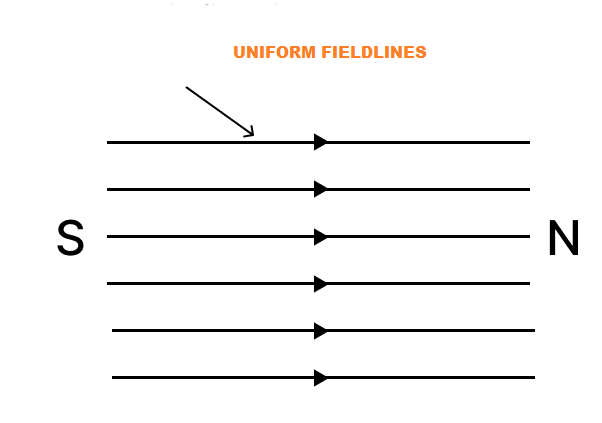
6.The magnetic field in a given region is uniform. Draw a diagram to represent it.
Answer: The figure indicates that the magnetic field is the same at all points in the solenoid. That is field is uniform inside the solenoid.
7.Choose the correct option.
The magnetic field inside a long straight solenoidcarrying current
(a) is zero.
(b) decreases as we move towards its end.
(c) increases as we move towards its end.
(d) is the same at all points.
Answer:
(d) is the same at all points.
- Which of the following property of a proton can change while it moves freely in a magnetic field? (There may be more than one correct answer.)
(a) mass
(b) speed
(c) velocity
(d) momentum
Answer: (c) velocity
(d) momentum.
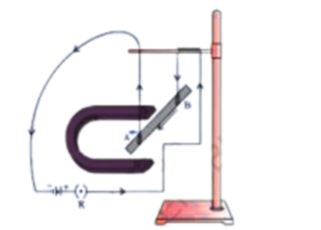
9.In Activity 13.7, how do we think the displacement of rod AB will be affected if
- current in rod AB is increased;
- a stronger horseshoe magnet is used; and
- length of the rod AB is increased?
Answer:
- displacement of A is increased.
- If a stronger horseshoe magnet is used magnetic field is increasing.
- current flows is more.
10.A positivelycharged particle (alphaparticle) projected towards west is deflected towards northby a magnetic field. The direction of magnetic field is(a) towards south
(b) towards east
(c) downward
(d) upward
Answer:(d) upward.
Since the positively charged particle alpha particle projected towards west, so the direction of current is towards west. Now the deflection is towards north, so the force is towards north. Now hold the forefinger, centre finger and thumb of our left – hand at right angles to one another. Let us adjust the hand in such a way that our centre finger points towards west and thumb points towards north. If we look at our forefinger, it will be pointing, upward. Thus, the magnetic field is in the upward direction. So, the correct answer is (d).
11.State Fleming’s lefthand rule.
Answer:According to this rule, stretch the thumb, forefinger, and middle finger of your left hand such that they are mutually perpendicular. If the first finger points in the direction of the Magnetic field and the second finger in the direction of current, then the thumb will point in the direction of motion or the force acting on the conductor.
12.What is the principle of an electric motor?
Answer:A currentcarrying conductor when placed in a magnetic field experiences a force. This is the principle of an electric motor.
13.What is the role of the split ring in an electric motor?
Answer:The split ring reverse the direction of current in the armature coil after every half rotation i.e., it acts as a commutator. The reversal of current reverses, the direction of the forces acting on the two arms of the armature after every half rotation. This allows the armature coil to rotate continuously in the same direction.
14.Explain different ways to induce current in a coil.
Answer:We can induce current in a coil either by moving it in a magnetic field or by changing the magnetic around it. It is convenient in most situations to move the coil in a magnetic field.
Text Book Part I Page No. 131
15.State the principle of an electric generator.
Answer:Based on the phenomenon of electromagnetic induction, electric generator are prepared. In an electric generator, Mechanical energy is used to rotate a conductor in a magnetic field to produce electricity. This is the principle of an electric generator.
16.vName some sources of direct current.
Answer: Dry cell, Battery and D.C. generator.
17c.Which sources produce alternating current?
Answer:vA.C. generator and D.C. generator.
18.Choose the correct option. A rectangular coil of copper wires is rotated in a magnetic field. The direction of the induced current changes once in each
(a) two revolutions
(b) one revolution
(c) half revolution
(d) onefourth revolution.
Answer:(c) half revolution.
19.Name two safety measures commonly used in electric circuits and appliances.
Answer:
- Electric fuse
- Earthing wire
20.An electric oven of 2 kW power rating is operated in a domestic electric circuit (220 V) that has a current rating of 5 A. What result do you expect? Explain.
Answer: Calculate the Oven's Current Draw: Use the formula
- P=V×I (Power = Voltage × ;Current) to find the current (I) the oven needs.
- I=P/V
- I=2000W/220V≈9.09 Amps
.
The fuse, designed to be the weakest link, melts at this high current, breaking the circuit to prevent damage to appliances and wiring, and to stop the risk of fire. The current drawn by this electric oven is 9 A whereas the fuse in the circuit is ( only 5 A capacity. When a high current of 9 A flows through the 5 A fuse, the fuse wire will get heated too much, melt and break, the circuit. Therefore, when a 2 kW power rating electric oven is operated in a circuit having a 5 A fuse will blow off cutting off the power supply in this circuit.
3.What precaution should be taken to avoid the overloading of domestic electric circuits?
Answer:
- Each appliance has a separate switch to ON/OFF the flow of current through it.
- The use of an electric fuse prevents the electric circuit and the appliance from possible damage by stopping the flow of unduly high electric current.
- We should not connect too many appliances to a single socket to prevent overloading.
Textbook Exercises-II
1.Which of the following correctly describes the magnetic Held near a long straight wire?
(a) The field consists of straight lines perpendicular to the wire.
(b) The field consists of straight lines parallel to the wire.
(c) The field consists of radial lines originating from the wire.
(d) The field consists of concentric circles centered on the wire.
Answer:(d) The field consists of concentric circles centered on the wire.
2.The phenomenon of electromagnetic induction is
(a) the process of charging a body.
(b) the process of generating magnetic field due to a current passing through a coil.
(c) producing induced current in a coil due to relative motion between a magnet and the coil.
(d) the process of rotating a coil of an electric motor.
Answer:(c) producing induced current in a coil due to relative motion between a magnet and the coil.
3.The device used for producing electric current is called a
(a) generator
(b) galvanometer
(c) ammeter
(d) motor.
Answer: (a) generator.
Question 4.The essential difference between an AC generator and a DC generator is that
(a) AC generator has an electromagnet while a DC generator has permanent magnet.
(b) DC generator will generate a higher voltage.
(c) AC generator will generate a higher voltage.
(d) AC generator has slip rings while the DC generator has a commutator.
Answer:(c) AC generator will generate a higher voltage.
Question 5.At the time of short circuit, the current in the circuit
(a) reduces substantially.
(b) does not change.
(c) increases heavily.
(d) vary continuously.
Answer:(c) increases heavily.
Question 6.State whether the following statements are true or false.
(a) An electric motor converts mechanical energy into electrical energy.
(b) An electric generator works on the principle of electromagnetic induction.
(c) The field at the centre of a long circular coil carrying current will be parallel straight lines.
(d) A wire with a green insulation is usually the live wire of an electric supply.
Answer:(a) False
(b) true
(c) true
(d) False.
Question 7.List two methods of producing magnetic fields.
Answer:
- Permanent magnet
- Electromagnet.
Question 8.How does a solenoid behave like a magnet? Can you determine the north and south poles of a current carrying solenoid with the help of a bar magnet? Explain.
Answer:
One end of the solenoid behaves as a magnetic north pole, while the other behaves as the south pole. The field lines inside the solenoid are in the form of parallel straight lines. This indicates that the magnetic field is the same at the points inside the solenoid.
As shown in figure a strong magnetic field produced inside a solenoid can be used to magnetise a piece of Magnetic material, like soft iron, when placed inside the coil. The magnet so formed is called an electromagnet.
Question 9.When is the force experienced by a current carrying conductor placed in a magnetic field largest?
Answer: If the direction of magnetic field and flow of electric current are mutually perpendicular then force experienced by a current carrying conductor in a magnetic field is largest.
Question 10.Imagine that you are sitting in a chamber with your back to one wall. An electron beam, moving horizontally from back wall towards the front wall, is deflected by a strong magnetic field to your right side. What is the direction of magnetic field?
Answer: According to Fleming’s left hand rule, the magnetic field acts in the vertically downward direction. Note that the direction of current will be opposite to that of the electron beam.
Question 11.Draw a labeled diagram of an electric motor. Explain its principle and working. What is the function of a split ring in an electric motor?
Answer:
Principle: An electric motor is a rotating device that converts electrical energy to mechanical energy working.
Working: Current in the coil ABCD enters from the source battery through conducting brush X and flow back to the battery through brush Y. Notice that the current in the Arm AB of the coil flows from A to B. In arm CD it flows from C to D that is opposite to the direction of current through arm AB on applying Fleming’s left hand rule for the direction of force on a current-carrying conductor in a magnetic field. We find that the force acting on arm AB pushes it downwards while the force acting on arm CD pushes it upwards.
Thus the coil and the Axle O, mounted free to turn about an axis, rotate anticlockwise at half rotation. Q makes contact with the brush X and P with brush Y. Therefore the current in the coil gets reversed and flows along the path DCBA. The reversal of current also reverses the direction of force acting on the two arms AB and CD. Thus the arm AB of the coil that was earlier pushed down, is now pushed up and the arm CD previously pushed up is pushed down. There is a continuous rotation of the coil and to the axle.
Split rings in electric motors acts as a commutator.
Question 12.Name some devices in which electric motors are used.
Answer:Electric motor is used as an important component in electric fans, refrigerators, mixers, washing machines, computers, MP3 players etc.
Question 13.A coil of insulated copper wire is connected to a galvanometer. What will happen ifa bar magnet is
- pushed into the coil
- withdrawn from inside the coil
- held stationary inside the coil?
Answer:
- There is a momentary deflection in the needle of the galvanometer.
- Now the galvanometer is deflected towards the left showing that the current is now set up in the direction opposite to the first.
- When the coil is kept stationary with respect to the magnet, the deflection of the galvanometer drops to zero.
Question 14.Two circular coils A and B are placed closed to each other. If the current in the coilA is changed, will some current be induced in coil B? Give reason.
Answer:If the current in the coil A is changed there is a change in its magnetic field. By this electricity is induced in B. This is called Electromagnetic induction.
Question 15.State the rule to determine the direction of a
- magnetic field produced around a straight conductor carrying current,
- force experienced by a current carrying straight conductor placed in a magnetic field which is perpendicular to it, and
- current induced in a coil due to its rotation in a magnetic field.
Answer:
- Right hand thumb rule: If the current carrying conductor is held in the right hand such that the thumb points in the direction of the current, then the direction of the curl of the fingers will be given the direction of the magnetic field.
- Fleming’s left hand rule: Stretch the forefinger, the central finger of the right hand mutually perpendicular to each other. If the forefinger points in the direction of the magnetic field, the central finger in the direction of the current, then the thumb points in the direction of a force in the conductor.
- Fleming’s right hand rule: Stretch the thumb/ forefinger and the central finger of the right hand mutually perpendicular to each other. If the forefinger points in the direction of the magnetic field, thumb in the direction conductor, then the central finger points in the direction of current induced in the conductor.
Question 16.Explain the underlying principle and working of an electric generator by drawing a labeled diagram. What is the function of the brushes?
Answer:
Principle: In an electric generator, mechanical energy is used to rotate a conductor in a magnetic field to produce electricity. It is working on the principle of electromagnetic induction.
Working: When the Axle attached to the two rings is rotated such that the arm AB moves up (and the arm CD moves down) in the magnetic field produced by the permanent magnet. Let us say the coil ABCD is rotated clockwise in the arrangement. By applying Fleming’s right hand rule, the induced currents are set up in these arms along with the directions AB and CD. Thus an induced current flows in the direction ABCD. If there are a larger number of turns in the coil, the current generated in each turn adds up to give a large current through the coil. This means that the current in the external circuit flows from B2 and B1.
After half a rotation, arm CD starts moving up and AB moving down. As a result, the directions of the induced currents in both the arms change, giving rise to the net induced current in the direction DCBA. The current in the external circuit now flows from B1 to B2. Thus after every half rotation the polarity of the current in the respective arms changes.
There are two brushes and in the electric generator, one brush is at all times in contact with the arm moving up in the field, while the other is in contact with the arm moving down. Because of these Brushes unidirectional current is produced.
Question 17.When does an electric short circuit occur?
Answer: Overloading can occur when the live wire and the neutral wire come into direct current (This occurs when the insulation of wires is damaged or there is a fault in the appliance) In such a situation, the current in the circuit abruptly increases. This is called short circuiting.
Question 18.What is the function of an earth wire? Why is it necessary to earth metallic appliances?
Answer: This is used as a safety measure, especially for those appliances that have a metallic body, for example, electric press, toaster, table fan, refrigerator, etc. The metallic body is connected to the earth wire which provides a low resistance conducting path for the current. Thus earth wire ensures that any leakage of current to the metallic body of the appliance keeps its potential to that of the earth and the user may not get a severe electric shock.
Previous year Board papers with solutions
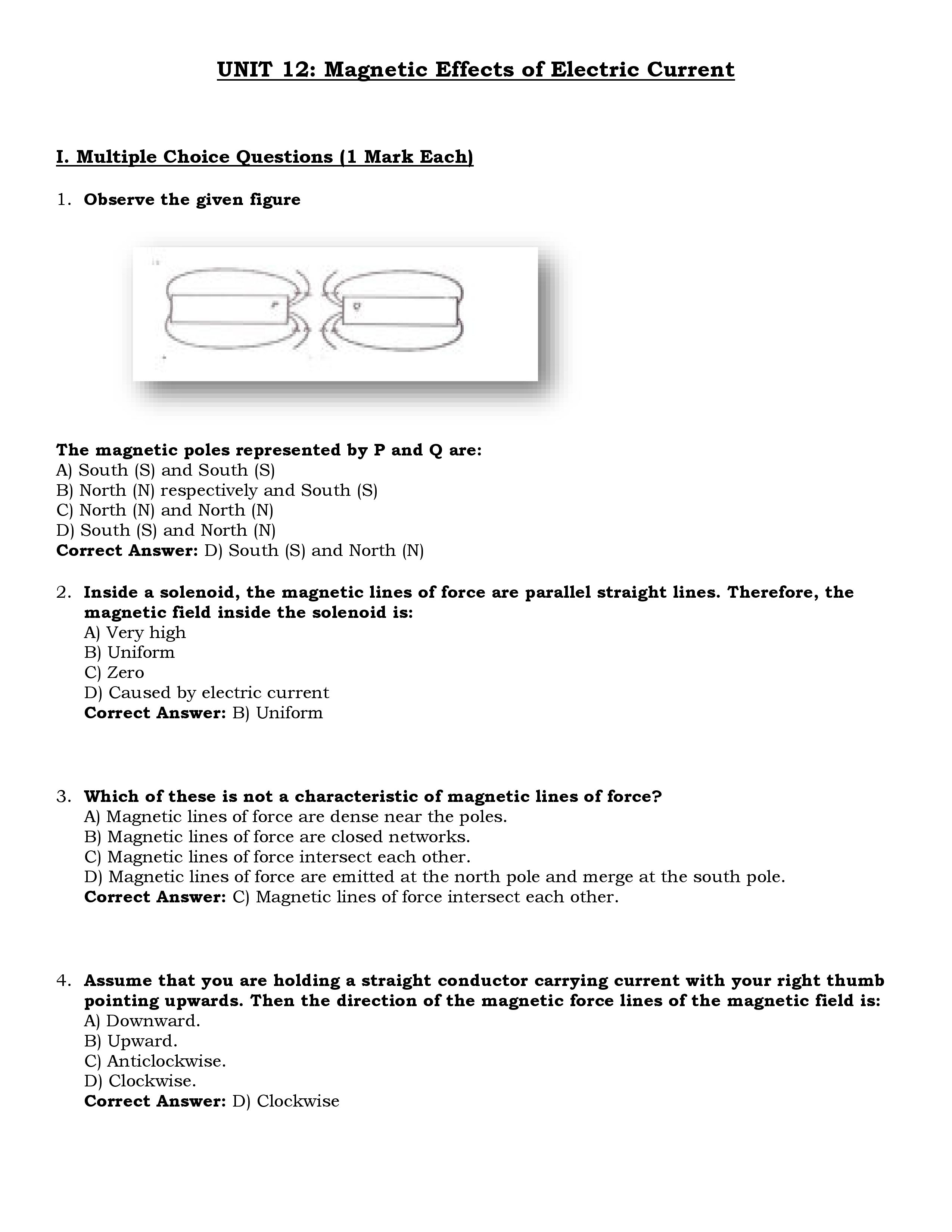
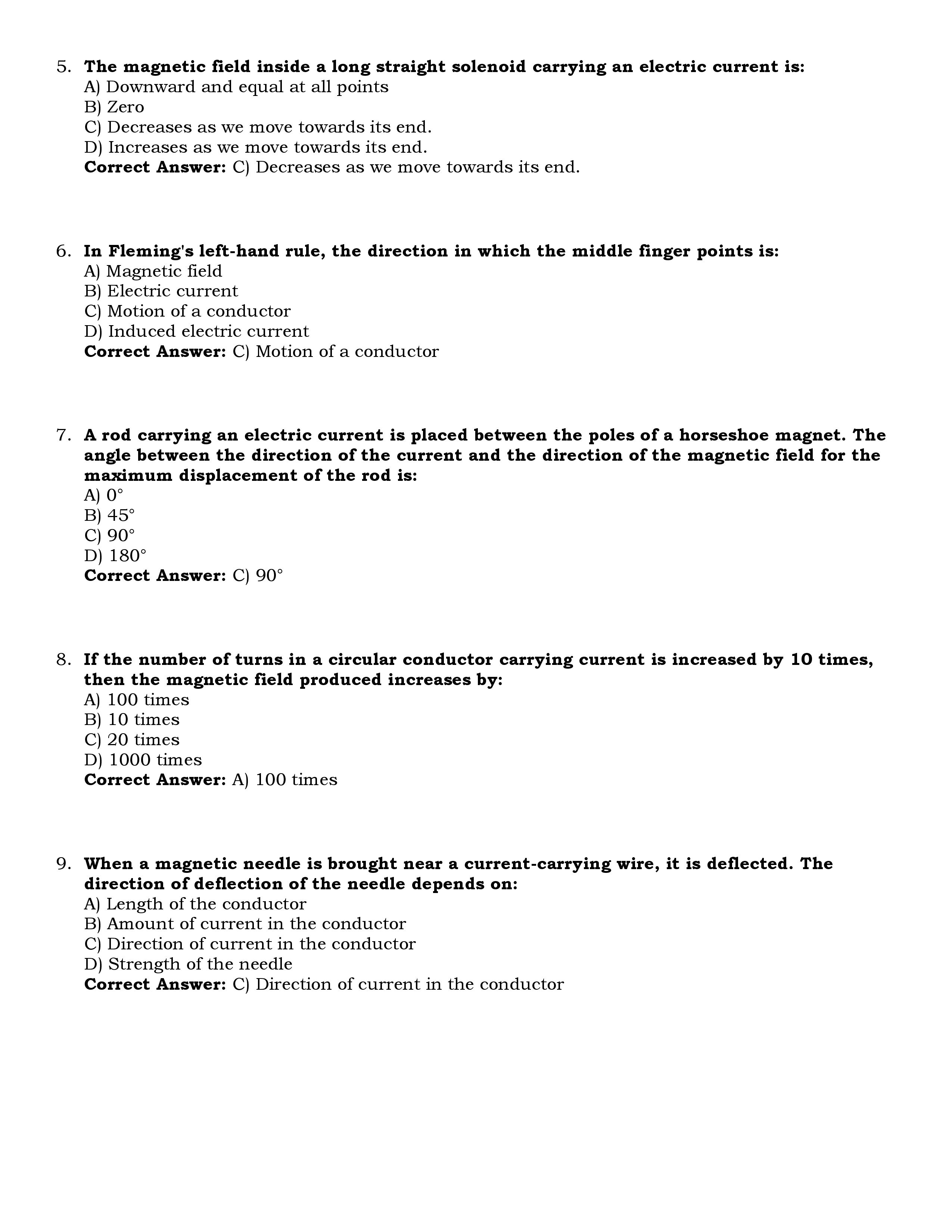
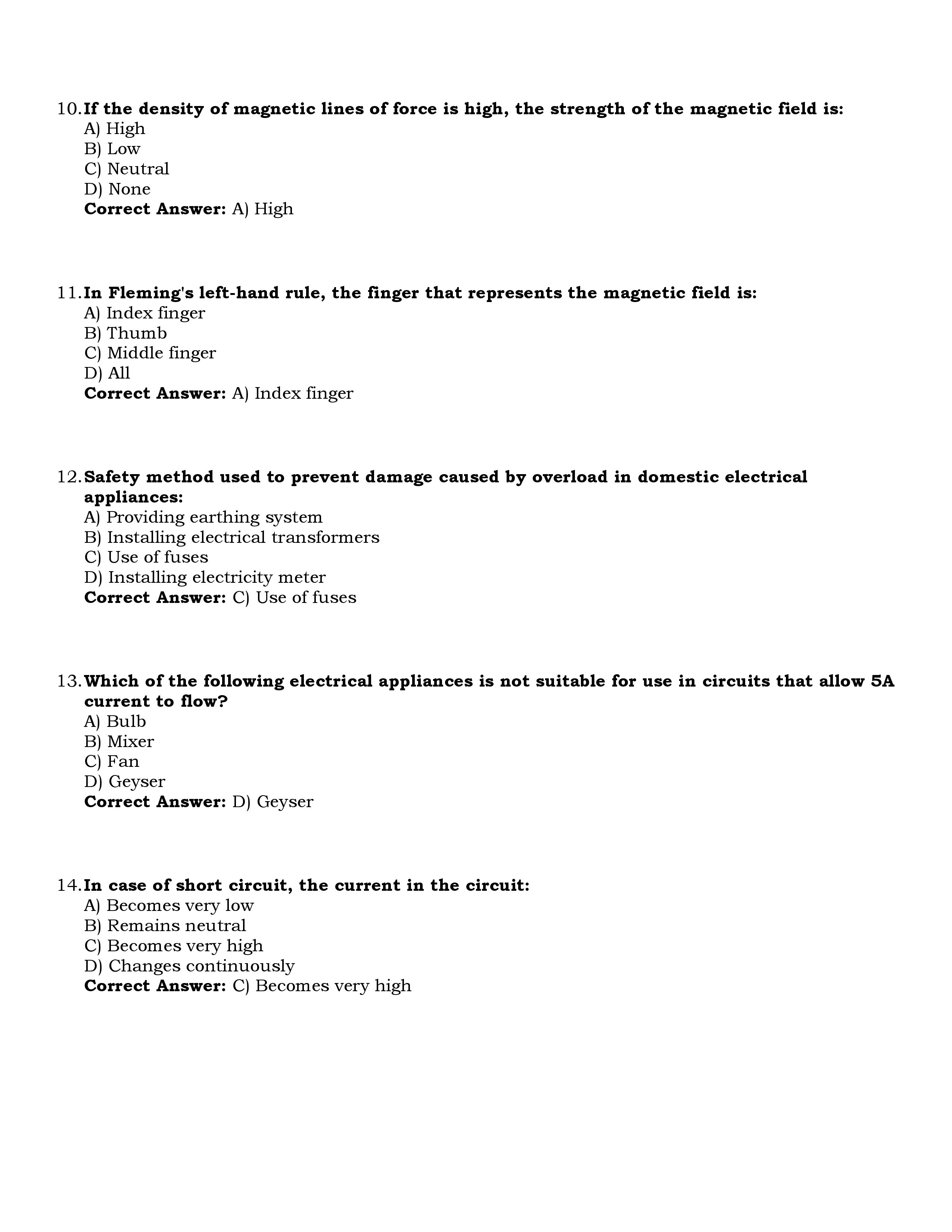
LBA- Lesson Based Solutions
Learning Points
- Magnetic field and magnetic lines of force
• Magnetic field due to a current carrying conductor
• Magnetic field due to current flowing in a straight conductor
• Right hand thumb rule
• Magnetic field due to current in a circular conductor
• Magnetic field due to current in a solenoid
• Force on a current carrying conductor in a magnetic field
• Household electrical circuits
• Weightage to difficulty level
Weightage According to Difficulty Level
|
Sl. No |
Difficulty Level |
Number of Questions |
Marks |
Percentage |
|
1 |
Easy |
15 |
22 |
30% |
|
2 |
Average |
23 |
36 |
50% |
|
3 |
Difficult |
10 |
14 |
20% |
I. Multiple Choice Questions(One Mark Questions)
-
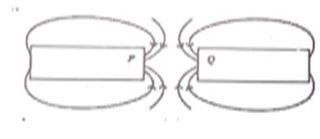
Observe the given figure. (Sept 2020)
The magnetic poles represented by P and Q are:
 A. South (S) and South (S)
B. North (N) respectively and South (S)
C. North (N) and North (N)
D. South (S) and North (N)
Answer: D – South (S) and North (N) -
Inside a solenoid, the magnetic lines of force are parallel straight lines. Therefore, the magnetic field inside the solenoid is (Mar 2021):
A. Very high
B. Uniform
C. Zero
D. Caused by electric current
Answer: B – Uniform -
Which of these is not a characteristic of magnetic lines of force? (Sup 2021)
A. Magnetic lines of force are dense near the poles
B. Magnetic lines of force are closed networks
C. Magnetic lines of force intersect each other
D. Magnetic lines of force are emitted at the north pole and merge at the south pole
Answer: C – Magnetic lines of force intersect each other -
Assume that you are holding a straight conductor carrying current with your right thumb pointing upwards. The direction of the magnetic field lines is (June 2023):
A. Downward
B. Upward
C. Anticlockwise
D. Clockwise
Answer: C – Anticlockwise -
The magnetic field inside a long straight solenoid carrying an electric current is (June 2024):
A. Uniform and equal at all points
B. Zero
C. Decreases towards the ends
D. Increases towards the ends
Answer: A – Uniform and equal at all points -
In Fleming’s left hand rule, the direction in which the middle finger points is (Aug 2024 / June 2025):
A. Magnetic field
B. Electric current
C. Motion of the conductor
D. Induced electric current
Answer: B – Electric current -
A rod carrying an electric current is placed between the poles of a horseshoe magnet. The angle between the direction of current and the magnetic field for maximum displacement of the rod is (March 2025):
A. 0°
B. 45°
C. 90°
D. 180°
Answer: C – 90° -
If the number of turns in a circular conductor carrying current is increased by 10 times, the magnetic field produced increases by (June 2025):
A. 100 times
B. 10 times
C. 20 times
D. 1000 times
Answer: B – 10 times -
When a magnetic needle is brought near a current carrying wire, it gets deflected. The direction of deflection depends on:
A. Length of the conductor
B. Amount of current in the conductor
C. Direction of current in the conductor
D. Strength of the needle
Answer: C – Direction of current in the conductor -
If the density of magnetic lines of force is high, the strength of the magnetic field is:
A. High
B. Low
C. Neutral
D. None
Answer: A – High -
In Fleming’s left hand rule, the finger that represents the magnetic field is:
A. Index finger
B. Thumb
C. Middle finger
D. All
Answer: A – Index finger -
Safety method used to prevent damage caused by overload in domestic electrical appliances:
A. Providing earthing system
B. Installing electrical transformers
C. Use of fuses
D. Installing electricity meter
Answer: C – Use of fuses -
Which of the following electrical appliances is not suitable for use in circuits that allow 5 A current to flow?
A. Bulb
B. Mixer
C. Fan
D. Geyser
Answer: D – Geyser -
In case of a short circuit, the current in the circuit:
A. Becomes very low
B. Remains neutral
C. Becomes very high
D. Changes continuously
Answer: C – Becomes very high -
The part where the magnetic force is maximum in a bar magnet is:
A. At the north end
B. At the south end
C. Between north and south
D. At both ends
Answer: D – At both ends -
Which of the following correctly describes the magnetic field around a long straight wire?
A. Concentric circular magnetic field lines around the wire
B. Straight lines parallel to the wire
C. Radial lines from the wire
D. Random lines
Answer: A – Concentric circular magnetic field lines around the wire -
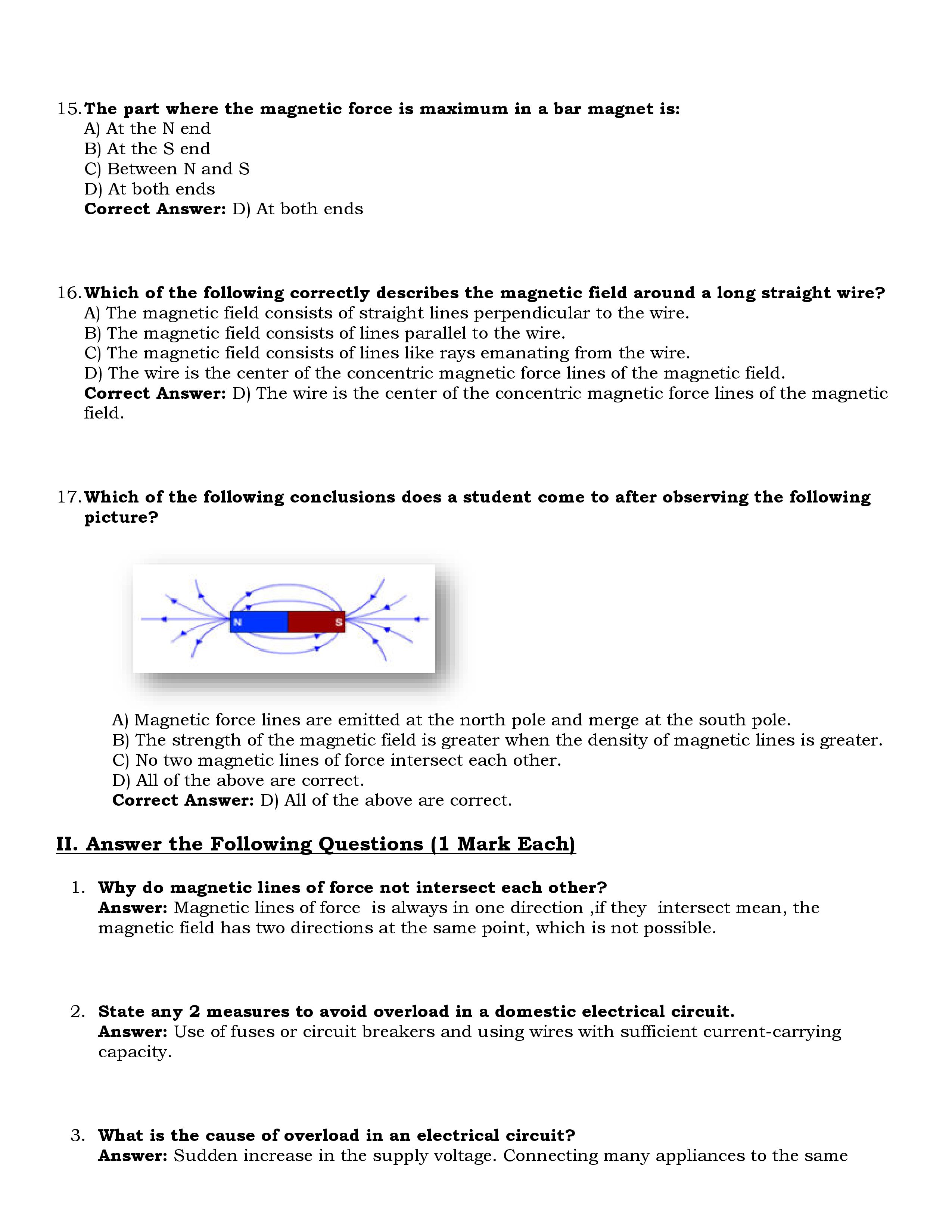
Which of the following conclusions can be drawn from the given picture?
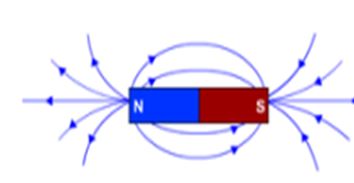 A. Magnetic lines of force are emitted at the north pole and merge at the south pole
B. Strength of magnetic field is greater where lines are denser
C. No two magnetic lines of force intersect
D. All of the above
Answer: D – All of the above
II. Answer the Following (One Mark Questions)
-
Why do magnetic lines of force not intersect each other?
Answer: Magnetic lines of force do not intersect because at any point the magnetic field has only one direction. If they intersected, it would show two directions at the same point, which is not possible. -
State any two measures to avoid overload in a domestic electrical circuit.
Answer:
1. Do not connect too many appliances to a single socket.
2. Use properly rated fuse or MCB in the circuit. -
What is the cause of overload in an electrical circuit?
Answer: Overload occurs when many appliances are connected to the same circuit and draw more current than the circuit can handle. -
What does the thumb indicate in the right hand thumb rule?
Answer: The thumb indicates the direction of electric current in the conductor. -
Write the characteristics of magnetic lines of force around a solenoid.
Answer:
1. Inside the solenoid, magnetic field lines are straight and parallel.
2. The magnetic field inside the solenoid is uniform.
3. The field pattern outside resembles that of a bar magnet. -
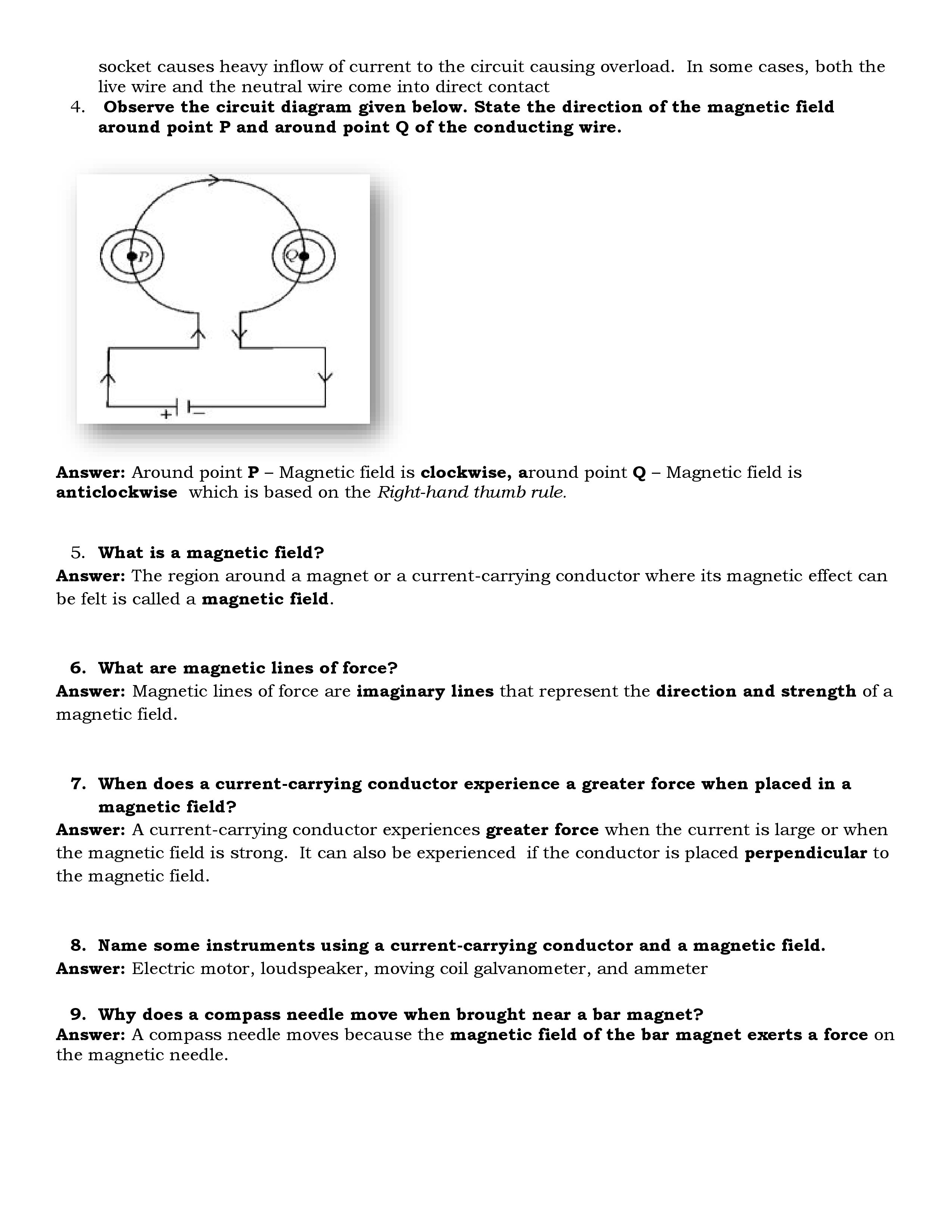
Observe the circuit diagram and state the direction of magnetic field at points P and Q.
Answer: The direction of the magnetic field at P and Q can be determined using the right hand thumb rule and depends on the direction of current shown in the diagram. -
What is a magnetic field?
Answer: A magnetic field is the region around a magnet or current carrying conductor where its magnetic force can be experienced. -
What are magnetic lines of force?
Answer: Magnetic lines of force are imaginary lines that represent the direction and strength of a magnetic field. -
When does a current carrying conductor experience greater force in a magnetic field?
Answer: A current carrying conductor experiences maximum force when it is placed perpendicular (90°) to the magnetic field. -
Name some instruments using a current carrying conductor and magnetic field.
Answer: Electric motor, loudspeaker, galvanometer and electric bell. -
Why does a compass needle move when brought near a bar magnet?
Answer: A compass needle moves because it is a small magnet and aligns itself with the magnetic field of the bar magnet. -
Draw magnetic lines of force around a bar magnet.
Answer: Magnetic lines of force emerge from the north pole and enter the south pole outside the magnet and form closed loops. -
List two methods of producing a magnetic field.
Answer:
1. By using a permanent magnet.
2. By passing electric current through a conductor.
III. Answer the Following (Two Mark Questions)
-
What are the causes of overload and short circuit in an electrical circuit?
Answer:
Overload occurs when many high-power appliances are connected to the same circuit and draw excessive current.
Short circuit occurs when live and neutral wires come into direct contact due to damaged insulation. -
State two properties of magnetic lines of force.
Answer:
1. Magnetic lines of force are closed continuous curves.
2. No two magnetic lines of force intersect each other. -
What are the reasons for overload in an electrical circuit?
Answer:
1. Using many electrical appliances at the same time.
2. Connecting high power appliances to a low-rated circuit. -
Why are electrical appliances with metal surface connected to earth wire?
Answer:
To prevent electric shock. The earth wire provides a low resistance path for leakage current to safely pass into the ground. -
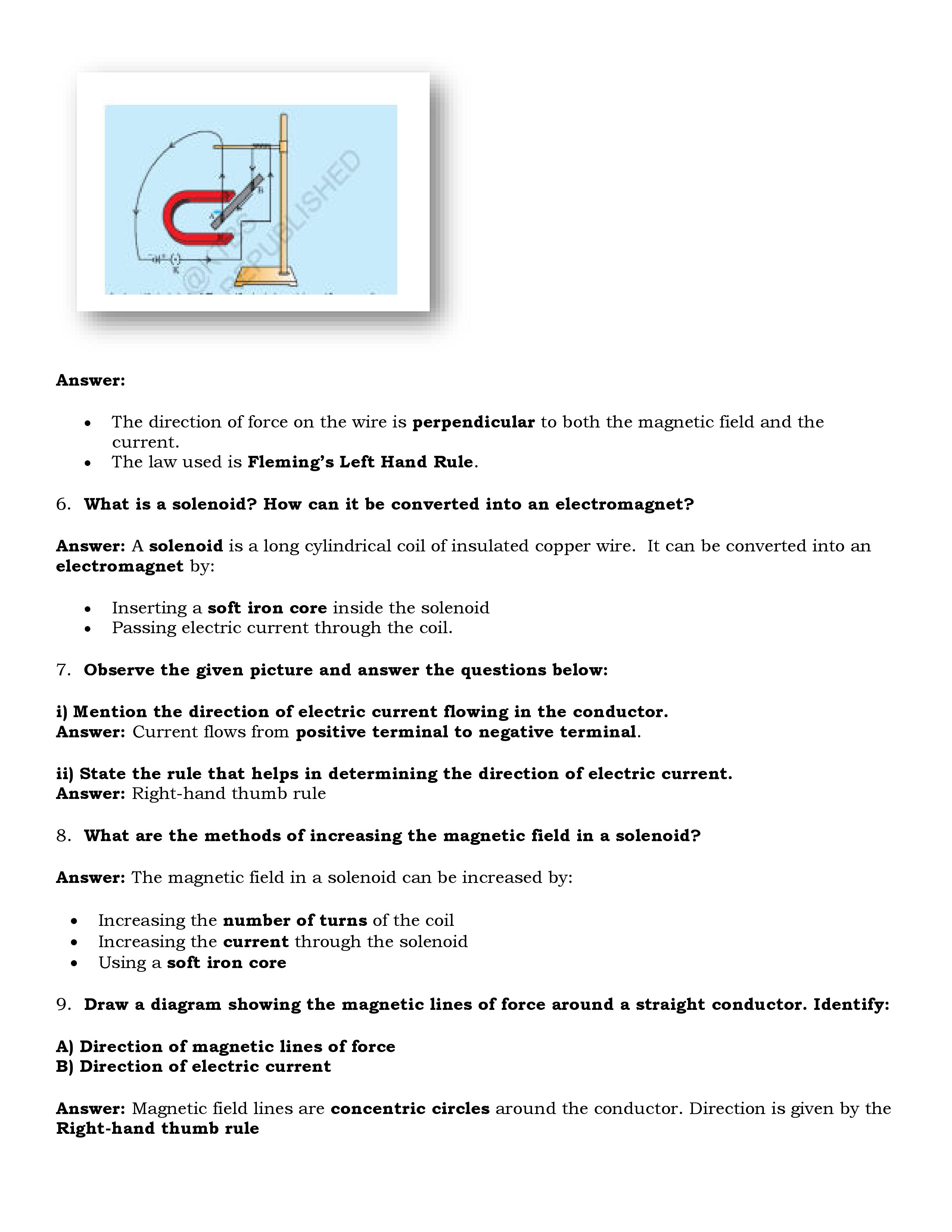
Observe the figure and state the direction of force on the current carrying conductor. Name the rule used.
 Answer:
The direction of force is perpendicular to both current and magnetic field and is determined using Fleming’s Left Hand Rule. -
What is a solenoid? How can it be converted into an electromagnet?
Answer:
A solenoid is a long cylindrical coil of insulated copper wire.
It can be converted into an electromagnet by inserting a soft iron core inside the solenoid and passing electric current through it. -
Observe the picture and answer:
i) Direction of electric current
ii) Rule used
Answer:
i) The direction of electric current is determined using the given diagram.
ii) The rule used is Fleming’s Left Hand Rule (or Right Hand Thumb Rule depending on the figure). -
What are the methods of increasing magnetic field in a solenoid?
Answer:
1. Increase the number of turns of the coil.
2. Increase the strength of current.
3. Insert a soft iron core inside the solenoid. -
Draw magnetic field around a straight conductor and identify directions.
Answer:
Magnetic field lines are concentric circles around the conductor.
The direction is given by the Right Hand Thumb Rule. -
List characteristics of magnetic field inside a solenoid.
Answer:
1. Magnetic field lines are parallel and straight.
2. Magnetic field inside the solenoid is uniform.
3. It behaves like a bar magnet with North and South poles. -
A microwave oven of 5 A and 2 kW is used in a domestic circuit. What happens?
Answer:
If connected to a 5 A circuit, it may draw excess current and cause overload, blowing the fuse or tripping the MCB. -
Write rules to determine direction of:
A) Magnetic field
B) Force on conductor
Answer:
A) Right Hand Thumb Rule – It gives the direction of magnetic field around a current carrying conductor.
B) Fleming’s Left Hand Rule – It gives the direction of force on a current carrying conductor in a magnetic field. -
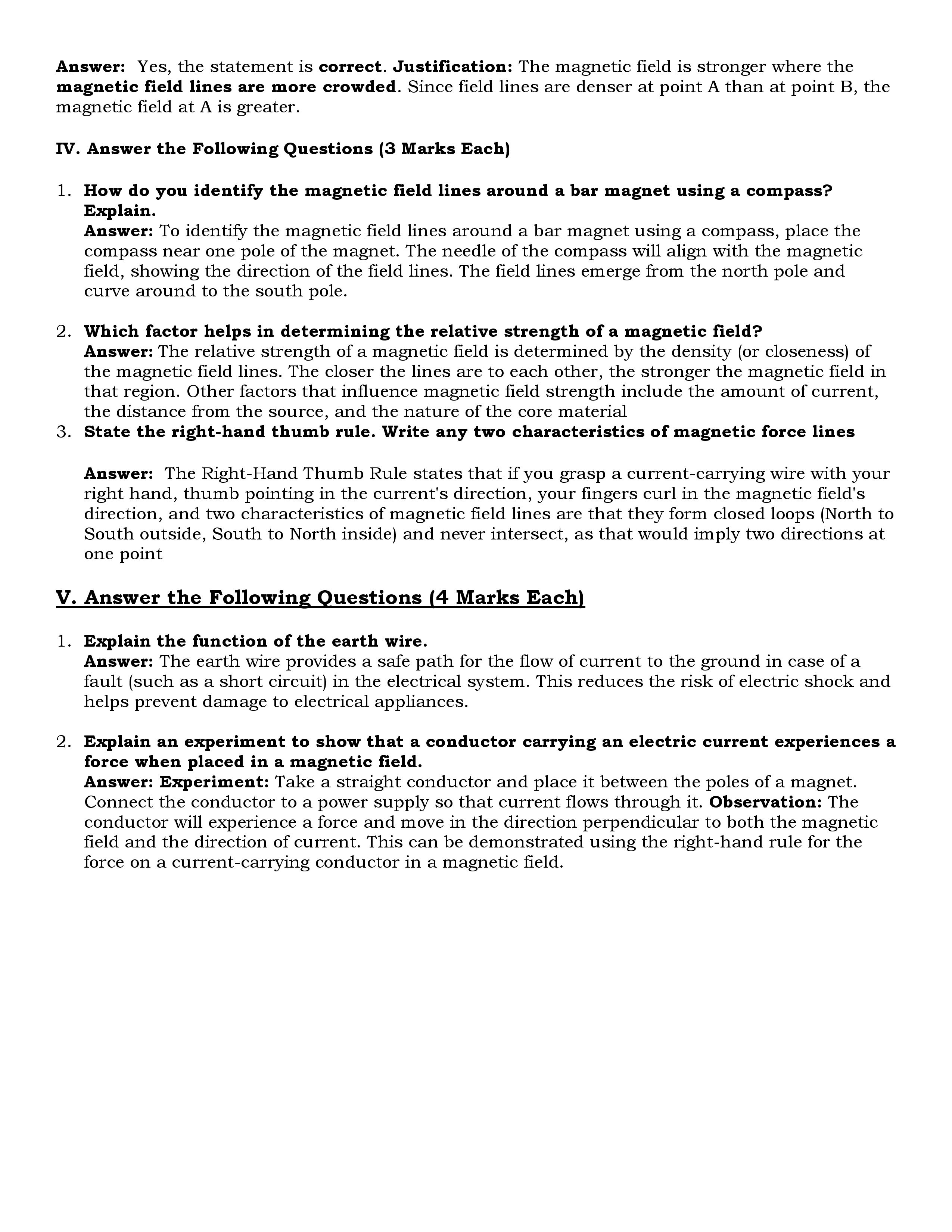
Identify poles P and Q with justification and compare magnetic field strength at points A and B shown in figure.
Answer:
Magnetic field lines emerge from the North pole and enter the South pole. Using this, poles P and Q can be identified.
Magnetic field strength is greater at the point where magnetic field lines are closer (denser).
IV. Answer the Following (Three Mark Questions)
-
Explain the causes and effects of short circuit in a domestic electrical circuit.
Answer:
Causes:
1. Direct contact between live and neutral wires.
2. Damaged or worn-out insulation.
Effects:
1. Sudden increase in current flow.
2. Heating of wires which may cause fire.
3. Fuse may blow or MCB may trip. -
How do you identify magnetic field lines around a bar magnet using a compass?
Answer:
1. Place a bar magnet under a sheet of paper.
2. Keep a compass near the magnet and mark the direction of the needle.
3. Move the compass step by step and mark the direction at different points.
4. Join the points to obtain magnetic field lines. -
a) Factors determining strength of magnetic field
b) State right hand thumb rule and two characteristics of magnetic field lines
Answer:
a) Factors determining strength of magnetic field:
• Strength of current
• Distance from the conductor
• Number of turns in the coil
b) Right Hand Thumb Rule:
If a current carrying conductor is held in the right hand such that the thumb points in the direction of current, the curled fingers show the direction of magnetic field.
Two characteristics of magnetic field lines:
1. They form closed continuous curves.
2. They never intersect each other.
V. Answer the Following (Four Mark Questions)
-
Explain the function of the earth wire.
Answer:
A. The earth wire is connected to the metal body of appliances.
B. It provides a low resistance path for leakage current.
C. Prevents electric shock by carrying current safely to the ground.
D. Ensures safety of the user. -
Explain an experiment to show that a current carrying conductor experiences a force in a magnetic field.
Answer:
A. Place a straight conductor between the poles of a horseshoe magnet.
B. Connect it to a battery to allow current to pass.
C. The conductor moves when current flows.
4. Reversing current reverses direction of motion.
D. This proves that a current carrying conductor experiences force in a magnetic field.
E. Direction is given by Fleming’s Left Hand Rule.