Coal and Petroleum Notes
Energy
Energy is the ability to do work or cause change. It exists in many forms and is essential to all physical and biological processes. From powering our homes and vehicles to enabling growth in plants and movement in animals, energy is central to life and technology. Energy is derived from many natural sources. Energy can neither be created nor be destroyed, however it can be transformed from one form to another. For example, in a diesel generator THE fuel energy is converted into electrical energy. Microphone, sound energy is converted into electrical energy. The different types of energy are:
1. Wind energy
2. Sound energy
3. Electrical energy
4. Mechanical energy
5. Chemical energy
6. Thermal energy
7. Nuclear energy
8. Solar energy
Sources of energy

Inexhaustible or renewable sources :
These are available in plenty and can never be depleted by human activities . the table below explains some inexhaustible sources in detail.
|
Source |
Description |
Advantages |
Disadvantages |
|
Solar Energy |
Energy from the sun, captured using solar panels or solar thermal collectors. |
Clean, abundant, low operating costs, sustainable. |
Depends on sunlight, high initial cost, needs storage or backup. |
|
Wind Energy |
Energy from moving air, captured by wind turbines. |
Clean, renewable, low operating cost, efficient in windy areas. |
Intermittent, noisy, can affect wildlife and scenery. |
|
Hydropower |
Energy from flowing or falling water (e.g., dams). |
Reliable, renewable, can store energy (reservoirs). |
Affects aquatic ecosystems, large land use, expensive infrastructure. |
|
Biomass |
Energy from organic matter like wood, crops, or waste. |
Uses waste, renewable, carbon-neutral if managed sustainably. |
Can cause pollution, land use conflicts, not always efficient. |
|
Geothermal |
Heat from inside the Earth, used for electricity or heating. |
Low emissions, reliable, small land footprint. |
Limited to specific regions, high installation cost. |
|
Tidal & Wave |
Energy from ocean tides and waves. |
Predictable, clean, huge potential. |
High cost, environmental impact, limited locations. |
Exhaustible Resources:
These are limited in nature and can be exhausted when used in excess. They include fossil fuels such as , coal, and petroleum, and natural sources like forests, wildlife, minerals, and natural gas. 40% of fossil energy is used by the industries, 24% of energy is used by the Transportation sector, 6% of energy is used by farms and 30% of energy is used for domestic and other purposes. However, growing concerns about environmental damage and climate change are driving a shift towards renewable energy alternatives. Fossil fuels can cause pollution, Greenhouse gases, Acid rain effect. Nuclear fuels such as Uranium, and thorium can lead to radioactive waste, and risk of nuclear accident.
Coal Formation:
 Coal is formed from plants that lived millions of years ago in swampy forests. The process of coal formation is called
carbonization happens infour main stages:
Coal is formed from plants that lived millions of years ago in swampy forests. The process of coal formation is called
carbonization happens infour main stages:
Stage-2 Burial and Compression lack of oxygen , the peat didn’t rot completely. The pressure compressed the peat into a denser form.
Stage-3 Heat and Pressure Over Millions of Years. As more layers piled up, the heat and pressure increased. This causes chemical and physical changes. The carbon content gradually increases which turns peat into lignite. The ignite is then turns into bituminous coal, and finally anthracite (the hardest coal). is formed
Stage-4 Formation of CoalThe final result is coal, a black, hard fossil fuel rich in carbon. It took millions of years for coal to form.
Petroleum Formation:
Petroleum (also known as crude oil) is a fossil fuel formed from the remains of marine organisms like plankton and algae that lived millions of years ago in ancient seas. The formation of petroleum happens in four phases as explained below:
-
Deposition of Dead Organisms:
Tiny sea plants and animals died and settled on the seabed. These dead remains mixed with mud, sand, and clay. -
Formation of Sedimentary Layers:
Over millions of years, sediments like sand, silt, and clay piled up, compressing the remains under great pressure. The absence of oxygen prevented complete decay. -
Transformation into Petroleum:
With time, intense heat and pressure transformed the buried organic matter into petroleum and natural gas through slow chemical processes. -
Accumulation in Reservoirs:
The oil and gas migrated upward through porous rocks but got trapped beneath non-porous rocks called cap rocks, forming oil reservoirs.
Types of coal
|
Type of Coal |
Carbon Content |
Usage |
Availability |
|
Peat |
Low |
Least efficient, partially decayed plant material |
plentiful |
|
Lignite |
Higher than Peat |
Used mainly for electricity generation |
Relatively abundant |
|
Bituminous Coal |
Higher than Lignite |
Used for energy and steel production |
Widely available |
|
Anthracite |
Highest |
Burns the cleanest and produces the most energy |
Less abundant, expensive to mine |
Coal Tar
Coal Tar is a thick, dark liquid . It is a byproduct obtained during the carbonization of coal in coke ovens. It is rich in aromatic hydrocarbons and has been used in a wide variety of industrial and medicinal applications. It is produced when bituminous coal is heated to high temperatures (about 1000 degree celsius) in the absence of air where the coal decomposes into coke, coal gas, and coal tar.
Uses of coal tar
|
Application Area |
Purpose |
|
Road Construction |
As bituminous binder in asphalt pavements (after refining to bitumen) |
|
Chemical Industry |
Source of phenol, naphthalene , cresols, and other intermediates |
|
Pharmaceuticals & Cosmetics |
Active ingredient in medicinal shampoos, soaps, and creams for skin conditions (e.g., psoriasis) |
|
Wood Preservation |
As a component of creosote for protecting wooden railway sleepers and telephone poles |
|
Dyes & Pigments |
Raw material for manufacture of azo dyes, aniline dyes, and pigments |
Types of Petroleum Products
Petroleum, also known as crude oil, is refined into various products through a process called fractional distillation. Some of the key petroleum products include:
|
Product |
Boiling-Point Range (degree celsius) |
Common Uses |
|
Liquefied Petroleum Gas (LPG) |
0 degree celsius to 30 degree celsius |
Cooking fuel, heating, automotive (auto gas) |
|
Gasoline (Petrol) |
30 degree celsius 200 to degree celsius |
Spark-ignition (petrol) engines in cars, motorcycles |
|
Kerosene (Paraffin) |
150 degree celsius to 275 degree celsius |
Jet fuel (aviation kerosene), domestic heating, lamps |
|
Diesel Oil |
200 degree celsius to 350 degree celsius |
Compression-ignition (diesel) engines, generators |
|
Fuel Oil |
250 degree celsiusto 400+ degree celsius |
Ship bunkers, power-plant boilers, industrial heating |
|
Lubricating Oils |
> 300 |
Engine oils, hydraulic fluids, gear oils |
|
Bitumen (Asphalt) |
> 525 |
Road surfacing, roofing, waterproofing |
|
Petrochemical Feed stocks |
Various fractions |
Manufacture of plastics, synthetic rubber, chemicals |
Uses of Coal and Petroleum
Coal and petroleum are integral to modern life due to their extensive applications across various industries.
|
Uses of Coal |
Uses of Petroleum |
|
Electricity Generation |
Transportation (Gasoline, Diesel, Jet Fuel) |
|
Steel Production |
Heating (Kerosene, Diesel) |
|
Cement Industry |
Industrial Use (Chemicals, Plastics) |
|
Industrial Heating |
Power Generation (Diesel for electricity) |
Natural Gas
Natural Gas is a fossil fuel composed primarily of methane, formed deep beneath the surface of the Eart.It serves as a versatile energy source for heating, electricity generation, and industrial processes. Below is a detailed, plain-language overview. Main Component of natural gas is Methane (CH4) which is typically 70 to 90% of the volume and Other Components include ; ethane (C2H6), propane (C3H8), butane (C4H10), and small amounts of nitrogen, carbon dioxide, hydrogen sulfide, and trace gases.
Formation of natural gas
Tiny marine organisms (plankton, algae) died and settled on ancient seabeds to create organic matter Layers of mud, sand, and clay buried this organic remains to make Sediments. Heat & Pressure Transformation , (50 to 150 degree celsius) over millions of years and pressure brakese down the complex organic molecules into simpler hydrocarbons which intially forms oil and then gas at greater depths and higher temperatures. The lighter gas molecules migrated upward through porous rock until trapped beneath impermeable caprocks, creating gas reservoirs.
Uses of Natural Gas
It is used in space heating, water heating, cooking, and clothes drying. It also helps in electricity Generation through gas-fired power plants . In industries, it is used as feedstock for petrochemicals (e.g., plastics, fertilizers), process heat, and hydrogen production. Compressed Natural Gas (CNG) and Liquefied Natural Gas (LNG) is used as a fuel for vehicles and ships.
Advantages of Natural Gas
- Lower CO2Emissions: Burns cleaner than coal or oil, emitting about 50 to 60% less CO2 per unit of energy.
- High Efficiency: Modern combined-cycle plants can exceed 60% thermal efficiency.
- Abundant Supply: Vast shale and tight-gas formations have expanded recoverable reserves.
- Versatility: Used across sectors like power, heat, industry, and transport.
Energy crisis
Exhaustible natural resources, like fossil fuels , forests, and minerals, are at risk to get over at anytime. These fuels, although, take millions of years to form their reserves may last only a few hundred years. moreover, consumption of fossil fuels causes air pollution and contributes to global warming due to carbon deposits. Thus, it is essential to use them cautiously to save the environment and ensure their availability for the future.
Methods to conserve energy :
|
No. |
Method |
Description |
|
1 |
Switch off when not in use |
Turn off lights, fans, TVs, and appliances when not needed |
|
2 |
Use LED bulbs |
Replace incandescent bulbs with energy-saving LED lights |
|
3 |
Opt for public transport |
Reduce fuel use by using buses, trains, or carpooling |
|
4 |
Use energy-efficient appliances |
Choose 5-star rated appliances (like ACs, refrigerators, washing machines) |
|
5 |
Fix electrical leaks |
Repair faulty wiring and avoid energy loss through short circuits |
|
6 |
Improve home insulation |
Proper sealing of doors/windows reduces the need for extra cooling/heating |
|
7 |
Use solar energy |
Install solar panels or solar water heaters |
|
8 |
Prefer manual tools |
Use hand tools instead of electric ones when possible |
|
9 |
Use pressure cookers |
Cooks food faster and saves LPG or electricity |
|
10 |
Spread awareness |
Educate others about the importance of energy conservation |
Question Answers
Question 1.What is the advantages of using CNG and LPG as fuels.
Answer:The advantages of using CNG and LPG as fuels are:
- It burns without producing any smoke.
- It burns completely and does not leave behind any residue.
- It can be easily ignited.
- It can be transported to distant places through pipelines.
- It has a high heat value.
Question 2.Name the petroleum product used for surfacing roads.
Answer: The petroleum product used for surfacing roads is bitumen. Bitumen is a thick, black, sticky substance obtained as a residue during the distillation of crude oil. It is commonly used in road construction for binding the surface materials together.
Question 3.Describe how coal is formed from dead vegetation. What is this process called?
Answer:About 300 million years ago, the earth had dense forests in low-lying wetland areas. Due to natural processes, like flooding, these forests got buried under the soil. As more soil deposited over them, they were compressed. The temperature also rose as they sank deeper and deeper. Under high pressure and high temperature, dead plants got slowly converted to coal. This process is called carbonization.
Question 4. Fill in the blanks (Answers)
1. coal, petroleum, and natural gas
2. refining
3. CNG
5. Tick True/False against the following statements.
- Fossil fuels can be made in the laboratory.
- CNG is a more polluting fuel than petrol.
- Coke is the most pure form of carbon.
- Coal tar is a mixture of various sub.
- False
- False
- True
- True
- False
Answer:Fossil fuels are exhaustible natural resources because they are limited and it takes millions of years to form fossil fuels.
Question 7.Describe characteristics and uses of coke.
Answer:Coke is a tough porous black substance. It is almost a pure form of carbon.
Uses of Coke:
1. Coke is used as a domestic fuel.
2. Coke is used as a reducing agent in metallurgical processes.
3. Coke is used for producing fuel gases such as water-gas (CO + H2) and produces gas (CO + N2).
4. Coke is used for producing carbides such as calcium carbide, silicon carbide, and aluminium carbide.
Question 8.Explain the process of formation of petroleum.
Answer:Petroleum was formed from organisms living in the sea. When these organisms died, then their bodies settled at the bottom of the sea and get covered with layers of sand and clay. Over millions of years, the dead organisms got transformed into petroleum oil under the condition of the absence of air, high temperature, and high pressure.
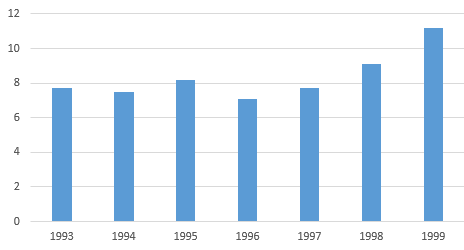
Question 9.The following table shows the total/power shortage in India from 1991-1997. Show these data in the form of a graph. Plot shortage percentage for the years on the Y-axis and the year on the X-axis.
| Sl. No. | Year | Shortage (%) |
|---|---|---|
| 1 | 1993 | 7.7 |
| 2 | 1994 | 7.5 |
| 3 | 1995 | 8.2 |
| 4 | 1996 | 7.1 |
| 5 | 1997 | 7.7 |
| 6 | 1998 | 9.1 |
| 7 | 1999 | 11.2 |
Additional Questions
Multiple Choice Questions
-
Which of the following is a fossil fuel?
- a) Wood
- b) Coal ✅
- c) Sunlight
- d) Wind
-
The process of converting dead vegetation into coal is called:
- a) Distillation
- b) Carbonization ✅
- c) Refining
- d) Fractionation
-
What is the main component of coal?
- a) Hydrogen
- b) Oxygen
- c) Carbon ✅
- d) Nitrogen
-
Which of the following is a product of coal and used as a fuel?
- a) Coal tar
- b) Coke
- c) Coal gas
- d) All of the above ✅
-
What is the term for the process of separating the different components of petroleum?
- a) Carbonization
- b) Refining ✅
- c) Distillation
- d) Fractionation
✍️ Short Answer Questions
- What are fossil fuels? Give examples.
Fossil fuels are formed from the remains of dead plants and animals buried underground for millions of years. Examples: Coal, petroleum, and natural gas.
- Explain the formation of coal.
Millions of years ago, dead plants in swamps were buried under soil. Heat and pressure transformed them into coal.
- What are the uses of coal?
Used in power plants, industries, and as raw material in manufacturing.
- What is petroleum?
Petroleum is a dark, oily liquid underground. It contains hydrocarbons and other compounds.
- How is petroleum formed?
Formed from marine organisms buried at the seabed. Heat and pressure over time converted them into petroleum.
- What are the uses of petroleum?
Used as fuel in vehicles, for heating, and to make plastics, lubricants, etc.
- What is CNG?
Compressed Natural Gas – a clean fuel used in vehicles and industry.
- What is LPG?
Liquified Petroleum Gas – a flammable gas used in homes and vehicles.
- Why are fossil fuels called exhaustible resources?
They are limited and take millions of years to form, but are used rapidly.
- What are the harmful effects of burning fossil fuels?
Releases harmful gases like CO₂, causing air pollution and global warming.
📘 Long Answer Questions
- Describe the process of fractional distillation of petroleum.
Petroleum is heated and vaporized. The vapors pass through a fractionating column. Components with high boiling points condense at the bottom; those with low boiling points condense at the top.
- What are petrochemicals? Give examples.
Petrochemicals are chemicals derived from petroleum or natural gas. Examples: Plastics, detergents, fertilizers, synthetic fibers.