Carbon and Carbon Compounds
Take the QuizCarbon is a fascinating element that forms the backbone of life on Earth. It is unique in its ability to form millions of compounds, more than any other element in the periodic table. This extraordinary property arises from two main reasons: catenation and the tetravalency. Catenation is the ability of carbon atoms to bond with other carbon atoms forming long chains, branched structures, and rings. Tetravalency means carbon has four valence electrons, allowing it to form four strong covalent bonds with a variety of elements, including hydrogen, oxygen, nitrogen, and other carbon atoms. Because of these characteristics, carbon compounds range from simple molecules like methane (CH4) to complex ones like DNA, proteins, and synthetic polymers. Carbon exists in nature in both elemental and compound forms:Elemental forms include diamond,graphite, and fullerenes, each having different physical properties due to different atomic arrangements.Compounds of carbon include a vast array of organic compounds such as alcohols, acids, hydrocarbons, detergents, medicines, plastics, and fuels. This chapter explores the types of carbon compounds, their bonding nature, chemical reactions, nomenclature, and daily-life applications, helping us understand the central role carbon plays in chemistry and life itself.
Why is Carbon a Versatile Element?
Carbon is called a versatile element because of its remarkable ability to form a wide variety of compounds. This versatility is the reason why carbon forms the basis of all known life. The key factors responsible for its versatility include:
1. Catenation
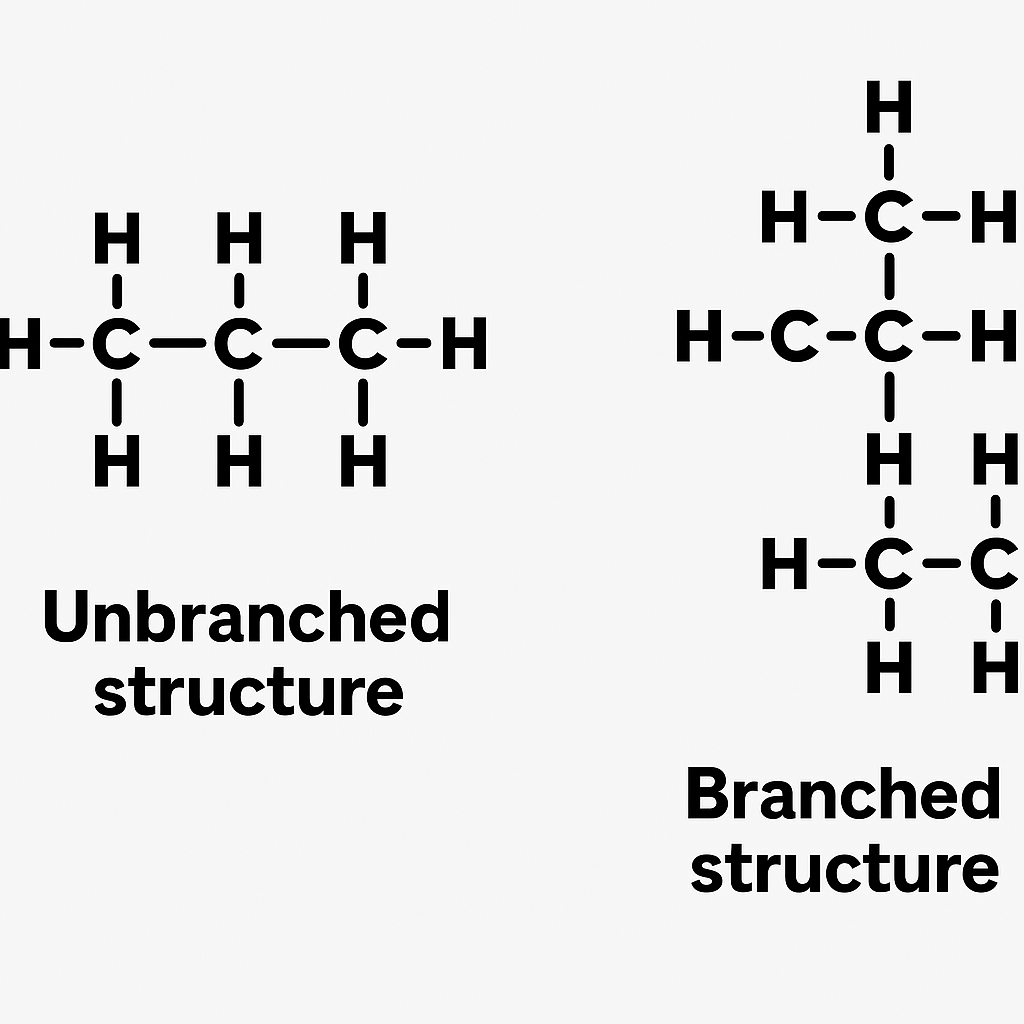
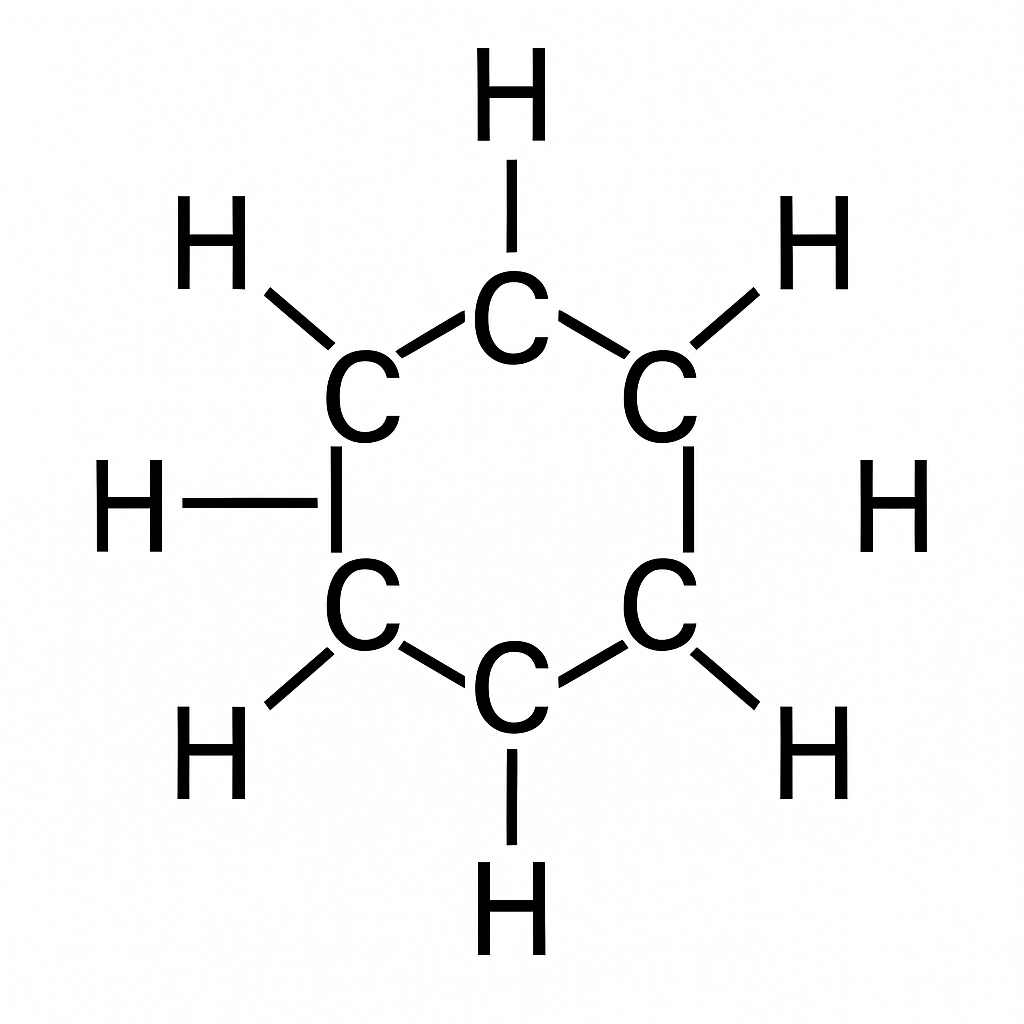
- Carbon atoms can bond with other carbon atoms to form long chains, branched structures, and rings.
- This property is known as catenation.
- These structures can be straight, branched, or cyclic, and can contain single, double, or triple bonds.
- Examples: Propane (C3H8), Butene (C4H8), Benzene (C6H6)
2. Tetravalency
- Carbon has 4 valence electrons and needs 4 more to complete its octet.
- It achieves this by forming 4 covalent bonds with other atoms (hydrogen, oxygen, nitrogen, halogens, etc.).
- This allows carbon to form stable compounds with a variety of elements.
- Example: CH4 (Methane), where carbon forms 4 single covalent bonds with hydrogen atoms.
3. Formation of Multiple Bonds
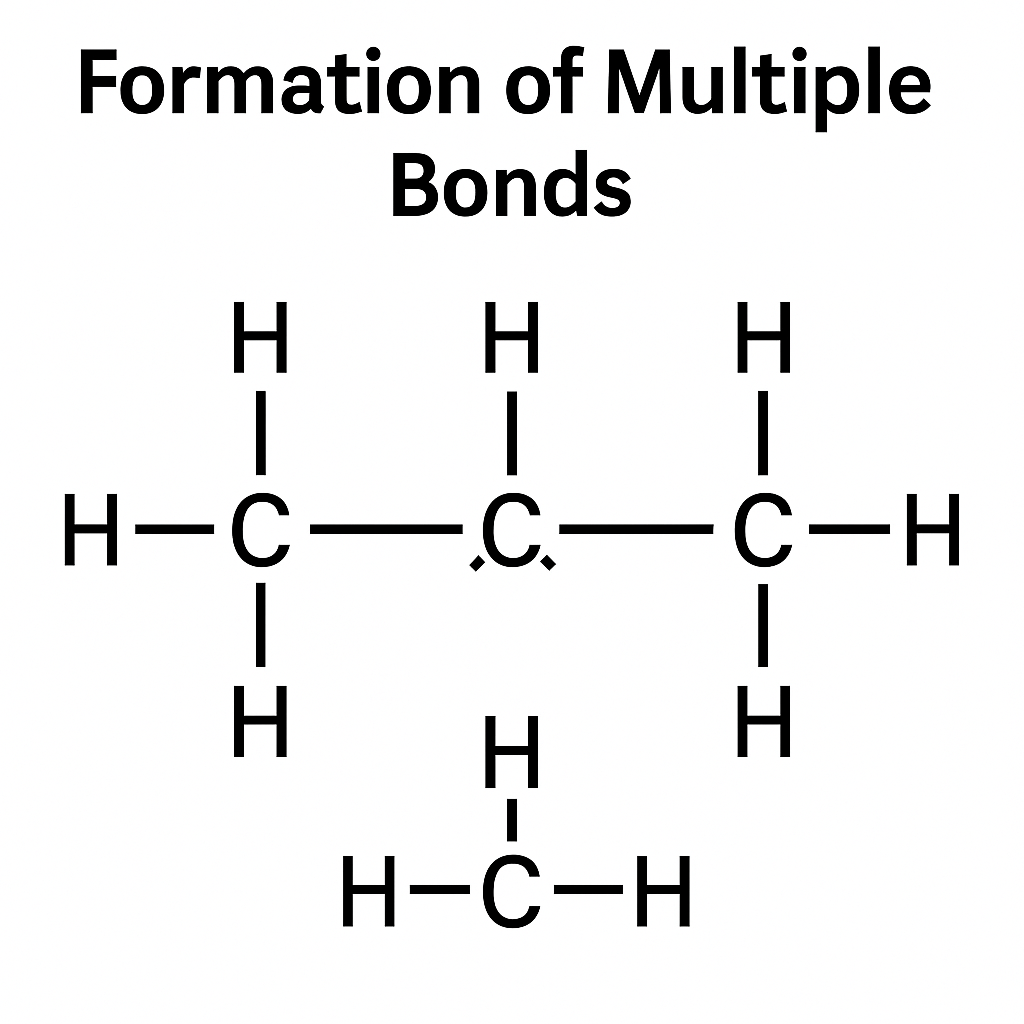
- Carbon can form single, double, and triple bonds with other atoms.
- This enhances its ability to create a wide range of compounds with different chemical and physical properties.
- Examples: CH4 (single bonds), C2H4 (double bond), C2H2 (triple bond)
4. Small Atomic Size
- Due to its small atomic radius, carbon forms strong covalent bonds.
- This contributes to the stability of carbon compounds, making them long-lasting and non-reactive under mild conditions.
5. Ability to Bond with Different Elements
- Carbon can combine with hydrogen, oxygen, nitrogen, sulfur, halogens, phosphorus, and many more elements.
- This makes it capable of forming a wide variety of functional groups like alcohols, acids, aldehydes, ketones, etc.
Because of all these properties, carbon forms more compounds than any other element — over 10 million and counting. Its versatility makes it central to the study of organic chemistry and life sciences.
Carbon in our daily life
Carbon compounds are essential to our daily lives and contribute to nearly every aspect of modern society. In the food we consume, compounds like starch, sugar, fats, proteins, and vitamins provide the energy and nutrients necessary for growth and health. Fuels such as wood, coal, alcohol, and petrol are carbon-based and serve as primary sources of energy for cooking, heating, transportation, and industry. In our households and industries, everyday products like paper, soap, cosmetics, oils, and paints are all composed of organic (carbon-containing) substances, underlining their commercial significance. Textile fabrics, including both natural fibers such as cotton, wool, silk, and linen, as well as synthetic fibers like rayon and nylon, are also made from carbon-rich materials. In medicine, carbon compounds form the basis of many crucial drugs and disinfectants, such as penicillin, quinine, aspirin, and sulpha drugs, which help fight diseases and infections. Some natural toxins like opium and strychnine, although dangerous, are carbon compounds with medicinal origins and have been historically used in small doses. The pleasant scents in perfumes such as vanillin and camphor are derived from organic compounds, adding fragrance to personal care items and surroundings. Explosives like nitroglycerine, dynamite, picric acid, and TNT, which are crucial in mining, construction, and defense, are also based on carbon chemistry. Additionally, dyes such as indigo, congo red, and malachite green are carbon compounds widely used in the textile and art industries. Finally, in warfare, some harmful carbon compounds are used to produce war gases like mustard gas, chloropicrin, and lewisite. Overall, the presence of carbon compounds is deeply woven into our daily lives, serving purposes ranging from nutrition and clothing to medicine, energy, and technology.
Carbon Uses Table
| Category | Examples | Role/Use |
|---|---|---|
| Food | Starch, Sugar, Fats, Proteins, Vitamins | Provide energy and nutrients essential for growth and health |
| Fuels | Wood, Coal, Alcohol, Petrol | Main sources of energy for cooking, heating, transport, and industry |
| Household & Industrial Products | Paper, Soap, Cosmetics, Oils, Paints | Common carbon-based materials for daily and industrial use |
| Textiles | Cotton, Wool, Silk, Linen, Rayon, Nylon | Natural and synthetic fibers used in clothing and fabrics |
| Medicines | Penicillin, Quinine, Aspirin, Sulpha drugs | Used to treat infections and diseases |
| Natural Toxins (Medicinal use) | Opium, Strychnine | Historically used in small doses for medical purposes |
| Fragrances | Vanillin, Camphor | Used in perfumes and aromatic products |
| Explosives | Nitroglycerine, TNT, Picric acid, Dynamite | Used in mining, construction, and defense applications |
| Dyes | Indigo, Congo red, Malachite green | Used in textiles, printing, and art industries |
| Warfare | Mustard gas, Chloropicrin, Lewisite | Carbon-based war gases used in defense strategies |
Covalent Bonding in Carbon Compounds
Covalent bonding is a type of chemical bonding where atoms share electrons to achieve a stable electronic configuration. Carbon, with four valence electrons, needs four more to complete its octet. It achieves this by forming four covalent bonds with other atoms such as hydrogen, oxygen, nitrogen, or other carbon atoms. Unlike ionic compounds where electrons are transferred, in covalent compounds, electrons are shared between atoms. This type of bonding leads to the formation of molecules rather than ions.
For example:
- Methane (CH4): Carbon forms four single covalent bonds with four hydrogen atoms.
- Ethene (C2H4): Carbon atoms share two electrons between them (double bond) and form single bonds with hydrogen atoms.
- Ethyne (C2H2): Carbon atoms share three electrons (triple bond) and bond with hydrogen atoms.
Covalent compounds usually have the following properties:
- Low melting and boiling points
- Do not conduct electricity (as there are no free ions)
- Are usually gases, liquids, or soft solids
Covalent bonding explains why carbon forms such a vast number of compounds. The versatility in bonding patterns, including single, double, and triple bonds, allows carbon to create a wide range of organic molecules with varying complexity and function.
Why Carbon Cannot Form a Stable Ion
Carbon is a tetravalent as it has four electrons in its outermost shell and requires four more to achieve a stable octet. However, it faces a challenge when it comes to forming ions:
- Forming C4 +: Losing four electrons requires a huge amount of energy, which is not feasible in normal chemical reactions. The nucleus cannot hold on to the remaining protons effectively, making the ion highly unstable.
- Forming C4 -: Gaining four electrons would lead to strong repulsion between electrons in a small carbon atom. The size of the atom is not sufficient to accommodate so many extra electrons.
Hence, carbon neither forms C4 + nor C4 -ions in general. Instead, it achieves stability by sharing electrons with other atoms that help in forming covalent bonds. This is why carbon forms such a vast number of covalently bonded organic compounds, rather than ionic compounds.
Covalent vs Ionic Bonds
In chemistry, chemical bonding plays a central role in the stability and behavior of compounds. Carbon compounds predominantly feature covalent bonding, but understanding the omparison with ionic bonding helps appreciate why covalent bonds are favored.
| Property | Covalent Bond | Ionic Bond |
|---|---|---|
| Electron Transfer | Electrons are shared between atoms | Electrons are transferred from one atom to another |
| Types of Elements Involved | Usually between non-metals | Between metals and non-metals |
| Formation of Particles | Forms molecules | Forms ions (cations and anions) |
| Electrical Conductivity | Poor conductors (except in certain conditions) | Conduct electricity in molten or solution form |
| Melting/Boiling Point | Usually low | Usually high |
| Examples | CH4, H2O, CO2 | NaCl, KBr, CaCl2 |
Thus, covalent bonding is essential in carbon chemistry, enabling it to form stable and diverse compounds necessary for life and modern industry, while ionic bonding is not typically observed in carbon compounds.
Covalent Bond and Polarity
A covalent bond is a chemical bond formed when two atoms share one or more pairs of electrons. This type of bonding usually occurs between non-metallic elements that have similar electronegativities (tendency to attract electrons).
Formation of Covalent Bonds
- Atoms share electrons to achieve a stable octet (8 electrons in the outer shell).
- Covalent bonds can be single (one pair shared), double (two pairs), or triple (three pairs).
- Examples:
- Methane (CH4): Carbon shares one electron each with four hydrogen atoms.
- Oxygen (O2): Two oxygen atoms share two electron pairs (O=O).
Polarity in Covalent Bonds
Not all covalent bonds are the same. When atoms of different electronegativities form a covalent bond, the shared electrons are not equally distributed. This leads to the formation of a polar covalent bond.
- Non-polar Covalent Bond: Electrons are shared equally between atoms of the same element.
Example: H2, O2, Cl2 - Polar Covalent Bond: Electrons are shared unequally due to a difference in electronegativity.
One atom becomes slightly negative (d?), and the other slightly positive (d?).
Example: H2O (Water): Oxygen is more electronegative, so electrons are pulled towards oxygen, making it d?.
Diagram: Polar vs Non-Polar
Non-polar:       H - H       (equal sharing)

Polar:           H - O - H   (oxygen pulls electrons more strongly)
                δ⁺   δ⁻   δ⁺
Importance of Polarity
- Polarity affects properties like boiling point, solubility, and intermolecular forces.
- Polar compounds dissolve in polar solvents (e.g., water), while non-polar compounds dissolve in non-polar solvents (e.g., oil).
- Polarity also influences chemical reactivity and interactions between molecules in biological systems.
Understanding covalent bonding and polarity helps explain why substances behave differently in physical and chemical reactions.
Lewis Dot Structure
In carbon compounds, Lewis dot structures help us visualize how carbon shares its four valence electrons with other atoms to form stable molecules.
- Carbon atom: Has 4 valence electrons → represented as 4 dots around the 'C'.
- Methane (CH₄): Each hydrogen shares one electron with carbon, forming 4 covalent bonds.
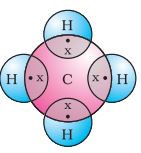
Lewis structure:H | H-C-H | H - Water (H₂O): Oxygen shares two electrons with two hydrogens.
Lewis structure (simplified):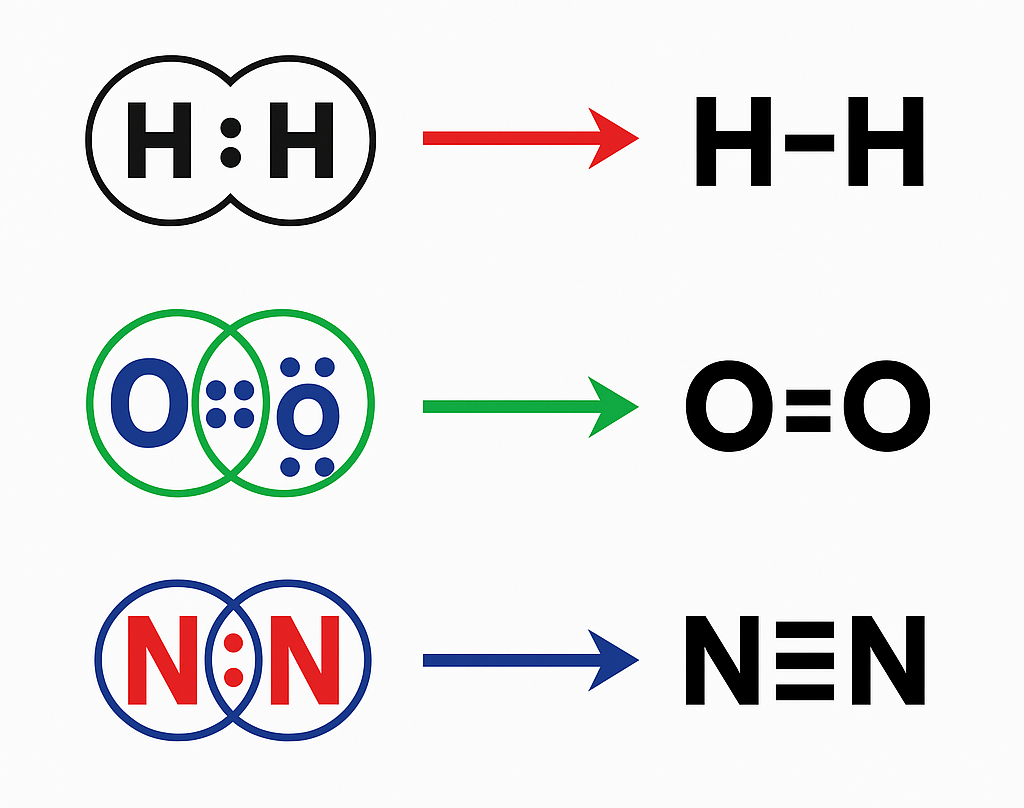
H-O-H
Lewis dot structures are particularly useful in predicting molecular shape, bonding, and reactivity of simple molecules.
Lewis Structure:
:Cl:-:Cl:
Lewis Structure:
O=N-O
  ⇄
O-N=O
Covalent Bonding in H2, N2 and O2
Hydrogen Molecule (H2): Each hydrogen atom has 1 valence electron. They share their single electrons to form one covalent bond:
H-H
Nitrogen Molecule (N2): Each nitrogen atom has 5 valence electrons. They share 3 electron pairs (triple bond) to complete their octet:
N=N
Oxygen Molecule (O2): Each oxygen atom has 6 valence electrons. They share 2 electron pairs (double bond) to complete the octet:
O=O
Examples of Double and Triple Bond Formation
Double and triple covalent bonds are formed when atoms share two or three pairs of electrons, respectively. These bonds are generally stronger and shorter than single bonds.
- Ethene (C2H4): Each carbon shares two electrons with the other (double bond) and forms single bonds with hydrogen.
H   H
 \ /
  C=C
 / \
H   H
- Ethyne (C2H2): Each carbon shares three electrons (triple bond) and one bond with hydrogen.
H-C=C-H
- Carbon Dioxide (CO2): Each oxygen atom forms a double bond with the central carbon atom.
O=C=O
Comparison Between Organic and Inorganic Compounds
| Property | Organic Compounds | Inorganic Compounds |
|---|---|---|
| Element Composition | Mainly composed of carbon and hydrogen; may contain O, N, S, etc. | May contain any element from the periodic table; carbon may or may not be present |
| Source | Mainly derived from living organisms (plants, animals) | Usually derived from minerals, earth crust, or non-living sources |
| Type of Bonding | Mostly covalent bonds | Mostly ionic or both ionic and covalent bonds |
| Melting and Boiling Points | Generally low due to weak intermolecular forces | Usually high due to strong ionic bonds |
| Solubility | Soluble in organic solvents (alcohol, ether) | Usually soluble in water |
| Electrical Conductivity | Poor conductors (no free ions) | Good conductors in molten or aqueous state |
| Flammability | Generally flammable | Usually non-flammable |
| Isomerism | Shows isomerism (same formula, different structure) | Rarely shows isomerism |
| Complexity | Usually large, complex molecules | Usually simple and smaller molecules |
| Examples | Methane, Glucose, Ethanol, Urea | Sodium chloride, Water, Calcium carbonate |
Physical and Chemical Properties of Organic Compounds
| Property | Description | Examples / Notes |
|---|---|---|
| Physical State | Most are gases, liquids, or soft solids at room temperature. | Ethane (gas), Ethanol (liquid), Glucose (solid) |
| Melting and Boiling Points | Generally low due to weak intermolecular forces. | Increases with molecular size; alcohols > alkanes |
| Solubility | Soluble in organic solvents, but most are insoluble in water. | Ethanol is an exception (water-soluble) |
| Electrical Conductivity | Do not conduct electricity (no free ions or electrons). | Unlike ionic inorganic compounds like NaCl |
| Flammability | Highly flammable; burn to produce CO2 and H2O. | Used as fuels (e.g., methane, LPG) |
| Isomerism | Organic compounds exhibit structural and functional isomerism. | Butane vs Isobutane (same formula, different structure) |
| Reactivity | Vary depending on functional groups (OH, COOH, NH2, etc.). | Alcohols react with acids to form esters |
| Combustion | Undergo exothermic combustion reactions releasing energy. | CH4 + 2O2 → CO2 + 2H2O + Heat |
| Substitution / Addition Reactions | Saturated compounds undergo substitution, unsaturated undergo addition reactions. | Alkanes: substitution; Alkenes/Alkynes: addition |
Single, Double, and Triple Bonds
Carbon atoms can form single, double, or triple covalent bonds depending on how many pairs of electrons are shared between two atoms. These types of bonding influence the physical and chemical properties of the compound.
1. Single Bonds
- Description: Involves sharing of one pair (2 electrons).
- Bond Strength: Weakest among the three types.
- Bond Length: Longest.
- Example:
CH₄ (Methane): H | H - C - H | H - Advantages:
- Allows free rotation around bond axis.
- Stable under normal conditions.
- Disadvantages:
- Less reactive in chemical reactions.
2. Double Bonds
- Description: Sharing of two pairs (4 electrons).
- Bond Strength: Stronger than single bonds.
- Bond Length: Shorter than single bonds.
- Example:
C₂H₄ (Ethene): H H \ / C = C / \ H H - Advantages:
- More reactive due to electron density.
- Forms planar structures useful in synthesis.
- Disadvantages:
- Less stable than single bonds.
- Rigid ,so it cannot rotate freely.
3. Triple Bonds
- Description: Sharing of three pairs (6 electrons).
- Bond Strength: Strongest type of covalent bond.
- Bond Length: Shortest.
- Example:
C2H2 (Ethyne)
H-C=C-H - Advantages:
- Very strong and rigid structure.
- High bond energy useful in reactions like welding.
- Disadvantages:
- Least flexible so, no rotation or bending possible.
- Highly reactive and flammable.
Nomenclature of Carbon Compounds
Nomenclature refers to the system of naming organic compounds in a standardized way. The most widely accepted system is the IUPAC (International Union of Pure and Applied Chemistry) system. It ensures that each compound has a unique and universally accepted name.IUPAC nomenclature provides a clear and logical way to name even complex organic molecules. Mastering these rules makes it easy to identify, write, and interpret the structures of carbon compounds in a scientific manner.
1. Types of Nomenclature
- Common Names: Based on traditional names or sources (e.g., acetic acid, formic acid).
- IUPAC Names: Based on a set of systematic rules to describe the compound’s structure.
2. Basic Rules of IUPAC Nomenclature
- Select the Longest Carbon Chain:
- This becomes the parent chain or base name.
- It must include the principal functional group, if present.
- Number the Carbon Chain:
- Start from the end nearer to the functional group or branch.
- Identify and Name the Substituents:
- Side chains (alkyl groups) or functional groups not part of the parent chain are named as prefixes or suffixes.
- Write the Name in the Order:
- Prefix (substituents) + Parent Name (main chain) + Suffix (functional group)
3. Prefixes and Suffixes
| Type | Group | Name | Example |
|---|---|---|---|
| Prefix | CH3 | Methyl | 2-Methylpropane |
| Suffix (primary) | Single bonds | ane | Butane (C4H10) |
| Suffix (secondary) | OH | ol | Butanol |
| Suffix (secondary) | COOH | oic acid | Butanoic acid |
4. Functional Group Priority Order (for Suffix Use)
- COOH (carboxylic acid)
- SO3H (sulfonic acid)
- COOR (ester)
- COX (acid halide)
- CONH2 (amide)
- CN (nitrile)
- CHO (aldehyde)
- CO (ketone)
- OH (alcohol)
- NH2 (amine)
- Double/Triple bonds (ene, yne)
5. Examples of IUPAC Naming
- CH3CH2–CH3: Propane (straight chain alkane)
- CH3CH(OH)CH3: Propan-2-ol (alcohol with OH on second carbon)
- CH3CH=CH2: Propene (alkene with double bond)
- CH3COOH: Ethanoic acid (carboxylic acid)
Tips for Writing IUPAC Names
- Use locants (numbers) to indicate the position of substituents and bonds.
- If more than one substituent is present, use di-, tri-, tetra- prefixes (e.g., dimethyl, trichloro).
- Arrange substituents alphabetically while writing the name.
Chains, Rings, and Branches in Carbon Compounds
One of the most remarkable properties of carbon is its ability to form long chains, rings, and branched structures. This property, called catenation, allows carbon atoms to bond with other carbon atoms in various ways, leading to an immense variety of organic compounds.
1. Straight Chains (Open-Chain Compounds)
Carbon atoms can form long straight chains by linking with each other through single, double, or triple bonds. These compounds are also known as acyclic compounds.
- They have a linear or zig zag structure.
- Can be saturated (only single bonds) or unsaturated (with double/triple bonds).
- Examples:
- Butane (C4H10) has Saturated straight chain
- But-1-ene (C4H8) has Unsaturated straight chain with a double bond
2. Branched Chains
Sometimes carbon atoms form branches instead of staying in a straight line. These are called branched-chain compounds.
- They have the same molecular formula as straight-chain compounds but differ in structure (isomers).
- This branching leads to structural isomerism.
- Examples:
- Isobutane (C4H10) is a branched isomer of butane
3. Ring Compounds (Cyclic Compounds)
Carbon atoms can also form closed rings by bonding with each other to make cyclic structures. These are called cyclic or ring compounds. Based on the type of atoms in the ring, they are classified as:
(a) Alicyclic Compounds
- Ring consists only of carbon atoms with single or double bonds.
- Examples: Cyclopropane (C3H6), Cyclohexane (C6H12)
(b) Aromatic Compounds
- Contain a benzene ring or similar structure with alternating double bonds.
- Highly stable due to delocalized electrons (resonance).
- Examples: Benzene (C6H6), Toluene (C7H8)
Comparison Table
| Type | Description | Examples |
|---|---|---|
| Straight Chain | Carbon atoms connected in a linear fashion | Propane, Butane |
| Branched Chain | One or more side chains branching off the main chain | Isobutane, Isopentane |
| Cyclic (Ring) | Carbon atoms form a closed loop or ring | Cyclohexane, Benzene |
Importance of These Structures
- They explain the enormous number of organic compounds carbon can form.
- Provide the basis for structural isomerism in organic chemistry.
- Help classify compounds and predict their chemical properties.
Thus, carbon’s ability to form chains, rings, and branched structures gives rise to millions of organic compounds with diverse properties and applications.
Allotropes and Isotopes of Carbon
Allotropes of Carbon
Allotropes are different physical forms in which an element can exist while being in the same state. Carbon exists in several allotropes, each with distinct structures and properties.
- Diamond:
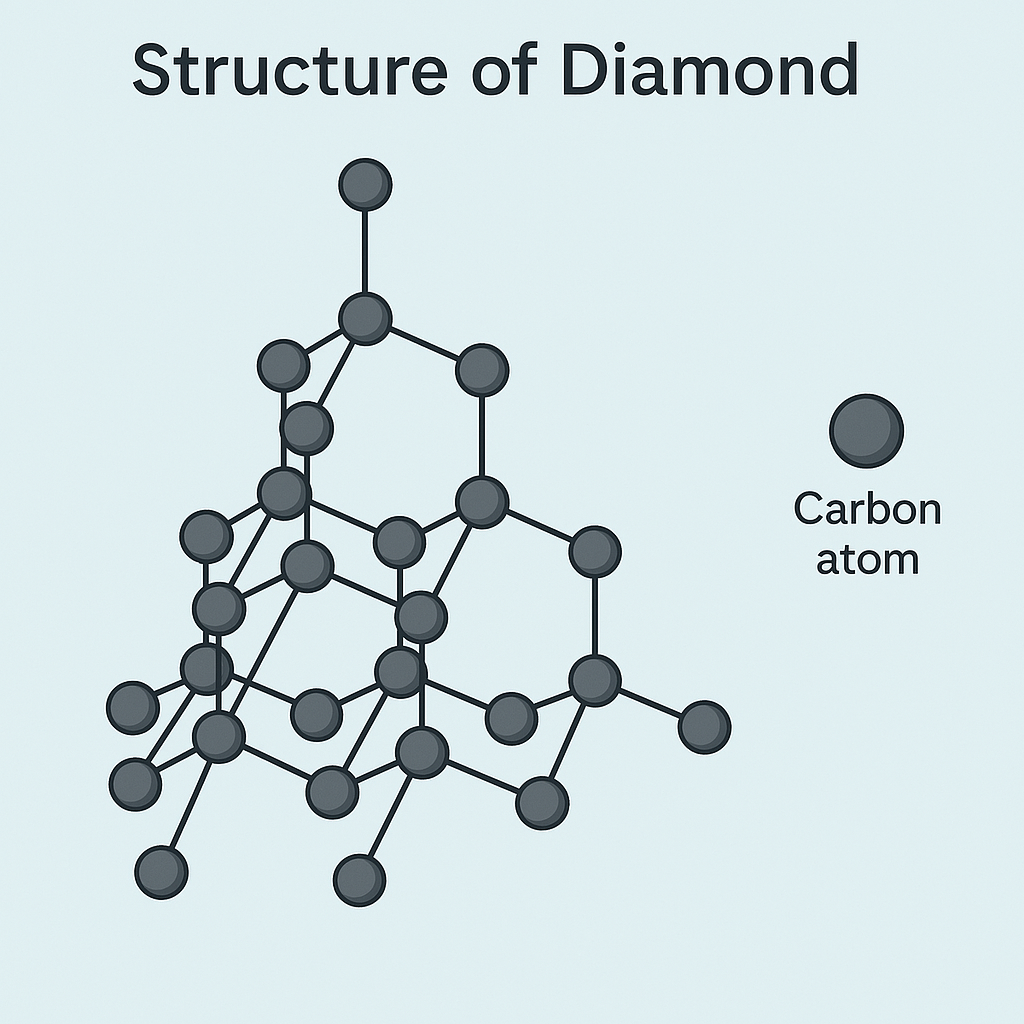
- Each carbon atom is bonded to four others in a tetrahedral structure.
- Hardest natural substance known.
- Used in cutting tools, jewelry, and abrasives.
- Poor conductor of electricity.
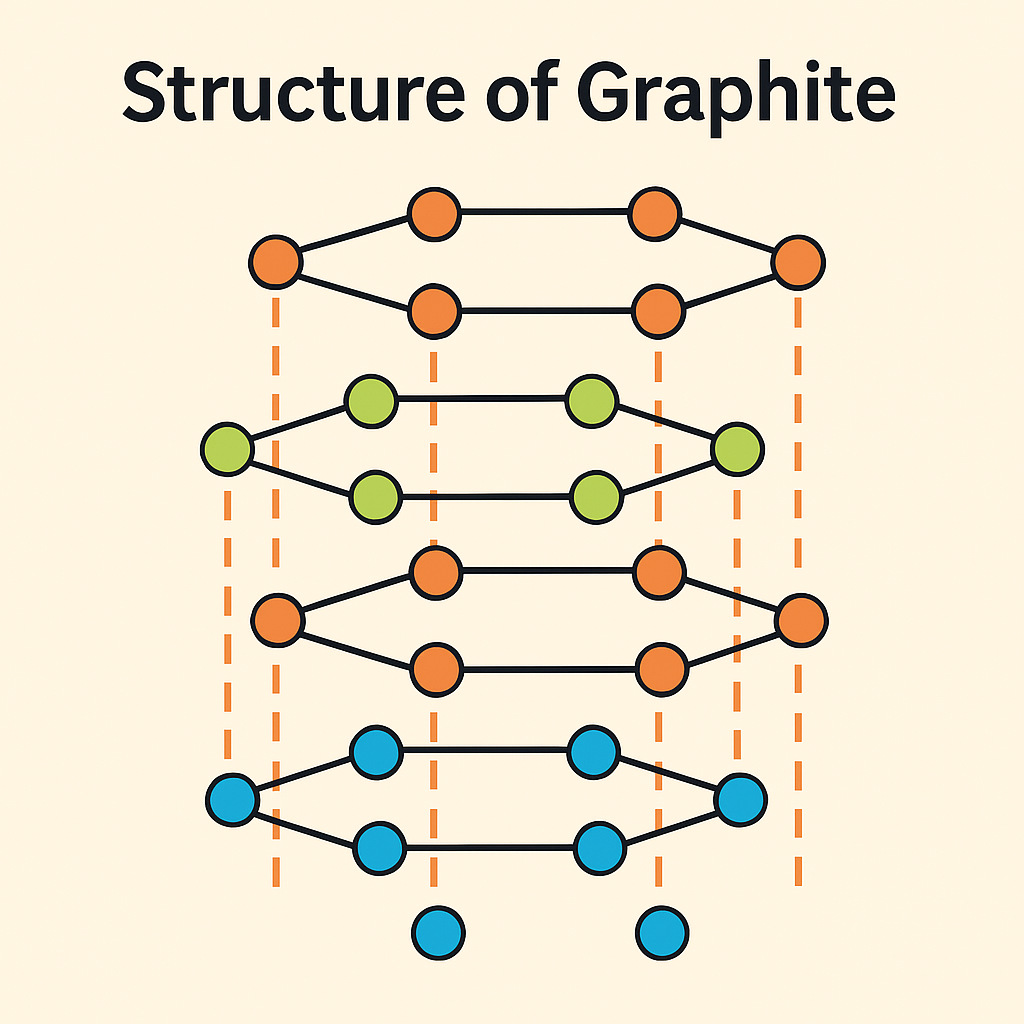
- Graphite:
- Each carbon atom is bonded to three others in flat hexagonal layers.
- Layers are held by weak forces, allowing them to slide making graphite soft and slippery.
- Good conductor of electricity due to free electrons.
- Used as a lubricant and in making electrodes.
- Fullerenes (e.g., C60):
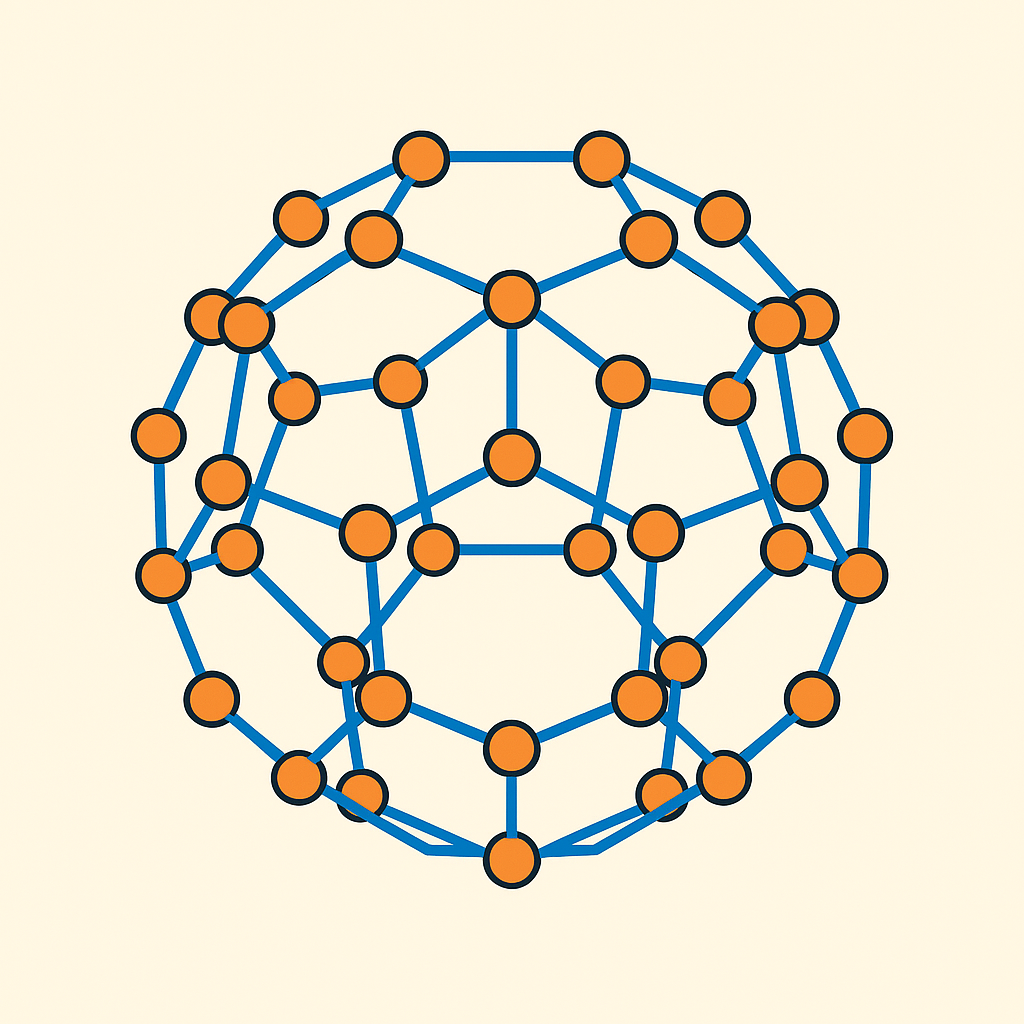
- Carbon atoms are arranged in hollow spheres or tubes (buckyballs and nanotubes).
- Discovered in 1985.
- Used in nanotechnology, drug delivery, and materials science.
Comparison Table: Diamond vs Graphite vs Fullerenes
| Property | Diamond | Graphite | Fullerenes |
|---|---|---|---|
| Structure | Tetrahedral (3D) | Hexagonal layers | Spherical or tubular |
| Hardness | Very hard | Soft | Moderate |
| Electrical Conductivity | Poor | Good | Varies |
| Uses | Jewelry, tools | Lubricants, electrodes | Nanotech, medicine |
Isotopes of Carbon
Isotopes are atoms of the same element that have the same number of protons but different numbers of neutrons. Carbon has three naturally occurring isotopes:
- Carbon-12 (C-12):
- 6 protons and 6 neutrons
- Most abundant (about 98.9%)
- Stable and non-radioactive
- Carbon-13 (C-13):
- 6 protons and 7 neutrons
- Used in NMR spectroscopy
- Stable and non-radioactive
- Carbon-14 (C-14):
- 6 protons and 8 neutrons
- Radioactive isotope (half-life is almost equal to 5730 years)
- Used in radiocarbon dating (archaeology and geology)
Thus, ability of carbo to exist in different physical forms (allotropes) and atomic forms (isotopes) adds to its chemical richness and importance in science and daily life.
Diamond, Graphite, and Important Carbon Compounds
1. Diamond
Diamond is one of the most popular allotropes of carbon. In this form, each carbon atom is covalently bonded to four other carbon atoms in a tetrahedral structure, forming a 3D network. Diamond and graphite demonstrate how the same element (carbon) can exhibit vastly different physical properties due to atomic arrangement. In addition, the wide range of carbon compounds ranging from fuels to fragrances, acids to alcohols highlight the central role of carbon in chemistry and everyday life.
- Structure: Tetrahedral, rigid, and extremely strong 3D lattice.
- Hardness: Hardest natural substance known.
- Transparency: Transparent with high refractive index which shines brilliantly.
- Electrical Conductivity: Does not conduct electricity (no free electrons).
- Uses:
- Jewelry (cut diamonds)
- Cutting and drilling tools (industrial diamonds)
- Precision instruments and abrasives
2. Graphite
Graphite is another allotrope of carbon where each carbon atom is bonded to three other carbon atoms in a hexagonal planar structure. The atoms form layers which slide over one another.
- Structure: Layers of hexagonal rings arranged in sheets. Weak Van der Waals forces between layers.
- Electrical Conductivity: Good conductor due to presence of delocalized (free) electrons.
- Texture: Soft and slippery to touch.
- Uses:
- Lubricants for machines
- Making pencil leads (mixed with clay)
- Electrodes in batteries and electric arcs
- Heat-resistant crucibles
Important Carbon Compounds
Carbon forms a vast number of compounds, but some key types are very important in daily life, industry, and biology. Below are the main categories with examples:
(a) Hydrocarbons
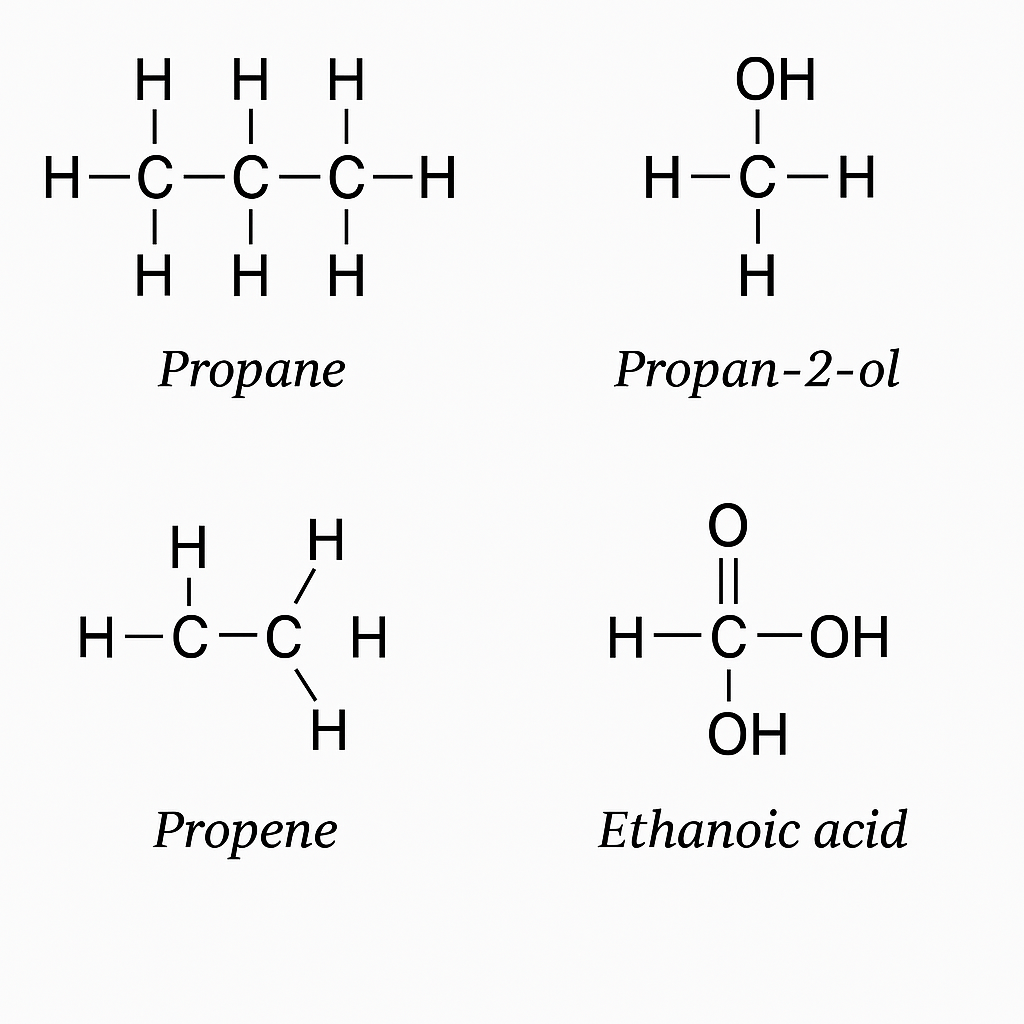
Hydrocarbons are compounds made of carbon and hydrogen only. Some examples: Methane (CH4), Ethane (C2H6), Propane (C3H8) . Theya re used as fuels (LPG, CNG), solvents, and raw materials in the petrochemical industry.
Types of Hydrocarbons
(a) Saturated Hydrocarbons (Alkanes)
- Contain only single covalent bonds (C-C) between carbon atoms.
- General formula: CnH2n+2
- Also called paraffins.
- Examples:
- Methane (CH4)
- Ethane (C2H6)
- Propane (C3H8)
- Properties:
- Less reactive
- Burn with clean flame
- Main component of natural gas and LPG
| Alkane | Molecular Formula | Structural Formula | Condensed Formula |
|---|---|---|---|
| Methane | CH₄ | H–C–H | H H |
CH₄ |
| Ethane | C₂H₆ | H H \ / H–C–C–H | | H H |
CH₃–CH₃ |
| Propane | C₃H₈ | CH₃–CH₂–CH₃ | CH₃–CH₂–CH₃ |
| Butane | C₄H₁₀ | CH₃–CH₂–CH₂–CH₃ | CH₃–(CH₂)₂–CH₃ |
| Pentane | C₅H₁₂ | CH₃–CH₂–CH₂–CH₂–CH₃ | CH₃–(CH₂)₃–CH₃ |
| Hexane | C₆H₁₄ | CH₃–CH₂–CH₂–CH₂–CH₂–CH₃ | CH₃–(CH₂)₄–CH₃ |
(b) Unsaturated Hydrocarbons
Alkenes (contain double bonds)
- At least one double bond (C=C) between carbon atoms.
- General formula: CnH2n
- Examples: Ethene (C2H4), Propene (C3H6)
Alkynes (contain triple bonds)
- At least one triple bond (C=C) between carbon atoms.
- General formula: CnH2n-2
- Examples: Ethyne (C2H2), Propyne (C3H4)
- Properties of Unsaturated Hydrocarbons:
- More reactive due to multiple bonds
- Burn with sooty flame due to incomplete combustion
- Useful in making alcohols, plastics, and chemicals
Aromatic Hydrocarbons
- Contain one or more benzene rings (a ring of 6 carbon atoms with alternating double bonds).
- Delocalized electrons give extra stability to the ring.
- Examples:
- Benzene (C6H6)
- Toluene (C7H8)
- Naphthalene (C10H8)
- Uses: Dyes, perfumes, pharmaceuticals, plastics
Importance of Hydrocarbons
- Main source of fuel: petrol, diesel, CNG, LPG are all hydrocarbon-based.
- Serve as raw materials in the petrochemical industry to manufacture plastics, fibers, detergents, and explosives.
- Used in making solvents like benzene and toluene.
Combustion of Hydrocarbons
Hydrocarbons undergo combustion reactions to release energy:
CH4 + 2O2 →CO2 + 2H2O + Heat
- Saturated hydrocarbons burn with a clean (blue) flame.
- Unsaturated hydrocarbons produce a yellow, sooty flame due to incomplete combustion.
(b) Alcohols
Organic compounds containing the OH (hydroxyl) group.Examples: Methanol (CH3OH), Ethanol (C2H5OH) Used in medicines, disinfectants, alcoholic beverages, and fuel blends.
(c) Carboxylic Acids
Contain COOH (carboxyl) functional group.Examples: Formic acid (HCOOH), Acetic acid (CH3COOH). These are used in manufacturing synthetic fibers.(d) Esters
Esters are formed by reaction of alcohols and acids (esterification). Examples: Ethyl acetate (CH3COOC2H5) Known for their fruity smell; used in perfumes and flavoring agents.
(e) Polymers
Large molecules made from repeating units (monomers). Examples: Polyethylene, PVC (polyvinyl chloride), Nylon Used in plastics, textiles, packaging, and construction materials.
(f) Medicines and Dyes
Many important medicines (aspirin, penicillin) and dyes (indigo, malachite green) are carbon-based. These are organic compounds often made synthetically from petroleum derivatives.
Homologous Series
A homologous series is a group of organic compounds that have the same functional group, similar chemical properties, and follow a regular pattern in their molecular structure. Each successive member differs from the previous one by a CH2 group.Homologous series reflect the regularity and predictability of organic compounds. Despite structural variety, members show similar chemical behavior, making them essential in understanding carbon chemistry.
Characteristics of a Homologous Series
- All members have the same functional group (e.g., OH in alcohols, COOH in acids).
- They differ by a fixed unit: CH2 (methylene group), which adds 14 amu to the molecular mass.
- Show a gradual change in physical properties like boiling point, melting point, and solubility.
- Show similar chemical properties due to the same functional group.
- Follow a general molecular formula.
Examples of Homologous Series
(a) Alkane Series (General formula: CnH2n+2)
| Name | Molecular Formula | Structure | Molecular Mass |
|---|---|---|---|
| Methane | CH4 | H-C-H (×4) | 16 |
| Ethane | C2H6 | CH3-CH3 | 30 |
| Propane | C3H8 | CH3-CH2-CH3 | 44 |
| Butane | C4H10 | CH3-CH2-CH2-CH3 | 58 |
(b) Alcohol Series (General formula: CnH2n+1OH)
- Methanol - CH3OH
- Ethanol - C2H5OH
- Propanol - C3H7OH
- Butanol - C4H9OH
(c) Carboxylic Acid Series (General formula: CnH2n+1COOH)
- Formic Acid HCOOH
- Acetic Acid CH3COOH
- Propionic Acid C2H5COOH
- Butanoic Acid C3H7COOH
Importance of Homologous Series
- Makes the study of organic compounds systematic and easy to understand.
- Helps in predicting properties of higher members based on lower ones.
- Helps in deriving general formulas for entire classes of compounds.
- Facilitates classification and identification of unknown organic compounds.
Classification of Functional Groups
A functional group is an atom or a group of atoms that gives a specific chemical property to a carbon compound. The presence of functional groups determines the compound’s chemical behavior and its classification in organic chemistry.
Even if two compounds have the same carbon skeleton, different functional groups attached to them can result in completely different physical and chemical properties.
Common Functional Groups in Organic Compounds
| Functional Group | Formula | Class of Compound | Example |
|---|---|---|---|
| Hydroxyl | OH | Alcohols | Ethanol (C2H5OH) |
| Aldehyde | CHO | Aldehydes | Formaldehyde (HCHO) |
| Ketone | CO | Ketones | Acetone (CH3COCH3) |
| Carboxyl | COOH | Carboxylic Acids | Acetic Acid (CH3COOH) |
| Halogen | Cl, Br, I | Haloalkanes | Chloromethane (CH3Cl) |
| Amine | NH2 | Amines | Methylamine (CH3NH2) |
| Ester | COO | Esters | Ethyl acetate (CH3COOC2H5) |
Key Points About Functional Groups
- They are responsible for the characteristic chemical reactions of molecules.
- They are the reactive part of an organic molecule.
- Compounds with the same functional group belong to the same homologous series.
- Each functional group has a specific name and structure.
Importance in Organic Chemistry
- Functional groups help in naming (nomenclature) of organic compounds.
- They allow systematic classification of millions of carbon compounds.
- Help predict chemical behavior and reactivity of compounds.
By learning functional groups, we can recognize, name, and understand how carbon compounds behave in chemical reactions which is the basis for studying organic chemistry.
Ethanol (C2H5OH)
Ethanol is a colorless liquid with a pleasant smell. It has a boiling point of 351 K and is completely miscible with water. Ethanol is a poor conductor of electricity as it lacks free ions and is neutral to litmus.
Uses of Ethanol:
- Used as an antifreeze in radiators in cold regions.
- Acts as a solvent in paints, dyes, medicines, soaps, and synthetic rubber industries.
- Used to prepare tincture of iodine.
Effects on Human Body:
- Consumption of ethanol mixed with methanol can lead to blindness or severe poisoning.
- Excessive intake can cause liver damage and addiction.
- Large doses may be fatal.
Reaction with Sodium:
Ethanol reacts with sodium to release hydrogen gas and forms sodium ethoxide.
2C2H5OH + 2Na → 2C2H5ONa + H2↑
Elimination (Dehydration) Reaction:
When heated with concentrated sulphuric acid at 443 K, ethanol loses a water molecule to form ethene.
CH3CH2OH → CH2=CH2 + H2O
Ethanoic Acid (CH3COOH)
Ethanoic acid, commonly known as acetic acid, is a sour-smelling, weak acid. It dissolves easily in water, alcohol, and ether. In cold climates, it may solidify to form glacial acetic acid.
Reactions with Metals and Bases:
- Reacts with sodium to produce hydrogen gas:
2CH3COOH + 2Na → 2CH3COONa + H2↑
CH3COOH + NaOH → CH3COONa + H2O
Reactions with Carbonates & Bicarbonates:
Acetic acid reacts with carbonates and bicarbonates to release carbon dioxide.
2CH3COOH + Na2CO3 → 2CH3COONa + H2O + CO2↑
CH3COOH + NaHCO3 → CH3COONa + H2O + CO2↑
Esterification
Esterification is the reaction between an alcohol and a carboxylic acid in the presence of concentrated sulphuric acid to form an ester (sweet-smelling compound).
CH3COOH + C2H5OH → CH3COOC2H5 + H2O
(Catalyst: Conc. H2SO4)
Saponification
Saponification is the process of making soap. Fats/oils react with sodium or potassium hydroxide to produce soap and glycerol. The soap molecule has a long hydrophobic tail (non-ionic) and a hydrophilic head (ionic).
Fat + NaOH → Soap (RCOONa) + Glycerol
Soaps and Detergents
Cleansing Action of Soap:
When soap is mixed with water, it forms spherical structures called micelles. The non-polar tail dissolves in oil/dirt, while the polar head remains in water. Scrubbing helps lift the dirt away from fabric or skin.
Soap vs Hard Water:
Hard water contains calcium and magnesium salts which react with soap to form insoluble scum, reducing its cleaning efficiency.
2C17H35COONa + CaCl2 → (C17H35COO)2Ca + 2NaCl
2C17H35COONa + MgCl2 → (C17H35COO)2Mg + 2NaCl
Hence, soaps are less effective in hard water. Detergents, being synthetic, can work better in hard water conditions.
Text Book Question Answers Part- I
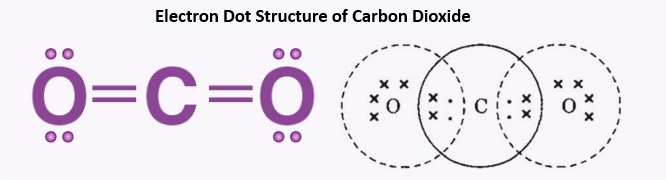
Question 1.What would be the electron dot structure of carbon dioxide which has the formula CO2?
Answer: In carbon dioxide molecule, the two oxygen atoms are bonded on either side with carbon atom be double bonds. These there are 2 double bonds in CO2. Carbon shares its electrons in the formation of a double bond with one oxygen atom and another two electrons with another oxygen atom. In this process, both the oxygen atoms and the carbon atom acquire the stable electronic configuration of the noble gas neon. The formation of CO2 molecule is shown below.
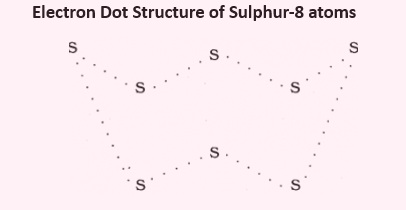
Question 2. What would be the electron dot structure of a molecule of sulphur which is made up of eightatoms of sulphur?
(Hint – The eight atoms of sulphur are joined together in the form of a ring.)
Answer:
Text Book Part II Page No. 12
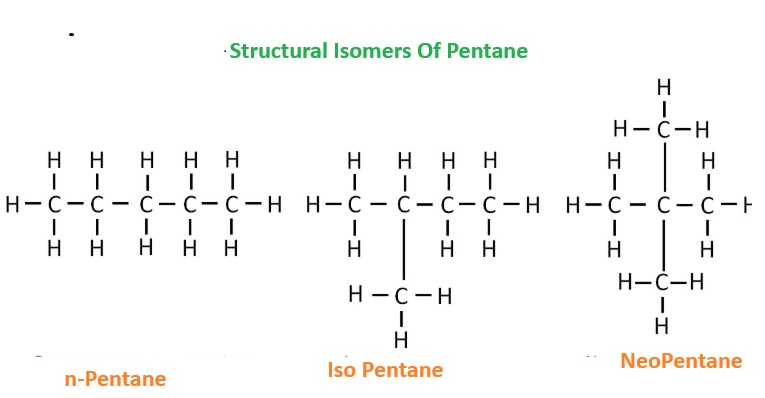
Question 1. How many structural isomers can you draw for pentane?
Answer: Pentane has 3 structural isomers. We can write as follows.
i) CH3CH2CH2CH2CH3
Question 2. What are the two properties of carbon which lead to the huge number of carbon compounds wesee around us?
Answer:
- Catenation: It is the ability to form bonds with other atoms of carbon.
- Tetravalency: With the valency of four, carbon is capable of bonding with four other atoms.
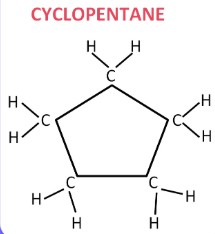
Question 3.What will be the formula and electron dot structure of cyclopentane?
Answer: Molecular formula of cyclopentane is: C5H10
Electron dot structure:
Question 4.Draw the structures for the following compounds.
- Ethanoic acid
- Bromopentane*
- Butanone
- Hexanal.
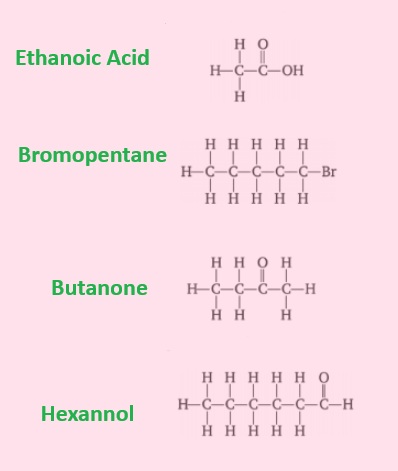
Are structural isomers possible for bromopentane?
Answer:

- 1- bromopentane where the bromine is attached to the first carbon in a straight chain.
- 2- bromopentane where the bromine is attached to the second carbon in a straight chain.
- 3- bromopentane where the bromine is attached to the third carbon in a straight chain.
- Branched isomers are also possible and involve a different arrangement of the five carbon atoms.
Question 5.How would you name the following compounds
Answer:
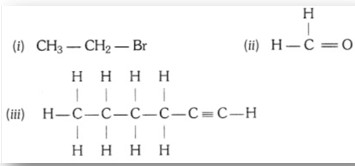
- Bromoethane
- Methanol
- Hexane.
Text Book Question Answers Part II
Question 1. Why is the conversion of ethanol to ethanoic acid an oxidation reaction?
Answer:
Addition reaction means adding oxygen. Adding ethanol to potassium permanganate, we get ethanoic acid. Hence this reaction is called oxidation
reaction.
Question 2.A mixture of oxygen and ethyne is burnt for welding. Can you tell why a mixture of ethyne and air is not used?
Answer: Air, also contains other gases like nitrogen, carbon dioxide and few more gases apart from oxygen. When ethyne is burnt in air, it gives a sooty flame. This is due to incomplete combustion caused by the limited supply of oxygen. However, if ethyne is burnt with oxygen, it gives a clean flame with temperature 3000°C because of complete combustion. This oxyacetylene flame is used for welding. It is not possible to attain such a high temperature without mixing oxygen. This is the reason why a mixture of ethyne and air is not used,
2HC ≡ CH + 5O2 → 4CO2 + 2H2O + Heat.
Question 3.How would you distinguish experimentally between an alcohol and a carboxylic acid?
Answer: All the carboxylic acids decompose sodium hydrogen carbonate giving brisk effervescence of carbon dioxide gas whereas ethanol does not react with sodium hydrogen carbonate
Experiment:
- Take two test tubes, label them as A and B
- Take about 0.5 g of sodium hydrogen carbonate (NaHco3) in each test tube
- Add 2 ml of ethanol in test tube A and 2ml of ethanoic acid in test tube B.
- We can observe the gas bubbles in test tube B. No such bubbles are seen in test tube A. Pass the gas produced in test tube B through lime water taken in another test tube
- We will find that lime water turns milky It is a test for carbon dioxide.
Hence, this experiment proves that when ethanoic acid reacts with sodium hydrogen carbonate, then carbon dioxide gas is produced with an effervescence (a rapid evolution of gas bubbles). Ethanol does not react with NaHCO3.
Question 4.What are oxidising agents?
Answer: Oxidising agents are the substances that gain electrons in redox reaction and whose oxidation number is reduced. Examples: KMnO4 or K2Cr2O7. They have the ability to oxidize or give their oxygen to other substances.
Text Book Question Answers Part III
Question 1. Would you be able to check if water is hard by using a detergent?
Answer: Detergent gives lather both with hard and soft water, while a soap gives lather with soft water only. Thus, it is not possible to check if the water is hard by using a detergent.
Question 2.People use a variety of methods to wash clothes. Usually after adding the soap, they ‘beat’ theclothes on a stone, or beat it with a paddle, scrub with a brush or the mixture is agitated in a washingmachine. Why is agitation necessary to get clean clothes?
Answer:
A soap molecule has two parts namely hydrophobic and hydrophilic. With the help of these particles, it attaches to the grease or dirt particle and forms a cluster called micelle. These micelles remain suspended as a colloid. To remove these micelles, it is necessary to agitate clothes.
Question 1.Ethane, with the molecular formula C2H6 has
(a) 6 covalent bonds.
(b) 7 covalent bonds.
(c) 8 covalent bonds.
(d) 9 covalent bonds.
Answer: (b) 7 covalent bonds.
Question 2.Butanone is a fourcarbon compound with the functional group
(a) carboxylic acid
(b) aldehyde
(c) ketone.
(d) alcohol.
Answer: (c) ketone.
Question 3.While cooking, if the bottom of the vessel is getting blackened on the outside, itmeans that
(a) the food is not cooked completely.
(b) the fuel is not burning completely.
(c) the fuel is wet.
(d) the fuel is burning completely.
Answer:(b) the fuel is not burning completely.
Question 4.Explain the nature of the covalent bond using the bond formation in CH3Cl.
Answer: Carbon has a valency of four. It shares one electron to each 3 hydrogen atoms and one more electron with chlorine.
Question 5.Draw the electron dot structures for
(a) ethanoic acid (b) H2S. (c) propanone (d) F2
Answer:
a) Ethanoic acid
Question 6. What is an homologous series? Explain with an example.
Answer: A homologous series is a series of carbon compounds that have different numbers of carbon atoms but contain the same functional group. Every next member of a homologous series has a clear difference of 14 units of mass.
For example, methane, ethane, propane, etc., are all part of the alkane homologous series. The general formula of this series is CnH2n+2.
An example is explained with formula as below:
- Methane, CH4
- Ethane, CH3CH3
- Propane, CH3CH2CH3
- Butane, CH3CH2CH2CH3
It can be noticed that there is a difference of CH2 unit between each successive compound.
Question 7. How can ethanol and ethanoic acid be differentiated on the basis of their physical and chemicalproperties?
Answer: Ethanol and Ethanoic acid can be differentiated on the basis of their following properties by:
- Ethanol is a liquid at room temperature with a pleasant smell. Ethanoic acid has a melting point of 17°C. Since it is below the room temperature so, it freezes during winter. Moreover, ethanoic acid has a smell like vinegar.
- Ethanol does not react with metal carbonates while, ethanoic acid reacts with metal carbonates to form a salt, water and carbon dioxide.
For example:
2CH3COOH + Na2CO3 → 2CH3COONa + CO2 +H2O - Ethanol does not react with NaOH while ethanoic acid reacts with NaOH to form sodium ethanoate and water.
For example,
CH3COOH + NaOH → CH3COONa + H2O - Ethanol is oxidized to give ethanoic acid in the presence of acidified KMnO4 while no reaction takes place with ethanoic acid in the presence of acidified KMnO4.
Difference in physical properties:
|
Ethanol |
Ethanoic acid |
|
This is in liquid form at room temperature. Its melting point is 156° K. |
Its melting point is 290K and hence it often freezes during winter in cold climates. |
|
Difference in chemical properties |
|
|
Ethanol will not react with metallic carbonates. |
Ethanoic acid reacts with carbonates and Hydrogen carbonate and forms salts, carbon dioxide and water. |
Question 8. Why does micelle formation take place when soap is added to water? Will a micelle be formedin other solvents such as ethanol also?
Answer: A soap molecule has two ends. One end is hydrophilic and another end is hydrophobic. When soap is dissolved in water and clothes are put in the soapy solution, soap molecules converge in a typical manner to make a structure is called micelle. The hydrophobic ends of different molecules surround a particle of grease and make the micelle, which is a spherical structure. In this, the hydrophilic end is outside the sphere and hydrophobic end is towards the centre of the sphere. This is why micelle formation takes place when soap is added to water. Since ethanol is not as polar as soap, micelles will not be formed in other solvents such as
ethanol.
Question 9. Why are carbon and its compounds used as fuels for most applications?
Answer: Carbon in all its allotropic forms, burns in oxygen to give carbondioxide along with the release of heat and light. Most carbon compounds also release a large amount of heat and light on burning. Hence carbon and its compounds are used as fuels for most applications.
Question 10. Explain the formation of scum when hard water is treated with soap.
Answer: Hard water often contains salts of calcium and magnesium. Soap molecules react with the salts of calcium and magnesium and form a precipitate. This precipitate begins floating as an offwhite layer over water. This layer is called scum. Soaps lose their cleansing property in hard water because of the formation of scum.
Question 11. What change will you observe if you test soap with litmus paper (red and blue)?
Answer: Soap is basic in nature, hence red litmus changes to blue. Blue litmus is seen blue only.
Question 12. What is hydrogenation? What is its industrial application?
Answer:
Hydrogenation is a reaction between hydrogen and other compounds in the presence of the desired catalyst. Hydrogenation is used for reducing saturated hydrocarbons. Hydrogenation is an addition reaction. For example: When ethane is heated with the catalyst, nickel, it is reduced to ethane.
- In the petrochemical industry, hydrogenation is used to convert alkenes into alkanes (paraffin) and cycloalkanes.
- It is also used to prepare vegetable cooking fat from vegetable oils.
Question 13. Which of the following hydrocarbons undergo addition reactions:
C2H6, C3H8, C3H6, C2H2 and CH4.
Answer: C2H6 and C2H2 are unsaturated Hydrocarbons. Hence these undergo addition reactions.
Question 14. Give a test that can be used to differentiate between saturated and unsaturated hydrocarbons.
Answer: Butter contains saturated fats. Therefore, it cannot be hydrogenated. On the other hand, oil has unsaturated fats. That is why it can be hydrogenated to saturated fats (solids).
Question 15.Explain the mechanism of the cleaning action of soaps.
Answer:
Soap are molecules in which the two ends have differing properties. One is hydrophilic, that is, it interacts with water, while the other end is hydrophobic, that is, it interacts with hydrocarbons. In the clusters of molecules in which the hydrophobic tails are on the surface of the cluster. This formation is called micelle. Since the oily dirt will be collected in the centre of the micelle. The micelles stay in solution as a colloid and will not come together to precipitate because of ionion repulsion. Thus the dirt suspended in the micelles is also easily rinsed away.
Additional Question Answers
Question 1. Write the electron dot formula of oxygen.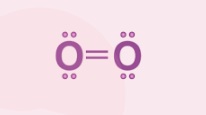 Question 2. What is substitution Reaction? Give an example.
Answer: If one type of atom or a group of atoms takes the place of another, it is called substitution reaction.
Eg: CH4 + Cl2 CH3Cl + HCl (in the presence of sunlight) Question 3. Name 2 commercially important compounds.
Answer: Ethanol and ethanoic acid. Question 4. Give an example for Esterification reaction.
Answer: Question 5. Write one use of ester.
Answer: Esters are used in making perfumes and as flourishing agents. Question 6.What are detergents?
Answer: Detergents are generally sodium salts of sulphonic acids or ammonium salts with chlorides or bromides etc. Question 7. Where is Ethanol used?
Answer: It is used in medicines such as tincture iodine, cough syrups, and many tonics. Question 8. What is vinegar? Mention one of its use.
Answer: 5 to 8% solution of acetic acid in water is called vinegar. It is used as a preservative in pickles.
LBA Solutions ( Lesson Based Assessment Solutions)
Learning Points
- Bonding in carbon – the covalent bond
- Versatile nature of carbon
- Saturated and unsaturated carbon compounds
- Chains, branches and rings
- Functional groups
- Homologous series
- Nomenclature of carbon compounds
- Combustion
- Oxidation
- Addition reaction
- Substitution reaction
- Properties of ethanol
- Properties of ethanoic acid
- Soaps and detergents
Weightage to Difficulty Level
| Sl. No | Difficulty Level | Marks | Percentage |
|---|---|---|---|
| 1 | Easy (30%) | 16 | 29% |
| 2 | Average (50%) | 24 | 48% |
| 3 | Difficult (20%) | 15 | 19% |
I. Multiple Choice Questions (1 Mark each)
Four alternatives are given for each of the following questions/incomplete statements. Choose the correct alternative and write the complete answer along with its letter of alphabet.
-
The valence electrons that an atom of carbon has in its outermost shell –
A. 1 B. 2 C. 3 D. 4 -
Diatomic molecule produced by the formation of double bond –
A. Chlorine B. Oxygen C. Nitrogen D. Ammonia -
The major component of bio-gas is (MQP 2020-21, MAIN EXAM 2021, SUP EXAM 2022) –
A. Propane B. Butane C. Methane D. Ethane -
Carbon can form bonds with other atoms of carbon giving rise to large molecules.
This unique property of carbon is (MQP 2020-21, 2024-25) –
A. Saponification B. Catenation C. Hydrogenation D. Esterification -
An unsaturated compound in which double bond is found between Carbon–Carbon atoms –
A. Methane B. Ethane C. Ethene D. Ethyne -
Functional group found in halo-alkanes –
A. −Cl or −Br B. −OH C. −CHO D. −COOH -
The structural formula of propanal is (MAIN EXAM 2021) –
________________________ -
Name of this compound is –
A. Propanone B. Propanol C. Propanal D. Propanoic acid -
The number of single bonds and double bonds present in the structure of benzene molecule respectively
(MQP 2020-21, MAIN EXAM 2021) –
A. 6 and 6 B. 9 and 3 C. 7 and 5 D. 3 and 9 -
The number of single bonds present in the structure of cyclohexane (MQP 2020-21) –
A. 12 B. 18 C. 24 D. 6 -
The number of carbon and hydrogen atoms present in the molecule of fifth member of alkene
(MQP 2024-25) –
A. Five and ten B. Five and twelve C. Six and twelve D. Six and six -
The molecular formula of both cyclohexane and hexane
(MQP 2020-21, SUP EXAM 2021) –
A. C6H12 B. C6H14 C. C6H10 D. C6H6 -
Difference between molecular formula of two successive compounds in homologous series –
A. CH2 B. CH4 C. C2H2 D. C2H4 -
The group of compounds which are in homologous series is
(MQP 2019-20, 2020-21) –
A. CH4, C2H4, C2H2
B. CH4, CH3OH, HCHO
C. C2H2, C2H6, CH4
D. C2H2, C3H4, C4H6 -
The correct group of saturated hydrocarbons
(MQP 2020-21, SUP EXAM 2021) –
A. Methane, ethene, ethyne
B. Ethane, propane, butane
C. Ethyne, ethane, methane
D. Ethyne, propene, butyne -
General formula of alkyne (MAIN EXAM 2019) –
A. CnH2n−2 B. CnH2n+2 C. CnH2n D. CnH2n+1 -
The suitable general formula for C2H6, C3H8, C4H10
(MAIN EXAM 2020) –
A. CnH2n B. CnH2n−1 C. CnH2n−2 D. CnH2n+2 -
Organic compounds obtained by the reaction between carboxylic acid and alcohol
(EXAM-1 2024) –
A. Aldehydes B. Ketones C. Esters D. Halo-alkanes
MCQs Answers
-
The valence electrons that an atom of carbon has in its outermost shell –
Answer: D. 4 -
Diatomic molecule produced by the formation of double bond –
Answer: B. Oxygen -
The major component of bio-gas is –
Answer: C. Methane -
Carbon can form bonds with other atoms of carbon giving rise to large molecules. This unique property of carbon is –
Answer: B. Catenation -
An unsaturated compound in which double bond is found between Carbon–Carbon atoms –
Answer: C. Ethene -
Functional group found in halo-alkanes –
Answer: A. −Cl or −Br -
The structural formula of propanal is –
Answer: CH3–CH2–CHO -
Name of this compound is –
Answer: C. Propanal -
The number of single bonds and double bonds present in the structure of benzene molecule respectively –
Answer: B. 9 and 3 -
The number of single bonds present in the structure of cyclohexane –
Answer: B. 18 -
The number of carbon and hydrogen atoms present in the molecule of fifth member of alkene –
Answer: A. Five and ten -
The molecular formula of both cyclohexane and hexane –
Answer: B. C6H14 -
Difference between molecular formula of two successive compounds in homologous series –
Answer: A. CH2 -
The group of compounds which are in homologous series is –
Answer: D. C2H2, C3H4, C4H6 -
The correct group of saturated hydrocarbons –
Answer: B. Ethane, propane, butane -
General formula of alkyne –
Answer: A. CnH2n−2 -
The suitable general formula for C2H6, C3H8, C4H10 –
Answer: D. CnH2n+2 -
Organic compounds obtained by the reaction between carboxylic acid and alcohol –
Answer: C. Esters
II. Answer the Following Questions (1 Mark each)
-
Write the electron dot structure of methane –
Answer:
H
|
H : C : H
|
H
(Methane, CH4, has four single covalent bonds.) -
Mention the number of single bonds and double bonds present in C2H5COOH molecule –
Answer: 7 single bonds and 1 double bond. -
Write the structural formula of ethene molecule –
Answer: CH2=CH2 -
Name the below given organic compound –
Answer: Ethanol -
Write the structural formula of the ketone having three carbon atoms –
Answer: CH3–CO–CH3 (Propanone) -
In a homologous series, if the first member has molecular formula C2H4, find the molecular formula of fifth member –
Answer: C6H12 -
Write the molecular and structural formula of benzene –
Molecular formula: C6H6
Structural formula: A six-carbon ring with three alternate double bonds. -
Hydrocarbon compounds are usually used as fuels. Why? –
Answer: Because they burn in air to produce a large amount of heat energy. -
Give reason why addition reaction is used in hydrogenation of vegetable oils –
Answer: Because unsaturated oils contain double bonds and hydrogen is added across the double bonds to convert them into saturated fats. -
Why ethanoic acid is known as glacial acetic acid? –
Answer: Because pure ethanoic acid freezes at 16.6°C forming ice-like crystals. -
The solution of 5–8% acetic acid in water is called as –
Answer: Vinegar -
When ethanol reacts with sodium, a gas is evolved. Name the gas and how will you test it? –
Answer: Hydrogen gas. It is tested by bringing a burning matchstick near it; it burns with a ‘pop’ sound. -
Name the compound produced when ethanoic acid reacts with base –
Answer: Salt (Sodium ethanoate, if reacted with sodium hydroxide)
III. Answer the Following Questions (2 Marks each)
-
Give reason:
a) Covalent compounds have low melting and boiling points.
Answer: Covalent compounds have weak intermolecular forces of attraction. Therefore, less heat energy is required to break these forces.
b) Covalent compounds are poor conductors of electricity.
Answer: They do not contain free ions or free electrons to conduct electricity. -
Write the two important properties of carbon.
Answer:
1. Tetravalency – Carbon has valency 4 and forms four covalent bonds.
2. Catenation – Carbon can form long chains, branched chains and rings with other carbon atoms. -
Give reason:
a) Gradation in physical properties is seen in homologous series.
Answer: As molecular mass increases, intermolecular forces increase gradually causing gradual change in boiling point and melting point.
b) Chemical properties remain similar in homologous series.
Answer: Because all members contain the same functional group. -
Electron dot structures:
i) Hydrogen (H₂): H : H
ii) Ethane (C₂H₆):
H H
| |
H : C : C : H
| |
H H -
What are functional groups? Name those in propanal and propanol.
Answer: Functional groups are atoms or group of atoms that determine chemical properties.
Propanal – Aldehyde group (–CHO)
Propanol – Alcohol group (–OH) -
Functional group and structural formula when –CHO replaces H in ethane.
Answer: Functional groups are specific groups responsible for characteristic reactions.
Structural formula formed: CH₃–CHO (Ethanal) -
Why CH₂ is not first member? Write first member.
Answer: CH₂ cannot exist independently as a stable molecule. At least two carbon atoms are required.
First member: Ethene (CH₂=CH₂) -
First member CH₂OHCHO. Find third member and group name.
Answer:
This belongs to the Aldehyde group.
Homologous difference = –CH₂
Third member molecular formula: C₄H₈O₂
General name: Aldehydes -
CH₄ + Cl₂ → CH₃Cl + HCl (sunlight). Identify reaction type.
Answer: Substitution reaction. One hydrogen atom of methane is replaced by chlorine. -
What are alkynes? First member and formula.
Answer: Alkynes are unsaturated hydrocarbons containing a triple bond.
First member: Ethyne
Molecular formula: C₂H₂ -
Complete reaction and explain saponification.
CH₃COOC₂H₅ + NaOH → C₂H₅OH + CH₃COONa
Answer: It is called saponification because ester reacts with base to produce alcohol and salt (soap). -
Name ‘a’ and ‘b’ and identify saturated/unsaturated.
Answer:
Product ‘a’ – Alkane (Saturated hydrocarbon)
Product ‘b’ – Alkene (Unsaturated hydrocarbon) -
Name the compounds for given structures.
Answer: (Names depend on provided structures such as propane, propene, propanol, propanoic acid, etc.) -
Activity to show ester formation.
Answer: Mix ethanol and ethanoic acid. Add few drops of concentrated H₂SO₄ and heat in water bath. After cooling, pour into water. Fruity smell confirms ester formation. -
Reaction of ethanoic acid with sodium carbonate and sodium hydrogen carbonate.
CH₃COOH + Na₂CO₃ → 2CH₃COONa + CO₂ + H₂O
CH₃COOH + NaHCO₃ → CH₃COONa + CO₂ + H₂O
CO₂ turns lime water milky. -
What is esterification? Mention uses.
Answer: Esterification is the reaction between carboxylic acid and alcohol in presence of concentrated H₂SO₄ to form ester and water.
Uses: Used in perfumes, flavoring agents, and solvents.
IV. Answer the Following Questions (3 Marks each)
-
Generally large number of compounds are obtained due to interlinking of carbon atoms to each other.
a) This property of carbon is called as?
Answer: Catenation.
b) Give reason why this property is seen to a great extent in carbon atoms.
Answer: Carbon forms strong covalent bonds with other carbon atoms due to its small size and ability to form stable C–C bonds.
c) Name the arrangements of carbon atoms these compounds may have.
Answer: Carbon atoms may form:
1. Straight chains
2. Branched chains
3. Ring (cyclic) structures -
a) What are saturated carbon compounds?
Answer: Saturated carbon compounds are hydrocarbons containing only single bonds between carbon atoms (alkanes).
b) Define the following:
i) Homologous series:
Answer: A series of organic compounds having the same functional group, similar chemical properties and successive members differing by –CH2 unit.
ii) Esters:
Answer: Esters are organic compounds formed by the reaction of a carboxylic acid and an alcohol in the presence of an acid. -
a) What are micelles?
Answer: Micelles are spherical structures formed by soap molecules in water, where the hydrophobic tails face inward and hydrophilic heads face outward, helping in cleaning action.
b) What is a covalent bond? Write any two properties of covalent compounds.
Answer: A covalent bond is a bond formed by sharing of electrons between atoms.
Two properties of covalent compounds:
1. They have low melting and boiling points.
2. They are poor conductors of electricity. -
a) What are substitution reactions?
Answer: Substitution reactions are reactions in which one atom or group of atoms in a compound is replaced by another atom or group.
b) Name the simplest hydrocarbon and write its molecular formula.
Answer: Methane (CH4).
c) What are oxidising agents?
Answer: Oxidising agents are substances that add oxygen or remove hydrogen from a compound during a chemical reaction.
V. Answer the Following Questions (4 Marks each)
-
a) The conversion of ethanol to ethanoic acid is an oxidation reaction. Why?
Answer: It is an oxidation reaction because ethanol gains oxygen (or loses hydrogen) to form ethanoic acid.
CH3CH2OH + [O] → CH3COOH + H2O
b) Write the characteristics of acetic acid (ethanoic acid).
Answer:
1. It has a sour taste and pungent smell.
2. It turns blue litmus red (acidic in nature).
3. It reacts with bases to form salt and water.
4. Pure acetic acid freezes at 16.6°C and is called glacial acetic acid. -
What are structural isomers? Write the structural isomers of butane.
Answer: Structural isomers are compounds having the same molecular formula but different structural arrangements.
Molecular formula of butane: C4H10
1. n-Butane: CH3–CH2–CH2–CH3
2. Isobutane (2-methylpropane):
CH3
|
CH3–CH–CH3 -
a) Explain the mechanism of cleaning action of soaps.
Answer: Soap molecules have two parts:
• Hydrophobic tail (repels water, dissolves in grease)
• Hydrophilic head (attracted to water)
The hydrophobic tails attach to grease and dirt, while hydrophilic heads remain in water. They form micelles that trap dirt particles, which are then washed away with water.
b) Which salts are responsible for hardness of water? Why are detergents effective in hard water?
Answer:
Salts of calcium and magnesium (like CaSO4, MgCl2) cause hardness of water.
Detergents are effective in hard water because they do not form insoluble precipitates with calcium and magnesium ions. -
a) Carbon atoms do not form C4− anion and C4+ cation. Why?
Answer: Formation of C4− requires gaining four electrons which is difficult and unstable. Formation of C4+ requires loss of four electrons which needs very high energy. Hence carbon forms covalent bonds instead.
b) Write the electron dot structure of nitrogen molecule and ethene molecule.
Nitrogen (N2):
:N ≡ N:
(Three shared pairs forming triple bond)
Ethene (C2H4):
H H
| |
C = C
| |
H H
VI. Answer the Following Questions (5 Marks)
-
a) Write any two differences between saturated and unsaturated carbon compounds.
Saturated Compounds Unsaturated Compounds Contain only single bonds. Contain double or triple bonds. Less reactive. More reactive.
b) Write the molecular and structural formula of the following:
i) Propanoic acid
Molecular formula: C3H6O2
Structural formula: CH3–CH2–COOH
ii) Cyclohexane
Molecular formula: C6H12
Structural formula: Six carbon ring with single bonds (cyclic structure).
iii) Pentane
Molecular formula: C5H12
Structural formula: CH3–CH2–CH2–CH2–CH3